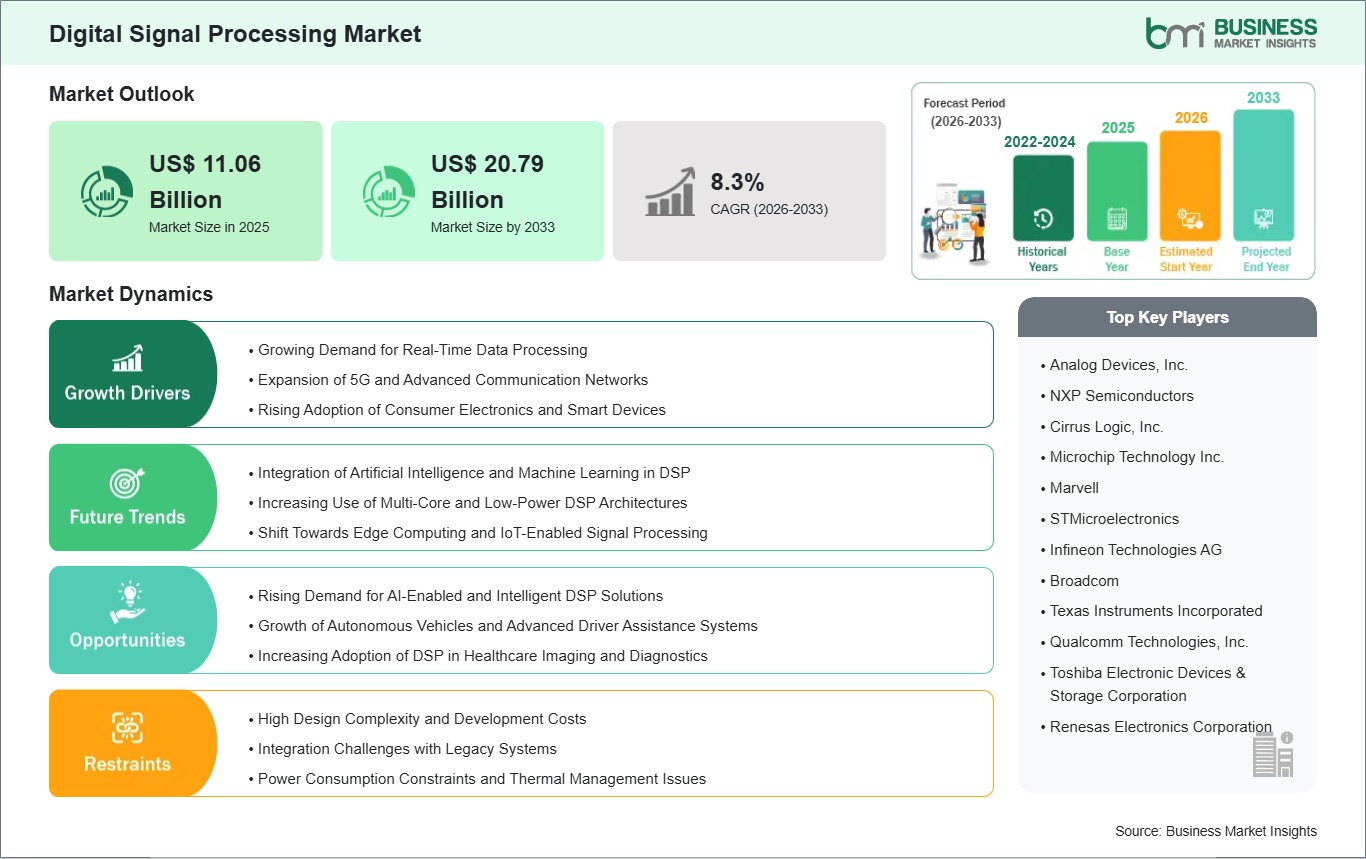
The digital signal processing market size is expected to reach US$ 20.79 billion by 2033 from US$ 11.06 billion in 2025. The market is estimated to record a CAGR of 8.3% from 2026 to 2033.
Digital signal processing solutions have emerged as a critical component across industries worldwide, enabling the efficient analysis, enhancement, and interpretation of digital signals in modern electronic systems. Digital signal processors, DSP software platforms, and signal processing algorithms are increasingly used across consumer electronics, telecommunications infrastructure, automotive systems, healthcare devices, and industrial applications, and these solutions have also gained widespread adoption in aerospace and defense systems. Digital signal processing technologies offer several advantages, including improved signal quality, real-time data analysis, noise reduction, and enhanced system performance, while supporting complex applications such as multimedia processing, wireless communication, and medical diagnostics. The rapid growth of connected devices, increasing data volumes, advancements in communication technologies, and the rising adoption of automation and intelligent systems have generated strong demand for digital signal processing solutions.
However, the digital signal processing market faces several challenges that may hinder its growth. These include the high cost of advanced DSP solutions, design complexity, power consumption constraints, and integration challenges with legacy systems. Additionally, the need for specialized expertise, rising development costs, and stringent performance requirements across end-use industries can impact market expansion. Despite these challenges, the digital signal processing market presents significant growth opportunities, driven by the expansion of 5G networks, increasing adoption of artificial intelligence and machine learning, growing demand for real-time data processing, and the proliferation of smart devices, autonomous systems, and advanced medical technologies.

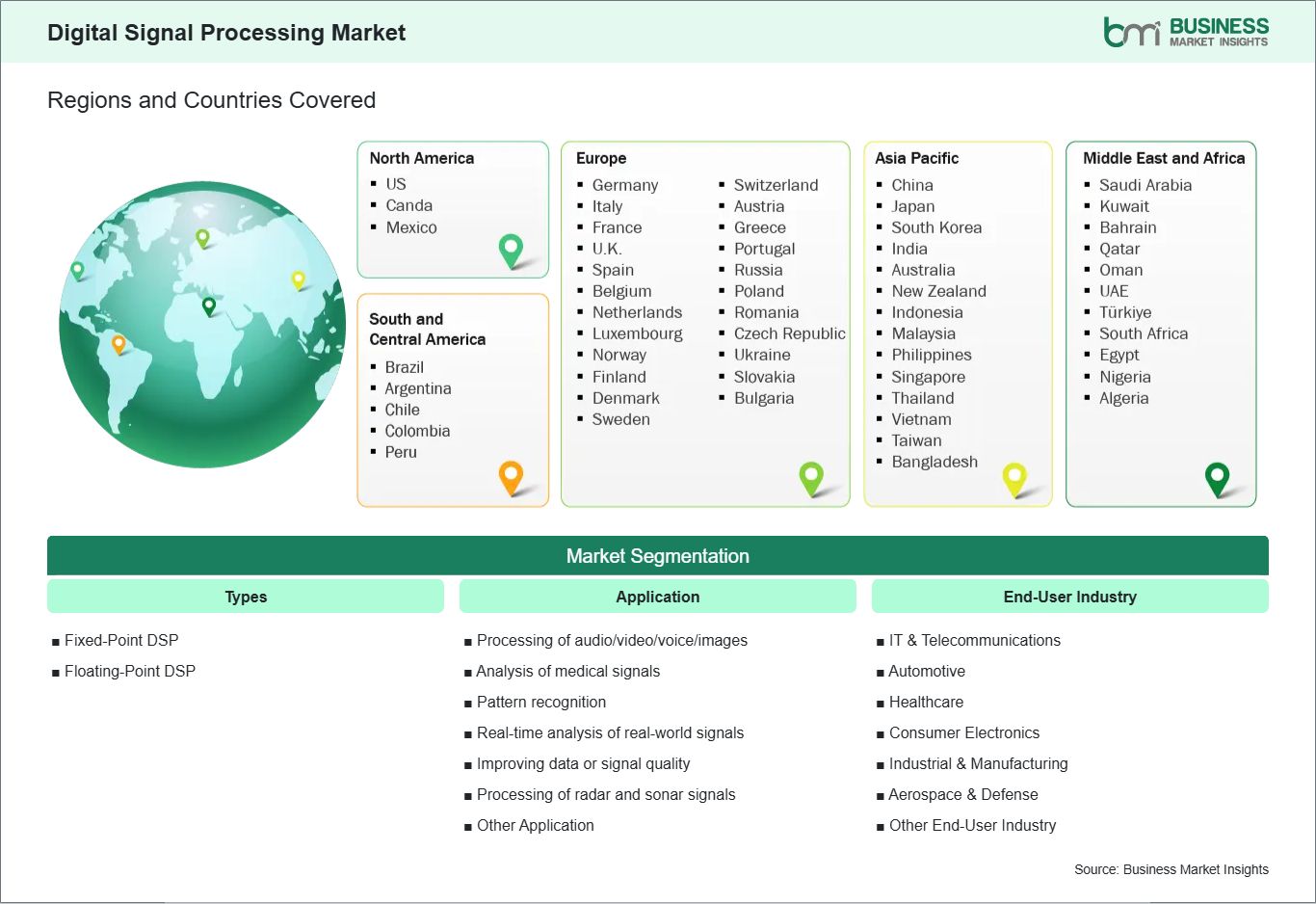
Key segments that contributed to the derivation of the digital signal processing market analysis are type, application, and end-user industry.
The increasing need for real-time data processing is a major driver of the digital signal processing market. Industries such as telecommunications, automotive, consumer electronics, and healthcare rely heavily on DSP technologies to process large volumes of data with minimal latency. Applications including 5G communication, autonomous driving systems, audio and video streaming, and medical imaging require high-speed signal analysis and optimization. DSP solutions enable efficient noise reduction, signal enhancement, and accurate data interpretation, making them indispensable for modern electronic systems. The rapid growth of connected devices and data-intensive applications continues to accelerate demand for advanced digital signal processing technologies.
The growing integration of artificial intelligence and machine learning presents a significant opportunity for the digital signal processing market. DSPs are increasingly being combined with AI and ML algorithms to enable intelligent signal analysis, pattern recognition, and predictive decision-making. This convergence is gaining traction in applications such as speech recognition, computer vision, predictive maintenance, and advanced medical diagnostics. As industries seek smarter and more autonomous systems, the demand for AI-enabled DSP solutions is expected to rise. Continuous advancements in edge computing and low-power processing further enhance the potential for DSP adoption in next-generation intelligent devices.
By types, the digital signal processing market is segmented into fixed-point DSP and floating-point DSP. Fixed-point DSP held a significant share in 2025 due to its cost efficiency, lower power consumption, and widespread adoption in consumer electronics, automotive systems, and embedded applications requiring high-volume signal processing.
By application, the digital signal processing market is segmented into processing of audio, video, voice, and images; analysis of medical signals; pattern recognition; real-time analysis of real-world signals; improving data or signal quality; processing of radar and sonar signals; and others. Processing of audio, video, voice, and images held a significant share in 2025 owing to the growing demand for smartphones, smart TVs, streaming devices, and advanced multimedia communication systems.
By end-user industry, the digital signal processing market is segmented into IT & telecommunications, automotive, healthcare, consumer electronics, industrial & manufacturing, aerospace & defense, and others. IT & telecommunications held a significant share in 2025 driven by the rapid expansion of 5G networks, increasing data traffic, and the rising need for high-speed signal processing in communication infrastructure.
| Report Attribute | Details |
|---|---|
| Market size in 2025 | US$ 11.06 Billion |
| Market Size by 2033 | US$ 20.79 Billion |
| Global CAGR (2026 - 2033) | 8.3% |
| Historical Data | 2022-2024 |
| Forecast period | 2026-2033 |
| Segments Covered | By Types
|
|
Regions and Countries Covered
| |
| North America | US, Canada, Mexico |
| Europe | Belgium, Austria, Finland, Denmark, Greece, Poland, Romania, Russia, Ukraine, Czech Republic, Slovakia, Bulgaria, Italy, Luxembourg, Germany, Switzerland, France, Netherlands, Norway, Portugal, Spain, Sweden, United Kingdom |
| Asia-Pacific | Australia, China, India, Japan, South Korea, Indonesia, Malaysia, Philippines, Singapore, Thailand, Vietnam, Bangladesh, New Zealand, Taiwan |
| South and Central America | Brazil, Argentina, Peru, Chile, Colombia |
| Middle East and Africa | Bahrain, Kuwait, Oman, Qatar, Saudi Arabia, United Arab Emirates, Turkiye, South Africa, Egypt, Algeria, Nigeria |
| Market leaders and key company profiles |
|
The "Digital signal processing market Size and Forecast (2022-2033)" report provides a detailed analysis of the market covering below areas:
The geographical scope of the digital signal processing market report is divided into five regions: North America, Asia Pacific, Europe, Middle East & Africa, and South & Central America. The digital signal processing market in Asia Pacific is expected to grow significantly during the forecast period.
The Asia-Pacific digital signal processing market is segmented into China, Japan, South Korea, India, Australia, New Zealand, Indonesia, Malaysia, the Philippines, Singapore, Thailand, Vietnam, Taiwan, Bangladesh, and the Rest of Asia. The region is witnessing robust growth, driven by rapid industrialization, expansion of consumer electronics manufacturing, and increasing investments in telecommunications and digital infrastructure. Major economies such as China, Japan, and India are leading market growth due to strong demand for DSP solutions across smartphones, automotive electronics, 5G infrastructure, healthcare devices, and industrial automation systems.
The region is also experiencing growing adoption of advanced digital signal processing technologies, including real-time signal analysis, AI-enabled DSP solutions, and low-power embedded processors. Rising demand for high-speed connectivity, increasing deployment of smart devices, and supportive government initiatives promoting digitalization and smart manufacturing are further fueling market growth. Additionally, continuous advancements in semiconductor technologies, expanding electronics production capacity, and rising R&D investments are positioning Asia-Pacific as a key growth region in the global digital signal processing market.
Digital signal processing market Research Report Guidance

The digital signal processing market is evaluated by gathering qualitative and quantitative data post primary and secondary research, which includes important corporate publications, association data, and databases. A few of the key developments in the digital signal processing market are:
The Digital Signal Processing Market is valued at US$ 11.06 Billion in 2025, it is projected to reach US$ 20.79 Billion by 2033.
As per our report Digital Signal Processing Market, the market size is valued at US$ 11.06 Billion in 2025, projecting it to reach US$ 20.79 Billion by 2033. This translates to a CAGR of approximately 8.3% during the forecast period.
The Digital Signal Processing Market report typically cover these key segments-
The historic period, base year, and forecast period can vary slightly depending on the specific market research report. However, for the Digital Signal Processing Market report:
The Digital Signal Processing Market is populated by several key players, each contributing to its growth and innovation. Some of the major players include:
The Digital Signal Processing Market report is valuable for diverse stakeholders, including:
Essentially, anyone involved in or considering involvement in the Digital Signal Processing Market value chain can benefit from the information contained in a comprehensive market report.
Please tell us your area of interest
(Market Segments/ Regions and Countries/ Companies)