
Mixed Signal IC Market Outlook: Size, Share, Trends, Growth Analysis, Competitive Landscape & Forecast, 2026-2033

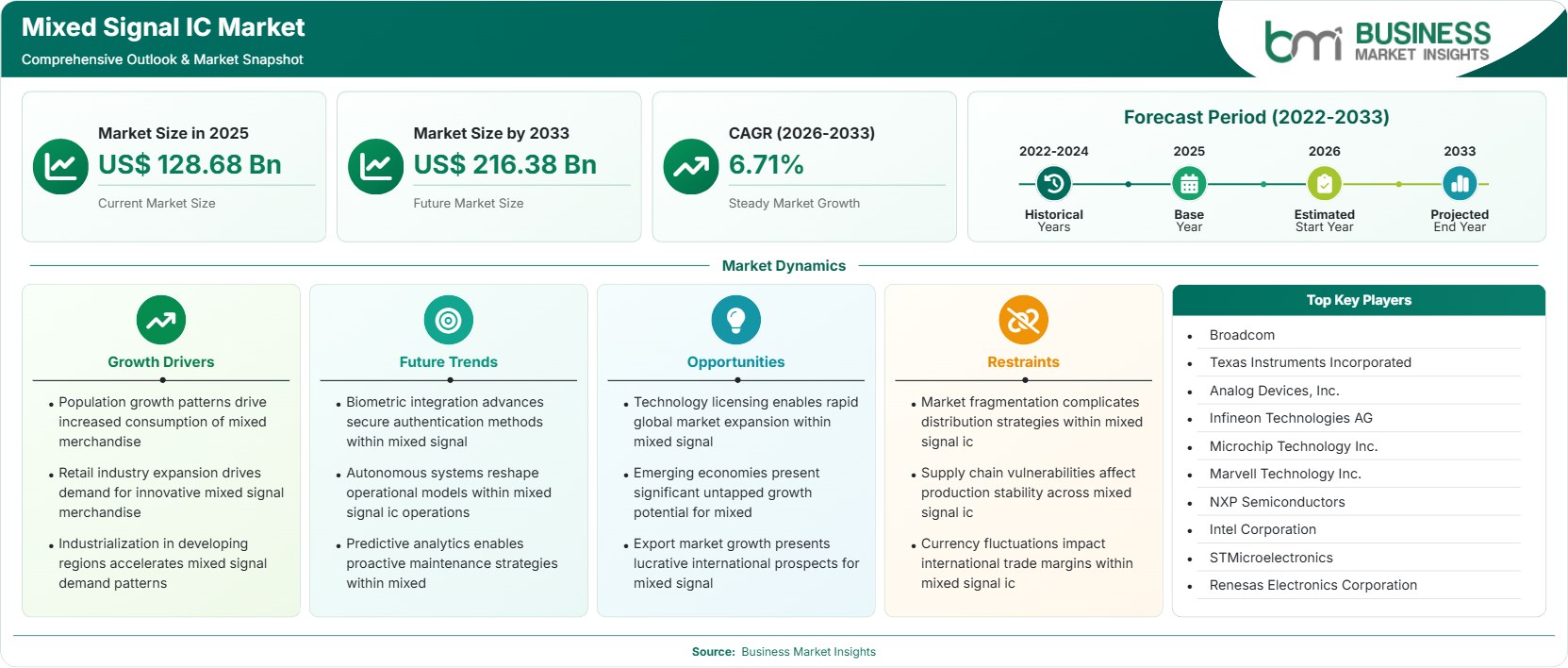
The Mixed Signal IC Market size was valued at US$ 128.68 Billion in 2025 and is projected to reach US$ 216.38 Billion by 2033, growing at a CAGR of 6.71% during 2026–2033. Rising semiconductor integration, automotive electronics, AI-enabled edge devices, industrial automation, and healthcare digitization continue to accelerate adoption, while advanced packaging technologies and expanding IoT ecosystems create long-term commercialization opportunities.

Report Coverage
  • Type: Mixed Signal SoC, Microcontroller, Data Converter
  • Application: Consumer Electronics Healthcare and Medical, Automotive, Telecommunications, Military and Defense, Others
US$ 128.68 Bn Market size in 2025
US$ 216.38 Bn Market Size by 2033
6.71% CAGR, 2026 - 2033
2026-2033 Forecast Period

01 AI Overview

Mixed Signal IC Market Summary

  • North America Region: North America holds 34%–37% market share in 2025, growing with a 6.0%–6.5% CAGR during 2026–2033, supported by advanced semiconductor manufacturing, automotive electronics innovation, aerospace demand, AI computing investments, and expanding industrial automation across multiple high-value applications. The U.S. remains the technology leader through strong fabless semiconductor innovation, government-backed manufacturing investments, and projected CAGR of 6.1%–6.6%.
  • Fastest Growing Region: Asia Pacific holds 30%–33% market share in 2025 and is expected to expand at a 7.6%–8.2% CAGR through 2026–2033 due to expanding electronics manufacturing, EV production, 5G infrastructure deployment, semiconductor fabrication investments, and growing consumer device demand across emerging economies.
  • Leading Segment: Mixed Signal SoC accounts for 44%–47% market share in 2025 while advancing at a 6.8%–7.3% CAGR, driven by increasing chip integration, energy-efficient architectures, AI-enabled edge computing, consumer electronics innovation, and automotive digitalization requiring compact multifunctional semiconductor solutions.
  • High Growth Segment: Automotive applications represent 21%–24% market share in 2025 and are projected to register a 7.8%–8.4% CAGR, supported by electric vehicle electronics, advanced driver assistance systems, battery management innovation, autonomous mobility technologies, and increasing semiconductor content per vehicle.
  • Key Market Opportunity: Growing deployment of edge AI processors, industrial IoT platforms, medical wearables, software-defined vehicles, and advanced communication infrastructure creates attractive opportunities for highly integrated mixed-signal semiconductor platforms delivering improved efficiency, reliability, scalability, and power optimization.
  • Major Market Players: Broadcom Inc., Texas Instruments Incorporated, Analog Devices, Inc., Infineon Technologies AG, Microchip Technology Incorporated, Marvell Technology, Inc., NXP Semiconductors N.V., Intel Corporation, STMicroelectronics N.V., Renesas Electronics Corporation, EnSilica plc, Semtech Corporation, Silicon Laboratories Inc., Diodes Incorporated, Lattice Semiconductor Corporation, Mixed Signal Integration, Awinic Technology Co., Ltd., MaxLinear, Inc., Maxim Integrated Products, Inc., and Asahi Kasei Microdevices Corporation.
02 Strategic Insights

Mixed Signal IC Market: Strategic Insights

Mixed Signal IC Market Strategic Framework
FREE PDF
Request your free sample
Request free sample
03 Stakeholder View

Key Takeaways

  • The industry's value chain increasingly emphasizes integrated design, wafer fabrication, advanced packaging, testing, embedded software, and long-term customer collaboration, enabling suppliers to deliver higher-value semiconductor platforms while improving manufacturing efficiency and supply chain resilience.
  • Automotive electronics, healthcare devices, industrial automation, and intelligent communications infrastructure present the strongest expansion potential as manufacturers seek integrated analog-digital processing solutions that reduce component counts, improve reliability, and optimize overall system performance.
  • Product innovation increasingly centers on heterogeneous integration, ultra-low-power architectures, embedded AI acceleration, higher-resolution data converters, secure connectivity, and compact system-on-chip platforms capable of supporting increasingly sophisticated intelligent electronic systems.
  • Asia Pacific offers compelling long-term investment potential because expanding semiconductor fabrication capacity, supportive industrial policies, growing electronics exports, and accelerating electric vehicle manufacturing continue creating sustained demand for advanced semiconductor technologies.
  • Strategic mergers, collaborative product development, foundry partnerships, and increased R&D investments are strengthening competitive positioning as semiconductor companies seek differentiated mixed-signal capabilities supporting automotive, industrial, communications, and medical applications.
  • Growing localization initiatives, government semiconductor incentives, resilient sourcing strategies, and diversified manufacturing footprints are becoming critical competitive advantages for companies seeking long-term stability amid evolving geopolitical and supply chain challenges.
04 Geographic Outlook

Mixed Signal IC Market Regional Highlights

North America Mixed Signal IC Market

North America accounted for 34%–37% of the Mixed Signal IC Market share in 2025 and is projected to expand at a 6.0%–6.5% CAGR during 2026–2033. The region benefits from a mature semiconductor ecosystem, advanced IC design capabilities, increasing automotive electronics demand, and strong investments in AI hardware. Government incentives supporting domestic semiconductor manufacturing, coupled with robust industrial automation and defense modernization, continue strengthening regional competitiveness. Leading fabless companies and research institutions accelerate commercialization of next-generation mixed-signal technologies across multiple high-value applications.

  • Strong investments in semiconductor fabrication, advanced packaging, and electronic design automation improve regional competitiveness while enabling manufacturers to address increasing requirements from automotive, industrial automation, aerospace, telecommunications, and intelligent healthcare equipment.
  • Automotive electrification and advanced driver assistance systems continue increasing semiconductor content per vehicle, supporting sustained demand for precision data converters, power management ICs, and integrated mixed-signal processing solutions.
  • AI-enabled edge computing, industrial IoT deployments, and next-generation communication infrastructure stimulate development of low-power mixed-signal architectures capable of supporting high-speed connectivity with enhanced energy efficiency and reliability.
  • Defense modernization, secure communications, and aerospace electronics programs encourage suppliers to prioritize high-reliability semiconductor platforms that meet stringent performance, durability, and cybersecurity requirements for mission-critical environments.
  • Expanding collaborations between semiconductor manufacturers, foundries, universities, and government agencies strengthen innovation pipelines while supporting commercialization of advanced analog-digital integrated circuit technologies.

US Mixed Signal IC Market

The United States represents 78%–82% of North American Mixed Signal IC Market demand and is forecast to grow at a 6.1%–6.6% CAGR through 2026–2033. Strong semiconductor design expertise, expanding federal manufacturing incentives, and increasing adoption across AI infrastructure, defense electronics, healthcare devices, and electric vehicles reinforce long-term market competitiveness. Leading technology companies continue investing in advanced mixed-signal innovation, strengthening domestic production capabilities and resilient semiconductor supply chains.

  • Federal semiconductor investment programs encourage expansion of domestic fabrication capacity, reducing dependence on overseas manufacturing while strengthening long-term resilience for critical electronic component supply chains.
  • Growing adoption of AI servers, data centers, and edge computing platforms increases demand for high-performance mixed-signal interfaces supporting efficient signal conversion and precision power management.
  • Medical technology innovation, including wearable monitoring systems and diagnostic imaging equipment, accelerates utilization of highly integrated semiconductor devices capable of delivering improved accuracy and lower energy consumption.
  • Increasing deployment of industrial robotics and smart manufacturing technologies supports rising demand for precision sensing, embedded control, and real-time analog-to-digital processing capabilities.

Europe Mixed Signal IC Market

Europe held 24%–27% Mixed Signal IC Market share in 2025 and is anticipated to register a 5.8%–6.3% CAGR during 2026–2033. Regional growth is supported by automotive electronics leadership, industrial automation, energy-efficient manufacturing initiatives, and semiconductor policy frameworks encouraging domestic production. Germany leads regional revenue generation, while France and the Netherlands continue strengthening semiconductor research. Ireland and Eastern European manufacturing hubs demonstrate faster production expansion supported by increasing electronics investments.

  • Automotive manufacturers continue integrating sophisticated semiconductor platforms supporting electric mobility, battery management systems, advanced safety technologies, and connected vehicle architectures across premium and commercial vehicle segments.
  • Industrial automation initiatives increase deployment of precision sensing, programmable control systems, and intelligent factory equipment requiring highly reliable mixed-signal integrated circuit solutions.
  • Government-backed semiconductor initiatives encourage investment in regional fabrication, advanced research, and resilient supply chains supporting long-term technological competitiveness.
  • Renewable energy systems, smart grids, and power electronics applications create additional opportunities for advanced mixed-signal devices supporting efficient energy conversion and system monitoring.
  • Healthcare digitization and medical imaging innovation continue expanding utilization of precision analog front-end technologies across hospitals, laboratories, and remote patient monitoring applications.

Asia Pacific Mixed Signal IC Market

Asia Pacific accounted for 30%–33% Mixed Signal IC Market share in 2025 and is projected to expand at the fastest 7.6%–8.2% CAGR between 2026 and 2033. The region benefits from dominant electronics manufacturing, expanding semiconductor fabrication capacity, rising electric vehicle production, and accelerating digital infrastructure investments. China, Japan, South Korea, and Taiwan remain major manufacturing centers, while India and Southeast Asia experience rapid growth through electronics production diversification and supportive government initiatives.

  • Consumer electronics manufacturing continues driving large-scale adoption of integrated mixed-signal semiconductor solutions across smartphones, wearables, smart appliances, and portable computing devices.
  • Electric vehicle manufacturing expansion significantly increases semiconductor demand for battery management, onboard charging, infotainment systems, and advanced safety electronics.
  • Government incentives supporting semiconductor self-sufficiency encourage investments in wafer fabrication facilities, packaging technologies, research centers, and workforce development initiatives.
  • Expanding 5G infrastructure, industrial IoT deployments, and AI-enabled manufacturing accelerate demand for highly integrated semiconductor platforms supporting reliable real-time data processing.
  • India and Southeast Asian countries attract increasing foreign investment through electronics manufacturing incentives, strengthening regional supply chain diversification and long-term poduction capacity.

Rest of World Mixed Signal IC Market

The Rest of World region represented 8%–10% Mixed Signal IC Market share in 2025 and is expected to register a 5.6%–6.1% CAGR during 2026–2033. South & Central America continue benefiting from industrial modernization and automotive manufacturing investments, while the Middle East and Africa experience growing demand for telecommunications infrastructure, smart city projects, and digital healthcare technologies. Government-led digital transformation initiatives and expanding electronics imports support gradual semiconductor market development across emerging economies.

Countries including Brazil and Mexico remain leading contributors within South & Central America due to established automotive manufacturing and industrial automation activities. In the Middle East and Africa, the United Arab Emirates and Saudi Arabia demonstrate stronger growth through smart infrastructure investments, while South Africa continues expanding industrial electronics adoption across mining, manufacturing, and energy sectors.

  • Automotive assembly, industrial modernization, and consumer electronics demand strengthen semiconductor imports across Latin America while encouraging regional electronics ecosystem development.
  • Telecommunications infrastructure expansion supports increasing deployment of high-performance mixed-signal integrated circuits enabling reliable wireless connectivity and network modernization.
  • Smart city investments across Gulf countries stimulate adoption of advanced sensing, intelligent transportation systems, surveillance technologies, and energy-efficient digital infrastructure.
  • Healthcare modernization programs increase procurement of medical imaging equipment, diagnostic devices, and patient monitoring technologies requiring precision analog-digital semiconductor integration.
  • Government digital transformation initiatives encourage broader deployment of connected industrial systems, supporting long-term semiconductor demand across emerging economies.
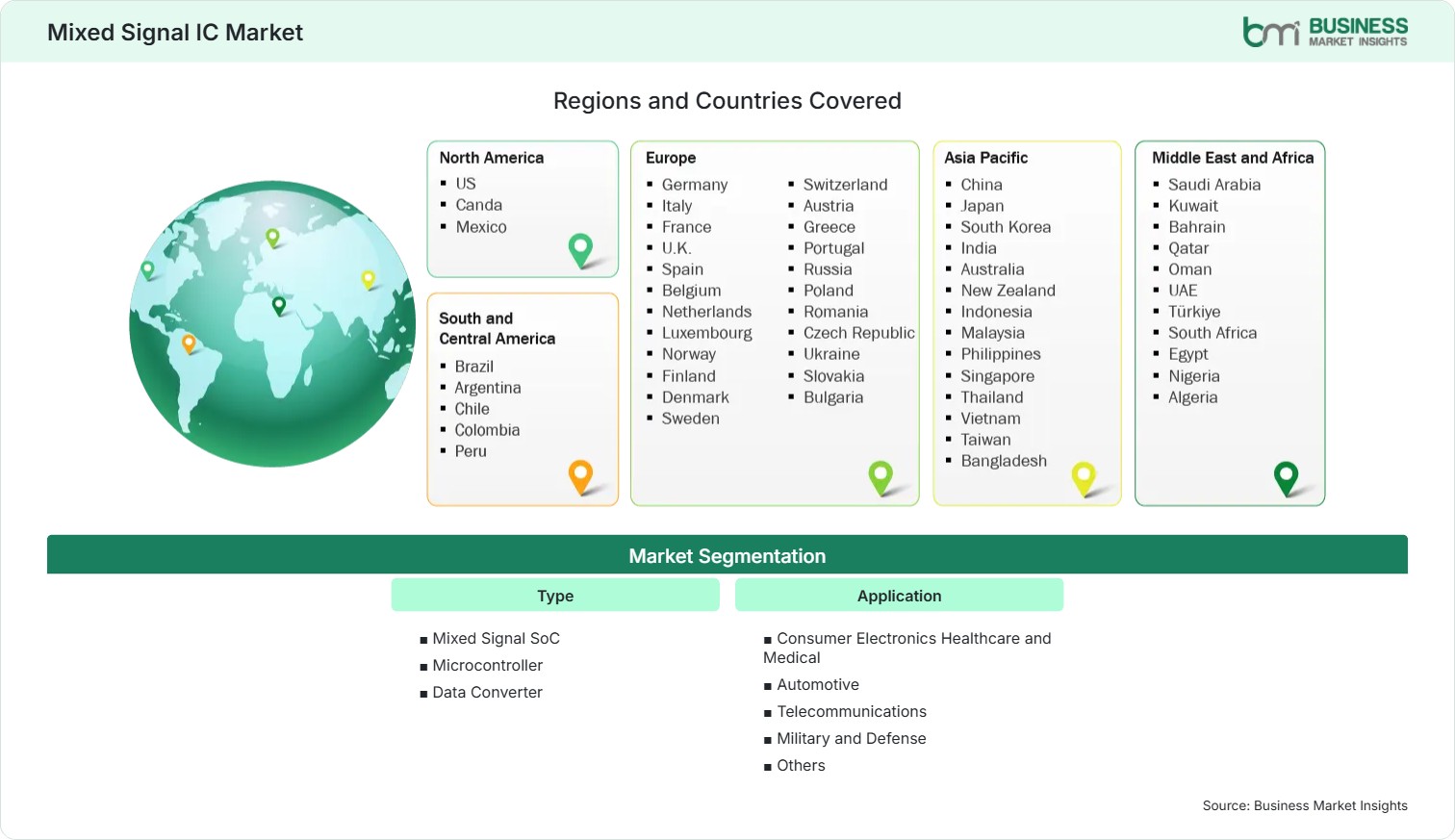
Global Market Geography
FREE PDF
Request your free sample
Request free sample
05 Segment Analysis

Mixed Signal IC Market Segmentation

Type

The Type segment accounted for approximately 58%–61% market share in 2025 and is projected to expand at a 6.7%–7.2% CAGR through 2033. Product innovation increasingly focuses on higher integration, improved power efficiency, and enhanced signal accuracy to support demanding electronic applications. The Mixed Signal IC Market scope continues expanding as manufacturers develop multifunctional semiconductor platforms serving automotive, industrial, consumer electronics, communications, and healthcare industries.

  • Mixed Signal SoC: Represents the largest product category, integrating analog, digital, memory, and processing functions into compact architectures that reduce board complexity, improve energy efficiency, and support AI-enabled intelligent electronic systems.
  • Microcontroller: Widely adopted across embedded systems, industrial controllers, automotive electronics, consumer appliances, and connected devices where integrated analog interfaces enable efficient sensing, processing, communication, and real-time control capabilities.
  • Data Converter: Increasing utilization in telecommunications, industrial automation, healthcare equipment, aerospace electronics, and precision instrumentation supports continued innovation in high-speed analog-to-digital and digital-to-analog conversion technologies.

Application

The Application segment represented approximately 39%–42% market share in 2025 and is anticipated to grow at a 7.1%–7.7% CAGR through 2033. Expanding deployment across connected electronics, industrial digitalization, intelligent transportation, medical technologies, and communication infrastructure continues to strengthen demand for integrated semiconductor platforms capable of delivering superior processing efficiency, precision measurement, and reliable real-time performance in the Mixed Signal IC Market.

  • Consumer Electronics: High shipment volumes of smartphones, wearable devices, laptops, tablets, smart home equipment, and entertainment systems continue supporting broad adoption of compact, energy-efficient mixed-signal integrated circuit technologies.
  • Healthcare and Medical: Growing demand for portable diagnostics, medical imaging systems, wearable monitoring equipment, implantable devices, and laboratory instrumentation encourages adoption of precision analog front-end semiconductor solutions.
  • Automotive: Rapid electrification, connected mobility, advanced driver assistance systems, infotainment platforms, and battery management technologies significantly increase semiconductor integration throughout modern vehicle architectures.
  • Telecommunications: Expansion of 5G infrastructure, fiber networks, satellite communications, and networking equipment drives increasing deployment of high-performance signal conversion and power management integrated circuits.
  • Military and Defense: Secure communications, radar systems, avionics, electronic warfare equipment, surveillance technologies, and mission-critical computing platforms require highly reliable mixed-signal semiconductor devices engineered for demanding operational environments.
06 Market Forces

Mixed Signal IC Market Dynamics

Key Market Drivers

Rising Semiconductor Content in Electric and Software-Defined Vehicles

Electric drive technology and software-defined architectures will continue to boost semiconductor content per vehicle, thereby sustaining demand for ICs that combine analog sensor functions with digital signal processing. Battery management systems, chargers, advanced driver assistance systems, infotainment systems, and vehicle networking all require this functionality. According to the International Energy Agency (IEA), global electric vehicle sales exceeded 17 million units in 2024, reinforcing long-term semiconductor demand across automotive applications. The Mixed Signal IC Market trends increasingly reflect automakers' focus on higher functional integration, lower power consumption, and enhanced reliability while reducing component counts, manufacturing complexity, and overall system costs.

Expansion of AI Edge Computing and Industrial Automation

Digitization of industries and edge computing enabled by AI keep changing the demands for semiconductors in manufacturing, logistics, healthcare, and intelligent infrastructure. Edge devices today must include a combination of analog inputs, data converters, embedded controllers, and power management features that enable real-time processing of sensory data with minimal possible latency. Investments into Industry 4.0 and the development of industrial IoT lead to the widespread use of advanced mixed-signal solutions. Increasing factory automation initiatives across developed and emerging economies strengthen long-term demand for compact semiconductor platforms delivering high precision, improved operational efficiency, secure connectivity, and reliable performance under demanding industrial operating conditions.

Growth of Connected Consumer Electronics and Healthcare Devices

Consumer electronics manufacturers continue integrating additional sensing, wireless connectivity, imaging, and power optimization features into compact devices, increasing demand for sophisticated mixed-signal integrated circuits. Simultaneously, healthcare providers expand the adoption of wearable monitoring systems, portable diagnostic equipment, and connected medical devices requiring highly accurate signal acquisition and processing. World Health Organization initiatives promoting digital healthcare and remote patient monitoring further strengthen technology adoption across developed and emerging Mixed Signal IC Markets. Semiconductor suppliers increasingly prioritize miniaturization, energy efficiency, and functional integration to address evolving requirements across smartphones, wearables, smart home devices, and advanced medical electronics.

Key Market Opportunities

Edge AI Semiconductor Platforms for Intelligent Connected Systems

The growing deployment of AI-enabled industrial equipment, autonomous machines, intelligent surveillance systems, and connected medical technologies creates significant opportunities for semiconductor manufacturers. Future Mixed Signal IC Market Forecasts indicate increasing demand for integrated platforms combining analog sensing, embedded processing, wireless connectivity, and AI acceleration within compact system-on-chip architectures. Investments in low-power neural processing, edge analytics, and advanced sensor fusion enable manufacturers to differentiate product portfolios while supporting emerging applications across smart factories, healthcare monitoring, transportation infrastructure, precision agriculture, and intelligent energy management systems requiring reliable real-time processing with reduced latency and enhanced operational efficiency.

Advanced Packaging and Heterogeneous Chip Integration

Rapid adoption of chiplet architectures, three-dimensional packaging, wafer-level integration, and heterogeneous semiconductor assembly creates new commercial opportunities for mixed-signal device manufacturers. They allow for increased functionality, smaller PCB size, enhanced heat dissipation, and reduced total system power. Rising demand from automotive electronics, communication systems, aerospace equipment, and industrial automation spurs manufacturers to design integrated semiconductor devices that offer combined analog, digital, RF, memory, and computing capabilities. Cooperation between foundry houses, packaging companies, and semiconductor developers will help to promote rapid development.

Domestic Semiconductor Manufacturing and Supply Chain Diversification

Governments across North America, Europe, and Asia continue introducing incentives supporting semiconductor fabrication, research, workforce development, and supply chain resilience. Domestic production enables investments in more sophisticated production facilities that minimize the geopolitical risks associated with overly centralized global supply chains. The semiconductor industry will profit from the development of regional collaborations, production within their regions, and more government funding for innovations. More secure procurement of semiconductors is demanded by various industries, including automotive, aerospace, medical, industrial automation, and military.

Market Restraints and Challenges

Complex Manufacturing Processes and Rising Development Costs

Factor: Advanced mixed-signal semiconductor development requires sophisticated process technologies, precision analog circuit design, extensive verification, and expensive fabrication infrastructure.

Impact: The increase in research and development spending, high cost of wafer production, and long product qualification time create hurdles for new players and reduce development options. The industry demands continuous investment in advanced process technologies, EDA software, packaging technology, and engineers. Cost pressures become particularly significant for suppliers targeting automotive, healthcare, aerospace, and industrial Mixed Signal IC Markets requiring rigorous certification, long product life cycles, exceptional reliability, and compliance with stringent international quality standards.

Supply Chain Volatility and Geopolitical Semiconductor Risks

Factor: Semiconductor manufacturing depends upon globally distributed supply chains involving wafer fabrication, specialty materials, assembly, testing, packaging, and logistics across multiple countries.

Impact: Trade restrictions, geopolitical tensions, transportation disruptions, and raw material shortages increase procurement uncertainty while extending production lead times. Firms react by means of supplier diversification, regionally oriented manufacturing investments, inventory management, and sourcing policies. In spite of such measures, volatility in the supply chain persists in affecting production plans, delivery time for customers, price policies, and investments in all automotive, telecommunications, industrial automation, healthcare, and consumer electronics industries.

07 Company Analysis

Competitive Landscape

The competitive environment is characterized by continuous innovation, strategic partnerships, product portfolio expansion, and increasing investment in AI-enabled semiconductor platforms. The Mixed Signal IC Market analysis indicates that leading companies are strengthening their positions through advanced mixed-signal integration, low-power architectures, automotive-grade solutions, industrial automation technologies, and next-generation communication chipsets.

Company Name

Overview

Products and Services Relevant to this Market

Broadcom Inc.

Develops advanced semiconductor solutions serving communications, enterprise networking, broadband, and industrial applications with extensive mixed-signal expertise.

Mixed-signal connectivity ICs, networking processors, broadband chips, interface controllers, optical communication solutions, and integrated semiconductor platforms.

Texas Instruments Incorporated

Global analog and embedded processing leader with diversified semiconductor solutions supporting industrial, automotive, healthcare, and consumer electronics industries.

Data converters, mixed-signal microcontrollers, power management ICs, analog front-end devices, interface products, and embedded processors.

Analog Devices, Inc.

Specializes in high-performance analog, mixed-signal, and digital signal processing technologies for precision applications worldwide.

Precision data converters, signal conditioning ICs, RF solutions, embedded processing, industrial sensing, and healthcare semiconductor products.

Infineon Technologies AG

Leading semiconductor manufacturer emphasizing automotive, industrial, energy, and secure electronics applications with broad mixed-signal capabilities.

Automotive microcontrollers, power management devices, sensor interfaces, mixed-signal controllers, security chips, and industrial semiconductor solutions.

Microchip Technology Incorporated

Provides embedded control and analog semiconductor products serving industrial automation, aerospace, automotive, and communications sectors.

Microcontrollers, analog interfaces, mixed-signal controllers, timing devices, connectivity solutions, and embedded system technologies.

Marvell Technology, Inc.

Designs semiconductor products supporting cloud infrastructure, networking, storage, automotive, and communications applications globally.

Networking processors, storage controllers, connectivity chipsets, signal processing solutions, and high-speed mixed-signal interfaces.

NXP Semiconductors N.V.

Strong supplier of automotive, industrial IoT, secure identification, and communication semiconductor technologies.

Automotive processors, radar chipsets, mixed-signal controllers, secure connectivity solutions, and embedded processing platforms.

Intel Corporation

Global semiconductor company investing in advanced manufacturing, AI computing, communications, and intelligent edge technologies.

Embedded processors, programmable solutions, interface technologies, AI accelerators, and integrated semiconductor platforms.

STMicroelectronics N.V.

Diversified semiconductor manufacturer serving automotive, industrial, consumer electronics, and power management markets.

MEMS sensors, mixed-signal ICs, microcontrollers, analog devices, imaging technologies, and industrial semiconductor products.

Renesas Electronics Corporation

Leading embedded semiconductor company supporting automotive, industrial, infrastructure, and IoT markets.

Automotive microcontrollers, analog ICs, mixed-signal SoCs, timing products, sensor interfaces, and connectivity solutions.

EnSilica plc

Fabless semiconductor company specializing in mixed-signal ASIC design and custom integrated circuit development.

Custom ASICs, mixed-signal design services, RF IC development, semiconductor consulting, and embedded chip solutions.

Semtech Corporation

Develops analog and mixed-signal semiconductor technologies emphasizing connectivity and high-performance communications.

Signal integrity devices, power management ICs, wireless connectivity chips, LoRa technologies, and analog interface solutions.

Silicon Laboratories Inc.

Focuses on intelligent wireless semiconductor technologies for IoT, industrial automation, and smart infrastructure.

Wireless SoCs, embedded controllers, analog interfaces, connectivity ICs, and IoT semiconductor platforms.

Diodes Incorporated

Manufactures analog, discrete, logic, and mixed-signal semiconductor products for multiple electronics industries.

Analog ICs, interface products, timing devices, signal conditioning components, and power management solutions.

Lattice Semiconductor Corporation

Specializes in low-power programmable semiconductor technologies supporting edge computing and industrial systems.

FPGA solutions, embedded control platforms, AI edge processing, programmable logic, and interface technologies.

Mixed Signal Integration

Develops specialized mixed-signal integrated circuits supporting industrial, communication, and embedded applications.

Custom mixed-signal ICs, signal processing devices, interface solutions, and semiconductor design services.

Awinic Technology Co., Ltd.

Chinese semiconductor company supplying analog and mixed-signal products for consumer electronics and smart devices.

Audio amplifiers, power management ICs, interface chips, display drivers, and integrated analog semiconductor solutions.

MaxLinear, Inc.

Develops high-performance connectivity and broadband semiconductor solutions serving networking and communications markets.

RF transceivers, broadband ICs, mixed-signal processors, interface chipsets, and connectivity semiconductor technologies.

Maxim Integrated Products, Inc.

Established provider of analog and mixed-signal semiconductor technologies, now operating within Analog Devices' portfolio.

Precision analog ICs, power management devices, interface technologies, mixed-signal controllers, and sensor solutions.

Asahi Kasei Microdevices Corporation

Japanese semiconductor manufacturer emphasizing sensing, audio, healthcare, and industrial electronic applications.

Audio codecs, sensor ICs, data converters, power management products, and precision mixed-signal semiconductor

10 Trust & Transparency

Research Methodology

The market analysis combines proprietary research with secondary data from government agencies, company disclosures, regulatory filings, industry databases and expert interviews. Market estimates are validated through data triangulation, cross-market benchmarking and analyst review.

View Full Research Methodology

11 Questions Answered

Frequently Asked Questions

What technologies will shape future product innovation in the Mixed Signal IC Market?

Future innovation will focus on heterogeneous integration, chiplet architectures, AI-enabled edge processing, advanced packaging, low-power analog design, high-speed data converters, precision sensing, and secure connectivity to support next-generation intelligent electronic systems.

Which region is expected to experience the fastest expansion through 2033?

Asia Pacific is projected to record the fastest growth, supported by expanding semiconductor fabrication capacity, large-scale electronics manufacturing, increasing electric vehicle production, government incentives, and continuous investments in digital infrastructure.

Why is automotive becoming a high-growth application?

Electric vehicles, battery management systems, advanced driver assistance systems, infotainment platforms, and vehicle connectivity require significantly more mixed-signal semiconductor content than conventional vehicles, driving faster adoption across global automotive manufacturers.

Which product category dominates the Mixed Signal IC Market Report?

Mixed Signal SoC solutions lead the market due to their ability to integrate analog, digital, memory, and processing functions on a single chip, reducing system complexity, lowering power consumption, and improving overall device performance.

What industries generate the highest demand for mixed signal integrated circuits?

Consumer electronics, automotive, industrial automation, telecommunications, and healthcare collectively account for the largest demand because these sectors require efficient analog signal acquisition, digital processing, low-power operation, and compact semiconductor integration for increasingly intelligent electronic systems.

Access the Full Mixed Signal IC Market Report

Get segment-level forecasts, regional estimates, competitive benchmarking, company profiles and downloadable Excel datasets.

Access the full Mixed Signal IC Market Report
350 pages PDF & Excel | 2026-08-17