Market Summary
Executive Summary and Global Market Analysis
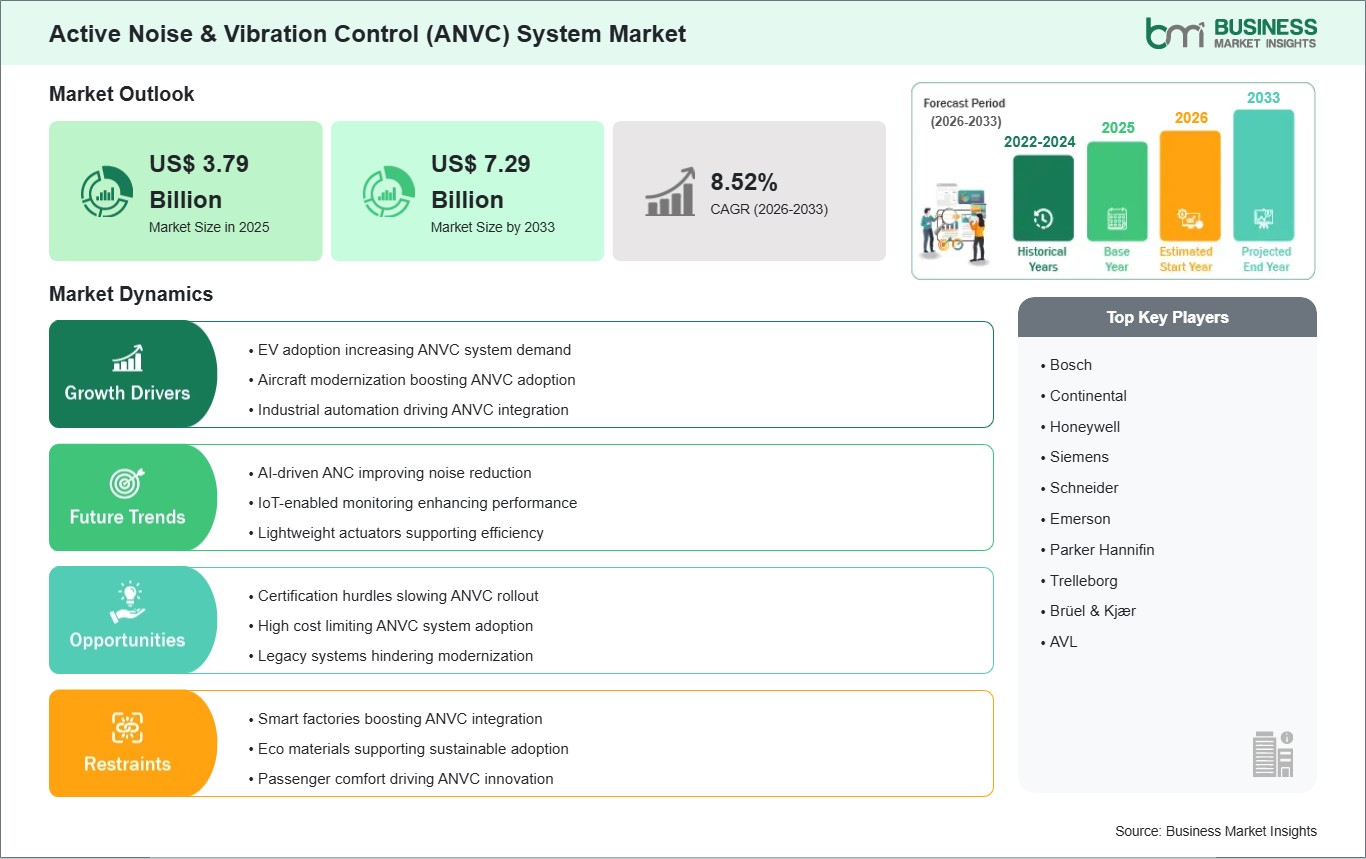
Active Noise & Vibration Control (ANVC) systems are designed to reduce unwanted noise and vibration using electronic sensors, actuators, controllers, and advanced software algorithms. These systems are widely used across commercial, military, and industrial platforms to improve operational comfort, equipment stability, and system performance. ANVC technologies are increasingly being integrated into aircraft, industrial machinery, vehicles, and defense systems to minimize noise levels and mechanical vibrations in critical operating environments. Growing demand for enhanced passenger comfort, workplace safety, and equipment reliability is supporting the adoption of ANVC systems across multiple industries. Manufacturers are focusing on lightweight system integration, real-time monitoring capabilities, and energy-efficient control technologies to improve operational performance and meet evolving industry requirements.
Several factors continue to influence the development of the Active Noise & Vibration Control System market. Industries are increasingly adopting digital signal processing technologies and intelligent control systems to improve precision and system responsiveness. Commercial transportation and industrial sectors are investing in vibration reduction technologies to enhance equipment lifespan and reduce maintenance costs. However, high implementation costs, system integration complexity, and technical limitations in harsh operating conditions can create challenges for manufacturers and end users. Military and aerospace applications require highly durable and reliable ANVC systems that can operate under demanding environmental conditions, increasing development and testing requirements. In addition, integrating advanced control software with existing mechanical infrastructure may require significant customization and engineering expertise.
Despite these challenges, the market continues to benefit from ongoing industrial modernization and technological advancements. Commercial platforms remain major contributors due to rising demand for quieter cabins and improved user comfort. Industrial facilities are increasingly adopting vibration control technologies to protect machinery and optimize operational efficiency. Military applications are also supporting market growth through investments in advanced defense platforms and mission-critical equipment. Technological advancements in smart sensors, AI-based control systems, and compact hardware designs are expected to create future growth opportunities. Competitive activity in the market is centered on product innovation, system integration capabilities, operational reliability, and long-term performance optimization.
Segment Analysis
Active Noise & Vibration Control (ANVC) System Market Segmentation
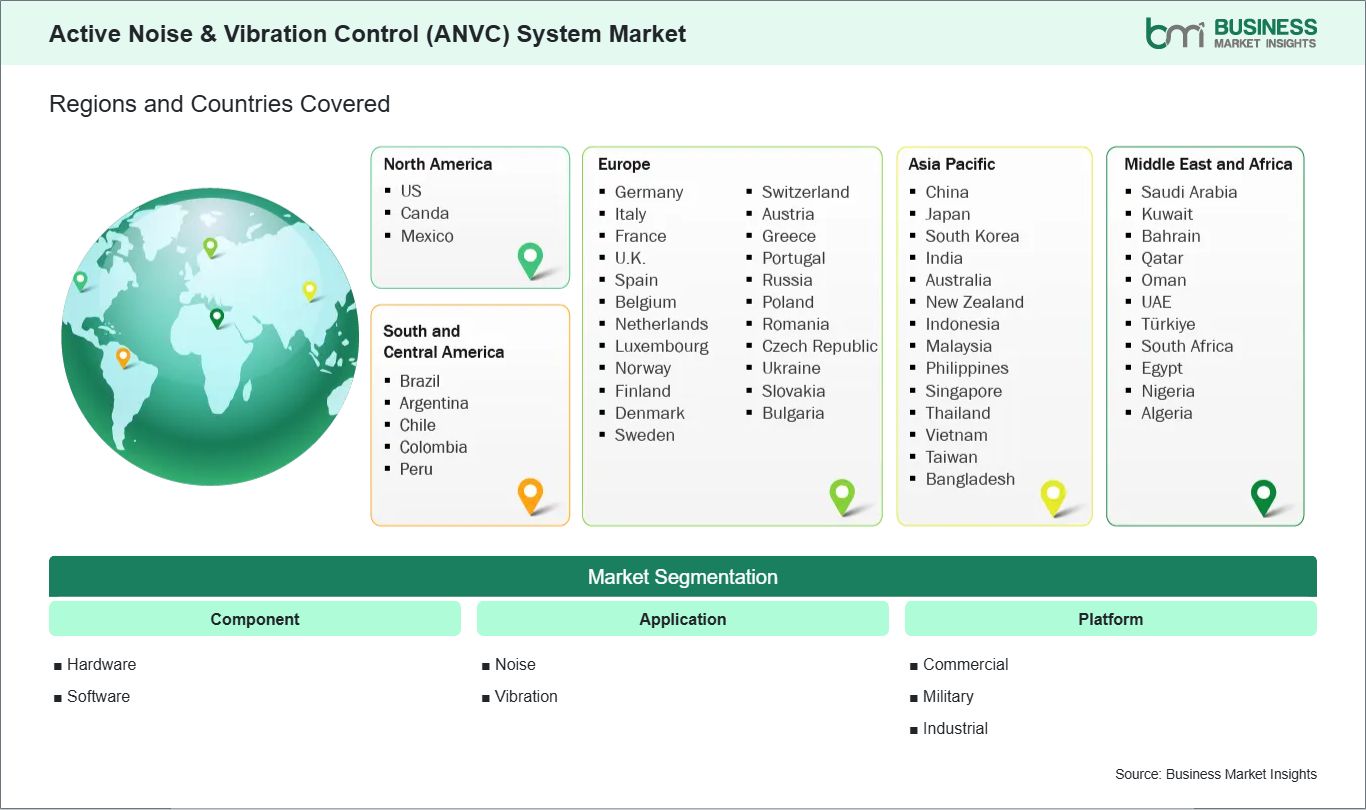
The Active Noise & Vibration Control System market is segmented based on component, application, and platform. These segments support the growing adoption of advanced noise and vibration reduction technologies across commercial, military, and industrial environments.
By Component
- Hardware: Includes sensors, actuators, microphones, and controllers used for detecting and reducing unwanted noise and vibration.
- Software: Focuses on signal processing, system monitoring, and adaptive control algorithms for real-time performance optimization.
By Application
- Noise: Widely used to reduce cabin noise, machinery sound, and environmental disturbances in transportation and industrial systems.
- Vibration: Supports equipment stability, structural protection, and operational efficiency across aerospace and industrial applications.
By Platform
- Commercial: Increasingly adopted in transportation, automotive, and aviation sectors to improve passenger comfort and system performance.
- Military: Used in defense platforms and mission-critical systems requiring precision, durability, and low acoustic signatures.
- Industrial: Applied in manufacturing plants and heavy machinery to reduce operational vibration and maintenance requirements.
Market Forces
Active Noise & Vibration Control (ANVC) System Market Drivers and Opportunities
Rising Demand for Passenger Comfort and Equipment Efficiency
The demand for Active Noise & Vibration Control systems is increasing as industries focus on improving operational comfort, equipment reliability, and workplace safety. Commercial transportation sectors such as aviation, railways, and automotive are integrating ANVC technologies to reduce cabin noise and improve passenger experience. Industrial facilities are also adopting these systems to minimize machinery vibration, protect equipment components, and reduce maintenance costs. Growing awareness regarding occupational noise exposure and vibration-related equipment damage is encouraging wider deployment of advanced control systems across manufacturing and heavy industries.
Military and aerospace sectors are increasingly investing in vibration and acoustic control technologies to improve operational performance and mission efficiency. Modern aircraft and defense platforms require advanced systems capable of operating under harsh environmental conditions while maintaining precision and reliability. Industries are also adopting lightweight materials and compact electronic systems to improve energy efficiency and reduce system complexity. Regulatory emphasis on worker safety, environmental noise control, and equipment reliability is further supporting market demand. As industries continue modernizing operational infrastructure, the need for efficient and intelligent ANVC systems is expected to remain strong.
Growing Integration of Smart Sensors and Intelligent Control Systems
The Active Noise & Vibration Control System market is creating new opportunities through the integration of smart sensors, artificial intelligence, and advanced digital control technologies. Intelligent monitoring systems can analyze vibration patterns and acoustic signals in real time, helping industries improve operational efficiency and predictive maintenance capabilities. IoT-enabled platforms are also making it easier to integrate ANVC systems with connected industrial infrastructure and smart transportation networks. As automation and digital transformation continue across industries, there is increasing demand for adaptive and self-learning control systems that can optimize performance under changing operational conditions.
The expansion of electric transportation and advanced aerospace technologies is also supporting the development of compact and energy-efficient ANVC solutions. Electric vehicles and hybrid aircraft require advanced noise management systems to improve passenger comfort and operational stability. Industrial automation projects are increasing the need for precision vibration control technologies that can support high-speed manufacturing environments. Sustainability goals are encouraging manufacturers to develop lightweight and energy-efficient components that reduce overall system load. As industries continue investing in intelligent infrastructure and connected technologies, companies focusing on advanced software integration, smart sensing capabilities, and real-time control technologies are expected to gain long-term growth opportunities.
Size and Share Analysis
Active Noise & Vibration Control (ANVC) System Market Size and Share Analysis
The Active Noise & Vibration Control System Market is projected to grow from US$ 3.79 Billion in 2025 to US$ 7.29 Billion by 2033 , registering a CAGR of 8.52% from 2026 to 2033.
By component, hardware holds a significant share due to its essential role in detecting and controlling unwanted noise and vibration through sensors, actuators, and controllers. Software is gaining importance with increasing adoption of intelligent control algorithms, digital signal processing, and real-time monitoring technologies.
By application, noise control leads the market owing to growing demand for passenger comfort, workplace safety, and acoustic management across transportation and industrial sectors. Vibration control is also witnessing steady growth due to its importance in protecting machinery, improving operational stability, and reducing maintenance requirements.
By platform, commercial applications dominate the market due to increasing integration of ANVC systems in aviation, transportation, and automotive industries. Military platforms continue to generate demand for advanced vibration and acoustic management technologies that support operational reliability and mission performance. Industrial applications are also expanding steadily with rising adoption of automation, connected manufacturing systems, and advanced equipment protection technologies. Increasing investments in smart infrastructure, industrial modernization, and intelligent transportation systems are expected to support long-term market growth.
Report Coverage
Active Noise & Vibration Control (ANVC) System Market Report Coverage and Deliverables
The "Active Noise & Vibration Control System Size and Forecast (2022-2033)" report provides a detailed analysis of the market covering below areas:
- Market size and forecast at global, regional, and country levels for all the key market segments covered under the scope
- Market trends, as well as market dynamics such as drivers, restraints, and key opportunities
- Market analysis covering key market trends, global and regional framework, major players, regulations, and recent market developments
- Industry landscape and competition analysis covering market concentration, heat map analysis, prominent players, and recent developments for the market
- Detailed company profiles, including SWOT analysis
Geographic Insights
Active Noise & Vibration Control (ANVC) System Market Geographic Insights
The Active Noise & Vibration Control System Market shows diverse regional adoption patterns influenced by industrial modernization, transportation advancements, and increasing focus on operational comfort and equipment efficiency.
North America, being a developed region, has a strong presence of aerospace, defense, automotive, and industrial manufacturing sectors that actively adopt advanced ANVC technologies. The region comprises the United States and Canada, where investments are being made in intelligent transportation systems, industrial automation, and modern aircraft technologies. The region focuses on improving passenger comfort, equipment reliability, and workplace safety through advanced noise and vibration reduction solutions. Strong technological infrastructure, research capabilities, and industrial digitization are supporting the integration of smart sensors, digital signal processing systems, and AI-based control technologies across commercial and military platforms.
Asia Pacific is growing significantly, driven by rapid industrialization, infrastructure development, and increasing transportation modernization activities. The region comprises countries such as China, India, Japan, and South Korea, where manufacturing expansion and rising investments in aviation and automotive industries are supporting market growth. The region focuses on improving industrial efficiency, reducing operational noise, and enhancing system durability through advanced ANVC solutions. Growing adoption of electric vehicles, high-speed transportation systems, and smart manufacturing technologies is creating additional demand for vibration and acoustic management systems. Government support for industrial automation and infrastructure modernization is also contributing to increased adoption across commercial and industrial sectors.
Both regions are contributing significantly to the growth of the Active Noise & Vibration Control System Market, focusing on advanced transportation systems, industrial efficiency improvements, and increasing demand for intelligent noise and vibration management technologies.
Industry Activity
Recent Developments
The Active Noise & Vibration Control System Market is analyzed using a mix of primary and secondary research sources, including corporate publications, industry associations, and verified databases. This approach ensures accurate tracking of innovation trends and strategic developments influencing the market.
- In February 2024, Honeywell announced advancements in active vibration control technologies for aerospace applications to improve passenger comfort and aircraft operational efficiency. The company focused on integrating lightweight sensors and intelligent control systems that help reduce cabin vibration and improve system stability in modern aircraft platforms.
- In October 2023, Moog Inc. expanded its intelligent motion and vibration control capabilities for industrial and aerospace systems. The development focused on improving precision control technologies and advanced vibration reduction systems for critical industrial machinery and defense applications.
Trust & Transparency
Research Methodology
The market analysis combines proprietary research with secondary data from government agencies, company disclosures, regulatory filings, industry databases and expert interviews. Market estimates are validated through data triangulation, cross-market benchmarking and analyst
review.
View Full Research Methodology
Key Sources Referred:
Industry Reports Company Filings Government Aviation and Industrial Safety Data Research Publications Technical Journals