Market Summary
Executive Summary and Global Market Analysis
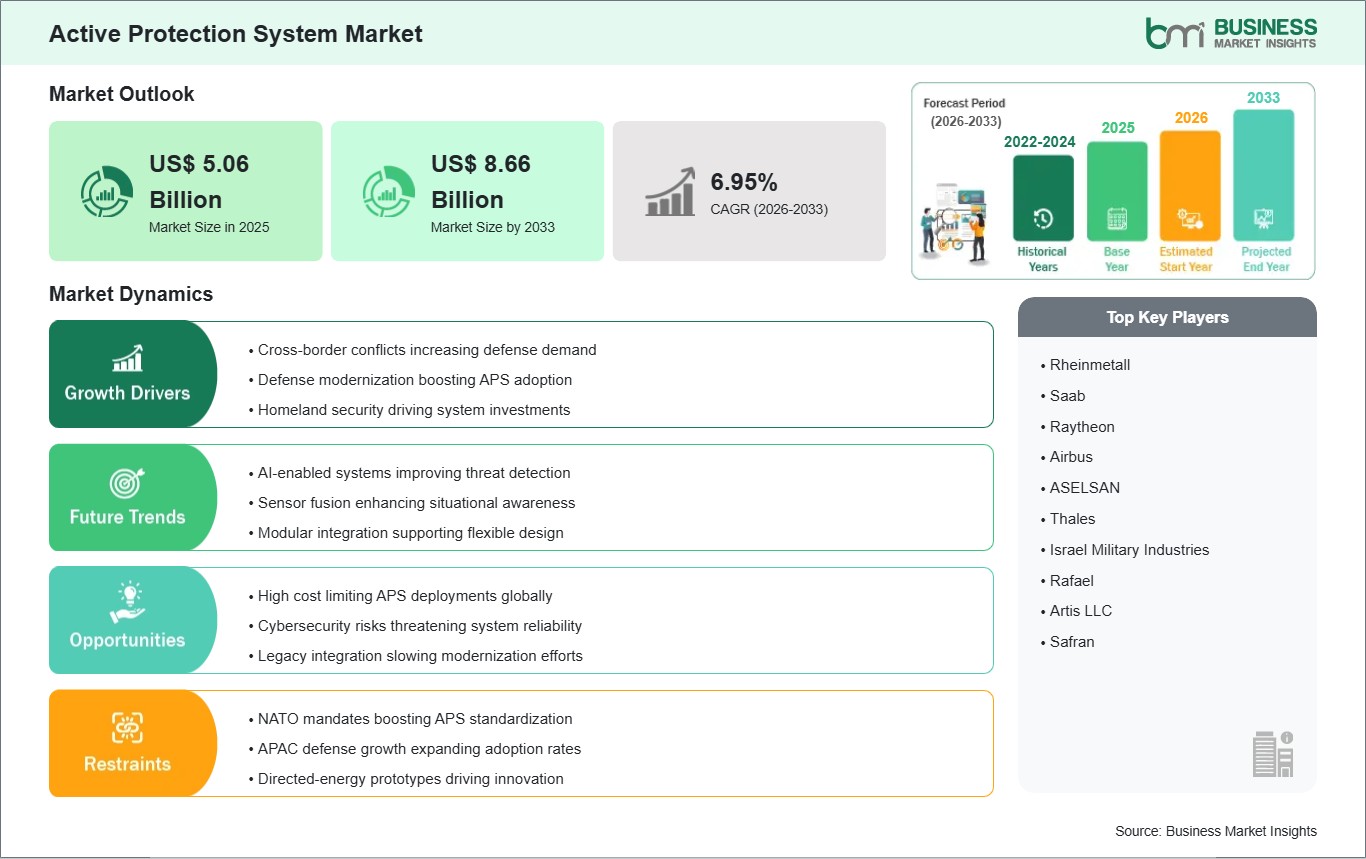
Active protection systems are advanced defense technologies designed to detect, track, and neutralize incoming threats before they strike military platforms. These systems use radar, sensors, countermeasures, launchers, and control software to improve vehicle survivability in combat situations. Active protection systems are widely used in armored vehicles, naval vessels, and airborne defense platforms to counter anti-tank missiles, rocket-propelled grenades, and guided projectiles. Growing geopolitical tensions, increasing border security concerns, and rising military modernization programs are supporting demand for advanced protection technologies.
Several factors continue to influence the development of the Active Protection System market. Defense manufacturers are integrating artificial intelligence, advanced sensors, and automated interception technologies to improve detection accuracy and response speed. Demand for lightweight and modular systems is increasing as military forces seek flexible solutions for both legacy and next-generation platforms. However, strict defense procurement procedures, high integration costs, and complex testing requirements can affect deployment timelines.
Despite these challenges, the market continues to benefit from long-term defense investments and technological advancements. Ground-based military vehicles remain major adopters due to increasing requirements for crew protection and combat effectiveness. Naval and airborne platforms are also integrating advanced defensive technologies to improve mission security and operational readiness. Growing investments in autonomous defense systems, network-centric warfare, and electronic countermeasure technologies are expected to create future opportunities for the Active Protection System market. Competitive activity is centered on sensor accuracy, rapid threat interception, modular integration capabilities, and long-term maintenance support services.
Segment Analysis
Active Protection System Market Segmentation
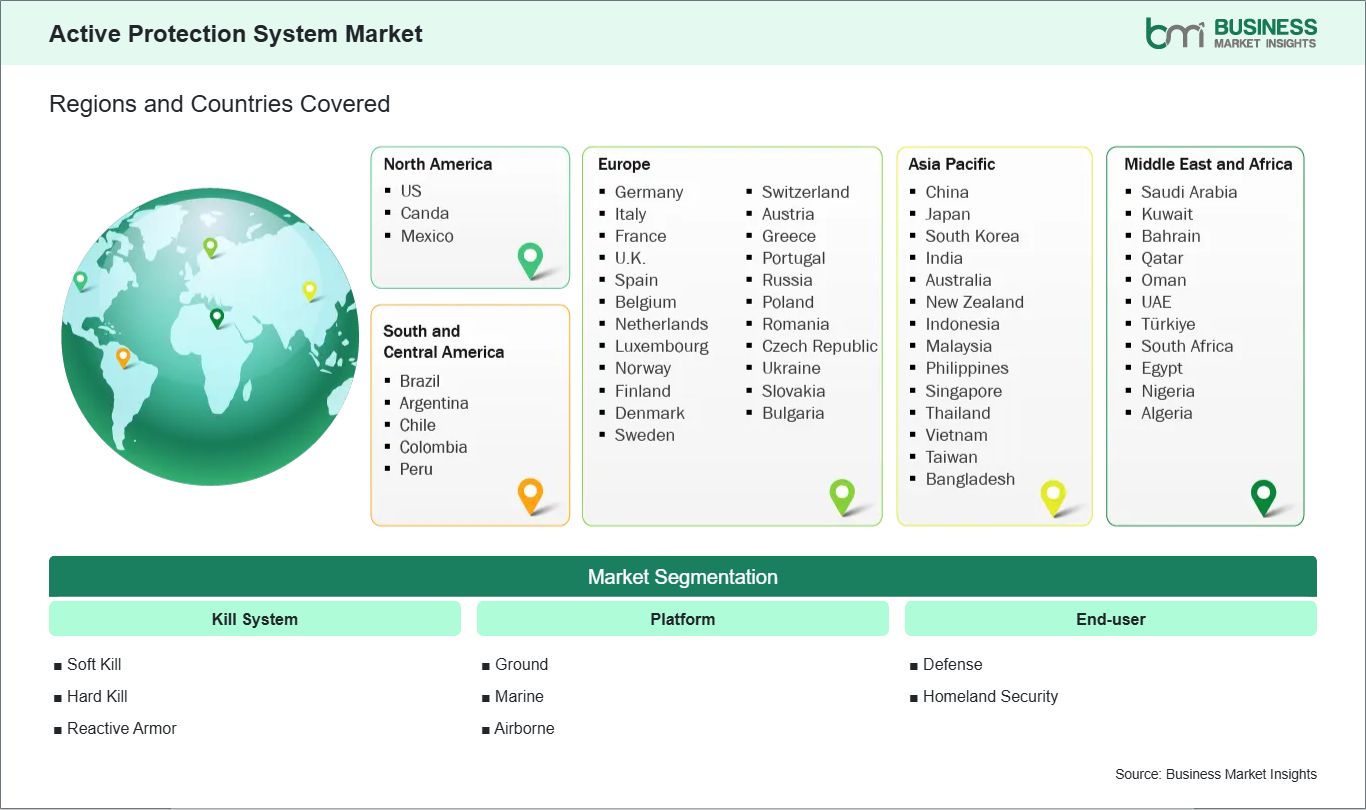
The Active Protection System market is segmented based on kill system, platform, and end-user. These segments help define operational requirements, deployment environments, and technology adoption patterns across global defense applications.
By Kill System
- Soft Kill: Uses electronic countermeasures, jamming, and decoys to divert or confuse incoming threats before impact.
- Hard Kill: Uses physical interception methods to destroy incoming missiles or projectiles before they reach the target.
- Reactive Armor: Includes explosive or advanced armor technologies designed to reduce damage from direct attacks.
By Platform
- Ground: Widely adopted in armored vehicles, tanks, and tactical combat systems for battlefield protection.
- Marine: Used in naval vessels and maritime defense systems to improve ship survivability against missile threats.
- Airborne: Integrated into military aircraft and airborne defense systems for enhanced operational protection.
By End-user
- Defense: Major segment driven by military modernization programs and rising defense procurement activities.
- Homeland Security: Supports border security, critical infrastructure protection, and tactical response operations.
Market Forces
Active Protection System Market Drivers and Opportunities
Rising Military Modernization and Demand for Battlefield Survivability
The demand for active protection systems is increasing because military organizations are focusing on improving battlefield survivability and reducing risks from advanced weapon systems. Modern combat environments involve threats such as anti-tank guided missiles, rocket-propelled grenades, and precision-guided munitions that require fast and reliable defensive technologies. Active protection systems help military platforms detect and intercept threats before impact, improving crew safety and operational effectiveness. Governments are investing in defense modernization programs to upgrade armored vehicles, naval systems, and airborne platforms with advanced protection technologies.
The increasing use of network-centric warfare and digital battlefield systems is also supporting market growth. Defense forces are adopting systems with integrated sensors, radar technologies, and automated response mechanisms to improve real-time situational awareness. Military operations now require flexible and modular defense solutions that can operate in different combat environments. Growing geopolitical tensions and cross-border security concerns are encouraging countries to strengthen defense preparedness and upgrade tactical capabilities. As military spending on advanced defense technologies continues to rise, the Active Protection System market is expected to maintain stable long-term demand across multiple regions.
Integration of Artificial Intelligence and Autonomous Defense Technologies
The Active Protection System market is creating new opportunities through the integration of artificial intelligence, automation, and advanced sensor technologies. AI-enabled systems can improve threat detection accuracy, reduce response time, and support automated interception capabilities during combat operations. These technologies are helping defense organizations manage increasingly complex threat environments involving drones, guided missiles, and electronic warfare systems. Autonomous defense technologies are also supporting the development of smarter battlefield protection systems with improved adaptability and operational efficiency.
Modern defense platforms are increasingly using connected systems that combine radar, communication networks, and predictive analytics to improve mission coordination and decision-making. The growth of unmanned combat vehicles and next-generation military platforms is creating demand for lightweight and scalable protection technologies. Naval and airborne defense systems are also benefiting from advancements in electronic countermeasure technologies and real-time threat management systems. Sustainability and operational efficiency are encouraging the use of compact electronic systems with reduced maintenance requirements. As defense forces continue investing in intelligent combat technologies and advanced security infrastructure, the market is expected to benefit from new deployment opportunities across land, marine, and airborne applications.
Size and Share Analysis
Active Protection System Market Size and Share Analysis
The Active Protection System Market is projected to grow from US$ 5.06 Billion in 2025 to US$ 8.66 Billion by 2033 , registering a CAGR of 6.95% from 2026 to 2033.
By kill system, hard kill systems hold a significant share due to their ability to physically intercept and neutralize incoming threats such as anti-tank missiles and rocket-propelled grenades. Soft kill systems are also gaining importance with increasing use of electronic countermeasures, jamming technologies, and decoy systems designed to disrupt enemy targeting capabilities. Reactive armor systems continue to support market demand, particularly in armored combat vehicles operating in high-risk defense environments where additional vehicle protection is required.
By platform, ground-based systems dominate the market owing to rising deployment of active protection technologies in armored vehicles, tanks, and tactical military transport platforms. Marine platforms are also adopting advanced protection systems to improve survivability against missile and torpedo threats in naval operations. Airborne platforms are witnessing gradual adoption as defense organizations focus on improving aircraft survivability and threat detection capabilities in modern combat environments.
By end-user, the defense sector accounts for the largest share due to increasing military modernization programs, rising geopolitical tensions, and growing investments in advanced battlefield protection technologies. Homeland security applications are also expanding steadily with increasing focus on protecting critical infrastructure, border security assets, and high-value tactical vehicles. Technological advancements in radar systems, sensor integration, and automated threat response systems are expected to support the long-term growth of the Active Protection System market.
Report Coverage
Active Protection System Market Report Coverage and Deliverables
The "Active Protection System Size and Forecast (2022-2033)" report provides a detailed analysis of the market covering below areas:
- Market size and forecast at global, regional, and country levels for all the key market segments covered under the scope
- Market trends, as well as market dynamics such as drivers, restraints, and key opportunities
- Market analysis covering key market trends, global and regional framework, major players, regulations, and recent market developments
- Industry landscape and competition analysis covering market concentration, heat map analysis, prominent players, and recent developments for the market
- Detailed company profiles, including SWOT analysis
Geographic Insights
Active Protection System Market Geographic Insights
The Active Protection System Market shows diverse regional adoption patterns influenced by defense modernization programs, geopolitical tensions, and increasing investments in advanced military protection technologies.
North America, being a technologically advanced defense region, has a strong presence of military modernization programs and advanced combat vehicle development activities. The region comprises the United States and Canada, where defense agencies are investing in next-generation battlefield protection systems and integrated defense technologies. The region focuses on improving armored vehicle survivability, real-time threat interception, and operational efficiency across land, marine, and airborne platforms.
Asia Pacific is witnessing significant growth due to rising regional security concerns, military expansion programs, and increasing investments in indigenous defense manufacturing. The region includes countries such as China, India, Japan, and South Korea, where governments are strengthening defense capabilities and upgrading armored vehicle fleets. The region focuses on improving border security, combat readiness, and tactical defense systems through advanced protection technologies. Growing investments in military vehicles, naval modernization, and smart defense infrastructure are supporting the demand for active protection systems. Expanding defense procurement programs and increasing focus on modern warfare technologies are also contributing to market growth across the region.
Both regions are contributing significantly to the growth of the Active Protection System Market, focusing on defense modernization, operational survivability, and advanced battlefield protection technologies.
Industry Activity
Recent Developments
The Active Protection System Market is analyzed using a mix of primary and secondary research sources, including corporate publications, industry associations, and verified databases. This approach ensures accurate tracking of innovation trends and strategic developments influencing the market.
- In June 2024, Rafael Advanced Defense Systems announced further operational deployment and integration activities related to its Trophy Active Protection System for armored combat vehicles. The system continued to gain international attention for improving vehicle survivability against anti-tank threats and supporting modern battlefield operations. The development highlighted growing defense investments in advanced protection technologies and integrated combat systems.
- In April 2023, Rheinmetall announced ongoing development and testing activities for advanced active protection technologies designed for armored military platforms. The company focused on improving threat detection, rapid interception capabilities, and modular integration for modern combat vehicles. The development reflected increasing global demand for enhanced battlefield protection systems and next-generation defense technologies.
Trust & Transparency
Research Methodology
The market analysis combines proprietary research with secondary data from government agencies, company disclosures, regulatory filings, industry databases and expert interviews. Market estimates are validated through data triangulation, cross-market benchmarking and analyst
review.
View Full Research Methodology
Key Sources Referred:
World Bank - Global Trade Indicators World Trade Organization (WTO) International Monetary Fund (IMF) International Trade Administration (ITA) Company Websites Company Annual Reports Company Investor Presentations