Market Summary
Executive Summary and Global Market Analysis
High integrity pressure protection systems are safety solutions designed to prevent excessive pressure within industrial processing environments. These systems operate independently from conventional process controls and support operational continuity across high-risk industries. The market continues evolving as industrial facilities prioritize asset protection, operational reliability, and compliance with stringent safety requirements. Expansion of complex processing infrastructure has further strengthened the need for advanced pressure management technologies. Industrial operators also continue modernizing legacy infrastructure to align with operational efficiency and safety performance objectives. Demand from offshore operations and high-pressure processing environments remains a notable industry contributor.
Industrial operators are increasingly implementing automated safety architectures to reduce operational disruptions and equipment failure risks. Oil and gas facilities, chemical processing plants, and power generation units require dependable protection systems capable of maintaining process integrity under demanding operating conditions. Regulatory emphasis on workplace safety and process hazard mitigation continues influencing procurement decisions across multiple industries. Technological advancement is reshaping system architecture through improved diagnostics, remote monitoring, and integrated control functionality. Facilities are increasingly adopting digital safety systems that support predictive maintenance and faster response management.
Segment Analysis
High Integrity Pressure Protection System Market Segmentation
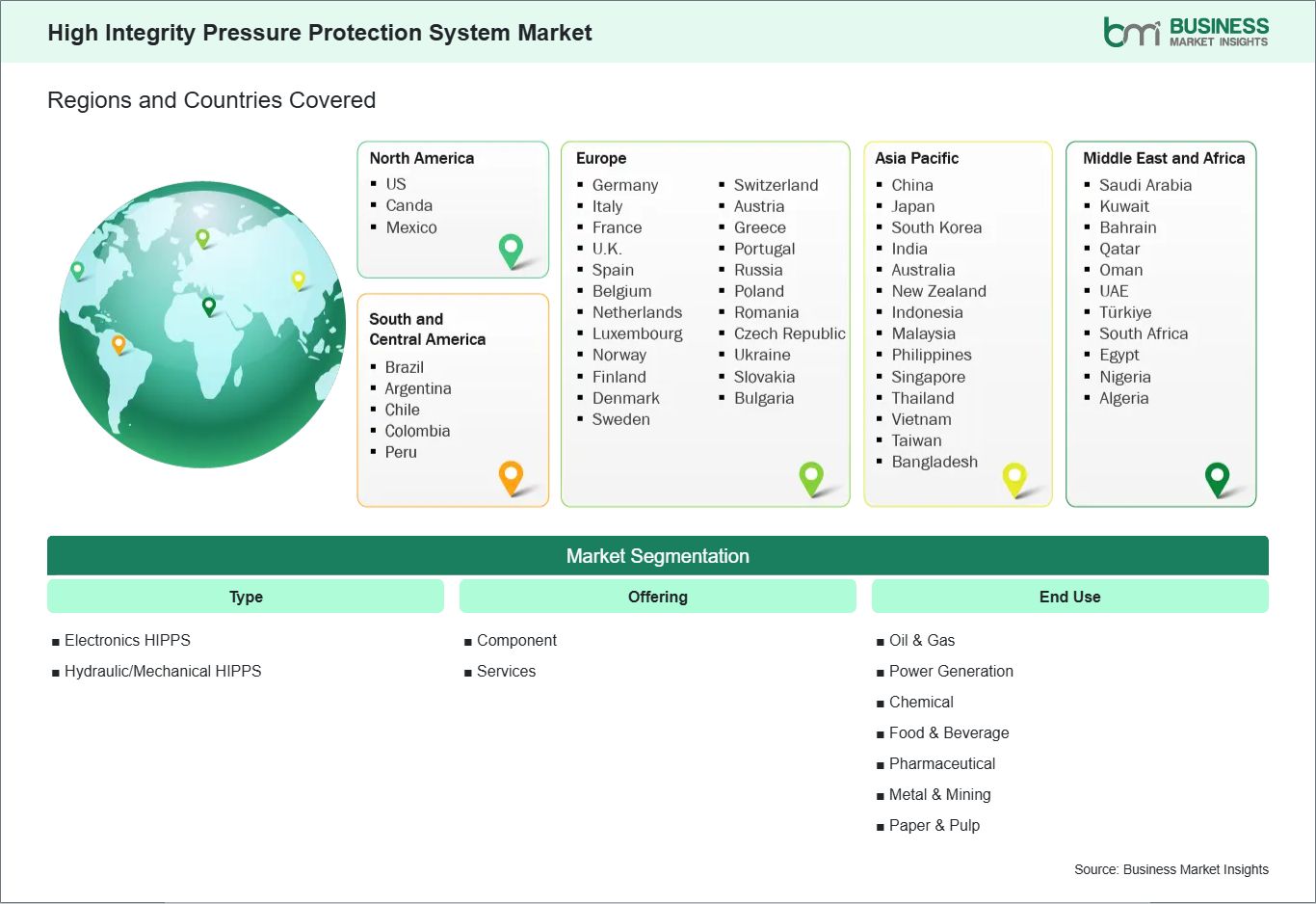
The High Integrity Pressure Protection System market is segmented based on type, offering, and end-use, reflecting the growing demand for advanced high pressure protection systems across multiple applications.
By Type
- Electronics HIPPS: Dominated the market in 2025 due to higher accuracy, faster response time, and strong adoption in modern safety instrumented systems.
- Hydraulic/Mechanical HIPPS: Used in conventional industrial setups where mechanical reliability and simplified operation are preferred.
By Offering
- Component: Held the largest share in 2025 driven by strong demand for sensors, logic solvers, and shutdown valves in HIPPS installations.
- Services: Growing steadily due to increasing need for installation, maintenance, testing, and system integration support.
By End-Use
- Oil & Gas: Held the largest share in 2025 due to high-pressure operations and strict safety regulations across upstream and downstream processes.
- Power Generation: Growing due to increasing adoption of advanced safety systems in thermal and nuclear power plants.
- Chemical: Expanding due to the need for precise pressure control in hazardous processing environments.
- Food & Beverage: Increasing adoption for maintaining safety and process integrity in production systems.
- Pharmaceutical: Growing due to stringent compliance requirements and controlled manufacturing environments.
- Metal & Mining: Rising deployment in high-pressure and heavy-duty industrial operations.
- Paper & Pulp: Adoption driven by process safety requirements and operational reliability needs in large-scale production facilities.
Market Forces
High Integrity Pressure Protection System Market Drivers and Opportunities
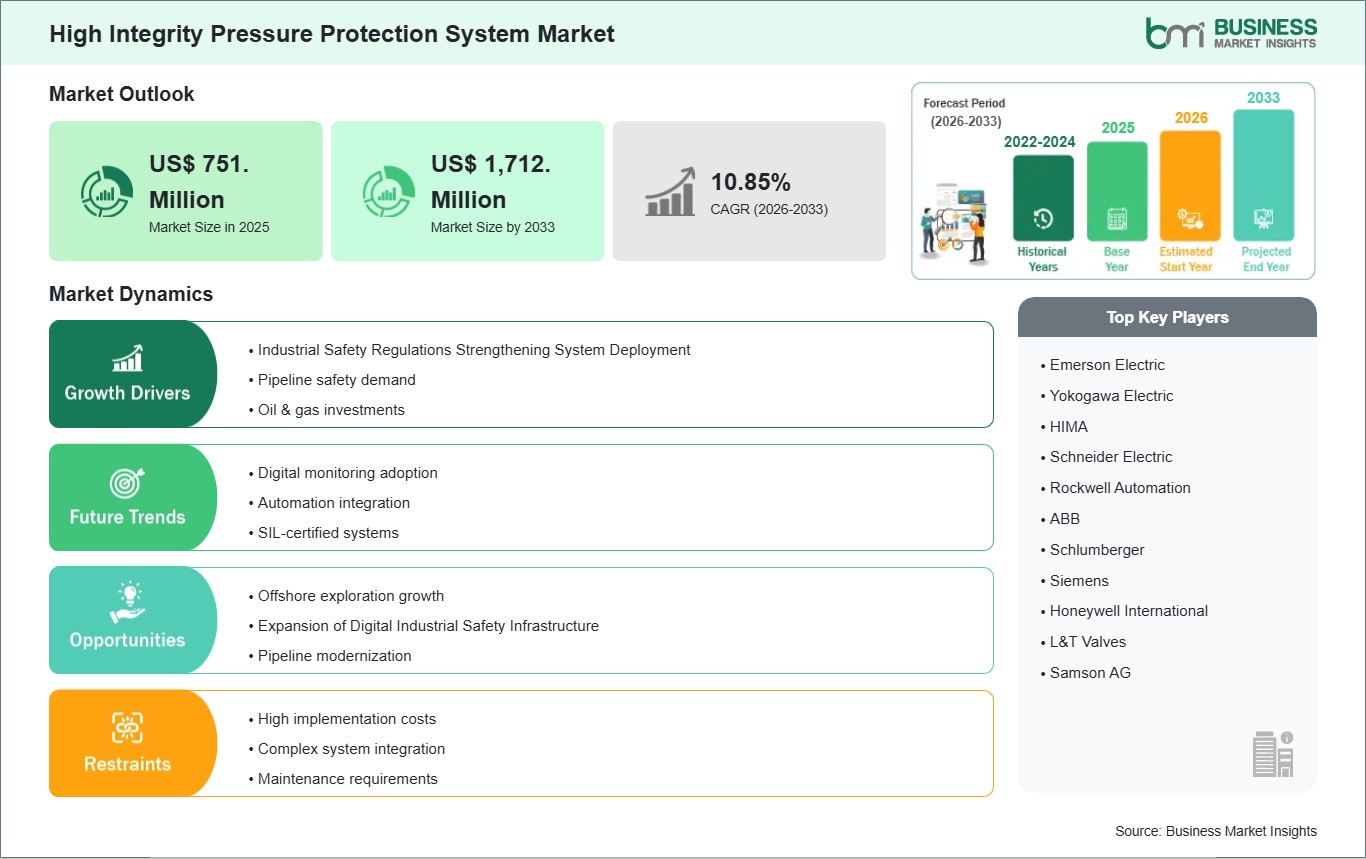
Industrial Safety Regulations Strengthening System Deployment
Industrial facilities continue facing stricter operational safety standards across hazardous processing environments. Pressure-related incidents within oil and gas, chemical, and energy operations have increased focus on independent protection systems capable of reducing operational risks. Organizations are prioritizing safety architectures that improve process integrity while minimizing unplanned shutdowns and equipment damage.
Regulatory agencies continue emphasizing certified safety systems and process hazard mitigation across industrial sectors. Compliance frameworks encourage operators to modernize pressure management infrastructure and improve operational monitoring capabilities. Technological improvements in automated shutdown functionality and integrated diagnostics further strengthen the relevance of advanced protection systems within critical industrial applications.
Expansion of Digital Industrial Safety Infrastructure
Industrial automation trends are creating opportunities for integrated pressure protection systems with advanced monitoring capabilities. Facilities increasingly prefer intelligent safety platforms capable of supporting predictive maintenance, operational analytics, and remote diagnostics. These developments are encouraging wider implementation across high-pressure operational environments requiring continuous system reliability and real-time performance visibility.
Future opportunities remain connected to industrial modernization initiatives and expansion of automated processing facilities. Offshore exploration projects, refinery upgrades, and energy infrastructure investments continue supporting long-term market potential. Integration of digital safety technologies within connected industrial ecosystems is also expected to improve operational efficiency and strengthen demand across multiple end-use sectors.
Size and Share Analysis
High Integrity Pressure Protection System Market Size and Share Analysis
The High Integrity Pressure Protection System Market is projected to grow from US$ 751. Million in 2025 to US$ 1,712. Million by 2033 , registering a CAGR of 10.85% from 2026 to 2033.
By type, the High Integrity Pressure Protection System market is divided into Electronics HIPPS and Hydraulic/Mechanical HIPPS. The Electronics HIPPS segment dominated the market in 2025 due to advanced monitoring capabilities and compatibility with automated industrial safety systems. Rising utilization of digital control infrastructure across high-pressure industrial environments further strengthened segment adoption.
By offering, the market is divided into Component and Services. The Component segment held the largest share in 2025, supported by continuous demand for valves, actuators, logic solvers, and pressure sensors within industrial facilities. Expansion of refinery modernization and process safety upgrades also contributed to stronger component deployment across critical operations.
By end use, the market is divided into Oil & Gas, Power Generation, Chemical, Food & Beverage, Pharmaceutical, Metal & Mining, and Paper & Pulp. The Oil & Gas segment held the largest share in 2025 owing to strict operational safety requirements and rising investment in high-pressure exploration and production activities. Offshore projects and pipeline infrastructure modernization further accelerated implementation of advanced pressure protection systems.
Report Coverage
High Integrity Pressure Protection System Market Report Coverage and Deliverables
The "High Integrity Pressure Protection System Market Size and Forecast (2022–2033)" report provides a detailed analysis of the market covering:
- High Integrity Pressure Protection System market size and forecast at global, regional, and country levels for all the key market segments covered under the scope
- Market trends, dynamics such as drivers, restraints, and key opportunities
- Industry landscape and competition analysis covering market concentration, heat map analysis, prominent players, and recent developments
- Detailed company profiles, including SWOT analysis
Geographic Insights
High Integrity Pressure Protection System Market Geographic Insights
The High Integrity Pressure Protection System market is divided into geographic segments, which include North America, Asia Pacific, Europe, Middle East & Africa, and South & Central America. Regional markets demonstrate different implementation priorities depending on industrial activity, refinery capacity, and process safety compliance frameworks. Developed economies continue emphasizing modernization of industrial facilities, while emerging regions focus on strengthening operational reliability within expanding processing industries.
North America maintains strong market visibility due to advanced industrial infrastructure and strict operational safety standards. The United States continues investing in refinery modernization, offshore exploration, and industrial automation technologies supporting safety system integration. Canada also contributes through oil sands operations and energy infrastructure projects requiring reliable pressure management systems. Industrial operators across the region continue prioritizing certified protection solutions within high-risk operational environments.
Asia-Pacific represents a significant regional market due to industrial expansion and increasing investments in energy and manufacturing infrastructure. China continues strengthening industrial safety practices across refining, chemical processing, and power generation facilities. India is also witnessing broader implementation of automated safety systems within expanding industrial corridors and energy projects. Japan and South Korea maintain focus on advanced process automation and operational reliability across technologically intensive industries.
Industry Activity
Recent Developments
The High Integrity Pressure Protection System market is evaluated by gathering qualitative and quantitative data post primary and secondary research, which includes important corporate publications, association data, and databases. A few of the key developments in the High Integrity Pressure Protection System market are:
- In February 2026, Yokogawa Electric Corporation (TOKYO: 6841) announced the release of the OpreX™ Pressure Transmitter EJX S Series as the successor to its core EJX A lineup*1 of plant field instruments. Building on the proven silicon resonant sensor technology that Yokogawa has been refining for the past 30 plus years, the EJX S Series offers enhancements in accuracy, long-term stability, and durability that ensure stable plant operations and improve maintenance efficiency.
Trust & Transparency
Research Methodology
The market analysis combines proprietary research with secondary data from government agencies, company disclosures, regulatory filings, industry databases and expert interviews. Market estimates are validated through data triangulation, cross-market benchmarking and analyst
review.
View Full Research Methodology
Key Sources Referred:
Government energy efficiency publications
National building and environmental policy documents
Industry white papers on thermal management technologies
Research publications covering tire material innovation and efficiency trends
Company website
Company annual reports
Company investor presentations