
Active Wound Care Market Outlook: Size, Share, Trends, Growth Analysis, Competitive Landscape & Forecast, 2022-2033

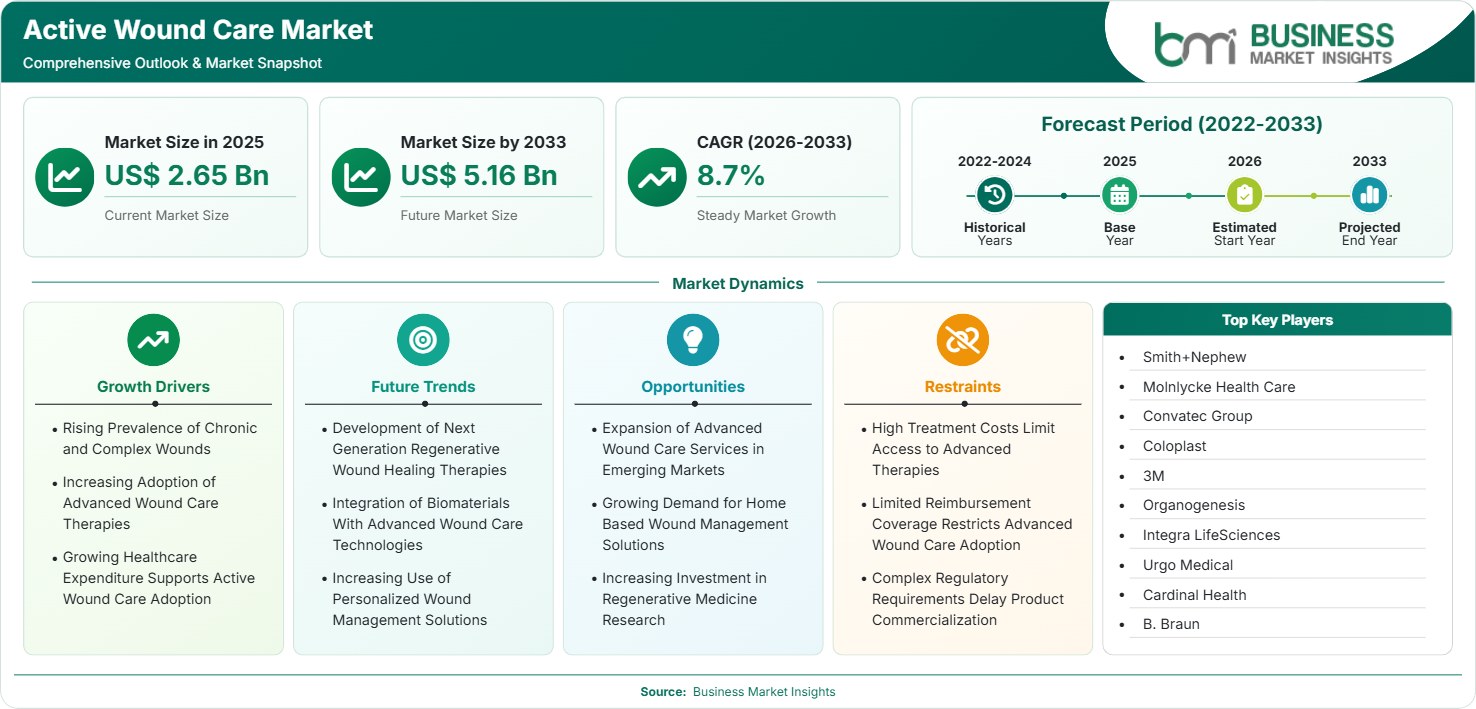
The Active Wound Care Market size was valued at US$ 2.65 billion in 2025 and is projected to reach US$ 5.16 billion by 2033, growing at a CAGR of 8.69% during 2026–2033, driven by chronic wound prevalence, advanced therapies, regenerative medicine, home care, and expanding healthcare expenditure.

Report Coverage
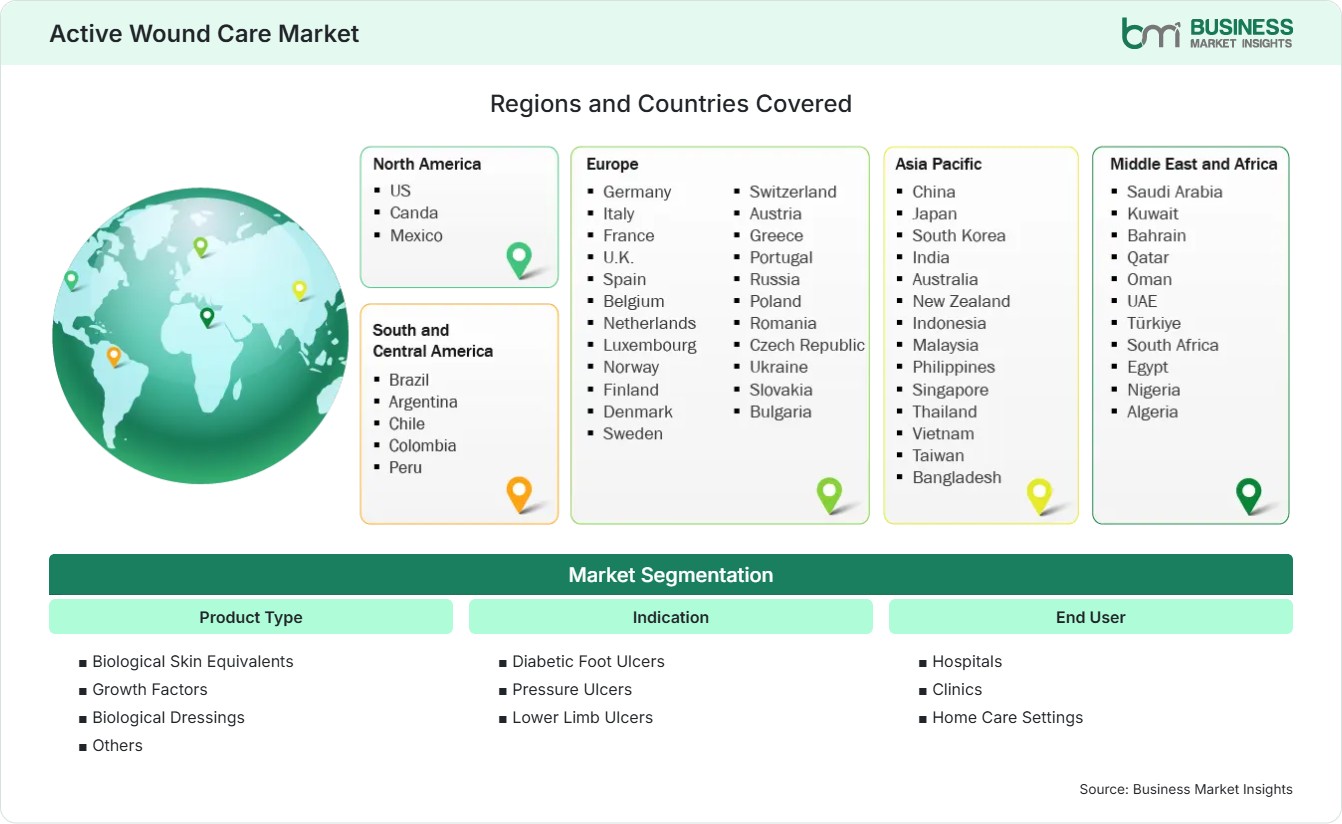
  • Product Type: Biological Skin Equivalents, Growth Factors, Biological Dressings, Others
  • Indication: Diabetic Foot Ulcers, Pressure Ulcers, Lower Limb Ulcers
  • End User: Hospitals, Clinics, Home Care Settings
US$ 2.65 Bn Market size in 2025
US$ 5.16 Bn Market Size by 2033
8.7% CAGR, 2026 - 2033
2026-2033 Forecast Period

01 AI Overview

Active Wound Care Market Summary

  • North America Region: North America held an estimated 38%–42% share in 2025 and is projected to grow at a 8.3%–8.7% CAGR, supported by advanced wound care adoption, high healthcare spending, established reimbursement pathways, and strong regenerative medicine research. The U.S. market is projected to grow at a 8.4%–8.8% CAGR, supported by chronic wound prevalence, specialist care, and advanced product adoption.
  • Fastest Growing Region: Asia Pacific held an estimated 19%–23% share in 2025 and is projected to expand at a 10.1%–10.5% CAGR, driven by rising diabetes prevalence, healthcare infrastructure development, expanding specialist services, increasing medical expenditure, and greater access to advanced wound management.
  • Leading Segment: Biological Dressings represented an estimated 30%–34% share in 2025 and are projected to grow at a 8.8%–9.2% CAGR, supported by improved tissue repair, broader clinical applications, and increasing preference for biologically active wound management.
  • High Growth Segment: Growth Factors represented an estimated 18%–22% share in 2025 and are projected to grow at a 10.0%–10.4% CAGR, supported by regenerative medicine research, tissue regeneration advances, and increasing interest in biologically driven healing.
  • Key Market Opportunity: Integration of regenerative medicine with advanced wound management can create differentiated therapies that improve healing outcomes, reduce treatment duration, and expand opportunities across chronic wounds and home-based care.
  • Major Market Players: Smith+Nephew plc, Molnlycke Health Care AB, Convatec Group Plc, Coloplast A/S, 3M Company, Organogenesis Holdings Inc., Integra LifeSciences Holdings Corporation, Urgo Medical, Cardinal Health, Inc., B. Braun SE.
02 Strategic Insights

Active Wound Care Market: Strategic Insights

active-wound-care-market-market-strategic-framework
FREE PDF
Request your free sample
Request free sample
03 Stakeholder View

Key Takeaways

  • The value chain extends across biomaterial suppliers, biotechnology companies, medical device manufacturers, wound care specialists, hospitals, clinics, distributors, home healthcare providers, and reimbursement stakeholders. Collaboration across these participants is increasingly important for product adoption.
  • Biological dressings remain a major commercial opportunity, while growth factors and biological skin equivalents offer stronger innovation potential as regenerative approaches move into broader clinical applications.
  • Research is increasingly focused on tissue regeneration, cell-based approaches, biomaterials, bioactive dressings, and combination therapies designed to address difficult-to-heal wounds.
  • Asia Pacific presents an attractive investment case as diabetes-related complications, healthcare infrastructure, specialist services, and medical spending increase across major emerging economies.
  • Companies with differentiated regenerative technologies and broad clinical evidence can strengthen market positions through strategic partnerships, acquisitions, licensing agreements, and expanded commercialization capabilities.
  • Home-based wound management is emerging as an important distribution and care opportunity as healthcare systems seek to reduce hospital utilization while supporting long-term treatment continuity.
04 Geographic Outlook

Active Wound Care Market Regional Highlights

North America Active Wound Care Market

North America held an estimated 38%–42% share in 2025, with the Active Wound Care Market share supported by advanced wound care infrastructure, high healthcare expenditure, specialist expertise, and established manufacturers. The region is projected to expand at a 8.3%–8.7% CAGR through 2033. The U.S. dominates regional demand, while Canada provides additional opportunities through healthcare modernization and increasing adoption of advanced wound management technologies.

  • The U.S. benefits from extensive specialist wound care infrastructure and broad clinical experience with biological dressings, growth factors, and advanced tissue repair technologies.
  • Chronic wounds associated with diabetes and vascular conditions continue to support demand for therapies designed to accelerate healing and reduce complications.
  • Strong research activity in regenerative medicine is encouraging development of biological products, tissue engineering approaches, and next-generation wound management technologies.
  • Home healthcare expansion is creating opportunities for products that enable patients to receive sophisticated wound management outside hospitals and specialist facilities.

US Active Wound Care Market

The U.S. represented an estimated 34%–38% share in 2025 and is projected to grow at a 8.4%–8.8% CAGR through 2033. Demand is supported by the prevalence of chronic wounds, specialist treatment centers, the adoption of advanced medical technology, and extensive clinical research. The country also provides a strong environment for regenerative medicine development, although reimbursement complexity and treatment costs influence adoption.

  • Hospitals and specialist wound centers remain major adoption points because complex wounds frequently require multidisciplinary evaluation and advanced therapeutic interventions.
  • Biotechnology and regenerative medicine research supports innovation in biological skin substitutes, tissue repair products, and therapies designed to improve healing outcomes.
  • Home care providers increasingly support long-term wound management, creating demand for products that can be administered effectively outside acute hospital environments.
  • Reimbursement policies and payer coverage remain important commercial considerations because advanced therapies can carry substantially higher costs than conventional wound products.

Europe Active Wound Care Market

Europe held an estimated 27%–31% share in 2025 and is projected to grow at a 7.8%–8.2% CAGR through 2033. Germany, the UK, France, and Italy represent leading Active Wound Care Markets supported by established healthcare systems and specialist wound management. Germany is projected to grow at a 8.0%–8.4% CAGR, while the UK and France offer opportunities through chronic wound services and home care expansion.

  • Germany benefits from sophisticated healthcare infrastructure and established clinical expertise supporting advanced wound management and specialist treatment services.
  • The UK offers opportunities through integrated community care and increasing attention to reducing hospital stays for patients requiring long-term wound management.
  • France is supported by established medical technology capabilities and growing interest in advanced products that improve healing outcomes for complex wounds.
  • Italy provides opportunities through an aging care infrastructure, chronic disease management, and gradual expansion of advanced treatment options across healthcare facilities.

Asia Pacific Active Wound Care Market

Asia Pacific represented an estimated 19%–23% share in 2025 and is projected to grow at a 10.1%–10.5% CAGR through 2033. China, Japan, South Korea, and India lead regional opportunities, while India is projected to grow at a 10.5%–10.9% CAGR. Rising healthcare spending, diabetes prevalence, specialist services, and infrastructure investment are expanding access to advanced wound therapies.

  • China offers significant potential as healthcare modernization, chronic disease management, and specialist wound care services expand across urban and regional healthcare networks.
  • Japan benefits from sophisticated medical infrastructure and strong demand for technologies addressing chronic wounds and complex healing requirements.
  • South Korea's advanced healthcare ecosystem and biotechnology capabilities support opportunities for regenerative medicine research and next-generation wound treatment products.
  • India represents a high-growth opportunity as diabetes prevalence, hospital infrastructure, and awareness of advanced wound management continue to increase.

Rest of World Active Wound Care Market

The South & Central American markets held an estimated share of 7%-9% in 2025 and are expected to register a CAGR of 7.2%-7.6% during the forecast period. Brazil and Mexico dominate in the region. The Middle East & Africa held an estimated 6%-8% share of the market in 2025 and is expected to register a CAGR of 6.8%-7.2%, supported by healthcare infrastructure expansion and the development of specialist services.

  • Brazil offers opportunities through expanding private healthcare services and increasing demand for advanced products addressing diabetic and complex chronic wounds.
  • Mexico is benefiting from healthcare modernization and increasing awareness of advanced wound management technologies among hospitals and specialist treatment providers.
  • Saudi Arabia's healthcare transformation initiatives support opportunities for advanced wound care infrastructure, specialist services, and innovative products addressing chronic disease complications.
  • The UAE provides potential through private healthcare investment, medical tourism, and the development of sophisticated hospitals offering advanced treatment capabilities.
global-market-geography
FREE PDF
Request your free sample
Request free sample
05 Segment Analysis

Active Wound Care Market Segmentation

Product Type

Product Type is led by Biological Dressings, which represented an estimated 30%–34% share in 2025 and is projected to grow at a 8.8%–9.2% CAGR between 2026–2034. Active Wound Care Market trends increasingly favor products that support tissue repair and biological healing. Growth factors and biological skin equivalents provide strong opportunities in complex wounds.

  • Biological Skin Equivalents: Engineered tissue products support wound closure and regeneration, particularly in difficult-to-heal wounds requiring advanced therapeutic approaches and specialized clinical management.
  • Growth Factors: Bioactive therapies stimulate cellular processes involved in healing, supporting applications in chronic wounds and regenerative medicine where conventional approaches deliver limited outcomes.
  • Biological Dressings: Biologically derived materials provide wound coverage while supporting tissue repair, making them valuable for complex wounds and advanced clinical treatment protocols.

Indication

The indication is led by Diabetic Foot Ulcers, contributing to an estimated market share of 43%–47% in 2025, and is forecast to register a 9.0%–9.4% CAGR through 2034. Indications such as pressure and lower-limb ulcers are expected to be part of the opportunity as the demand for wound treatments expands.

  • Diabetic Foot Ulcers: Complex diabetic wounds require prolonged treatment and advanced healing solutions, creating demand for biological products and regenerative therapies that improve closure outcomes.
  • Pressure Ulcers: Pressure injuries require sustained management across hospitals, long-term care, and home settings, supporting adoption of products designed to promote healing and protect vulnerable tissue.
  • Lower Limb Ulcers: Venous and arterial lower limb wounds create ongoing demand for advanced therapies alongside compression, vascular management, and multidisciplinary treatment approaches.

End User

The end-user market is driven by Hospitals, contributing 58%-62% in 2025 and growing at an 8.4%-8.8% CAGR until 2034. Hospitals treat patients with complicated wounds that need professional assessment and treatment. Other possible end-user markets include Clinics and Home Care Centers, as more and more healthcare systems transfer long-term wound management out of hospitals.

  • Hospitals: Hospitals remain primary users because complex wounds often require specialist teams, advanced therapies, surgical support, and multidisciplinary treatment planning.
  • Clinics: Outpatient clinics support ongoing wound management, providing opportunities for advanced products that reduce treatment complexity and enable regular specialist monitoring.
  • Home Care Settings: Home care adoption is increasing as patients require extended treatment, creating demand for easy-to-use therapies and products suitable for decentralized wound management.
06 Market Forces

Active Wound Care Market Dynamics

Key Market Drivers

Rising Prevalence of Chronic and Complex Wounds

There is a constant need for an active approach to wound treatment because chronic wounds related to diabetes, vascular problems, pressure sores, and various other health conditions lead to a continuous requirement for an active treatment method. Delayed healing of these wounds leads to increased use of health care resources. The Active Wound Care Market growth can be attributed to the need for innovative products to address complex situations during wound healing. There are many biological dressings, tissue replacement products, and growth factors that have begun to receive considerable attention because conventional wound dressings fail to meet the needs of difficult situations.

Increasing Adoption of Advanced Wound Care Therapies

Advanced therapies are increasingly used by clinicians when traditional wound treatments fail to yield satisfactory results. Biological skin substitutes, growth factors, and biological dressings can be considered targeted solutions in wound healing. The Active Wound Care Market trends are also driven by growing clinical data and better access to products. Hospitals and specialty clinics are developing the capacity to manage complex wounds, creating an environment conducive to market innovation. The development of new technologies that improve handling, distribution, application, and performance is making advanced therapies applicable in wound care

Growing Healthcare Expenditure Supports Active Wound Care Adoption

An increase in health care expenditures will enable hospitals and clinics to invest in more sophisticated wound management technology. Health care organizations are also making efforts to minimize potential complications and reduce the time it takes to treat, improving the quality of life for people with wounds that take time to heal. More funding will assist in the adoption of expensive biological products, based on evidence of their efficacy. The existing health infrastructure in developed nations enables the use of these therapies, while in developing nations, it is being gradually improved.

Key Market Opportunities

Expansion of Advanced Wound Care Services in Emerging Markets

There is plenty of scope for growth in emerging countries as hospitals become more advanced and wound specialists start developing. Increased awareness among medical professionals and patients can help with the early diagnosis of chronic wounds and enable treatment. Companies can forge local partnerships, improve their distribution systems, and offer products that align with regional affordability. The market prospects are especially favorable in countries where the number of diabetic patients is increasing, and private healthcare systems are growing.

Growing Demand for Home-Based Wound Management Solutions

Treatment of wounds at home may reduce the burden on hospitals and enable patients to continue treatment for longer. Product development in this area is making some treatments easier to administer and maintain outside specialized centers. The potential is supported by healthcare systems that require more cost-effective treatment options and by patients who desire treatment near their homes. The companies can produce simpler products, telemonitoring solutions, and caregiver-focused solutions that aid in the continuation of treatment.

Increasing Investment in Regenerative Medicine Research

With regenerative medicine research leading the way, there are new possibilities for active wound treatment that move beyond mere coverage toward tissue regeneration. According to the Active Wound Care Market forecast, there are increasing opportunities for treatments that use materials, cells, growth factors, and tissues to treat hard-to-heal wounds. This allows businesses to enter into collaborations with biotech companies, educational institutions, and healthcare organizations to expedite their development. Clinical proof will remain crucial, as any modern treatment should be shown to be safe, effective, and economically viable. Successful products might be used to treat patients with diabetic foot ulcers, pressure sores, and lower-limb ulcers.

Market Restraints and Challenges

High Treatment Costs Limit Access to Advanced Therapies

Factor: Biological skin equivalents, growth factors, and other advanced products often involve higher acquisition and treatment costs than conventional wound care products. Impact: High costs can restrict adoption among patients, hospitals, and healthcare systems with constrained budgets, particularly in emerging Active Wound Care Markets. Treatment expenses may also increase when specialized administration or repeated applications are required. Manufacturers can reduce this barrier by improving production efficiency, simplifying application methods, and providing evidence of better clinical outcomes. However, affordability will remain an important consideration as healthcare providers increasingly evaluate advanced therapies based on both clinical performance and total treatment costs.

Limited Reimbursement Coverage Restricts Advanced Wound Care Adoption

Factor: Reimbursement policies may provide limited or inconsistent coverage for certain advanced wound therapies, particularly newer biological and regenerative products. Impact: Uncertain payment pathways can delay procurement decisions and discourage clinicians from adopting higher-cost technologies even when potential clinical benefits exist. Manufacturers must generate strong evidence supporting safety, efficacy, and cost-effectiveness to improve payer acceptance. Reimbursement challenges can be particularly restrictive in markets where patients carry substantial out-of-pocket expenses. Clear clinical guidelines and health economic evidence may help strengthen coverage decisions and support broader access to advanced wound management.

07 Company Analysis

Competitive Landscape

The competitive environment includes diversified medical technology companies, specialized wound-care manufacturers, regenerative-medicine developers, and healthcare distributors. The Active Wound Care Market analysis indicates that competitive positioning increasingly depends on clinical evidence, product differentiation, physician adoption, reimbursement support, manufacturing capabilities, and distribution reach.

Company Name

Overview

Products and Services relevant to this market

Smith+Nephew plc

Global medical technology company with a broad wound management portfolio and established clinical presence.

Advanced wound dressings, biological wound products, negative pressure therapy, and wound management technologies.

Molnlycke Health Care AB

Specialist healthcare company focused on wound care, surgical solutions, and products supporting clinical outcomes.

Advanced wound dressings, wound management products, surgical solutions, and specialist wound care technologies.

Convatec Group Plc

Global medical products company with strong capabilities in advanced wound care and chronic wound management.

Advanced dressings, skin protection products, wound care solutions, and chronic wound management technologies.

Coloplast A/S

Healthcare company specializing in products supporting chronic conditions and long-term patient care.

Advanced wound care products, dressings, skin management solutions, and chronic wound treatment technologies.

3M Company

Diversified technology company with established healthcare and wound management capabilities.

Advanced wound dressings, medical adhesives, skin protection products, and wound management systems.

Organogenesis Holdings Inc.

Regenerative medicine company focused on advanced products supporting tissue repair and wound healing.

Bioengineered skin substitutes, regenerative wound products, and advanced tissue repair therapies.

Integra LifeSciences Holdings Corporation

Medical technology company developing products for tissue regeneration, wound management, and surgical care.

Regenerative tissue products, skin substitutes, wound care solutions, and advanced surgical technologies.

Urgo Medical

Specialist wound care company focused on advanced treatment solutions for chronic and complex wounds.

Advanced dressings, healing technologies, chronic wound management, and specialized treatment solutions.

Cardinal Health, Inc.

Healthcare services and distribution company supporting providers with medical products and supply chain capabilities.

Wound care products, medical supplies, distribution services, and healthcare delivery support.

B. Braun SE

Global healthcare company providing medical products and technologies across multiple clinical specialties.

Advanced wound care products, surgical solutions, medical supplies, and clinical wound management technologies.


10 Trust & Transparency

Research Methodology

The market analysis combines proprietary research with secondary data from government agencies, company disclosures, regulatory filings, industry databases and expert interviews. Market estimates are validated through data triangulation, cross-market benchmarking and analyst review.

View Full Research Methodology

11 Questions Answered

Frequently Asked Questions

What does the Active Wound Care Market report indicate about emerging opportunities?

The report indicates that emerging opportunities will center on regenerative medicine, advanced biological products, emerging-market healthcare infrastructure, home-based treatment, and technologies designed to improve healing outcomes for complex chronic wounds.

What is the main challenge for advanced wound therapy adoption?

High treatment costs and reimbursement limitations remain major barriers. Healthcare providers increasingly require strong clinical and economic evidence before adopting premium biological and regenerative therapies.

Why is home care becoming more important for wound management?

Home care can reduce hospital utilization, improve treatment continuity, and provide greater convenience for patients requiring prolonged wound management. Easier-to-use products and remote monitoring can further support decentralized treatment.

Which product category offers strong future potential?

Growth factors and biological skin equivalents offer substantial potential as regenerative medicine research develops new approaches to stimulate tissue repair and address difficult-to-heal wounds.

What factors are increasing demand for active wound care products?

Demand in the Active Wound Care Market is driven by the prevalence of chronic wounds, diabetes-related complications, pressure injuries, increased adoption of advanced therapies, higher healthcare expenditure, and greater awareness of regenerative treatment approaches.

Access the Full Active Wound Care Market Report

Get segment-level forecasts, regional estimates, competitive benchmarking, company profiles and downloadable Excel datasets.

Access the full Active Wound Care Market Report
350 pages PDF & Excel | 2026-08-03