Market Summary
Executive Summary and Global Market Analysis
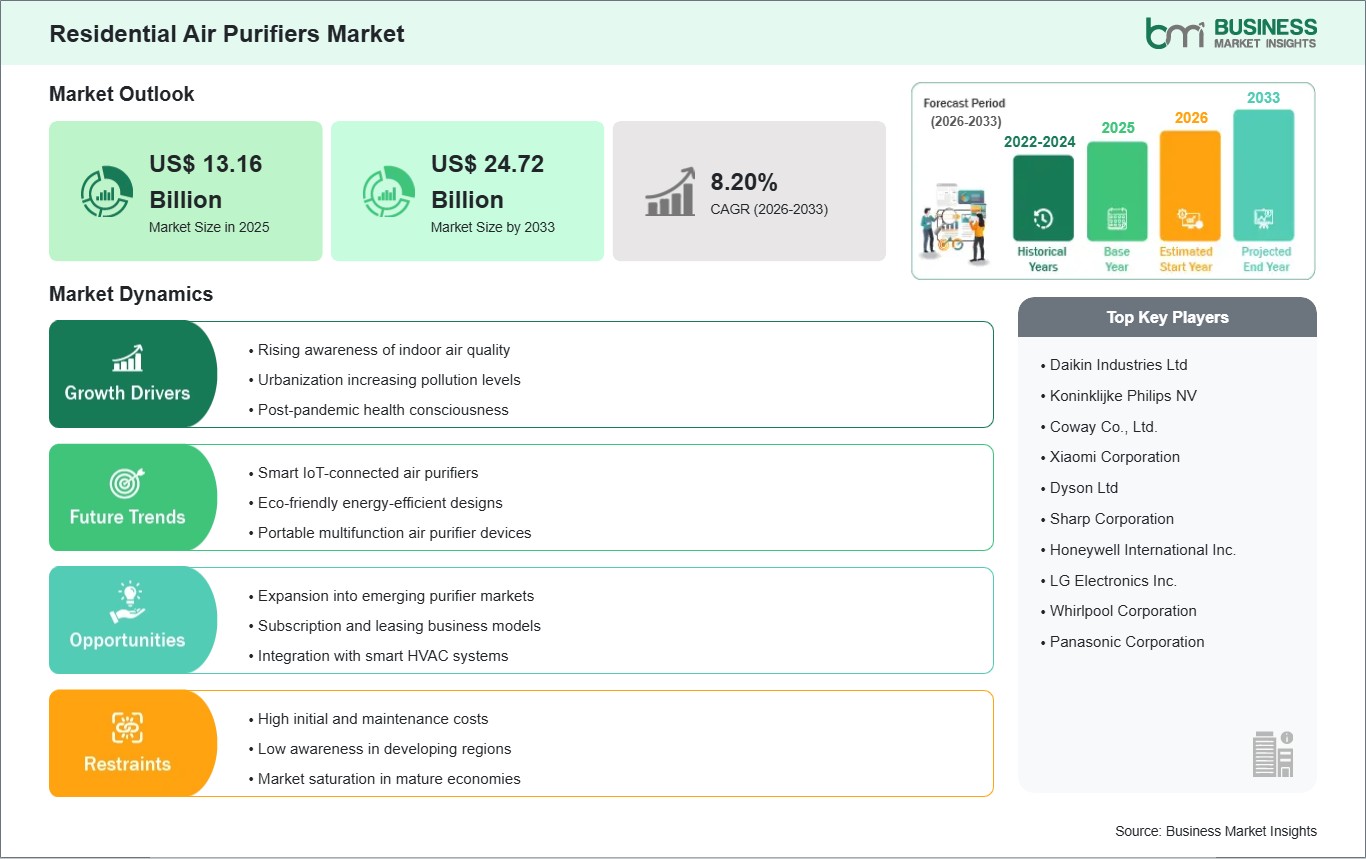
Residential air purifiers are standalone or integrated household appliances designed to remove airborne contaminants, including fine particulate matter, allergens, volatile organic compounds (VOCs), and pathogens, from indoor environments. These devices provide significant value by reducing health risks associated with declining urban air quality and elevated concentrations of indoor pollutants in modern, well-sealed residences. The expansion of the air purifier market is primarily driven by increasing urbanization, rising industrial emissions, changes in consumer behavior following the COVID-19 pandemic that emphasize indoor environmental safety, and a growing prevalence of respiratory conditions such as asthma and seasonal allergies. Additionally, the integration of IoT-enabled sensors and artificial intelligence-based automation enables these devices to operate as intelligent components within a broader home ecosystem, dynamically adjusting performance in response to real-time pollution levels.
However, several challenges can restrain market growth: high upfront acquisition costs and substantial recurring expenses for filter replacements can act as a barrier for middle-income households. Varying regional safety standards and the lack of universal performance certifications can lead to consumer confusion regarding actual filtration efficacy. Additionally, the industry faces constraints due to noise-level concerns during high-speed operation and the potential generation of ozone by-products in certain lower-end ionic models, which can deter health-conscious buyers.
Despite these hurdles, the market holds immense opportunities in the surge of smart city development and the rising demand for energy-efficient, eco-friendly filtration media. The expansion of subscription-based filter delivery models and the integration of dehumidification or humidification hybrids are expected to create significant opportunities for long-term market growth.
Segment Analysis
Residential Air Purifiers Market Segmentation
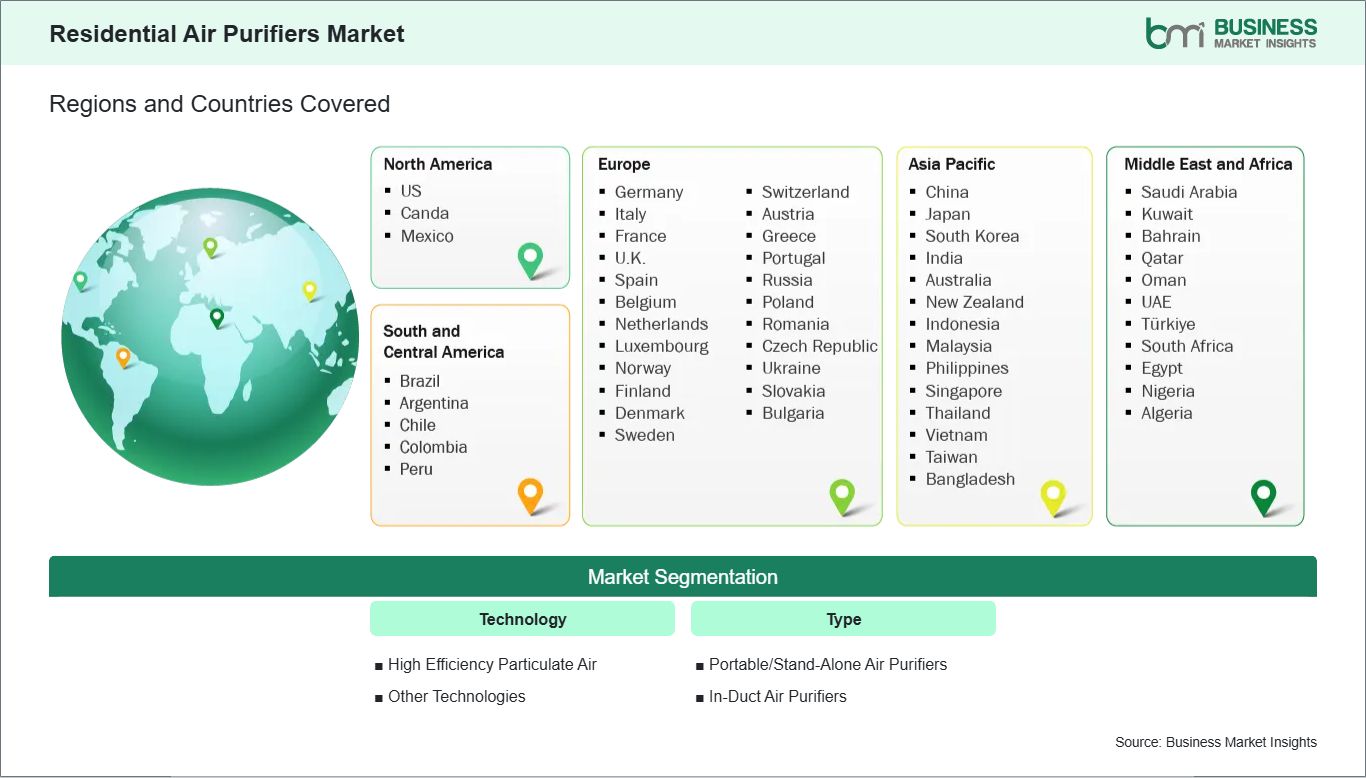
Key segments that contributed to the derivation of the Residential Air Purifiers market analysis are technology and type.
- By Technology, the market is segmented into High Efficiency Particulate Air (HEPA) and Other Technologies.
- By Type, the market is divided into Portable/Stand-Alone Air Purifiers and In-Duct Air Purifiers
Market Forces
Residential Air Purifiers Market Drivers and Opportunities
Advancing Health-First Living Spaces and Smart Atmospheric Control
The primary driver of the Residential Air Purifiers Market is the increasing global demand for health-resilient living environments, prompted by worsening urban air quality and a growing public emphasis on respiratory health. Currently, the market is undergoing a significant transition, with air purifiers now regarded as essential health equipment rather than luxury items. This shift is propelled by the rising incidence of seasonal smog, industrial emissions, and the accumulation of volatile organic compounds (VOCs) in modern, tightly sealed homes. In contrast to traditional filtration systems that primarily targeted dust, contemporary consumer preferences focus on high-efficiency particulate air (HEPA) systems designed to capture microscopic pathogens, allergens, and PM2.5 particles. The heightened awareness of airborne disease transmission following the pandemic has further increased demand, prompting widespread adoption of medical-grade filtration as a preventive health strategy. Additionally, the growing prevalence of asthma and chronic obstructive pulmonary disease (COPD) among aging populations in developed countries, combined with rapid urbanization in emerging markets such as India and China, is expected to sustain robust and accelerated growth in the residential air purifier sector.
AI-Native Smart Ecosystems and Sustainable Filter Innovations
A significant high-value opportunity lies in the convergence of Residential Air Purifiers with Artificial Intelligence (AI) and the Internet of Things (IoT). Next-generation AI-native purifiers are evolving from basic manual controls to fully autonomous nodes within smart home ecosystems. These devices utilize advanced sensors to detect pollution spikes and automatically adjust filtration speeds in real time. Another major growth area is the development of sustainable and energy-efficient filtration technologies. As environmental awareness increasingly influences consumer choices, manufacturers can benefit by shifting from virgin plastics to biodegradable or recycled materials and by introducing washable or long-life filters that lower recurring ownership costs. The trend toward multifunctional and aesthetically integrated home products also presents substantial potential. Purifiers that serve as high-end furniture, humidifiers, or localized cooling fans are in demand among urban residents with limited space. In addition to standalone units, the adoption of subscription-based filter replacement models provides manufacturers with predictable revenue streams and enhances user experience by addressing maintenance challenges. Companies that prioritize ultra-quiet, sleep-optimized designs and those advancing zero-ozone ionization technologies are likely to lead the most innovative and profitable segments of the residential air purifier market.
Residential Air Purifiers Market Size and Share Analysis
The Residential Air Purifiers market demonstrates steady growth, with size and share analysis revealing evolving trends and competitive positioning among key players. The report further examines subsegments categorized within technology and type, offering insights into their contribution to overall market performance.
Based on technology, the High Efficiency Particulate Air (HEPA) subsegment holds a substantial market share and is widely regarded as the industry standard for mechanical air filtration. HEPA technology is particularly vital in the residential sector due to its capacity to capture nearly all microscopic particles, such as pollen, pet dander, and dust mites, making it the preferred option for individuals with allergies or asthma. An emerging trend is the increasing adoption of alternative technologies, especially those utilizing UV-C light and activated carbon, which are attracting greater consumer interest as protection against volatile organic compounds (VOCs) and biological contaminants becomes a priority. These hybrid systems are increasingly important in urban households, offering effective solutions for neutralizing household odors and microscopic pathogens that conventional mechanical filters may not address.
Size and Share Analysis
Residential Air Purifiers Market Size and Share Analysis
The Residential Air Purifiers market demonstrates steady growth, with size and share analysis revealing evolving trends and competitive positioning among key players. The report further examines subsegments categorized within technology and type, offering insights into their contribution to overall market performance.
Based on technology, the High Efficiency Particulate Air (HEPA) subsegment holds a substantial market share and is widely regarded as the industry standard for mechanical air filtration. HEPA technology is particularly vital in the residential sector due to its capacity to capture nearly all microscopic particles, such as pollen, pet dander, and dust mites, making it the preferred option for individuals with allergies or asthma. An emerging trend is the increasing adoption of alternative technologies, especially those utilizing UV-C light and activated carbon, which are attracting greater consumer interest as protection against volatile organic compounds (VOCs) and biological contaminants becomes a priority. These hybrid systems are increasingly important in urban households, offering effective solutions for neutralizing household odors and microscopic pathogens that conventional mechanical filters may not address.
Report Coverage
Residential Air Purifiers Market Report Coverage and Deliverables
The "Residential Air Purifiers Market Size and Forecast (2022 - 2033)" report provides a detailed analysis of the market covering below areas:
- Residential Air Purifiers market size and forecast at global, regional, and country levels for all the key market segments covered under the scope
- Residential Air Purifiers market trends, as well as market dynamics such as drivers, restraints, and key opportunities
- Residential Air Purifiers market analysis covering key market trends, global and regional framework, major players, regulations, and recent market developments
- Industry landscape and competition analysis covering market concentration, heat map analysis, prominent players, and recent developments for the Residential Air Purifiers market
- Detailed company profiles, including SWOT analysis
Geographic Insights
Residential Air Purifiers Market Geographic Insights
The geographical scope of the Residential Air Purifiers market report is divided into five regions: North America, Asia Pacific, Europe, Middle East & Africa, and South & Central America.
North America continues to be a significant revenue contributor, driven by high adoption rates of premium, smart-connected devices and a strong emphasis on allergen and wildfire smoke mitigation. Europe demonstrates consistent growth, supported by stringent indoor air quality regulations and increased public awareness of the long-term health effects of fine particulate matter. The Asia-Pacific Residential Air Purifiers Market is divided into China, Japan, South Korea, India, Australia, and the Rest of Asia. This region serves as the primary driver of industry volume, especially in China and India, where declining air quality index (AQI) levels have shifted air purifiers from luxury products to essential household appliances. Japan and South Korea are regional leaders in technological advancement, focusing on integrated systems that combine humidification with medical-grade HEPA filtration.
Industry Activity
Recent Developments
The Residential Air Purifiers market is evaluated by gathering qualitative and quantitative data post primary and secondary research, which includes important corporate publications, association data, and databases. A few of the key developments in the Residential Air Purifiers market are:
- In Feb 2025, LG Electronics introduced the PuriCare AeroHit, a compact residential air purifier with 360-degree multi-layer filtration, real-time PM1.0 monitoring, and automatic air quality adjustment. Designed for home use, it provides cleaner air while blending seamlessly into living spaces, including a pet-friendly variant.
- In June 2024, IQAir launched its new XE series of smart air purifiers in North America, featuring Wi-Fi connectivity, real-time PM2.5 monitoring, and energy-efficient HyperHEPA filtration. Designed for residential use, these purifiers automatically adjust performance based on indoor air quality, enhancing home air safety and comfort.
Trust & Transparency
Research Methodology
The market analysis combines proprietary research with secondary data from government agencies, company disclosures, regulatory filings, industry databases and expert interviews. Market estimates are validated through data triangulation, cross-market benchmarking and analyst
review.
View Full Research Methodology
Key Sources Referred:
World Bank - Global Trade Indicators World Trade Organization (WTO) International Monetary Fund (IMF) International Trade Administration (ITA) Company Websites Company Annual Reports Company Investor Presentations