
Emission Monitoring System Market Outlook: Size, Share, Trends, Growth Analysis, Competitive Landscape & Forecast, 2026-2033

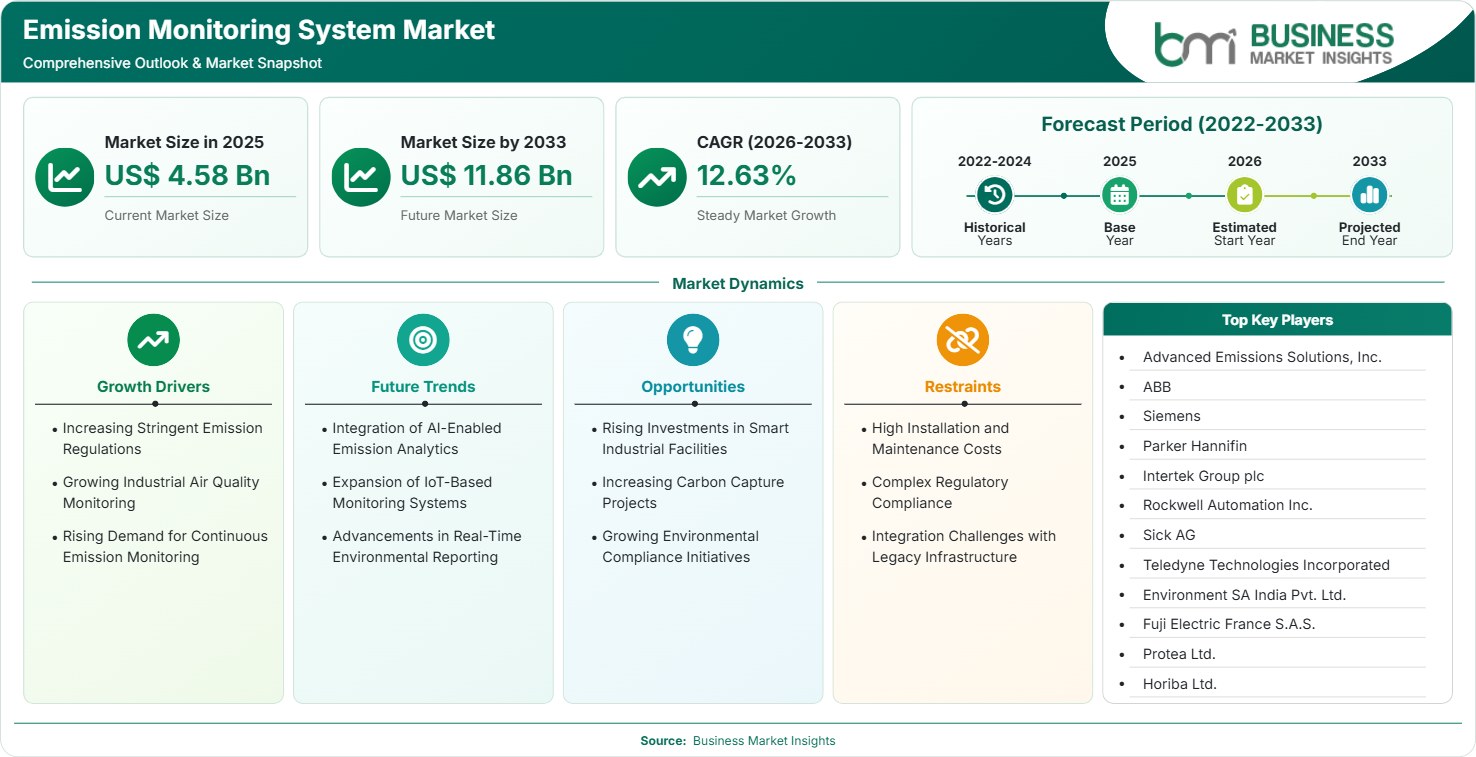
The Emission Monitoring System Market size was valued at US$ 4.58 Billion in 2025 and is projected to reach US$ 11.86 Billion by 2033, growing at a CAGR of 12.63% during 2026–2033, driven by stringent emission regulations, industrial decarbonization initiatives, smart monitoring adoption, and rising investments in environmental compliance technologies.

Report Coverage
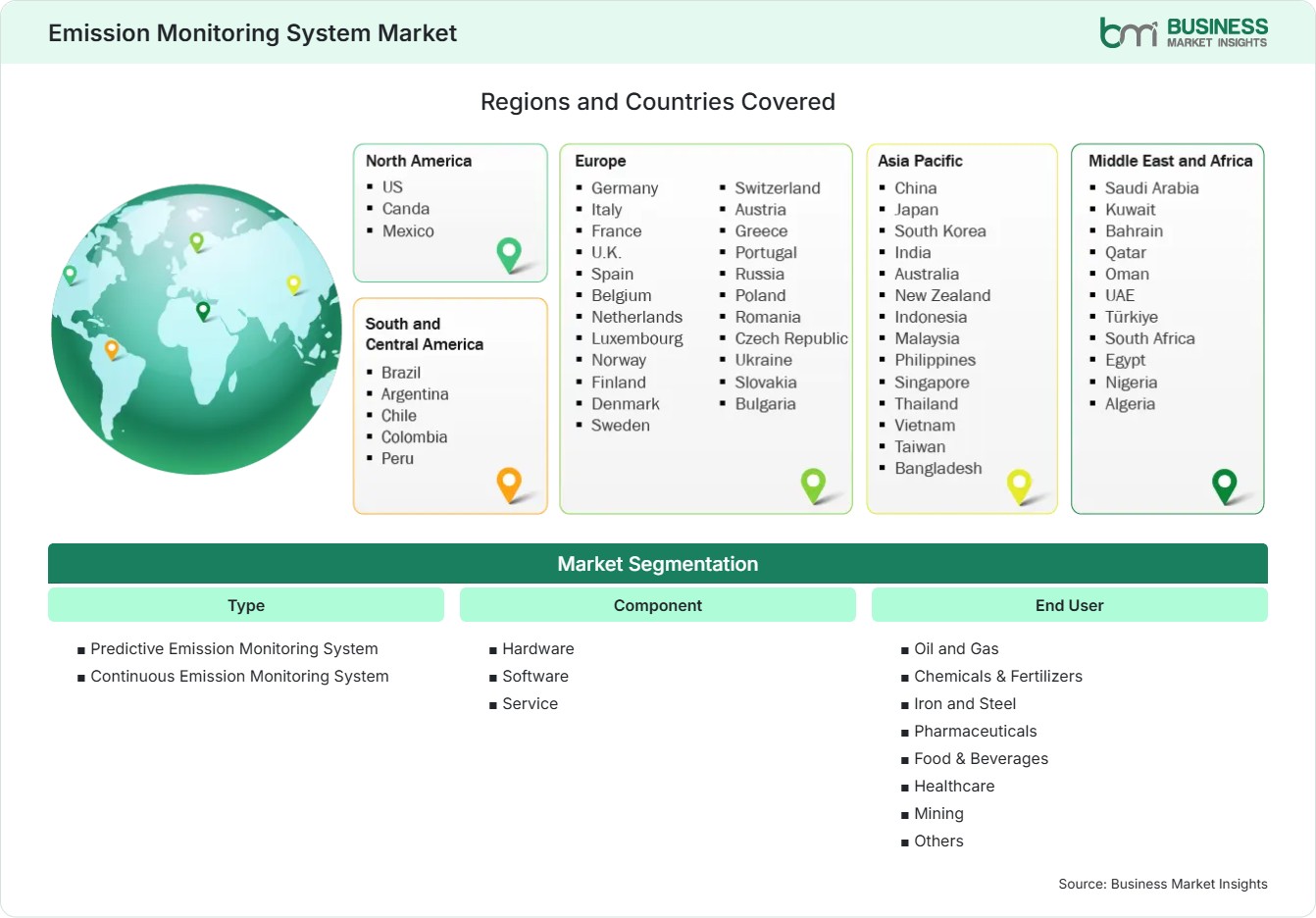
  • Type: Predictive Emission Monitoring System, Continuous Emission Monitoring System
  • Component: Hardware, Software, Service
  • End User: Oil and Gas, Chemicals & Fertilizers, Iron and Steel, Pharmaceuticals, Food & Beverages, Healthcare, Mining, Others
US$ 4.58 Bn Market size in 2025
US$ 11.86 Bn Market Size by 2033
12.63% CAGR, 2026 - 2033
2026-2033 Forecast Period

AI Overview

Emission Monitoring System Market Summary

  • North America Region: North America holds 32%–35% share in 2025, growing with a CAGR of 11.5%–12.5% during 2026–2033, supported by emission control mandates, industrial modernization, and environmental monitoring investments. The US market analysis indicates steady adoption with a CAGR of 11.8%–12.8% due to power sector compliance and advanced analytics integration.
  • Fastest Growing Region: Asia Pacific represents 28%–31% share in 2025, expanding with a CAGR of 14.0%–15.0% during 2026–2033, supported by industrial expansion, pollution control programs, infrastructure upgrades, smart manufacturing adoption, and increasing environmental monitoring requirements across developing economies.
  • Leading Segment: Continuous Emission Monitoring System Market holds 55%–58% share in 2025, growing with a CAGR of 12.0%–13.0% during 2026–2033, driven by regulatory compliance, real-time pollutant tracking, operational efficiency improvement, and increasing demand from energy-intensive industries.
  • High Growth Segment: Software component demonstrates 14.0%–15.0% CAGR during 2026–2033, supported by artificial intelligence analytics, cloud-based platforms, predictive maintenance capabilities, data visualization tools, and integration with industrial automation systems for improved emission management.
  • Key Market Opportunity: Growing adoption of digital industrial ecosystems creates opportunities for advanced monitoring platforms, AI-enabled emission forecasting, carbon management solutions, and integration with sustainability reporting frameworks across industrial sectors.
  • Major Market Players: Advanced Emissions Solutions, Inc.; ABB; Siemens; Parker Hannifin Corporation; Intertek Group plc; Rockwell Automation, Inc.; SICK AG; Teledyne Technologies Incorporated; Environment SA India Pvt. Ltd.; Fuji Electric France S.A.S.; Protea Ltd.; Horiba Ltd.; Opsis AB; Enviro’ & Industrial Solutions ME; NUKEM Technologies.
Strategic Insights

Emission Monitoring System Market: Strategic Insights

Emission Monitoring System Market Strategic Framework
FREE PDF
Request your free sample
Request free sample
Stakeholder View

Key Takeaways

  • Industrial compliance requirements are shifting the value chain toward integrated solutions combining sensors, analytical software, and service support, creating opportunities for technology providers and system integrators.
  • Power generation, oil and gas, and chemical industries remain major adoption areas, while emerging applications in pharmaceuticals, food processing, and healthcare facilities are expanding demand for advanced monitoring capabilities.
  • Artificial intelligence, cloud connectivity, and predictive analytics are transforming conventional monitoring platforms by enabling proactive emission management, automated reporting, and improved operational decision-making.
  • Asia Pacific provides strong investment potential due to industrial expansion, urban pollution concerns, and increasing environmental regulations across China, India, Japan, and Southeast Asian economies.
  • Strategic partnerships, acquisitions, and technology collaborations are increasing as established automation companies expand environmental monitoring portfolios and strengthen digital sustainability offerings.
  • Integration with carbon accounting platforms and sustainability reporting systems is becoming an important competitive differentiator for solution providers serving regulated industries.
Geographic Outlook

Emission Monitoring System Market Regional Highlights

North America Emission Monitoring System Market

North America accounted for 32%–35% share in 2025 and is projected to expand at a CAGR of 11.5%–12.5% during 2026–2033. The region benefits from strict environmental regulations, advanced industrial infrastructure, and widespread adoption of digital monitoring platforms. The Emission Monitoring System Market share remains strong due to demand from power generation, oil and gas, and manufacturing sectors. The United States and Canada are investing in automated compliance technologies, supporting continuous monitoring deployment and emission reduction initiatives across industrial facilities.

  • The United States maintains a leading position through stringent EPA regulations, modernization of industrial facilities, and increasing adoption of real-time emission tracking technologies for compliance management and operational optimization.
  • Canada is strengthening environmental monitoring capabilities through clean energy transition programs, industrial emission reduction targets, and increased deployment of advanced analytical solutions across resource-intensive industries.
  • The region is witnessing higher demand for software-enabled monitoring platforms integrating artificial intelligence, cloud analytics, and predictive maintenance functions to improve environmental performance.
  • Industrial operators are prioritizing automated reporting systems that reduce compliance risks, enhance transparency, and support sustainability objectives across regulated manufacturing and energy sectors.

US Emission Monitoring System Market

The US Emission Monitoring System market represented 25%–28% share within North America in 2025 and is expected to grow at a CAGR of 11.8%–12.8% during 2026–2033. Strong regulatory frameworks, including emission control requirements for industrial facilities, support adoption across utilities, chemicals, and manufacturing sectors. The country’s advanced industrial ecosystem encourages deployment of connected monitoring solutions.

  • Federal and state-level emission regulations encourage industries to upgrade monitoring infrastructure with continuous data collection and automated compliance reporting capabilities.
  • Industrial facilities are increasingly integrating emission monitoring solutions with distributed control systems to improve operational visibility and reduce environmental risks.
  • Demand for predictive analytics is increasing as companies seek early detection of emission variations and improved maintenance planning.
  • Expansion of renewable energy and low-carbon industrial projects is creating additional requirements for advanced environmental monitoring technologies.

Europe Emission Monitoring System Market

Europe held 27%–30% share in 2025 and is anticipated to register a CAGR of 11.0%–12.0% during 2026–2033. The region benefits from strict environmental policies, carbon reduction initiatives, and industrial sustainability programs. Germany, the United Kingdom, and France represent leading markets due to strong industrial bases and regulatory enforcement. The Emission Monitoring System Market growth is supported by decarbonization investments, digital transformation, and increasing demand for accurate emissions measurement across energy-intensive industries.

  • Germany is adopting advanced monitoring technologies across manufacturing and power sectors, supported by industrial automation leadership and sustainability-focused investments.
  • France is expanding emission monitoring adoption through environmental compliance initiatives, clean technology programs, and modernization of industrial facilities.
  • The United Kingdom is increasing deployment of monitoring systems due to carbon reduction commitments and stricter reporting requirements for industrial operators.
  • European manufacturers are integrating emission data platforms with sustainability management systems to improve transparency and regulatory alignment.

Asia Pacific Emission Monitoring System Market

Asia Pacific accounted for 28%–31% share in 2025 and is projected to achieve a CAGR of 14.0%–15.0% during 2026–2033, making it the fastest-growing regional market. Industrial expansion, urban pollution concerns, and government-led environmental initiatives are accelerating adoption. China, India, Japan, and South Korea are key contributors due to manufacturing growth and increasing regulatory focus.

  • China is expanding emission monitoring adoption through industrial pollution control programs, power sector upgrades, and stricter environmental compliance requirements.
  • India is increasing investments in industrial monitoring infrastructure due to growing manufacturing activities and stronger regulatory emphasis on emission reduction.
  • Japan and South Korea are adopting advanced systems through smart factory initiatives and technology-driven environmental management programs.
  • Southeast Asian economies are creating new opportunities through industrial development, infrastructure expansion, and increasing awareness of sustainable production practices.

Rest of World Emission Monitoring System Market

Rest of World accounted for 8%–11% share in 2025 and is expected to grow at a CAGR of 10.5%–11.5% during 2026–2033. South and Central America are experiencing increasing adoption due to mining, energy, and industrial expansion. Middle East and Africa markets are supported by oil and gas investments, environmental compliance requirements, and modernization of industrial facilities. The Emission Monitoring System Market share is gradually increasing as industries improve sustainability practices and regulatory reporting capabilities.

  • Brazil is adopting monitoring technologies across mining and energy sectors due to environmental protection initiatives and industrial compliance requirements.
  • Middle Eastern countries are investing in emission monitoring solutions for oil and gas facilities, supporting cleaner production and operational efficiency.
  • African markets are gradually increasing adoption through industrial development projects and environmental governance improvements.
  • Mining activities across emerging economies are encouraging deployment of monitoring systems to manage emissions and improve regulatory compliance.
  • Growing partnerships between technology providers and industrial operators are supporting implementation of advanced environmental monitoring infrastructure.
Global Market Geography
FREE PDF
Request your free sample
Request free sample
Segment Analysis

Emission Monitoring System Market Segmentation

Type

The Type segment demonstrates diverse adoption based on regulatory requirements and industrial monitoring needs. Continuous Emission Monitoring System accounted for 55%–58% share in 2025, while Predictive Emission Monitoring System is gaining traction through advanced analytics. The segment outlook remains positive as industries prioritize real-time measurement, forecasting capabilities, and compliance optimization. The Emission Monitoring System Market scope continues expanding through integration of digital technologies and automated environmental management platforms.

  • Predictive Emission Monitoring System: Uses analytical models and operational data to estimate emission levels, supporting proactive management, forecasting, and reduced dependence on conventional measurement processes.
  • Continuous Emission Monitoring System: Enables real-time pollutant tracking across industrial facilities, supporting regulatory compliance, operational control, and accurate environmental reporting requirements.

Component

The Component segment includes hardware, software, and service solutions supporting complete monitoring ecosystems. Hardware remains essential due to sensor and analyzer requirements, while software adoption is accelerating through data analytics and cloud integration. The Emission Monitoring System Market trends indicate increasing demand for integrated platforms combining equipment reliability with intelligent data processing capabilities.

  • Hardware: Includes sensors, analyzers, monitoring devices, and measurement equipment required for accurate pollutant detection across industrial applications.
  • Software: Provides analytics, reporting, visualization, and predictive capabilities that enhance emission management, compliance tracking, and operational decision-making.
  • Service: Covers installation, maintenance, calibration, technical support, and consulting solutions ensuring reliable system performance throughout operational lifecycles.

End User

The End User segment reflects adoption across industries with significant emission generation and regulatory obligations. Oil and gas and chemicals industries remain major users due to strict monitoring requirements. Mining, pharmaceuticals, food and beverages, and healthcare sectors are increasingly adopting monitoring technologies. The segment supports the Emission Monitoring System Market analysis through diverse industrial applications requiring accurate measurement, reporting, and sustainability improvements.

  • Oil and Gas: Requires advanced monitoring solutions for production facilities, refineries, and processing operations to manage emissions and regulatory compliance.
  • Chemicals & Fertilizers: Uses emission monitoring technologies to control industrial pollutants and improve environmental performance across manufacturing processes.
  • Iron and Steel: Adopts monitoring systems to track emissions from energy-intensive production operations and support sustainability objectives.
  • Pharmaceuticals: Implements monitoring solutions to maintain environmental standards and improve process transparency within regulated manufacturing facilities.
  • Food & Beverages: Utilizes emission monitoring technologies to support sustainable operations and compliance with environmental management requirements.
  • Healthcare: Deploys monitoring solutions in facilities requiring controlled emissions management and environmental safety practices.
  • Mining: Uses advanced monitoring systems to manage emissions from extraction and processing activities while meeting regulatory standards.
Market Forces

Emission Monitoring System Market Dynamics

Key Market Drivers

Increasing Stringent Emission Regulations

Strict environmental regulations are pushing companies to adopt sophisticated monitoring technologies that provide accurate measurements and compliance. Environmental regulators are implementing stricter emission standards in various industries such as power, manufacturing, and processing, resulting in high demand for automatic monitoring solutions. Factors that contribute to the growth of the market include the need for proper reporting tools in industries and lower environmental risks. The Emission Monitoring Systems Market Trends suggest increased use of monitoring systems within automation systems in industries.

Growing Industrial Air Quality Monitoring

Industrial growth in both developing and developed countries is driving the need for better air quality monitoring solutions. Industrial plants, chemical industries, and power generation companies are deploying state-of-the-art monitoring systems to analyze emissions and improve overall efficiency. Connected devices, cloud platforms, and analytics are enhancing environmental awareness in industrial settings. Growing workplace safety regulations and sustainability practices are adding to the decision-making process. Industries are increasingly relying on proactive emission management as opposed to reactive practices. This need for environmental assessment is expected to drive the demand for intelligent monitoring systems for a long time to come.

Rising Demand for Continuous Emission Monitoring

Continuous monitoring implementation is growing because of the need by various industries to monitor emissions on a real-time basis along with automatic reporting and effective operations management. Various regulatory agencies have become more focused on reliable and transparent emission data from industrial sites and this has led to the implementation of continuous monitoring of emissions systems. Power stations, refineries, and manufacturing facilities are making use of advanced analyzers and digitized systems to stay compliant. The Emission Monitoring Systems Market trends are indicating a preference towards systems which are hardware, software and analytical in nature.

Key Market Opportunities

Rising Investments in Smart Industrial Facilities

The development of smart facilities in the industrial sector presents opportunities for monitoring technologies that are combined with automation, artificial intelligence, and industrial internet of things technologies. Companies are making investments in connected systems to achieve greater efficiency and better environmental performance. Emission Monitoring System Market Forecasts show growing opportunities as industries integrate environmental compliance and digitalization initiatives. Integration with enterprise systems and remote monitoring systems will facilitate future demand by industrial companies.

Increasing Carbon Capture Projects

The growth in the implementation of carbon capture and storage programs is creating fresh prospects for monitoring technologies that will be needed to measure carbon emissions and validate reduction results. Companies that are developing projects focused on the reduction of carbon emissions need to have measurement systems that would allow them to measure their progress and show environmental improvements. Monitoring systems will become key components of the carbon management infrastructure, especially for energy, cement, chemical and heavy industries.

Growing Environmental Compliance Initiatives

With the increasing number of sustainability commitments by companies and governments’ initiatives towards improving environmental performance, industries need better monitoring capabilities. Companies are investing in new monitoring systems that can help them provide more accurate data about their emissions, assist in environmental audits, and satisfy the new regulations. The compliance process in developing countries creates additional demand for monitoring systems due to the development of industrial processes. There is an increase in investments in digital monitoring solutions, creating opportunities for solution providers offering scalable systems suitable for diverse industrial applications and regulatory environments.

Market Restraints and Challenges

High Installation and Maintenance Costs

Factor: High installation expenses associated with advanced sensors, analyzers, calibration equipment, and system integration increase initial investment requirements for industrial operators. Impact: High capital expenditure and maintenance cost can result in delayed implementation for smaller and medium-size plants that have low budgets for environmental technologies. The complexities involved in installation, frequent calibration needs, and technical assistance are some of the factors that lead to increased costs. Companies have developed a number of approaches in response to these problems, including modularity, remote diagnosis, and deployment services. However, the industries that have multiple emission points will continue to incur costs.

Complex Regulatory Compliance

Factor: Diverse emission standards, reporting requirements, and regulatory frameworks across regions increase complexity for companies implementing monitoring systems. Impact: Organizations must invest additional resources in compliance management, system customization, and technical expertise to meet varying environmental obligations. Different regulatory approaches across countries require adaptable monitoring solutions capable of supporting multiple reporting formats and measurement standards. Compliance complexity can increase implementation timelines and operational burdens, particularly for multinational companies managing facilities across different jurisdictions. Technology providers are developing flexible platforms with automated reporting features to help industries address regulatory challenges and improve compliance efficiency.

Company Analysis

Competitive Landscape

The Emission Monitoring System Market analysis highlights competition among automation providers, environmental technology specialists, and industrial solution companies offering advanced monitoring platforms. Companies are focusing on sensor innovation, software integration, regulatory compliance solutions, and service capabilities to strengthen their positions across industrial emission management applications.

Company Name

Overview

Products and Services relevant to this market

Advanced Emissions Solutions, Inc.

Advanced Emissions Solutions develops emission control technologies focused on reducing industrial pollutants and improving environmental performance.

Provides emission management technologies, environmental solutions, and monitoring-related services for industrial emission reduction applications.

ABB

ABB is a global automation and electrification technology company serving industrial sectors with digital solutions.

Offers emission monitoring systems, gas analyzers, automation platforms, and digital solutions for industrial environmental management.

Siemens

Siemens provides industrial automation and digital transformation solutions across energy, manufacturing, and infrastructure sectors.

Supplies continuous emission monitoring systems, environmental software, process instrumentation, and industrial data management solutions.

Parker Hannifin Corporation

Parker Hannifin develops motion and control technologies supporting industrial and environmental applications worldwide.

Provides analytical instrumentation, filtration technologies, monitoring components, and emission control solutions for industrial facilities.

Intertek Group plc

Intertek is a global testing, inspection, and certification provider supporting regulatory compliance requirements.

Offers emission testing, environmental verification, monitoring services, and compliance assessment solutions for industrial customers.

Rockwell Automation, Inc.

Rockwell Automation specializes in industrial automation, digitalization, and control systems for manufacturing industries.

Provides industrial automation platforms, data analytics solutions, and integration services supporting emission monitoring applications.

SICK AG

SICK develops sensor-based solutions for industrial automation, safety, and environmental monitoring applications.

Offers gas analyzers, particulate monitoring systems, emission measurement equipment, and process monitoring technologies.

Teledyne Technologies Incorporated

Teledyne provides advanced instrumentation and digital imaging technologies for industrial and scientific applications.

Supplies gas measurement instruments, environmental monitoring equipment, analytical systems, and emission detection technologies.

Environment SA India Pvt. Ltd.

Environment SA India specializes in environmental monitoring solutions for industrial and regulatory applications.

Provides air quality monitoring systems, emission analyzers, continuous monitoring solutions, and environmental measurement services.

Fuji Electric France S.A.S.

Fuji Electric France develops energy and measurement technologies supporting industrial efficiency and sustainability.

Offers gas analyzers, emission monitoring equipment, measurement instruments, and environmental monitoring solutions.

Protea Ltd.

Protea develops analytical instrumentation and monitoring technologies for industrial applications.

Provides emission monitoring analyzers, gas measurement systems, and environmental compliance solutions.

Horiba Ltd.

Horiba is a global provider of measurement and analytical technologies across industrial and environmental sectors.

Supplies emission monitoring instruments, gas analyzers, environmental measurement systems, and analytical solutions.

Opsis AB

Opsis AB specializes in optical emission monitoring and gas analysis technologies.

Provides optical monitoring systems, emission measurement solutions, and industrial gas analysis platforms.

Enviro’ & Industrial Solutions ME

Enviro’ & Industrial Solutions ME delivers environmental technology solutions for industrial customers.

Offers emission monitoring systems, environmental equipment, installation support, and compliance-focused services.

NUKEM Technologies

NUKEM Technologies provides engineering and environmental solutions for energy and industrial sectors.

Supports monitoring, measurement, and environmental management applications for industrial and energy facilities.

Trust & Transparency

Research Methodology

The market analysis combines proprietary research with secondary data from government agencies, company disclosures, regulatory filings, industry databases and expert interviews. Market estimates are validated through data triangulation, cross-market benchmarking and analyst review.

View Full Research Methodology

Questions Answered

Frequently Asked Questions

What factors influence the adoption of the Emission Monitoring System Market Report solutions?

The report solutions are influenced by industrial regulations, sustainability targets, automation investments, operational efficiency goals, and increasing demand for transparent environmental reporting.

Why is regulatory compliance important for emission monitoring adoption?

Regulatory compliance requires industries to maintain accurate emission records, demonstrate environmental responsibility, and avoid penalties associated with exceeding permitted pollutant levels.

What technologies are improving modern emission monitoring solutions?

Artificial intelligence, cloud platforms, advanced sensors, remote monitoring, and predictive analytics are improving measurement accuracy, reporting efficiency, and operational decision-making capabilities.

How do predictive emission monitoring systems differ from continuous systems?

Predictive systems estimate emissions using operational data and analytical models, while continuous systems directly measure pollutants in real time using sensors and analyzers installed at industrial facilities.

What industries primarily use emission monitoring systems market?

Emission monitoring systems are widely used in power generation, oil and gas, chemicals, fertilizers, iron and steel, pharmaceuticals, mining, and manufacturing industries requiring regulatory compliance and environmental performance tracking.

Access the Full Emission Monitoring System Market Report

Get segment-level forecasts, regional estimates, competitive benchmarking, company profiles and downloadable Excel datasets.

Access the full Emission Monitoring System Market Report
350 pages PDF & Excel | 2026-08-06