
Radiation Detection Monitoring and Safety Market Outlook: Size, Share, Trends, Growth Analysis, Competitive Landscape & Forecast, 2026-2033

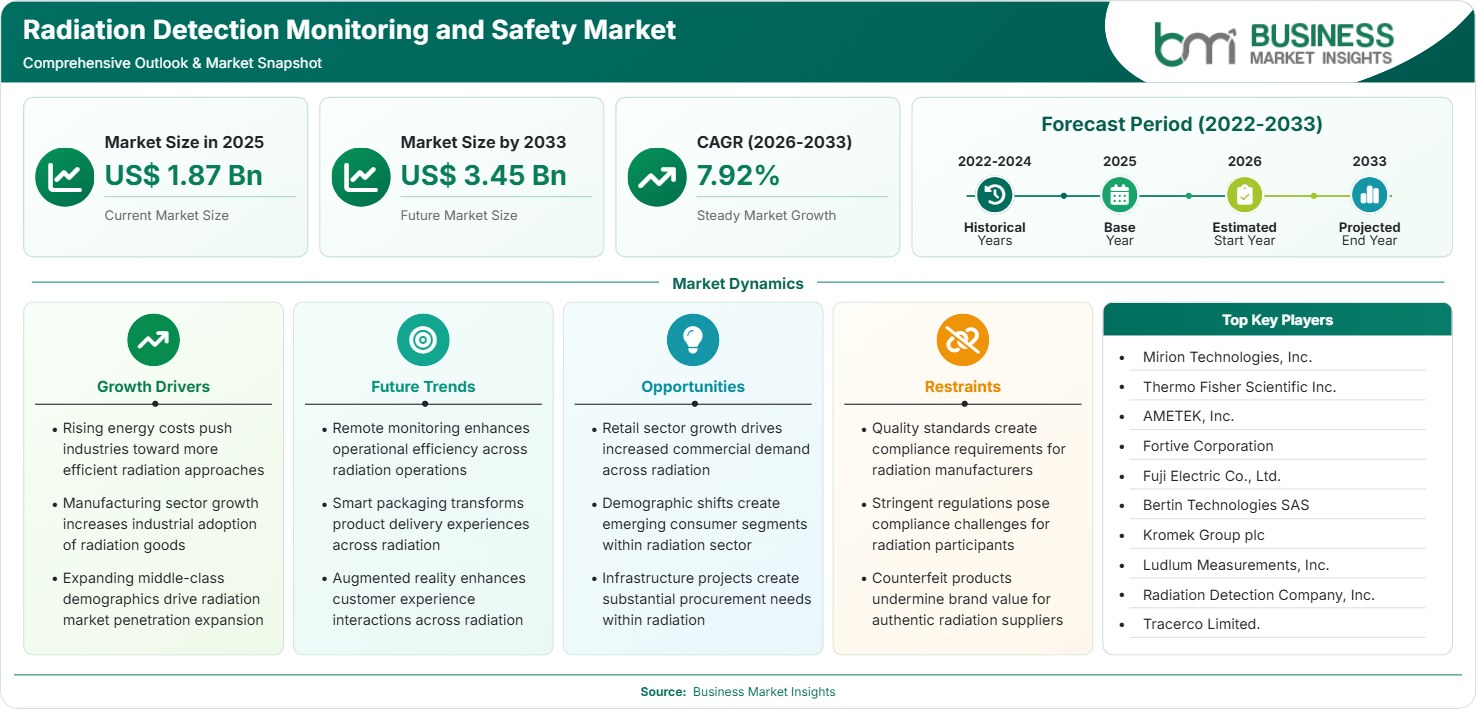
The Radiation Detection Monitoring and Safety Market size was valued at US$ 1.87 Billion in 2025 and is projected to reach US$ 3.45 Billion by 2033, growing at a CAGR of 7.92% during 2026–2033. Key drivers include nuclear safety investments, expanding medical imaging procedures, defense modernization, and stricter radiation monitoring regulations, while opportunities arise from digital dosimetry, AI-enabled analytics, and emerging nuclear energy programs.

Report Coverage
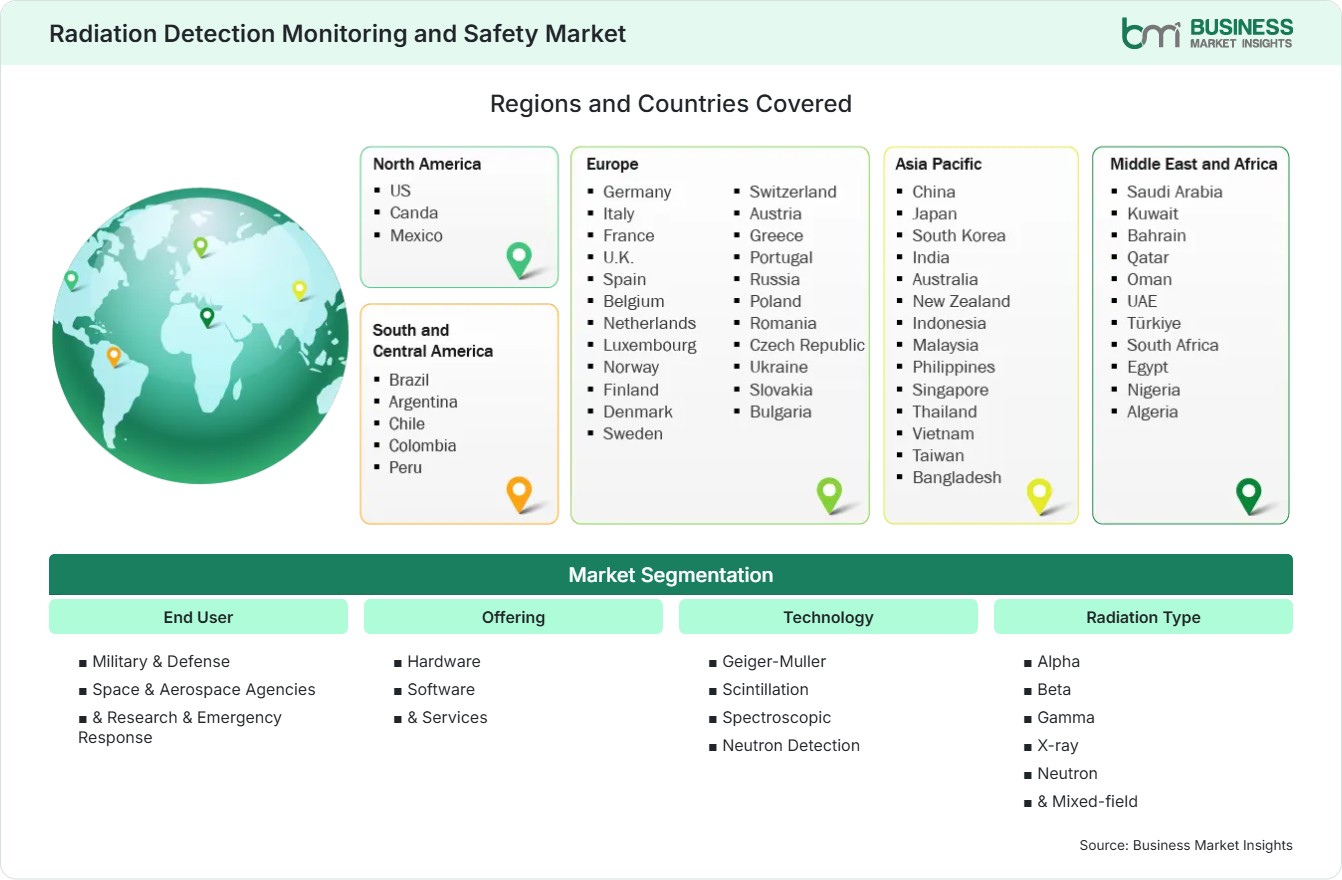
  • End User: Military & Defense, Space & Aerospace Agencies, & Research & Emergency Response
  • Offering: Hardware, Software, & Services
  • Technology: Geiger-Muller, Scintillation, Spectroscopic, Neutron Detection
  • Radiation Type: Alpha, Beta, Gamma, X-ray, Neutron, & Mixed-field
  • Product Type: Personal Radiation Detectors & Dosimeters, Handheld Survey & Identification Instruments, Area & Environmental Radiation Monitors, Portal & Fixed Radiation Monitoring Systems
US$ 1.87 Bn Market size in 2025
US$ 3.45 Bn Market Size by 2033
7.92% CAGR, 2026 - 2033
2026-2033 Forecast Period

AI Overview

Radiation Detection Monitoring and Safety Market Summary

  • North America Region: North America holds a Radiation Detection Monitoring and Safety market share of 38%–41% in 2025, growing at a CAGR of 7.1%–7.6% during 2026–2033, supported by defense spending, nuclear fleet modernization, healthcare radiation compliance, and border security monitoring investments. US market remains dominant, driven by nuclear infrastructure upgrades and medical radiation safety programs, advancing at 7.2%–7.7% CAGR.
  • Fastest Growing Region: Asia Pacific holds 24%–27% share in 2025 and expands at 9.0%–9.6% CAGR, supported by nuclear energy expansion, industrial safety requirements, healthcare diagnostics growth, technology localization initiatives, emergency preparedness programs, and smart monitoring deployments.
  • Leading Segment: Hardware accounts for 58%–61% of the Radiation Detection Monitoring and Safety market share in 2025 and advances at 7.4%–7.9% CAGR, driven by detector replacement cycles, infrastructure modernization, portable instrumentation demand, regulatory compliance requirements, facility upgrades, and security-related procurement.
  • High Growth Segment: Software represents 11%–14% share in 2025 and grows at 9.4%–10.0% CAGR, supported by cloud integration, remote monitoring, predictive analytics, digital compliance management, centralized radiation intelligence platforms, and cybersecurity-enhanced operational visibility.
  • Key Market Opportunity: Expansion of small modular reactor projects, cross-border radiological surveillance networks, connected dosimetry ecosystems, and AI-assisted threat identification creates substantial opportunities for solution providers targeting public safety and infrastructure resilience.
  • Major Market Players: Mirion Technologies, Inc.; Thermo Fisher Scientific Inc.; AMETEK, Inc.; Fortive Corporation; Fuji Electric Co., Ltd.; Bertin Technologies SAS; Kromek Group plc; Ludlum Measurements, Inc.; Radiation Detection Company, Inc.; Tracerco Limited.
Strategic Insights

Radiation Detection Monitoring and Safety Market: Strategic Insights

Radiation Detection Monitoring and Safety Market Strategic Framework
FREE PDF
Request your free sample
Request free sample
Stakeholder View

Key Takeaways

  • The value chain increasingly combines detector manufacturing, software intelligence, calibration services, and long-term compliance management, creating recurring revenue opportunities beyond equipment sales.
  • Software-driven monitoring platforms and integrated radiation management ecosystems present the highest upside due to growing demand for centralized oversight and automated compliance reporting.
  • Product innovation is moving toward spectroscopic identification, AI-assisted threat classification, cloud-connected dosimetry, and portable multi-radiation detection platforms.
  • Asia Pacific offers the strongest investment potential as nuclear energy expansion, healthcare infrastructure upgrades, and industrial monitoring requirements accelerate procurement activity.
  • Strategic acquisitions continue focusing on detector technologies, analytics capabilities, and service networks, enabling vendors to broaden portfolios and improve geographic reach.
  • Environmental surveillance and emergency response preparedness are becoming increasingly important procurement priorities following heightened attention to critical infrastructure resilience.
Geographic Outlook

Radiation Detection Monitoring and Safety Market Regional Highlights

North America Radiation Detection Monitoring and Safety Market

North America accounted for 38%-41% of the Radiation Detection Monitoring and Safety Market share in 2025 and is anticipated to grow at a CAGR of 7.1%-7.6% during the forecast period through 2033. This region possesses vast nuclear power infrastructure, ongoing efforts to modernize defense and homeland security programs, and strict regulations on radiation use in healthcare facilities. Agencies of the federal government, utility companies, laboratories, and emergency organizations are constantly upgrading their legacy systems to connected monitoring systems.

  • Homeland security programs continue investing in fixed and mobile detection networks for ports, borders, transportation hubs, and critical infrastructure protection.
  • Nuclear plant life-extension projects generate demand for continuous monitoring, contamination surveillance, and workforce radiation management solutions.
  • Healthcare organizations increasingly implement connected dosimetry programs to strengthen workforce protection and regulatory compliance.
  • Research laboratories emphasize high-sensitivity neutron and spectroscopic technologies supporting scientific and defense-related activities.

US Radiation Detection Monitoring and Safety Market

The United States accounted for around 77%-80% of the North American market in 2025 and is expected to grow at a 7.2%-7.7% CAGR during the forecast period. Government funding, modernization of nuclear facilities, the use of advanced medical imaging technologies, and the military sector's detection needs ensure continued purchases. In addition, the presence of technology providers enables the faster commercialization of innovative monitoring and detection solutions.

  • Departmental security initiatives support demand for portal monitoring and radiological threat detection systems.
  • Large healthcare networks continue transitioning toward digital exposure tracking and centralized compliance management.
  • National laboratories remain important adopters of neutron detection, spectroscopy, and advanced identification technologies.
  • Industrial users increasingly deploy networked monitoring systems for real-time environmental and facility oversight.

Europe Radiation Detection Monitoring and Safety Market

Europe accounted for 27%–30% market share in 2025 and is expected to grow at a CAGR of 7.3%–7.8% between 2023 and 2033. Stringent regulations, decommissioning processes, medical imaging needs, and environmental monitoring initiatives drive demand in the region. France has the largest market, driven by its nuclear power industry, whereas Poland shows promising growth due to planned nuclear infrastructure development.

  • France leads regional demand supported by nuclear infrastructure and extensive radiological monitoring requirements.
  • Germany sustains demand through industrial safety, research applications, and environmental surveillance programs.
  • Poland records high-growth potential as future nuclear projects strengthen long-term procurement opportunities.
  • Border security modernization supports adoption of identification instruments and portal monitoring technologies.
  • Digital compliance solutions gain momentum among healthcare and government institutions.

Asia Pacific Radiation Detection Monitoring and Safety Market

The Asia Pacific region holds a share of 24%-27% in 2025 and is also the region with the highest growth rate, at a CAGR of 9.0%-9.6%. Increasing nuclear power generation capacity, growing healthcare diagnostics, industrialization, and government preparedness initiatives are driving adoption. China holds the leading position in revenue contribution, while India is showing strong growth in healthcare development and nuclear investments.

  • China leads adoption through extensive nuclear infrastructure, industrial monitoring, and public safety investments.
  • India records robust expansion supported by healthcare modernization and growing radiation safety awareness.
  • Japan continues replacing and upgrading monitoring systems across critical facilities and research institutions.
  • Growing semiconductor and advanced manufacturing sectors support demand for precise radiation measurement technologies.
  • Emergency preparedness initiatives encourage procurement of portable and networked detection systems.

Rest of World Radiation Detection Monitoring and Safety Market

Rest of World has captured an 8% -11% share and is projected to witness 8.0%-8.5% CAGR during 2033. The Middle East is investing in nuclear and infrastructure, whereas South and Central America focus more on healthcare and industrial monitoring systems. The procurement process will continue to be project-based but holds long-term potential. UAE countries are among the top investors in the region, whereas Brazil is considered to be the growth country in South America because of its healthcare and industrial safety initiatives.

  • UAE investments in nuclear infrastructure support demand for advanced monitoring and safety ecosystems.
  • Saudi Arabia continues evaluating nuclear energy pathways, creating future equipment deployment opportunities.
  • Brazil remains a major regional healthcare and industrial monitoring market.
  • Mining and resource sectors contribute to adoption of environmental radiation surveillance technologies.
  • Government preparedness programs encourage procurement among emergency response organizations.
Global Market Geography
FREE PDF
Request your free sample
Request free sample
Segment Analysis

Radiation Detection Monitoring and Safety Market Segmentation

End User

This segment accounted for approximately 29%–32% share in 2025 and is forecast to advance at 8.1%–8.6% CAGR. Radiation Detection Monitoring and Safety Market scope continues expanding across defense, aerospace, research, and emergency response institutions due to heightened security awareness, scientific investments, and radiological preparedness requirements.

  • Military & Defense: Procurement focuses on battlefield awareness, border security, critical infrastructure monitoring, and radiological threat detection, encouraging adoption of portable and fixed monitoring systems.
  • Space & Aerospace Agencies: Deep-space missions, radiation shielding studies, and astronaut exposure monitoring continue driving demand for specialized detection instruments.
  • Research & Emergency Response: Universities, laboratories, and public safety agencies increasingly deploy advanced identification systems supporting rapid incident assessment and environmental monitoring.

Offering

This section accounted for 100% market reach, with hardware continuing to dominate while software grew at the highest rate. The factors contributing to growth include digitalization, lifecycle services, and compliance-based solutions.

  • Hardware: Includes detectors, monitors, dosimeters, and identification instruments deployed across nuclear, healthcare, industrial, and defense environments.
  • Software: Supports centralized monitoring, analytics, incident management, exposure tracking, and regulatory reporting through connected platforms.
  • Services: Calibration, maintenance, training, consulting, and compliance support remain essential for long-term operational performance.

Technology

Technology adoption reflects evolving requirements for higher sensitivity, accuracy, and identification capabilities. Integration of intelligent analytics and portable form factors continues influencing procurement decisions.

  • Geiger-Muller: Widely utilized for general radiation surveying and cost-effective monitoring across industrial and environmental applications.
  • Scintillation: Preferred for sensitivity, rapid response, and gamma detection performance in security and healthcare environments.
  • Spectroscopic: Increasingly adopted for isotope identification, threat assessment, and advanced analytical applications.
  • Neutron Detection: Critical for security, nuclear power, defense, and specialized scientific research applications.

Radiation Type

Demand patterns vary according to application complexity, regulatory requirements, and environmental monitoring objectives across end-user industries.

  • Alpha: Important for contamination monitoring within nuclear facilities and environmental assessments.
  • Beta: Frequently monitored in industrial processes, laboratories, and decommissioning activities.
  • Gamma: Represents a major application area due to healthcare, security, and nuclear power requirements.
  • X-ray: Linked closely to medical imaging, industrial inspection, and occupational exposure management.
  • Neutron: Essential for reactor environments, border security, and scientific instrumentation.
  • Mixed-field: Supports complex operational environments requiring simultaneous multi-radiation monitoring capabilities.

Product Type

The product category holds 58%–61% of the Radiation Detection Monitoring and Safety Market trends through hardware-intensive deployments and is forecast at 7.4%–7.9% CAGR as monitoring infrastructure modernizes globally.

  • Personal Radiation Detectors & Dosimeters: Increasing workplace safety compliance drives widespread deployment among healthcare, nuclear, and defense personnel.
  • Handheld Survey & Identification Instruments: Portable systems enable rapid field assessment, emergency response, and radiological threat identification.
  • Area & Environmental Radiation Monitors: Continuous monitoring supports facility oversight, environmental surveillance, and regulatory compliance programs.
  • Portal & Fixed Radiation Monitoring Systems: Widely implemented across borders, ports, transportation facilities, and critical infrastructure locations.
Market Forces

Radiation Detection Monitoring and Safety Market Dynamics

Key Market Drivers

Expansion of Nuclear Energy Infrastructure and Safety Programs

The growing deployment of nuclear energy facilities and reactor life-extension projects continues to increase demand for radiation monitoring systems worldwide. According to reports from the International Atomic Energy Agency (IAEA), many nations are investing in expanding nuclear energy capacity to achieve their objectives related to energy security and carbon emissions. The initiatives for new reactor installations in the Asia-Pacific and Middle East regions, coupled with refurbishments in North America and Europe, are driving the uptake of new detection products. The need to maintain regulatory compliance and protect the workforce has led to the increasing adoption of real-time monitoring and surveillance systems and handheld radiation meters.

Rising Medical Imaging and Radiopharmaceutical Utilization

Healthcare remains a significant catalyst for market expansion as diagnostic imaging procedures and cancer treatment interventions become more common globally. According to the World Health Organization, medical imaging is of great importance in diagnosis and treatment planning, while the increased use of PET, CT, fluoroscopy, and radiation therapy makes constant dose monitoring and management indispensable. Healthcare facilities are focusing on developing digital dosimetry systems, area-monitoring technologies, and compliance systems to enhance safety measures. The rising number of radiology departments, the increase in interventional procedures, and the use of radiopharmaceuticals have resulted in a growing demand for sophisticated radiation measurement technologies in healthcare facilities globally.

Growing National Security and Border Protection Requirements

National security agencies continue to strengthen their capabilities to detect the illicit movement of radioactive materials through ports, border crossings, airports, and transportation corridors. More funding is being made available to develop radiation detection technologies to protect critical infrastructure. This is achieved through portal monitors, portable isotope identifiers, neutron detectors, and other monitoring systems that provide situational awareness and support emergency preparedness. Modernization of the armed forces and other defense initiatives are also prompting military personnel to purchase portable radiation detection technologies in situations involving potential threats. The need for radiation detection technologies has been reinforced by the overlap between homeland security objectives, emergency response preparations, and critical asset protection.

Key Market Opportunities

AI-Enabled Radiation Intelligence and Predictive Monitoring

Radiation Detection Monitoring and Safety Market forecasts indicate the integration of artificial intelligence offers significant growth opportunities for solution providers seeking to improve detector performance and decision-making processes. Analytics systems will be able to analyze large volumes of radiation-related data, increase anomaly-detection accuracy, reduce false alarms, and generate automated reports. Centralized monitoring platforms that provide meaningful insights from dispersed sources have become increasingly popular among utilities, healthcare institutions, and government authorities. With the rise of digital transformation programs, vendors offering machine learning-powered threat assessments, predictive maintenance capabilities, and cloud-based monitoring dashboards are expected to secure longer-term contracts. Radon Detection, Monitoring, and Safety Market Forecasts indicate that software-driven business models will become more popular.

Small Modular Reactor Development and New Nuclear Projects

There are many opportunities associated with the commercialization of small modular reactors and next-generation nuclear technology for the manufacturers and service providers of such equipment. The emerging designs of such reactors demand the development of sophisticated monitoring systems capable of enabling highly automated operation. When governments and power companies invest in such technologies, they will require environmental monitoring systems, containment monitoring systems, neutron detection systems, and workforce protection systems throughout the entire lifecycle of their projects. Apart from the requirements of the construction phase, there are also long-term needs associated with monitoring operations that can become a source of recurring revenue.

Expansion of Connected Environmental Monitoring Networks

Increasing focus on environmental stewardship and emergency planning is driving the widespread adoption of continuously operating radiation monitoring networks. National governments demand quick access to data and remote monitoring to build robust public safety systems. Sensor systems that are connected offer visibility into cities, industrial plants, transport lines, and critical infrastructure assets. There is an increased likelihood of success in deploying monitoring in a smart-city environment and within the context of public safety digital infrastructure. Furthermore, industrial companies and research centers are developing more comprehensive environmental monitoring solutions due to increasing regulatory expectations.

Market Restraints and Challenges

High Capital Costs and Lengthy Procurement Cycles

Factor: Advanced radiation detection systems often require significant upfront investment, specialized installation procedures, calibration infrastructure, and ongoing maintenance support. High-performance spectroscopic instruments, portal monitoring systems, and integrated software platforms can represent substantial capital expenditures for utilities, government agencies, and industrial operators.

Impact: Budget constraints frequently delay procurement decisions and limit adoption among smaller organizations. Complex public-sector tendering processes can extend sales cycles and create project execution uncertainty for vendors. The challenge becomes particularly pronounced in developing markets, where competing infrastructure priorities may restrict investment in advanced radiation safety technologies despite growing operational requirements and regulatory expectations.

Regulatory Complexity and Skilled Workforce Constraints

Factor: Radiation monitoring deployments must comply with strict regulatory requirements that vary across jurisdictions, operating environments, and end-user applications. Organizations often require specialized personnel capable of managing calibration, data interpretation, compliance reporting, and system maintenance activities.

Impact: Workforce shortages and regulatory complexity can increase implementation timelines and operational costs. End users may face difficulties integrating new technologies into existing safety frameworks, particularly when advanced software and connected monitoring platforms are involved. These constraints can slow technology adoption rates, limit system utilization efficiency, and create barriers for organizations lacking dedicated radiation protection expertise, ultimately affecting broader market penetration across certain regions and application segments.

Company Analysis

Competitive Landscape

Radiation Detection Monitoring and Safety Market analysis highlights competition centered on detector performance, software integration, service capabilities, regulatory expertise, and global deployment reach.

Company Name

Overview

Products and Services relevant to this market

Mirion Technologies, Inc.

Global provider serving nuclear, medical, defense, and research sectors with broad radiation management capabilities.

Dosimeters, contamination monitors, spectroscopy tools, area monitoring systems, software platforms, calibration services.

Thermo Fisher Scientific Inc.

Diversified scientific technology company with strong radiation detection and measurement portfolio.

Personal dosimetry, portal monitors, isotope identifiers, environmental monitoring and analytical solutions.

AMETEK, Inc.

Industrial technology company supplying precision monitoring and measurement systems.

Radiation monitors, detection instrumentation, environmental surveillance technologies, industrial solutions.

Fortive Corporation

Technology group serving safety and operational performance applications worldwide.

Detection systems, compliance tools, industrial monitoring, measurement solutions.

Fuji Electric Co., Ltd.

Major industrial manufacturer with expertise in nuclear instrumentation and monitoring.

Radiation monitoring systems, plant safety instrumentation, environmental surveillance equipment.

Bertin Technologies SAS

Specialist provider focused on defense, security, and environmental technologies.

Detection instruments, mobile monitoring systems, emergency response solutions.

Kromek Group plc

Advanced detection technology company recognized for spectroscopic capabilities.

Radiation detectors, isotope identifiers, security screening technologies.

Ludlum Measurements, Inc.

Established manufacturer with broad product portfolio for radiation measurement applications.

Survey meters, contamination monitors, dosimeters, fixed radiation monitoring systems.

Radiation Detection Company, Inc.

Specialized provider of occupational radiation monitoring services.

Dosimetry programs, digital monitoring, exposure tracking and compliance services.

Tracerco Limited

Industrial-focused radiation technology company serving inspection and safety applications.

Personal dosimeters, radiation survey devices, industrial monitoring services.

Trust & Transparency

Research Methodology

The market analysis combines proprietary research with secondary data from government agencies, company disclosures, regulatory filings, industry databases and expert interviews. Market estimates are validated through data triangulation, cross-market benchmarking and analyst review.

View Full Research Methodology

Questions Answered

Frequently Asked Questions

What can buyers expect from a Radiation Detection Monitoring and Safety Market Report?

A comprehensive study typically covers market sizing, technology trends, competitive positioning, regional demand patterns, regulatory influences, investment opportunities, and forecast developments.

Which region offers the strongest long-term growth potential?

Asia Pacific presents the most compelling long-term opportunity due to nuclear energy investments, healthcare expansion, industrial growth, and increasing safety regulations.

How are software platforms changing the industry?

Software enables centralized monitoring, automated compliance reporting, predictive maintenance, exposure management, and integration of geographically distributed detection assets.

Which technology category is gaining the strongest momentum?

Spectroscopic and intelligent detection technologies are gaining traction because they enable isotope identification, faster response times, and improved threat assessment capabilities.

What is driving adoption of radiation monitoring technologies beyond nuclear facilities?

Growing use in healthcare, border security, industrial inspection, research laboratories, and environmental surveillance is expanding deployment beyond traditional nuclear applications.

Access the Full Radiation Detection Monitoring and Safety Market Report

Get segment-level forecasts, regional estimates, competitive benchmarking, company profiles and downloadable Excel datasets.

Access the full Radiation Detection Monitoring and Safety Market Report
350 pages PDF & Excel | 2026-08-31