
Wireless Charging Market Outlook: Size, Share, Trends, Growth Analysis, Competitive Landscape & Forecast, 2026-2033

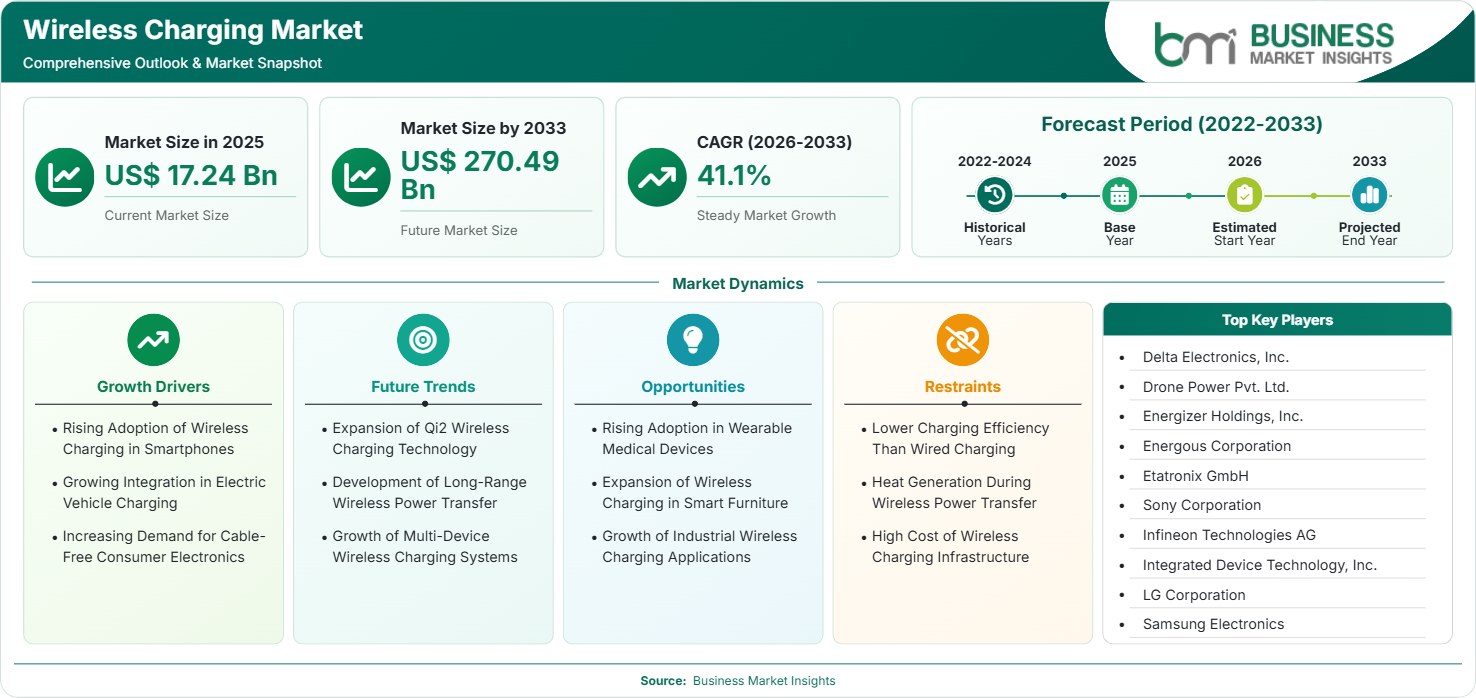
The Wireless Charging Market size was valued at USD 17.24 Billion in 2025 and is projected to reach USD 270.49 Billion by 2033, growing at a CAGR of 41.1% during 2026–2033. Growth is driven by increasing adoption of wireless power solutions in consumer electronics, rising demand for convenient charging technologies, expanding deployment of electric vehicles, growing investments in smart infrastructure, and advancements in high-efficiency charging technologies.

Report Coverage
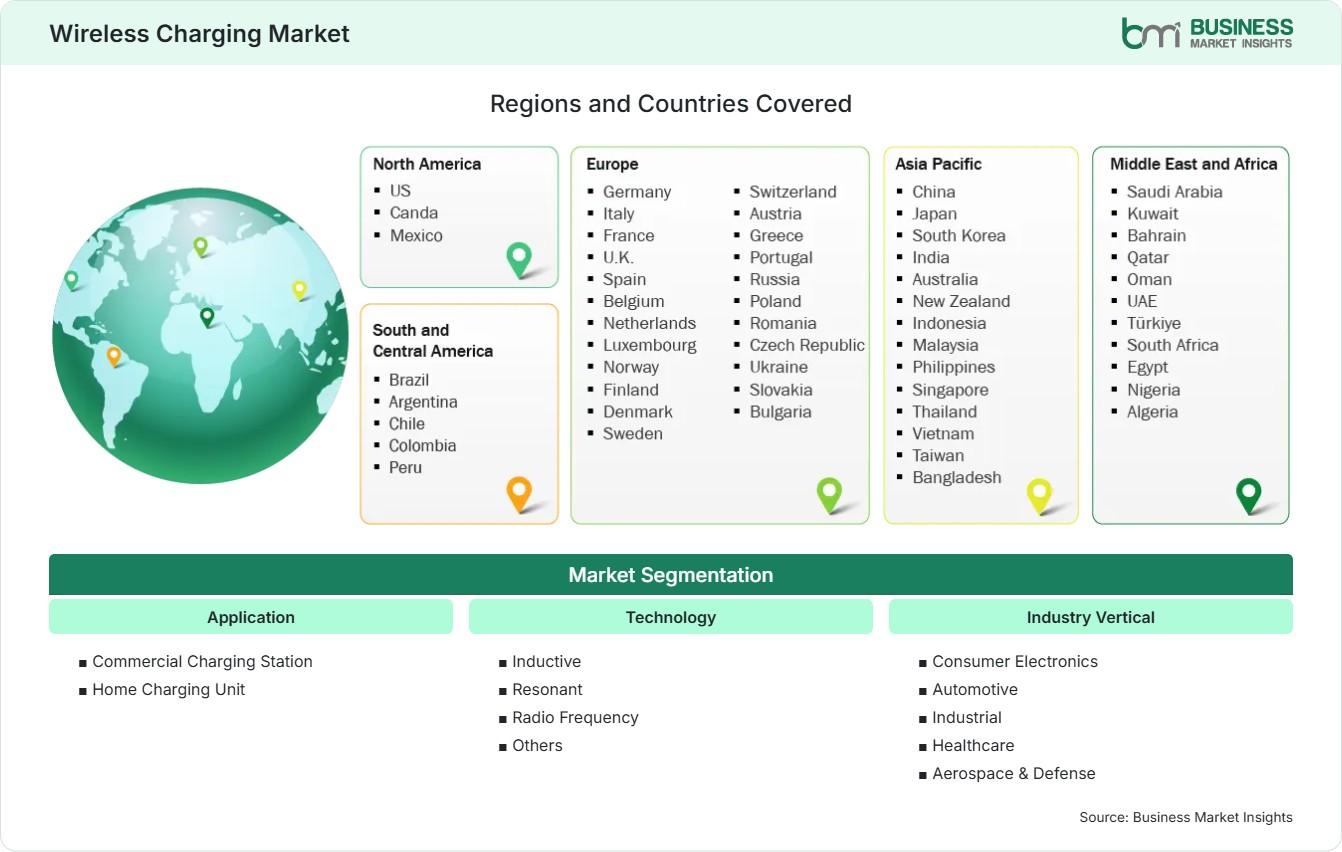
  • Application: Commercial Charging Station, Home Charging Unit
  • Technology: Inductive, Resonant, Radio Frequency, Others
  • Industry Vertical: Consumer Electronics, Automotive, Industrial, Healthcare, Aerospace & Defense
US$ 17.24 Bn Market size in 2025
US$ 270.49 Bn Market Size by 2033
41.1% CAGR, 2026 - 2033
2026-2033 Forecast Period

AI Overview

Wireless Charging Market Summary

  • North America Region: North America holds a market share of 31%–34% in 2025, growing at a CAGR of 39.5%–40.3% during 2026–2033. Demand is supported by strong consumer electronics adoption, increasing investments in charging infrastructure, and rising deployment of connected devices. The U.S. remains the dominant market, advancing at a CAGR of 39.8%–40.6%.
  • Fastest Growing Region: Asia Pacific accounts for 36%–39% of revenue in 2025 and is projected to register a CAGR of 42.8%–43.6% through 2033. Expanding smartphone penetration, growing electric vehicle production, and rapid technological innovation continue supporting market development.
  • Leading Segment: Inductive Technology holds a market share of 56%–60% in 2025 and is expected to grow at a CAGR of 40.8%–41.6%. Demand is driven by widespread adoption in smartphones, wearables, and consumer electronics devices.
  • High Growth Segment: Automotive Industry Vertical accounts for 21%–25% of market revenue in 2025 and is projected to register a CAGR of 44.0%–44.8% during the forecast period. Increasing deployment of wireless charging for electric vehicles and in-cabin charging systems continues supporting expansion.
  • Key Market Opportunity: Growing adoption of electric mobility, smart consumer devices, and next-generation wireless power transmission technologies is creating significant opportunities for market participants.
  • Major Market Players: Delta Electronics, Inc., Drone Power Pvt. Ltd., Energizer Holdings, Inc., Energous Corporation, Etatronix GmbH, Sony Corporation, Infineon Technologies AG, Integrated Device Technology, Inc., LG Corporation, and Samsung Electronics.
Strategic Insights

Wireless Charging Market: Strategic Insights

Wireless Charging Market Strategic Framework
FREE PDF
Request your free sample
Request free sample
Stakeholder View

Key Takeaways

  • The market ecosystem includes component manufacturers, charging technology providers, consumer electronics companies, automotive manufacturers, infrastructure developers, and end users across multiple industries.
  • Inductive charging remains the dominant technology due to its proven reliability, established standards, and widespread integration across smartphones, wearables, and consumer electronic products.
  • Market participants are increasingly investing in higher-power charging solutions, improved energy transfer efficiency, and enhanced interoperability across device ecosystems.
  • Asia Pacific offers the strongest growth opportunities due to large-scale electronics manufacturing, strong electric vehicle adoption, and increasing demand for advanced charging technologies.
  • Automotive applications are emerging as a major long-term growth area as manufacturers integrate wireless charging into electric vehicle platforms and in-vehicle consumer electronics systems.
  • Advancements in resonant charging, radio-frequency charging, and smart charging infrastructure are expected to expand application areas and create new revenue opportunities throughout the forecast period.
Geographic Outlook

Wireless Charging Market Regional Highlights

North America Wireless Charging Market

North America accounted for 31%–34% of global revenue in 2025 and is projected to expand at a CAGR of 39.5%–40.3% through 2033. Growth is supported by high adoption of premium consumer electronics, increasing deployment of smart devices, and rising investments in wireless charging infrastructure. The Wireless Charging Market share in the region continues benefiting from strong technological innovation and growing integration of wireless charging solutions across automotive and commercial applications.

  • Consumer electronics manufacturers are increasingly integrating wireless charging capabilities into smartphones, wearables, laptops, and other connected devices.
  • Growing adoption of smart homes and IoT-enabled products is accelerating demand for convenient cable-free charging solutions across residential environments.
  • Automotive manufacturers are expanding the availability of wireless charging pads and advanced charging systems in passenger vehicles and electric mobility platforms.
  • Commercial locations such as airports, hotels, restaurants, offices, and retail centers are increasingly deploying public wireless charging stations to enhance customer experience.
  • Ongoing investments in next-generation charging technologies continue improving charging speed, efficiency, and interoperability across multiple device categories.

US Wireless Charging Market

The United States represented 26%–29% of global revenue in 2025 and is anticipated to register a CAGR of 39.8%–40.6% during the forecast period. Demand is driven by rapid adoption of premium electronics, increasing electric vehicle penetration, and strong investment in emerging charging technologies. Continued innovation across consumer and enterprise applications supports Wireless Charging Market growth.

  • Technology companies continue investing heavily in advanced wireless power transfer systems and ecosystem expansion.
  • Consumer demand for seamless charging experiences is supporting growth across smartphones, tablets, earbuds, and wearable devices.
  • Electric vehicle manufacturers are increasingly exploring wireless charging solutions to improve convenience and user experience.
  • Growing enterprise digitization and connected workplace environments continue increasing demand for wireless charging infrastructure.

Europe Wireless Charging Market

Europe accounted for 24%–27% of global revenue in 2025 and is projected to grow at a CAGR of 40.0%–40.8% in Wireless Charging Market forecasts. Rising adoption of smart consumer devices, increasing electric vehicle deployment, and growing investments in energy-efficient technologies continue supporting market expansion. Germany remains the leading market with a CAGR of 40.1%–40.9%, while the United Kingdom is the fastest-growing country, expanding at a CAGR of 41.0%–41.8%.

  • Growth in electric mobility initiatives continues, encouraging the adoption of wireless charging technologies across transportation applications.
  • Consumer preference for premium electronics and connected devices remains a major demand driver.
  • Germany maintains leadership through strong automotive manufacturing capabilities and advanced technology adoption.
  • The United Kingdom is witnessing increasing deployment of smart infrastructure projects incorporating wireless charging capabilities.
  • Sustainability initiatives and energy efficiency objectives continue supporting investments in innovative charging technologies.

Asia Pacific Wireless Charging Market

Asia Pacific accounted for 36%–39% of global revenue in 2025 and is expected to remain the fastest-growing region, registering a CAGR of 42.8%–43.6% through 2033. Expanding electronics manufacturing, rising smartphone penetration, increasing electric vehicle production, and rapid digitalization continue driving market growth. China remains the largest regional market with a CAGR of 42.5%–43.3%, while India records the highest growth at 43.4%–44.2%.

  • Large-scale consumer electronics production continues creating strong demand for integrated wireless charging components and technologies.
  • China benefits from a robust electronics supply chain, expanding electric vehicle market, and significant technology investments.
  • India is witnessing rapid adoption of smartphones, wearable devices, and wireless charging-enabled consumer products across urban markets.
  • Manufacturers are increasingly incorporating wireless charging into premium and mid-range electronic devices to meet evolving consumer expectations.
  • Growing smart city initiatives, connected infrastructure projects, and next-generation mobility solutions continue creating substantial opportunities throughout the region.

Rest of World Wireless Charging Market

The Rest of World region accounted for 6%–9% of global revenue in 2025 and is expected to register a CAGR of 39.2%–40.0% through 2033. Market growth is supported by increasing adoption of connected devices, expanding electronics consumption, and rising awareness regarding convenient charging technologies. Demand remains particularly strong across consumer electronics and emerging smart mobility applications.

Brazil is the leading market in South & Central America and is forecast to grow at a CAGR of 39.5%–40.3%. In the Middle East & Africa, the United Arab Emirates is expected to be the fastest-growing country with a CAGR of 40.0%–40.8%.

  • Brazil continues benefiting from increasing smartphone adoption and expanding consumer electronics sales.
  • The United Arab Emirates is witnessing rising implementation of smart infrastructure and advanced digital technologies.
  • Retail and commercial establishments are increasingly deploying wireless charging stations to enhance customer convenience.
  • Growing investments in technology modernization continue supporting adoption across residential and commercial settings.
  • Expanding awareness regarding next-generation charging solutions is creating long-term market opportunities across emerging economies.
Global Market Geography
FREE PDF
Request your free sample
Request free sample
Segment Analysis

Wireless Charging Market Segmentation

Application

Application demand continues expanding as wireless charging technologies become increasingly integrated into residential, commercial, and public environments. Home Charging Units account for the largest market share due to widespread adoption of smartphones, wearables, tablets, and other consumer electronics requiring convenient charging solutions. The Wireless Charging Market scope continues broadening as users increasingly seek cable-free and clutter-free charging experiences across daily applications.

  • Commercial Charging Station: Benefits from increasing deployment across airports, hotels, restaurants, offices, retail centers, healthcare facilities, and public infrastructure projects.
  • Home Charging Unit: Leads adoption due to growing ownership of wireless charging-enabled consumer devices and increasing demand for convenient charging solutions in residential environments.

Technology

Technology innovation remains a critical factor shaping market competitiveness and adoption. Inductive Technology leads the segment with 56%–60% share in 2025 and is projected to grow at a CAGR of 40.8%–41.6% through 2033. Wireless Charging Market trends indicate growing investment in improving charging efficiency, transmission distance, and multi-device charging capabilities.

  • Inductive: Dominates the market due to established standards, widespread compatibility, reliability, and large-scale integration within consumer electronics.
  • Resonant: Supports greater flexibility and charging distance, making it attractive for automotive and industrial applications.
  • Radio Frequency: Gains interest for low-power charging applications involving connected devices and IoT ecosystems.
  • Others: Include emerging wireless power transfer technologies designed for specialized and next-generation applications.

Industry Vertical

Industry-specific adoption continues accelerating as wireless charging expands beyond consumer electronics into transportation, healthcare, and industrial environments. Automotive accounts for 21%–25% market share in 2025 and is projected to register the fastest growth at a CAGR of 44.0%–44.8% through 2033.

  • Consumer Electronics: Represents the largest revenue contributor due to widespread deployment in smartphones, tablets, smartwatches, earbuds, and portable devices.
  • Automotive: Benefits from growing wireless charging integration in electric vehicles and in-cabin consumer device charging systems.
  • Industrial: Increasingly utilizes wireless charging for automation equipment, sensors, robotics, and connected devices.
  • Healthcare: Supports cable-free charging of medical monitors, wearable devices, and portable healthcare equipment.
  • Aerospace & Defense: Adopts wireless charging technologies for mission-critical electronics and specialized communication systems.
Market Forces

Wireless Charging Market Dynamics

Key Market Drivers

Rising Adoption of Wireless Charging in Smartphones

The growing penetration of premium smartphones equipped with wireless charging capabilities continues driving market expansion. Leading consumer electronics manufacturers are increasingly integrating wireless charging technology as a standard feature across flagship and mid-range devices. Consumers are showing strong preference for convenient and simplified charging experiences that eliminate dependence on cables and connectors. The increasing popularity of smartphones, earbuds, smartwatches, and connected accessories is further strengthening demand. As device ecosystems continue expanding, wireless charging adoption is expected to remain a major contributor to long-term market growth.

Growing Integration in Electric Vehicle Charging

The automotive industry is increasingly exploring wireless charging solutions to improve convenience and user experience for electric vehicle owners. Wireless charging systems eliminate the need for physical connectors and support automated charging processes. Automakers, infrastructure providers, and technology companies are investing in advanced charging technologies designed to improve efficiency and operational reliability. Growing electric vehicle adoption worldwide continues creating favorable conditions for wireless charging deployment. As charging infrastructure evolves, the automotive application segment is expected to generate significant market opportunities.

Increasing Demand for Cable-Free Consumer Electronics

Consumers increasingly prefer minimalist and connected device ecosystems that reduce cable management challenges and improve convenience. Wireless charging aligns with this trend by enabling easy power transfer across a variety of electronic devices. Manufacturers are integrating charging functionality into furniture, accessories, and public infrastructure to enhance user experiences. Growing adoption of connected lifestyles and smart devices continues supporting demand for cable-free charging technologies. These developments remain important drivers for market expansion globally.

Key Market Opportunities

Rising Adoption in Wearable Medical Devices

Healthcare providers and medical device manufacturers are increasingly adopting wireless charging technologies for wearable monitoring systems, portable diagnostic equipment, and patient care devices. Wireless charging helps improve hygiene, reduce cable-related limitations, and enhance device reliability in healthcare environments. As healthcare facilities accelerate digital transformation initiatives, demand for efficient and convenient charging solutions is increasing. Growing utilization of remote patient monitoring and connected healthcare technologies is further strengthening this opportunity. Continued innovation in wearable medical electronics is expected to support additional demand for wireless charging solutions over the forecast period.

Expansion of Wireless Charging in Smart Furniture

Manufacturers of smart furniture are increasingly integrating wireless charging functionality into desks, tables, bedside units, seating systems, and commercial furniture products. Consumers are seeking convenience-oriented home and workplace environments where devices can be charged seamlessly without additional accessories. Smart furniture technology is being used by hotels, airports, offices, schools, and other public places to enhance the user experience. There is increasing importance of connected life and smart infrastructure construction, which keeps fueling this opportunity. The growing adoption of smart furniture will speed up the adoption of wireless charging capability.

Growth of Industrial Wireless Charging Applications

Industrial environments are increasingly utilizing wireless charging technologies to support automation systems, robotics, autonomous vehicles, sensors, and industrial IoT devices. Wireless charging reduces maintenance requirements, minimizes connector wear, and improves operational flexibility in demanding environments. The rise in adoption of smart manufacturing and Industry 4.0 is fostering the use of new power transmission systems. Businesses are adopting automated systems that need an uninterrupted supply of energy. There will be significant opportunities for wireless charging device manufacturers in the future.

Market Restraints and Challenges

Lower Charging Efficiency Than Wired Charging

Factor: Wireless charging systems typically experience energy losses during power transmission, resulting in lower efficiency levels compared with conventional wired charging solutions.

Impact: Inefficiency may increase charging time and energy use in some cases. These performance inefficiencies may discourage users who prefer fast charging and optimal energy use from using the technology. There have been efforts by tech companies to improve efficiency.

Heat Generation During Wireless Power Transfer

Factor: Power transfer through wireless charging systems can generate heat due to energy conversion processes, alignment issues, and extended charging periods.

Impact: Heat generation can affect how effectively charging is done and can have a bearing on the battery’s life cycle. This means that manufacturers need to invest adequately in order to reduce heat generation by the battery.

Company Analysis

Competitive Landscape

The market remains highly competitive, with semiconductor manufacturers, wireless power technology providers, consumer electronics companies, charging infrastructure developers, and industrial solution providers. Companies are focusing on improving charging efficiency, extending the range of wireless power transmission, developing high-power charging technologies, and expanding applications across the automotive, industrial, and healthcare sectors. Growing adoption of connected devices and smart mobility solutions continues shaping Wireless Charging Market analysis and competitive strategies across the global wireless power ecosystem.

Company Name

Overview

Products and Services Relevant to this Market

Delta Electronics, Inc.

Power and energy management solutions provider serving industrial and consumer markets.

Wireless charging systems, power management solutions, charging infrastructure.

Drone Power Pvt. Ltd.

Technology company focused on wireless power transfer and charging innovations.

Wireless power solutions, charging modules, energy transfer technologies.

Energizer Holdings, Inc.

Consumer products company with a broad portfolio of charging and power solutions.

Wireless chargers, portable charging devices, power accessories.

Energous Corporation

Wireless power technology company specializing in over-the-air charging solutions.

Wireless charging platforms, RF-based charging technologies, power transfer systems.

Etatronix GmbH

Engineering company focused on wireless energy transmission technologies.

Wireless charging systems, industrial charging solutions, power electronics.

Sony Corporation

Global electronics manufacturer integrating advanced charging technologies into consumer devices.

Wireless charging-enabled devices, consumer electronics, charging solutions.

Infineon Technologies AG

Semiconductor company supporting wireless power applications through advanced chip technologies.

Power semiconductors, wireless charging ICs, energy management components.

Integrated Device Technology, Inc.

Semiconductor and wireless power technology provider.

Wireless charging chipsets, power management solutions, charging controllers.

LG Corporation

Global electronics company serving consumer and commercial markets.

Wireless charging devices, smartphones, consumer electronics solutions.

Samsung Electronics

Leading consumer electronics manufacturer with broad wireless charging adoption.

Smartphones, wearables, wireless charging accessories, consumer devices.

Industry Activity

Recent Developments

April 2026

Astronics Corporation announced that it debuted its EmPower® Qi2 Wireless Charging Module, a 25W aircraft cabin power solution featuring MagSafe compatibility for precise passenger and crew device alignment.

March 2026

Autolane and Hevo announced that they have partnered to integrate wireless vehicle charging into autonomous fleet operations, removing the last remaining manual steps for autonomous commerce and logistics hubs.

December 2025

Infineon Technologies AG announced that it will supply customized silicon carbide (SiC) power modules to Electreon for its dynamic wireless in-road charging technology, enabling electric vehicles to charge inductively while in motion.

September 2025

Porsche AG announced that it will introduce an 11 kW wireless charging system featuring a one-box base plate, making it the first car manufacturer to bring this inductive vehicle charging technology to market maturity.

Trust & Transparency

Research Methodology

The market analysis combines proprietary research with secondary data from government agencies, company disclosures, regulatory filings, industry databases and expert interviews. Market estimates are validated through data triangulation, cross-market benchmarking and analyst review.

View Full Research Methodology

Questions Answered

Frequently Asked Questions

What challenge has the greatest long-term impact on the industry?

Lower charging efficiency compared with wired charging remains a major challenge because energy losses can affect charging speed, performance, and user preferences in certain applications.

How is the automotive industry influencing the Wireless Charging growth?

The Wireless Charging Market report highlights that automotive manufacturers are increasingly integrating wireless charging systems into vehicles and exploring wireless electric vehicle charging technologies, creating substantial long-term growth opportunities.

Why is Asia Pacific the fastest-growing region?

The region benefits from strong electronics manufacturing capabilities, increasing smartphone penetration, growing electric vehicle production, and significant investments in advanced technologies.

Which technology segment leads the market?

Inductive technology leads the market due to its reliability, established standards, broad compatibility, and extensive deployment across consumer electronic devices.

What is driving growth in the Wireless Charging Market?

Rising adoption of wireless charging in smartphones, growing integration in electric vehicle charging systems, increasing demand for cable-free consumer electronics, and continuous technological advancements are the primary growth drivers.

Access the Full Wireless Charging Market Report

Get segment-level forecasts, regional estimates, competitive benchmarking, company profiles and downloadable Excel datasets.

Access the full Wireless Charging Market Report
350 pages PDF & Excel | 2026-08-04