
Electric Vehicle (EV) Charging Stations Market Outlook: Size, Share, Trends, Growth Analysis, Competitive Landscape & Forecast, 2026–2033

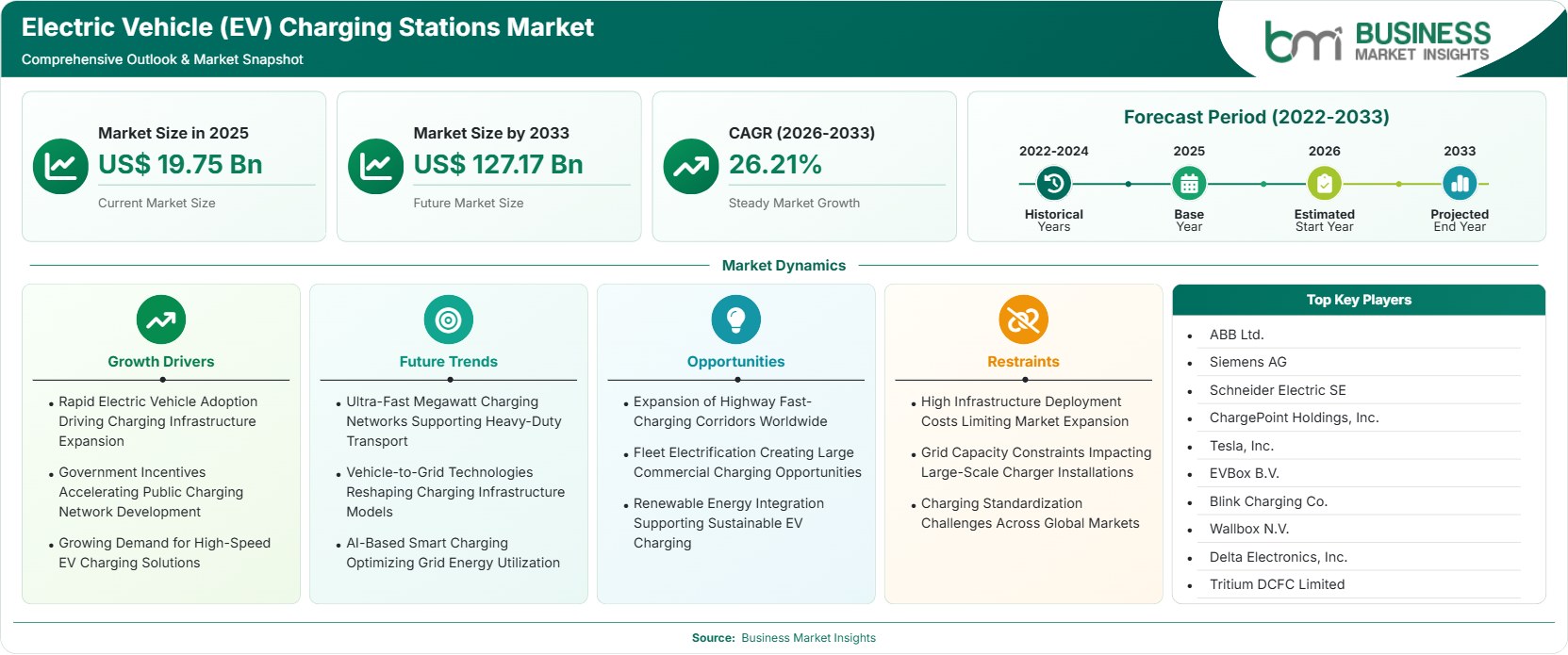
The Electric Vehicle (EV) Charging Stations Market size was valued at US$ 19.75 Billion in 2025 and is projected to reach US$ 127.17 Billion by 2033, growing at a CAGR of 26.21% during 2026–2033. Rapid electric vehicle adoption, supportive government policies, expanding fast-charging infrastructure, and increasing investments in smart energy networks are accelerating market growth across developed and emerging economies.

Report Coverage
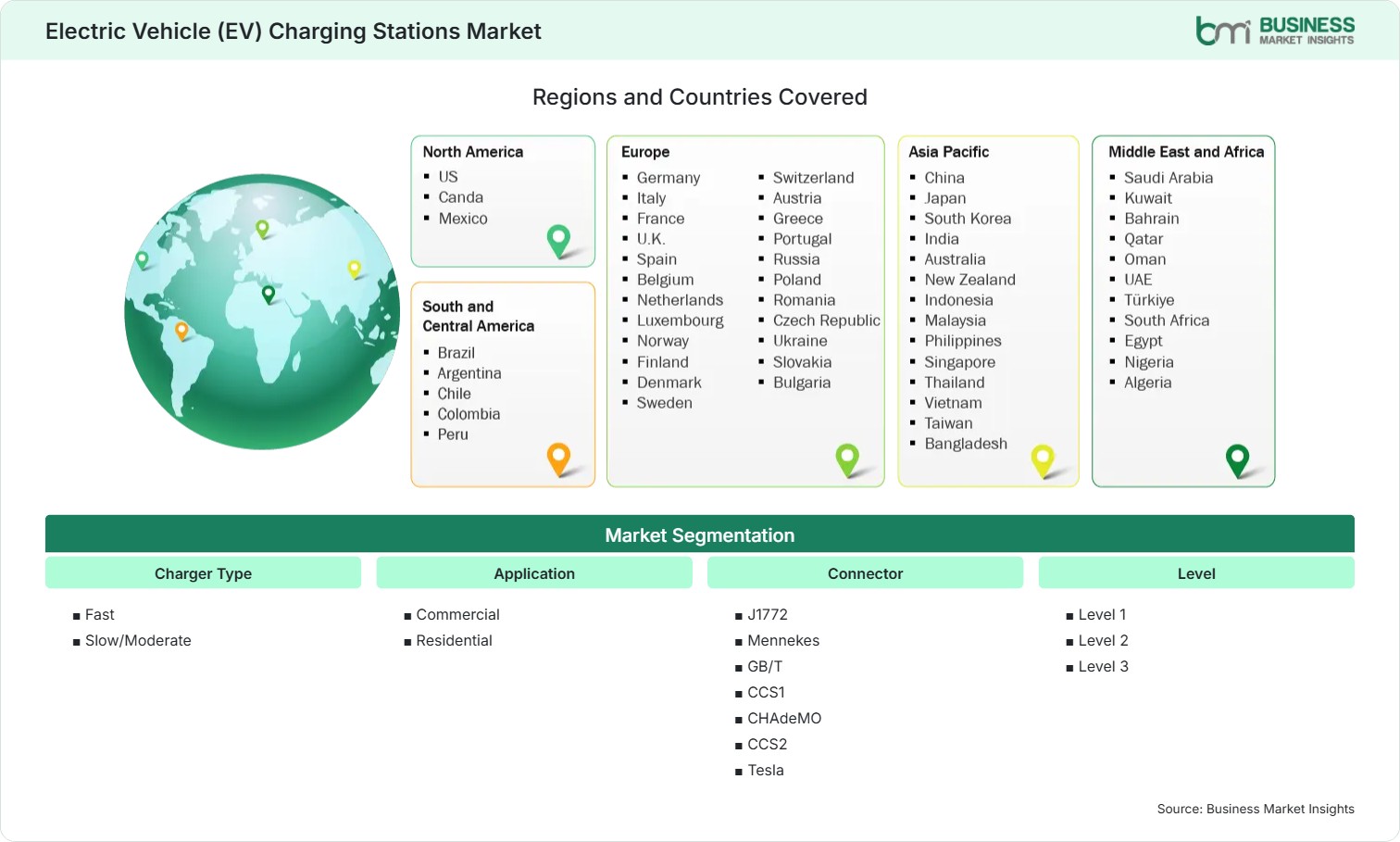
  • Charger Type: Fast, Slow/Moderate
  • Application: Commercial, Residential
  • Connector: J1772, Mennekes, GB/T, CCS1, CHAdeMO, CCS2, Tesla
  • Level: Level 1, Level 2, Level 3
  • Vehicle Type: Passenger Cars, Commercial Vehicles
US$ 19.75 Bn Market size in 2025
US$ 127.17 Bn Market Size by 2033
26.21% CAGR, 2026 - 2033
2026-2033 Forecast Period

AI Overview

Electric Vehicle (EV) Charging Stations Market Summary

  • North America Region: North America holds 31%–34% market share in 2025 and is projected to grow at a 25.4%–26.0% CAGR during 2026–2033. Strong electric vehicle adoption, expanding federal infrastructure investments, and supportive emission reduction policies continue driving regional expansion. The U.S. dominates the regional landscape through extensive public charging investments, private charging network expansion, and nationwide electrification initiatives, advancing at approximately 25.6%–26.2% CAGR during the forecast period.
  • Fastest Growing Region: Asia Pacific accounts for 36%–39% market share in 2025 and is expected to register a 27.8%–28.5% CAGR during 2026–2033. Growing EV production, government-backed charging infrastructure programs, urban electrification, expanding battery manufacturing, and increasing consumer adoption continue strengthening regional growth.
  • Leading Segment: Commercial represents 63%–67% market share in 2025 while expanding at a 26.0%–26.7% CAGR through 2033. Increasing deployment across public charging stations, workplaces, retail locations, fleet depots, and highway corridors continues supporting sustained market expansion.
  • High Growth Segment: Fast chargers account for 42%–46% market share in 2025 and are anticipated to register a 28.8%–29.6% CAGR during 2026–2033. Rising demand for rapid charging, long-distance travel support, commercial fleet electrification, and ultra-fast charging technologies continues accelerating investments.
  • Key Market Opportunity: Integration of renewable energy, battery energy storage systems, vehicle-to-grid technologies, intelligent charging software, and AI-enabled energy management is creating substantial long-term opportunities for charging infrastructure providers.
  • Major Market Players: ABB Ltd., Siemens AG, Schneider Electric SE, ChargePoint Holdings, Inc., Tesla, Inc., EVBox B.V., Blink Charging Co., Wallbox N.V., Delta Electronics, Inc., and Tritium DCFC Limited.
Strategic Insights

Electric Vehicle (EV) Charging Stations Market: Strategic Insights

Electric Vehicle (EV) Charging Stations Market Strategic Framework
FREE PDF
Request your free sample
Request free sample
Stakeholder View

Key Takeaways

  • The market value chain is becoming increasingly integrated as charging equipment manufacturers, utilities, automotive OEMs, energy storage companies, and charging network operators collaborate to deliver scalable and interoperable charging ecosystems.
  • Commercial charging infrastructure continues presenting the largest revenue opportunity owing to rapid expansion of public charging networks, charging hubs, and highway fast-charging corridors supporting mass EV adoption.
  • Artificial intelligence, cloud-based charging management, vehicle-to-grid (V2G) technology, and smart energy optimization are reshaping charging infrastructure development and operational efficiency.
  • Asia Pacific remains the strongest long-term investment destination due to large-scale EV production, supportive government incentives, and continuous deployment of public charging infrastructure.
  • Strategic collaborations among automakers, charging network providers, utilities, renewable energy developers, and technology companies continue accelerating charging infrastructure expansion..
  • Future market leadership will increasingly depend on high-power DC charging capabilities, cybersecurity, and scalable charging solutions supporting commercial and public transportation electrification.
Geographic Outlook

Electric Vehicle (EV) Charging Stations Market Regional Highlights

North America Electric Vehicle (EV) Charging Stations Market

North America accounted for approximately 31%–34% of the Electric Vehicle (EV) Charging Stations Market share in 2025 and is projected to expand at a CAGR of 25.4%–26.0% through 2033. The region is well-positioned because of increasing penetration of EVs, robust infrastructure funding provided by the federal government, developing public charging stations, and investments from utility companies and third-party chargers. Fast-charging corridors, commercial charging stations, and efficient energy management systems will fuel growth in the regional market.

  • Federal infrastructure programs continue supporting nationwide deployment of public charging stations, improving long-distance EV travel while strengthening charging accessibility across urban and rural transportation networks.
  • Utility companies increasingly integrate smart charging technologies and grid management systems to balance electricity demand while supporting large-scale EV charging infrastructure deployment.
  • Commercial property owners continue expanding workplace, retail, hospitality, and mixed-use charging facilities to accommodate growing electric vehicle ownership and improve customer engagement.
  • Technological advancements in ultra-fast charging, energy storage integration, and intelligent charging software continue enhancing operational efficiency while reducing charging times for EV users.

US Electric Vehicle (EV) Charging Stations Market

The U.S. electric vehicle (EV) charging stations market emerges as the largest contributor from North America, generating about 79% to 82% of the revenues and growing at a CAGR of 25.6% to 26.2% during the forecast period. Favorable policies, rising private investments, expanding production of EVs, and installation of charging infrastructures drive fast-paced growth in the region.

  • Federal and state incentive programs continue encouraging deployment of public charging stations supporting nationwide transportation electrification objectives.
  • Fleet operators increasingly invest in dedicated commercial charging infrastructure to support electric delivery vehicles, buses, and logistics operations.
  • Retail chains, hospitality providers, and commercial real estate developers continue integrating EV charging facilities to improve customer convenience and property value.
  • Smart charging platforms leveraging artificial intelligence and cloud connectivity continue optimizing charging schedules, energy consumption, and operational efficiency.

Europe Electric Vehicle (EV) Charging Stations Market

Europe electric vehicle (EV) charging stations market represented 26%–29% market share in 2025 and is anticipated to grow at a CAGR of 26.2%–26.9% through 2033. Stringent emission regulations, ambitious electrification targets, and extensive public charging investments continue driving regional demand. Germany leads the regional market through strong EV adoption and charging deployment, while the Netherlands demonstrates one of the fastest growth rates supported by dense charging infrastructure and favorable regulatory policies.

  • Germany continues expanding ultra-fast charging corridors supporting long-distance electric mobility and commercial transportation electrification.
  • The Netherlands records rapid growth through extensive public charging deployment, smart grid integration, and widespread residential charging adoption.
  • European utilities increasingly integrate renewable energy and battery storage with EV charging infrastructure to improve sustainability and grid stability.
  • Public-private partnerships continue accelerating charging infrastructure deployment across urban centers, highways, and commercial locations.
  • Smart charging technologies supporting demand response and vehicle-to-grid services continue strengthening regional charging network efficiency.

Asia Pacific Electric Vehicle (EV) Charging Stations Market

Asia Pacific electric vehicle (EV) charging stations market accounted for 36%–39% of global revenue in 2025 and is projected to register the highest CAGR of 27.8%–28.5% during 2026–2033. Rapid EV adoption, expanding domestic vehicle manufacturing, strong government incentives, and large-scale charging infrastructure investments continue driving regional growth. China dominates regional deployment through comprehensive charging programs, while India records the fastest expansion owing to increasing EV adoption and supportive government initiatives.

  • China continues leading global charging infrastructure deployment through extensive public charging investments and strong domestic electric vehicle production.
  • India demonstrates the fastest regional growth as national electrification policies, urban mobility programs, and charging infrastructure investments continue accelerating.
  • Japan and South Korea continue investing in high-power charging technologies supporting passenger vehicles, commercial fleets, and advanced mobility ecosystems.
  • Expanding battery manufacturing capabilities strengthen regional EV value chains while encouraging additional charging infrastructure deployment.

Rest of World Electric Vehicle (EV) Charging Stations Market

The Rest of the World contributed 8%–10% of global revenue in 2025 and is expected to expand at a CAGR of 26.8%–27.4% through 2033. South & Central America is gradually expanding EV charging infrastructure through urban electrification initiatives, government incentives, and increasing private investment in public charging networks. The Middle East & Africa continue investing in sustainable transportation, smart city developments, and renewable energy integration to support long-term electric mobility adoption.

  • Brazil leads South & Central America through expanding public charging networks and increasing electric vehicle adoption across major metropolitan areas.
  • The United Arab Emirates and Saudi Arabia continue investing in high-speed charging infrastructure supporting national sustainability and smart mobility strategies.
  • Growing commercial fleet electrification creates opportunities for depot charging installations across logistics, public transportation, and corporate mobility applications.
  • Renewable energy-powered charging stations continue gaining momentum as governments pursue low-carbon transportation infrastructure development.
Global Market Geography
FREE PDF
Request your free sample
Request free sample
Segment Analysis

Electric Vehicle (EV) Charging Stations Market Segmentation

Charger Type

Charger type remains one of the most influential factors determining charging speed, infrastructure investment, and user convenience across public and private charging networks. This segment accounted for approximately 44%–48% market share in 2025 and is projected to register a CAGR of 26.8%–27.5% during 2026–2033.

  • Fast: Rapidly gaining adoption owing to shorter charging durations, increasing highway corridor deployment, fleet electrification initiatives, growing long-distance travel demand, and continuous advancements in ultra-fast DC charging technologies.
  • Slow/Moderate: Continues serving residential communities, workplaces, commercial buildings, and overnight charging applications by offering economical installation costs, grid-friendly operation, and convenient daily vehicle charging.

Application

Charging infrastructure deployment continues expanding across residential properties and commercial facilities as electric vehicle ownership rises worldwide. This segment represented approximately 63%–67% market share in 2025 while advancing at a CAGR of 26.0%–26.7% through the forecast period.

  • Commercial: Represents the dominant application through deployment at public charging stations, retail centers, office complexes, fleet depots, hotels, parking facilities, and highway service locations supporting high vehicle utilization.
  • Residential: Continues expanding alongside increasing electric vehicle ownership as homeowners install private charging systems that provide convenient overnight charging, lower operating costs, and improved charging flexibility.

Connector

Connector standardization remains critical for ensuring charging compatibility across different electric vehicle platforms and charging networks. This segment accounted for approximately 17%–21% market share in 2025 and is projected to register a CAGR of 26.5%–27.2% through 2033.

  • J1772: Widely utilized across North America for AC charging applications, providing standardized connectivity for residential charging stations, workplace installations, and public charging infrastructure.
  • Mennekes: Commonly adopted throughout Europe for AC charging applications due to standardized compatibility, operational safety, and extensive integration across public and private charging networks.
  • GB/T: Dominates China's charging ecosystem through nationwide standardization supporting passenger vehicles, commercial fleets, and large-scale public charging deployments.
  • CCS1: Increasingly adopted across North America by supporting both AC and DC fast charging while improving charging flexibility and interoperability.
  • CHAdeMO: Maintains relevance within selected electric vehicle models by offering reliable DC fast charging capabilities and established charging infrastructure across several global markets.
  • CCS2: Continues expanding globally through widespread support for high-power DC charging, improved interoperability, and compatibility with numerous next-generation electric vehicles.
  • Tesla: Supports Tesla's proprietary charging ecosystem while gradually expanding compatibility with broader charging infrastructure through evolving connector strategies and network accessibility.

Level

Charging level determines charging duration, installation complexity, and suitability across residential, commercial, and public charging applications. This segment represented approximately 33%–37% market share in 2025 while growing at a CAGR of 26.3%–27.0% through the forecast period as charging requirements continue diversifying.

  • Level 1: Primarily utilized for residential charging where overnight charging, minimal installation requirements, and lower charging frequency adequately support daily commuting needs.
  • Level 2: Experiences broad adoption across residential, workplace, retail, hospitality, and public charging environments by balancing charging speed, installation cost, and operational efficiency.
  • Level 3: Records the fastest expansion through deployment at highway corridors, commercial charging hubs, fleet operations, and urban fast-charging stations requiring minimum vehicle downtime.

Vehicle Type

Vehicle electrification continues driving charging infrastructure investment across passenger transportation and commercial mobility applications. This segment accounted for approximately 68%–72% market share in 2025 while registering a CAGR of 26.4%–27.1% through 2033 as governments continue supporting zero-emission transportation.

  • Passenger Cars: Continue representing the largest installed charging base owing to rising consumer EV adoption, expanding charging accessibility, supportive government incentives, and growing model availability.
  • Commercial Vehicles: Experience rapid deployment as logistics operators, public transportation agencies, and fleet owners accelerate electrification strategies requiring dedicated high-capacity charging infrastructure.

Propulsion

Battery technologies and propulsion systems significantly influence charging frequency, charging speed requirements, and infrastructure deployment strategies. This segment represented approximately 61%–65% market share in 2025 and is expected to grow at a CAGR of 26.7%–27.4% during the forecast period.

  • BEV: Dominates charging infrastructure demand because fully electric vehicles depend entirely on external charging networks for daily operation, encouraging continuous expansion of public and private charging stations.
  • PHEV: Maintains steady demand through increasing adoption among consumers seeking flexible driving capability while utilizing residential and workplace charging infrastructure for improved fuel efficiency.
Market Forces

Electric Vehicle (EV) Charging Stations Market Dynamics

Key Market Drivers

Rapid Electric Vehicle Adoption Driving Charging Infrastructure Expansion

Rapid adoption of Battery Electric Vehicles (BEV) and Plug-In Hybrid Electric Vehicles (PHEV) is significantly driving up the demand for efficient charging stations across the globe. Expansion of the charging stations by governments, utilities and private investment is happening as part of this trend towards lowering range anxiety. These factors motivating Electric Vehicle EV Charging Stations Market growth more robust and promoting installation of charging stations at public, residential, workplace and DC fast charging sites.

Government Incentives Accelerating Public Charging Network Development

The governments from North America, Europe, and Asia Pacific regions are still adopting supportive policies and incentive schemes and financing their infrastructure development projects in order to speed up the installation process of charging stations. The national decarbonization policies, emissions standards for vehicles, and public and private partnerships are motivating the utilities companies and operators to provide nationwide access to charging stations. These policy initiatives continue shaping Electric Vehicle EV Charging Stations Market trends.

Growing Demand for High-Speed EV Charging Solutions

The growing trend among consumers and commercial fleets is to have fast charging systems that can considerably decrease the time needed for vehicle charging. Installation of level 3 DC fast charger systems and ultra fast charger systems can contribute to facilitating long distance travel, commercial operations, ride sharing services, and electrification of public transport. The development of advanced power electronics, liquid cooled cables, and smart energy management systems improves charging efficiency and increases charging capabilities.

Key Market Opportunities

Expansion of Highway Fast-Charging Corridors Worldwide

Governments and private operators of the EV charging networks will keep on investing in national and international highway corridors equipped with charging points, which will help in creating an unobstructed long-distance travel facility for electric vehicles. The large scale development of the ultra fast charging points helps in increasing accessibility, as well as in decreasing the duration of charging for passenger cars and trucks. The Electric Vehicle EV Charging Stations Market Forecasts indicate significant long-term opportunities for charging equipment manufacturers.

Fleet Electrification Creating Large Commercial Charging Opportunities

Fleet companies in logistics, public transport, municipal operations, and corporate transportation are speeding up their transition to electric cars to cut down on operational costs and reach sustainability goals. The installation of dedicated depots, fleet energy management, and fast-charging stations can generate significant revenues for charging station providers. Fleet electrification is anticipated to drive investments in commercial charging stations.

Renewable Energy Integration Supporting Sustainable EV Charging

Integration of solar energy, wind power, battery energy storage systems, and vehicle-to-grid technologies is transforming EV charging into a more sustainable and resilient energy ecosystem. Intelligent charging platforms optimize electricity consumption based on renewable energy availability while supporting grid stability and energy cost optimization. Growing investments in clean energy infrastructure continue creating new opportunities for integrated charging solutions.

Market Restraints and Challenges

High Infrastructure Deployment Costs Limiting Market Expansion

Factor: The deployment of the charging infrastructure involves considerable costs in terms of the provision of charging facilities, electricity supply, connectivity, land use, construction, installation, and maintenance. Impact: High initial investment needs may delay the process of implementing the infrastructure, especially in rural areas and developing countries, where there is need for longer paybacks on investments. Small-scale charging facility providers encounter financing problems, thus restricting the expansion of networks.

Grid Capacity Constraints Impacting Large-Scale Charger Installations

Factor: The rapid development of high-capacity charging stations will have a big impact on the demand for electricity and thus necessitate the development of transmission systems, distribution systems, substations, and other aspects of the power grid. Impact: The lack of sufficient capacity within the grid can prevent the construction of such stations, make construction more expensive, and limit the capacity within urban environments.

Company Analysis

Competitive Landscape

Continuous innovations in high-power charging technologies and interoperable charging infrastructure are key attributes of the competitive environment. The Electric Vehicle EV Charging Stations Market analysis indicates that the leading firms are expanding their presence around the globe through various business strategies such as partnerships, innovations, software, and fast-charging networks due to rising demands for electric vehicle charging.

Company Name

Overview (20–30 words)

Products and Services Relevant to this Market (20–30 words)

ABB Ltd.

Global electrification leader delivering advanced EV charging infrastructure and digital energy management solutions across residential, commercial, and public applications.

AC chargers, DC fast chargers, ultra-fast charging systems, energy management software, grid integration, and charging network solutions.

Siemens AG

Industrial technology company providing intelligent EV charging infrastructure integrated with digital energy and smart grid solutions worldwide.

Public charging systems, smart charging software, energy automation, charging infrastructure management, and grid optimization technologies.

Schneider Electric SE

Global energy management specialist supporting sustainable electric mobility through intelligent charging and power distribution technologies.

EV charging stations, smart energy management, electrical distribution equipment, charging controllers, and digital infrastructure solutions.

ChargePoint Holdings, Inc.

Leading EV charging network operator delivering cloud-connected charging solutions for commercial, fleet, and residential applications.

Networked charging stations, charging management software, fleet charging, subscription services, and cloud-based charging analytics.

Tesla, Inc.

Electric vehicle manufacturer operating one of the world's largest proprietary fast-charging networks supporting long-distance electric mobility.

Supercharger network, destination chargers, charging software, energy storage integration, and vehicle charging technologies.

EVBox B.V.

EV charging technology company specializing in scalable charging solutions for businesses, public infrastructure, and residential users.

AC chargers, DC fast chargers, charging management software, commercial charging systems, and cloud-based charging services.

Blink Charging Co.

Charging infrastructure provider focused on expanding public and commercial EV charging accessibility worldwide.

Public charging stations, network management software, charging services, fleet charging, and infrastructure deployment solutions.

Wallbox N.V.

Technology company developing intelligent residential and commercial EV charging equipment with advanced energy management capabilities.

Smart home chargers, commercial charging systems, energy optimization software, bidirectional charging, and charging management platforms.

Delta Electronics, Inc.

Power electronics manufacturer delivering efficient EV charging solutions and smart energy infrastructure technologies globally.

DC fast chargers, power conversion systems, energy management technologies, charging hardware, and grid-connected charging solutions.

Tritium DCFC Limited

Manufacturer specializing in high-power DC fast charging solutions supporting commercial and public transportation electrification.

High-power DC chargers, ultra-fast charging equipment, charging software, commercial charging infrastructure, and fleet charging solutions.

Trust & Transparency

Research Methodology

The market analysis combines proprietary research with secondary data from government agencies, company disclosures, regulatory filings, industry databases and expert interviews. Market estimates are validated through data triangulation, cross-market benchmarking and analyst review.

View Full Research Methodology

Questions Answered

Frequently Asked Questions

How does this Electric Vehicle (EV) Charging Stations Market Report support strategic planning?

The Market Report provides comprehensive insights into regional opportunities, future investment prospects, helping stakeholders make informed business decisions.

Which region leads the Electric Vehicle (EV) Charging Stations Market?

Asia Pacific leads the global market owing to strong electric vehicle production, government-supported charging infrastructure programs, and widespread public charging deployment, particularly in China.

Why does the commercial application segment dominate the market?

Commercial charging stations serve public charging networks, retail centers, and highway corridors, resulting in higher charger utilization and stronger revenue generation than residential installations.

Which charger type is expected to experience the fastest growth?

Fast chargers are projected to record the highest growth due to increasing demand for shorter charging times, and long-distance electric mobility.

What is driving the growth of the Electric Vehicle (EV) Charging Stations Market?

Rapid electric vehicle adoption, and advancements in fast-charging technologies are the primary factors accelerating market growth worldwide.

Access the Full Electric Vehicle (EV) Charging Stations Market Report

Get segment-level forecasts, regional estimates, competitive benchmarking, company profiles and downloadable Excel datasets.

Access the full Electric Vehicle (EV) Charging Stations Market Report
350 pages PDF & Excel | 2026-08-20
Similar Research

Related Market Reports