Market Summary
Executive Summary and Global Market Analysis
Military vehicle electrification refers to the integration of advanced electric propulsion systems, hybrid-electric drivetrains, energy storage technologies, power electronics, and intelligent energy management systems into military land vehicles. Electrified military vehicles are designed to enhance operational efficiency, reduce fuel dependency, improve stealth capabilities, lower thermal and acoustic signatures, and support high-power onboard mission systems. These technologies are increasingly being integrated into armored personnel carriers, infantry fighting vehicles, tactical trucks, autonomous ground vehicles, and next-generation combat platforms to improve battlefield mobility, survivability, and mission effectiveness.
The market is experiencing substantial growth due to increasing defense modernization programs, rising fuel logistics challenges in combat operations, and growing demand for silent mobility and enhanced energy efficiency across military fleets. Defense organizations worldwide are increasingly investing in hybrid-electric and fully electric military vehicles to reduce operational costs, improve energy resilience, and support next-generation battlefield requirements. The growing deployment of autonomous military vehicles, advanced communication systems, directed energy weapons, and onboard electronic warfare equipment is significantly increasing demand for high-capacity power generation and electrified propulsion systems. In addition, advancements in lithium-ion batteries, solid-state battery technologies, power management systems, electric drivetrains, and lightweight materials are accelerating the development of highly efficient military electric vehicle platforms.
However, market growth faces several technological and operational constraints. Military-grade electrification systems require ruggedized designs capable of operating under harsh battlefield environments, extreme temperatures, and high-impact combat conditions. High development and procurement costs, battery performance limitations, charging infrastructure challenges, and cybersecurity concerns related to connected vehicle architectures may hinder widespread adoption. Furthermore, limited charging capabilities in remote combat zones, dependence on critical raw materials for battery manufacturing, and integration complexities with existing military vehicle platforms can create operational and logistical challenges for defense agencies and manufacturers.
Despite these challenges, the market outlook remains highly positive due to rapid innovation in military mobility technologies and defense electrification initiatives. Emerging opportunities are being created through the development of autonomous electric combat vehicles, modular hybrid propulsion systems, advanced battlefield energy networks, and AI-enabled power management technologies. The increasing focus on reducing military fuel consumption, improving mission endurance, enhancing stealth operations, and enabling mobile power generation capabilities is expected to drive long-term market demand globally. Additionally, investments in next-generation battery technologies, vehicle-to-grid military power systems, and intelligent energy optimization platforms are supporting the evolution of highly connected and electrified defense mobility ecosystems.
Segment Analysis
Military Vehicle Electrification Market Segmentation
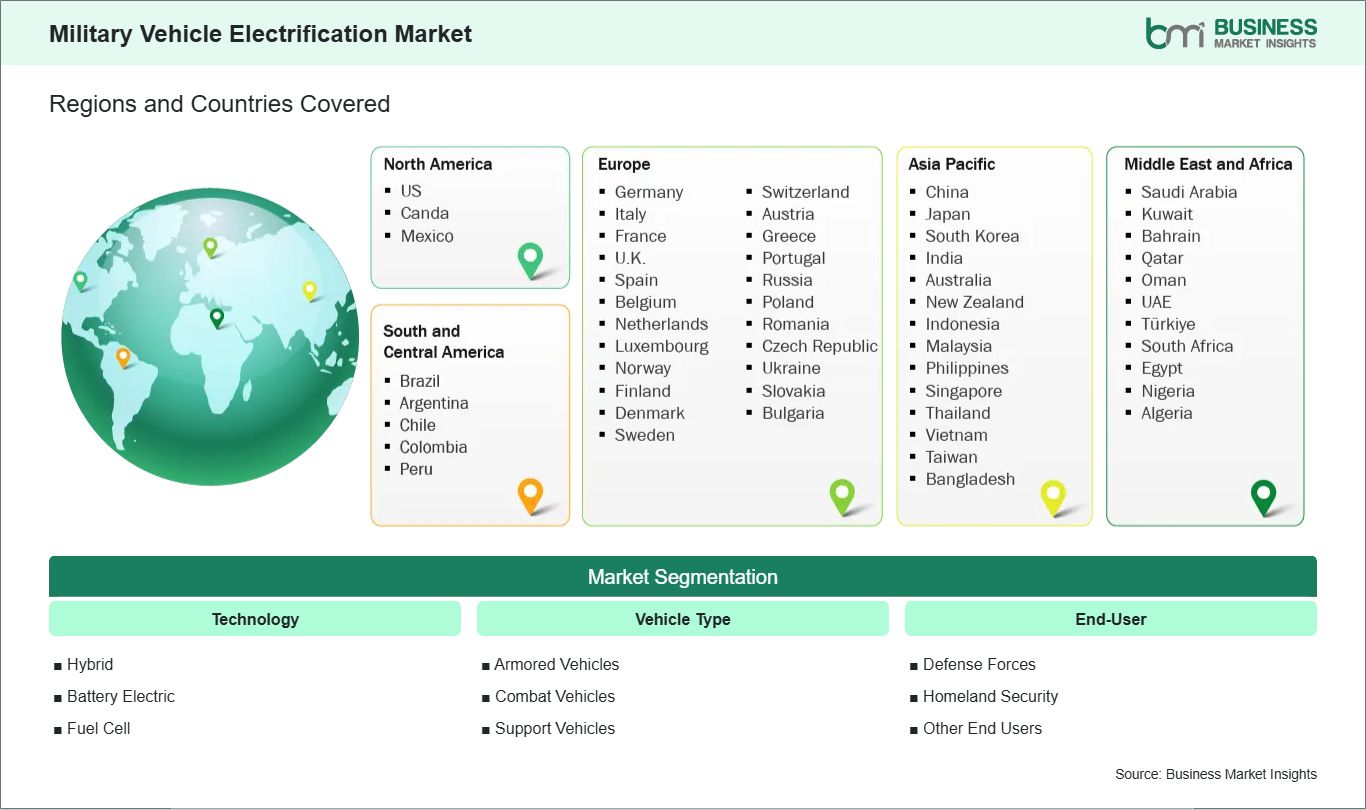
The military vehicle electrification market is segmented based on technology, vehicle type, and end-user, reflecting the growing adoption of advanced electric mobility solutions across defense operations.
By Technology
- Hybrid Electric: Military vehicles equipped with both internal combustion engines and electric propulsion systems to improve fuel efficiency, operational flexibility, and mission endurance
- Battery Electric: Fully electric military vehicles powered by advanced battery systems designed for silent mobility, low thermal signatures, and reduced maintenance requirements
- Fuel Cell: Hydrogen fuel cell-powered military vehicles offering extended operational range, rapid refueling capability, and clean energy generation for tactical missions
By Vehicle Type
- Armored Vehicles: Electrified armored personnel carriers, infantry fighting vehicles, and main battle support vehicles
- Tactical Vehicles: Electrified tactical trucks, utility vehicles, and logistics transport platforms used in military operations
- Autonomous Ground Vehicles: Unmanned and robotic military vehicles equipped with electric propulsion systems for reconnaissance and combat support
- Combat Support Vehicles: Engineering vehicles, recovery vehicles, and mobile command systems integrated with hybrid-electric technologies
By Vehicle Type
- Armored Vehicles: Electrified armored personnel carriers, infantry fighting vehicles, mine-resistant vehicles, and protected combat mobility platforms
- Combat Vehicles: Electrified tanks, reconnaissance vehicles, autonomous combat systems, and next-generation battlefield platforms integrated with advanced electric drivetrains
- Support Vehicles: Hybrid and electric logistics trucks, troop carriers, engineering vehicles, recovery vehicles, and mobile command platforms supporting military operations
By Application
- Defense Forces: Army, navy, air force, and special operations units deploying electrified military vehicles for combat and tactical mobility applications
- Homeland Security: Border security agencies, internal security organizations, and paramilitary forces utilizing electric and hybrid vehicles for surveillance and rapid response missions
- Other End Users: Peacekeeping organizations, disaster response agencies, military research institutions, and defense training organizations adopting electrified mobility platforms
Market Forces
Military Vehicle Electrification Market Drivers and Opportunities
Increasing Demand for Fuel-Efficient and Silent Military Mobility
The military vehicle electrification market is experiencing strong growth due to the increasing demand for fuel-efficient, low-signature, and operationally resilient military mobility solutions. Conventional military vehicles consume significant quantities of fuel, creating logistical challenges and increasing vulnerability during combat operations. Electrified military vehicles provide improved fuel economy, reduced dependency on fuel supply convoys, and enhanced operational flexibility across tactical missions.
Hybrid-electric and battery-electric military vehicles are increasingly being adopted for silent reconnaissance operations, covert missions, and urban warfare scenarios where reduced acoustic and thermal signatures provide a strategic advantage. Governments and defense organizations are investing heavily in advanced electric propulsion technologies to strengthen battlefield mobility, reduce operational costs, and support sustainable defense initiatives. In addition, the growing use of advanced communication systems, electronic warfare technologies, radar platforms, and directed-energy weapons is creating demand for high-capacity onboard power generation systems supported by electrified vehicle architectures.
Expansion of Autonomous and AI-Enabled Military Platforms
Significant opportunities are emerging in the military vehicle electrification market through advancements in autonomous combat systems, AI-powered battlefield management technologies, and intelligent energy optimization platforms. Electrified propulsion systems are increasingly being integrated into autonomous ground vehicles and robotic military systems to support reconnaissance, logistics transport, surveillance, and combat support operations.
The growing development of connected battlefield ecosystems, smart defense platforms, and unmanned combat vehicles is accelerating demand for advanced batteries, fuel cells, and modular electric drivetrain technologies. Hydrogen fuel cell vehicles are gaining attention for long-duration tactical missions due to their extended range and rapid refueling capabilities. Furthermore, advancements in lightweight materials, next-generation charging systems, and AI-enabled predictive maintenance technologies are enabling the deployment of highly efficient and durable military electric vehicle fleets. Vendors focusing on autonomous mobility, energy resilience, and intelligent power distribution systems are expected to gain a competitive advantage as defense organizations continue to modernize military infrastructure globally.
Size and Share Analysis
Military Vehicle Electrification Market Size and Share Analysis
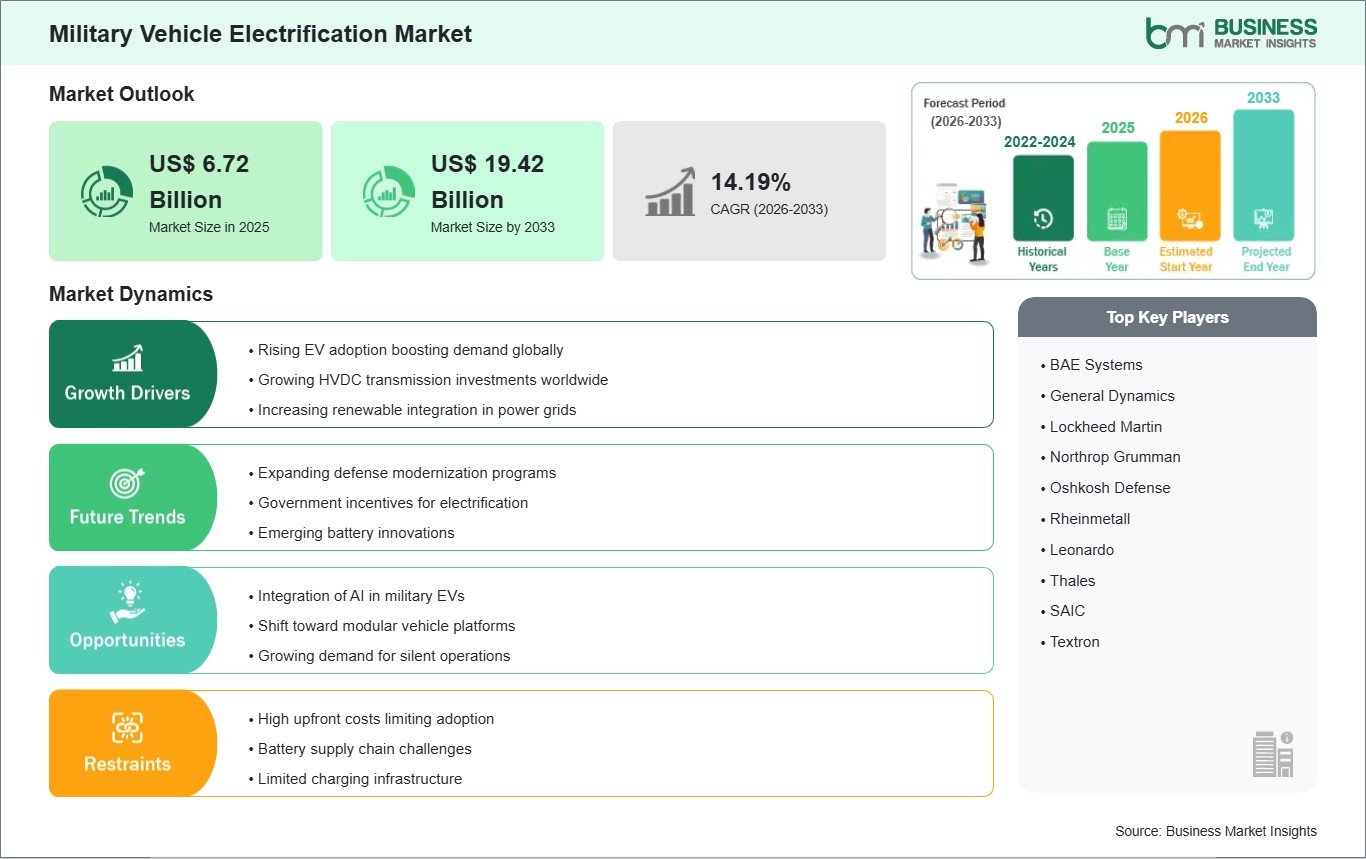
The Military Vehicle Electrification Market is projected to grow from US$ 6.72 Billion in 2025 to US$ 19.42 Billion by 2033 , registering a CAGR of 14.19% from 2026 to 2033.
By technology, hybrid electric vehicles account for a major market share due to their operational flexibility, lower fuel consumption, and compatibility with existing military vehicle platforms. Battery electric vehicles are witnessing strong growth driven by increasing demand for silent mobility, reduced maintenance requirements, and advancements in battery energy density. Fuel cell-powered military vehicles are expected to gain significant traction owing to growing investments in hydrogen energy infrastructure and demand for long-range tactical mobility solutions.
By vehicle type, armored vehicles dominate the market owing to rising deployment of electrified armored personnel carriers and infantry fighting vehicles across modern defense programs. Combat vehicles are experiencing strong adoption due to increasing investments in next-generation battle tanks, autonomous combat systems, and electric reconnaissance platforms. Support vehicles are also witnessing notable growth driven by electrification of logistics fleets, engineering vehicles, and military transport systems aimed at reducing operational fuel dependency.
By end-user, defense forces hold the largest market share due to extensive adoption of electrified mobility systems across army modernization programs and tactical battlefield operations. Homeland security agencies are increasingly deploying hybrid and electric patrol vehicles for border surveillance and rapid response applications. Other end users, including peacekeeping organizations and disaster response agencies, are also contributing to market expansion through increasing adoption of sustainable and low-emission military mobility solutions.
Report Coverage
Military Vehicle Electrification Market Report Coverage and Deliverables
The "Military Vehicle Electrification market Size and Forecast (2022–2033)" report provides a detailed analysis of the market covering below areas:
- Military vehicle electrification market size and forecast at global, regional, and country levels for all market segments covered under the scope
- Military vehicle electrification market trends, as well as drivers, restraints, and opportunities
- Military vehicle electrification market analysis covering key trends, global and regional framework, major players, regulations, and recent developments
- Industry landscape and competition analysis covering market concentration, heat map analysis, prominent players, and recent developments for the military vehicle electrification market
- Detailed company profiles, including SWOT analysis
Geographic Insights
Military Vehicle Electrification Market Geographic Insights
The military vehicle electrification market demonstrates varying regional growth patterns influenced by defense modernization strategies, military mobility requirements, government investments in clean energy technologies, and increasing adoption of advanced battlefield systems.
North America holds a dominant position in the market due to high defense expenditure, strong military research capabilities, and increasing investments in hybrid-electric combat vehicles and autonomous military platforms. The United States is actively investing in electrified tactical vehicles, next-generation combat mobility systems, battlefield energy resilience programs, and autonomous ground vehicle technologies. The region is also witnessing increased deployment of advanced battery systems, intelligent power management platforms, and hydrogen fuel technologies across military applications. Canada is expanding investments in Arctic defense mobility, sustainable military transportation systems, and border surveillance infrastructure.
Asia Pacific is witnessing substantial market growth driven by rising geopolitical tensions, military modernization programs, and increasing indigenous defense manufacturing activities. Countries such as China, India, Japan, and South Korea are investing heavily in electric armored vehicles, autonomous military systems, advanced battery manufacturing, and hydrogen-powered defense mobility platforms. The region is increasingly focusing on energy-efficient combat systems, smart battlefield infrastructure, and AI-enabled defense technologies to strengthen national security and tactical readiness. Rising investments in military logistics modernization and unmanned defense systems are further accelerating market expansion across Asia Pacific.
Europe is also experiencing notable market growth due to increasing defense cooperation initiatives, NATO modernization programs, and rising focus on sustainable military mobility solutions. European defense agencies are investing in hybrid-electric combat vehicles, intelligent battlefield energy systems, and low-emission military transport fleets. Meanwhile, Middle East and Africa countries are strengthening defense mobility infrastructure and border security capabilities, contributing to rising adoption of advanced military electrification technologies across the region.
Industry Activity
Recent Developments
The military vehicle electrification market is evaluated by gathering qualitative and quantitative data post primary and secondary research, which includes important corporate publications, association data, and databases. A few of the key developments in the military vehicle electrification market are:
- In May 2026, Kodiak AI, Inc. and General Dynamics Land Systems announced a strategic collaboration to create autonomous ground vehicles (AGVs) for defense applications. Through this collaboration, Kodiak will provide the Kodiak Driver, its Physical AI-powered virtual driver that is operating driverlessly today, demonstrating the ability to scale autonomous operations beyond controlled testing. General Dynamics Land Systems will lead vehicle integration, power systems, communications and ruggedized platform development. Their collaboration establishes a scalable autonomy capability that can be applied across multiple military vehicle platforms and mission sets.
- In September 2025, BAE Systems and Forterra collaborating to rapidly prototype an autonomous Armored Multi-Purpose Vehicle (AMPV). This is the first industry partnership BAE Systems has established as part of the vehicle’s capability kit series announced last month.
Trust & Transparency
Research Methodology
The market analysis combines proprietary research with secondary data from government agencies, company disclosures, regulatory filings, industry databases and expert interviews. Market estimates are validated through data triangulation, cross-market benchmarking and analyst
review.
View Full Research Methodology
Key Sources Referred:
Stockholm International Peace Research Institute (SIPRI)
North Atlantic Treaty Organization (NATO)
International Institute for Strategic Studies (IISS)
S. Department of Defense (DoD)
Company Websites
Company Annual Reports
Company Investor Presentations