Market Summary
Executive Summary and Global Market Analysis
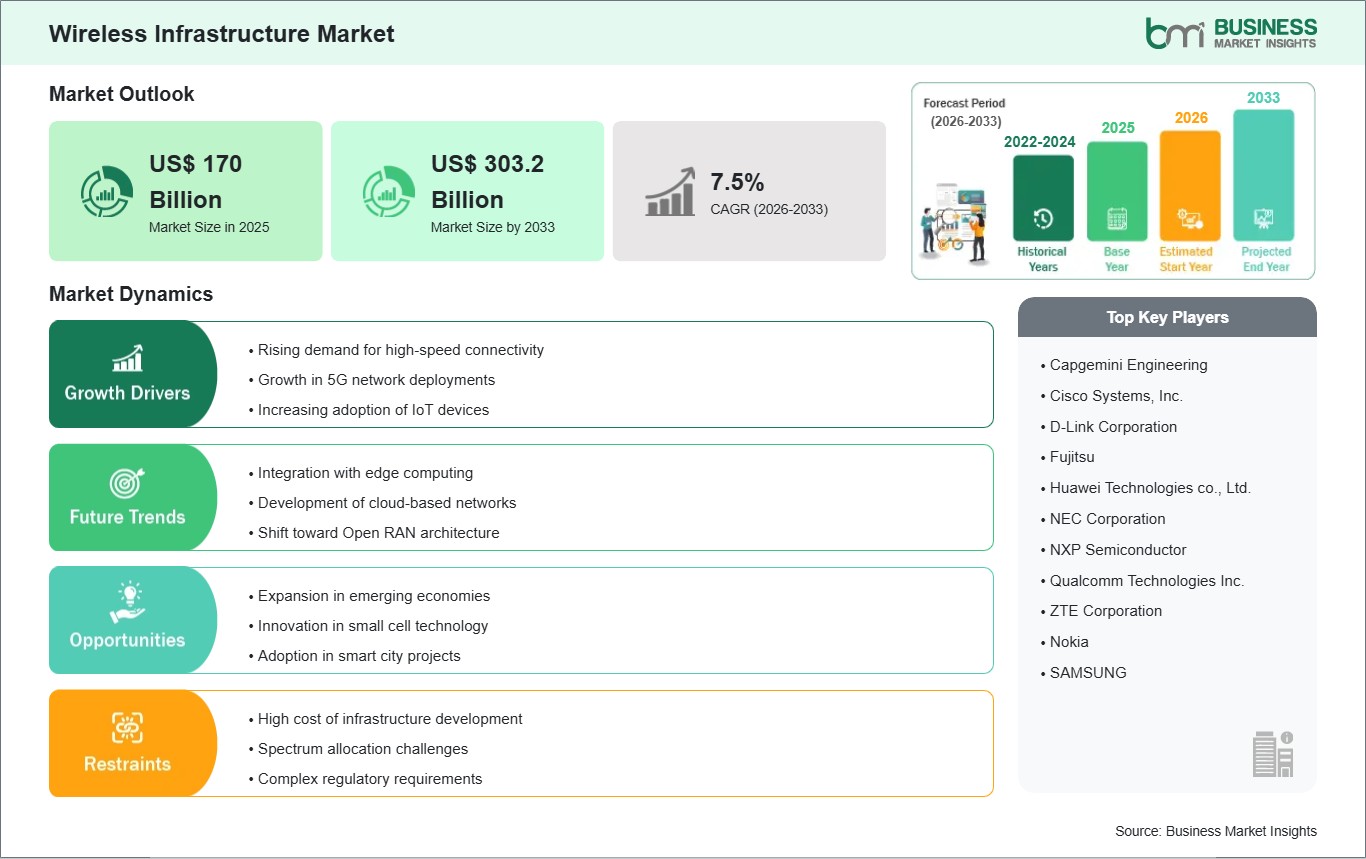
Wireless Infrastructure refers to the physical and logical components (hardware, software, and services) required to enable wireless communication networks, primarily for cellular mobile services, Wi-Fi, and satellite communications. This includes cell towers, small cells, Radio Access Network (RAN) equipment, mobile core network components, and fiber/microwave backhaul solutions.
The Wireless Infrastructure market is experiencing robust expansion, fundamentally driven by the global 5G network rollout and the explosive growth in mobile data consumption and connected devices. The transition to 5G requires unprecedented network densification, particularly through the deployment of small cells and advanced RAN architectures (like Massive MIMO), creating massive demand for new hardware and software solutions. Governmental initiatives and competitive pressure among mobile network operators further accelerate investments in network upgrades and coverage expansion to meet consumer and enterprise demand for ultra-low latency and high-speed services.
Segment Analysis
Wireless Infrastructure Market Segmentation
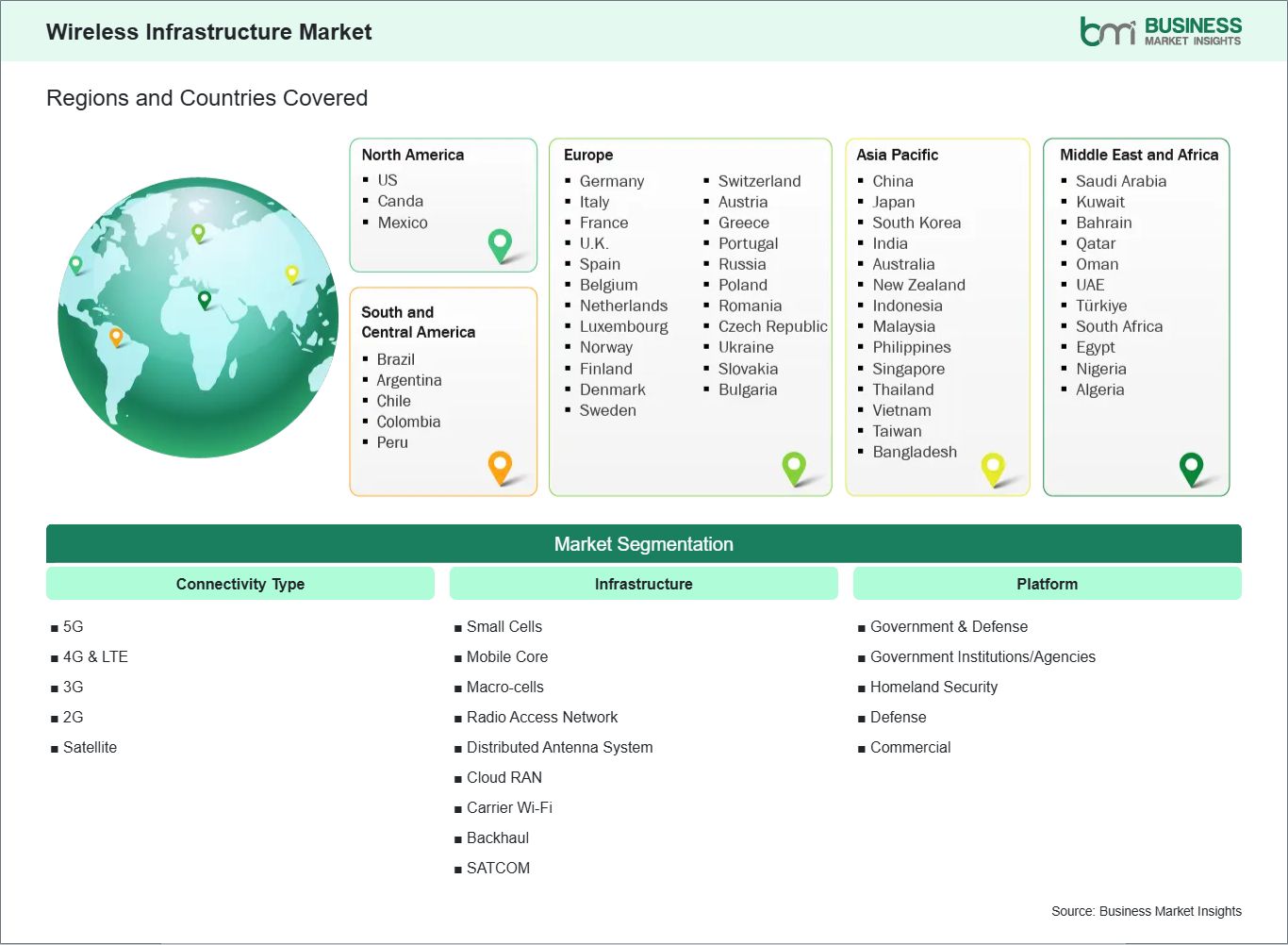
Key segments that contributed to the derivation of the Wireless Infrastructure Market analysis are connectivity type, infrastructure, and platform.
- By Connectivity Type, the market is segmented into 5G, 4G & LTE, 3G, 2G, and Satellite.
- By Infrastructure, the market is segmented into Small Cells, Mobile Core, Macro-cells, Radio Access Network, Distributed Antenna System, Cloud RAN, Carrier Wi-Fi, Backhaul, and SATCOM.
- By Platform, the market is segmented into Government & Defense, Government Institutions/Agencies, Homeland Security, Defense, and Commercial.
Market Forces
Wireless Infrastructure Market Drivers and Opportunities
Demand for 5G Network Densification and Capacity
The primary driver for the Wireless Infrastructure Market is the aggressive, global rollout of 5G technology and the subsequent requirement for massive network densification. Unlike previous generations, 5G utilizes higher frequency spectrum bands (like mid-band and millimeter-wave) to achieve ultra-high speeds and ultra-low latency. However, these higher frequencies travel shorter distances and have difficulty penetrating buildings, necessitating a vastly denser network footprint. This forces mobile network operators (MNOs) to invest heavily not only in upgrading Macro Cells but, more crucially, in deploying a large number of Small Cells (miniature base stations) across urban and suburban environments.
This structural shift drives demand for new RAN equipment, complex fiber backhaul solutions, specialized power infrastructure, and advanced software for network management and virtualization (like Open RAN and Cloud RAN), effectively accelerating infrastructure spending across the entire ecosystem to meet the exponential growth in mobile data traffic from consumers and enterprises.
Increasing Focus on Aviation Safety and Situational Awareness
The unwavering regulatory and operational focus on enhancing aviation safety and pilot situational awareness presents a significant, high-growth opportunity for wireless infrastructure and related technologies. As air traffic volumes and complexity increase, driven by factors like the growth of commercial air travel, military modernization, and the emergence of Unmanned Aerial Systems (UAS/drones), the demand for systems that prevent collisions and human error is escalating. This is fueling investments in technologies.
Furthermore, the push for digital cockpits and Electronic Flight Bags (EFBs) requires continuous, secure wireless connectivity to deliver real-time meteorological data, navigation charts, and predictive analytics to the flight crew. This entire ecosystem demands an intelligent, resilient, and widely deployed wireless strength from ground-based sensor networks and advanced satellite communication systems to secure airport area networks, to ensure the integrity and fusion of all critical safety data.
Size and Share Analysis
Wireless Infrastructure Market Size and Share Analysis
The Wireless Infrastructure Market demonstrates consistent growth, with size and share analysis revealing strong positioning for material and product leaders amid customization trends. The report examines subsegments within connectivity type, infrastructure, and platform, offering insights into their contribution to overall market performance.
The Wireless Connectivity Market is undergoing a transformative shift to 5G technology, due to its ultra-low latency and high-speed capabilities. While 4G & LTE currently maintains a significant growth legacy, 2G and 3G networks are rapidly being decommissioned to repurpose spectrum for next-generation services. In terms of infrastructure, Small Cells are outpacing traditional Macro-cells as network densification becomes essential for urban 5G coverage. From a platform perspective, the Government & Defense segment is fueled by high-priority national security initiatives and smart city rollouts. This segment encompasses critical investments in Homeland Security and secure Defense communications, while the Commercial segment continues to drive high-volume growth through industrial automation and consumer-facing digital transformation projects.
Report Coverage
Wireless Infrastructure Market Report Coverage and Deliverables
The "Wireless Infrastructure Market Size and Forecast (2022 - 2033)" report provides a detailed analysis of the market covering below areas:
- Wireless Infrastructure Market size and forecast at global, regional, and country levels for all the key market segments covered under the scope
- Wireless Infrastructure Market trends, as well as market dynamics such as drivers, restraints, and key opportunities
- Wireless Infrastructure Market analysis covering key market trends, global and regional framework, major players, regulations, and recent market developments
- Industry landscape and competition analysis covering market concentration, heat map analysis, prominent players, and recent developments for the Wireless Infrastructure Market
- Detailed company profiles, including SWOT analysis
Geographic Insights
Wireless Infrastructure Market Geographic Insights
The geographical scope of the Wireless Infrastructure Market report is divided into five regions: North America, Asia Pacific, Europe, Middle East & Africa, and South & Central America.
The market in North America is anticipated to grow significantly, primarily due to early and substantial investment by major telecom carriers in 5G network rollouts and advanced technological adoption. Asia Pacific is expected to exhibit the highest growth rate during the forecast period, driven by the aggressive pace of 5G deployment and digitalization initiatives in major economies like China and India.
Industry Activity
Recent Developments
The Wireless Infrastructure Market is evaluated by gathering qualitative and quantitative data post-primary and secondary research, which includes important corporate publications, association data, and databases. A few of the key developments in the Wireless Infrastructure Market are:
- In December 2025, du, a leading telecom and digital services provider, entered into a three-year agreement with Huawei following a successful deployment of the world’s first 25Gbps E-band microwave link in a 5G-Advanced (5G-A) site rollout.
- In November 2025, Cisco introduced innovations to modernize campus, branch, and industrial networks for the AI era. Cisco's solutions simplify operations, scale for evolving business needs, and enhance security, all critical for unlocking the full potential of enterprise AI.
- In May 2024, HCLTech, a leading global technology company, and Cisco announced the launch of Pervasive Wireless Mobility as-a-Service for secure and seamless enterprise-wide connectivity.
Trust & Transparency
Research Methodology
The market analysis combines proprietary research with secondary data from government agencies, company disclosures, regulatory filings, industry databases and expert interviews. Market estimates are validated through data triangulation, cross-market benchmarking and analyst
review.
View Full Research Methodology
Key Sources Referred:
World Bank - Global Trade IndicatorsWorld Trade Organization (WTO)International Monetary Fund (IMF)International Trade Administration (ITA)Company WebsitesCompany Annual ReportsCompany Investor Presentations