Market Summary
Executive Summary and Global Market Analysis
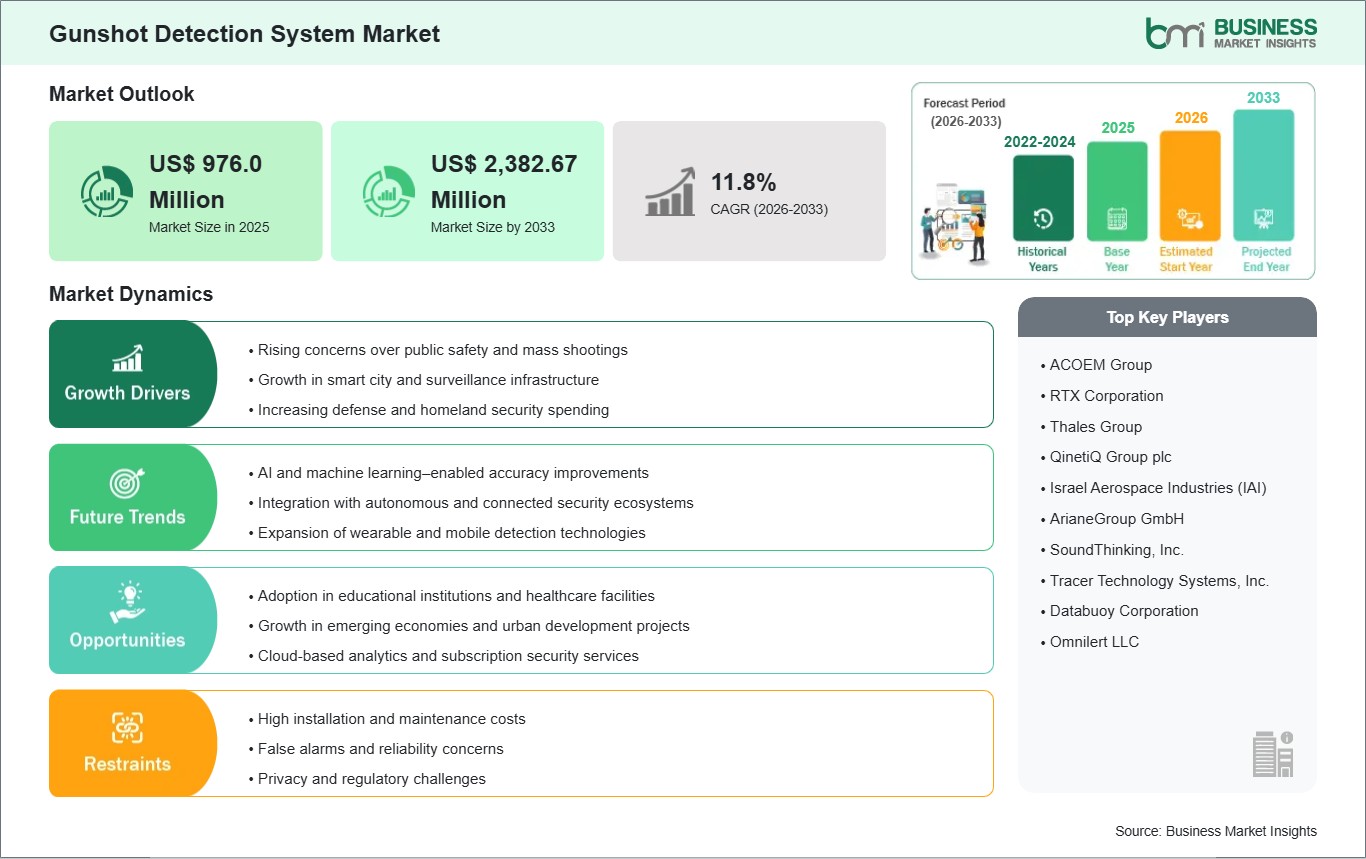
Gunshot detection systems refer to the integrated application of acoustic and optical sensing technologies engineered to identify, locate, and alert authorities to the discharge of a firearm. By utilizing high-sensitivity microphone arrays and infrared sensors, these systems detect the unique sonic boom and muzzle flash of a gunshot, triangulating the shooter's precise coordinates through advanced time-difference-of-arrival (TDOA) algorithms. This technology is fundamental to the operational architecture of Real-Time Crime Centers (RTCCs), campus safety frameworks, and military perimeter defense. Market expansion is being propelled by the global rollout of 5G-Advanced for ultra-low latency alerts, the rising institutional requirement for automated Drone-as-First-Responder (DFR) dispatch, and the increasing integration of detection nodes into smart city infrastructure to enhance public safety response times.
However, several factors may restrain market progression. The high capital intensity associated with large-scale outdoor deployments, which necessitate the installation of dozens of spatially distributed sensors per square mile, remains a primary hurdle for municipal budgets. The industry also faces persistent technical challenges regarding false-alarm mitigation, as urban noise pollution from fireworks, car backfires, and construction can occasionally trigger inaccurate alerts, leading to concerns over evidentiary reliability. Additionally, the proliferation of continuous audio monitoring has intensified debates regarding data privacy and civil liberties, as community advocates question the retention of background ambient sound. These hurdles, compounded by the strategic risks of complex integration with legacy emergency dispatch software and the high operational costs of sensor recalibration, increase the total cost of ownership and may lengthen the validation cycles for mission-critical law enforcement applications.
Despite these hurdles, the market outlook remains highly favorable as the sector transitions toward AI-driven and multi-sensor architectures. Opportunities are emerging through the adoption of Acoustic-IR Sensor Fusion; the market is witnessing a surge in hybrid systems that cross-verify sound signatures with thermal flash detection to achieve accuracy. The expansion of Subscription-based Detection-as-a-Service (SaaS) is gaining significant traction, allowing schools and mid-sized cities to convert high upfront hardware costs into predictable operating expenses. Furthermore, the growth of edge-processed detection, where AI filtering occurs directly on the sensor node, aligns with global goals for reduced network bandwidth and enhanced data security. Collectively, these innovations position the gunshot detection system industry for sustained long-term development as a cornerstone of the modern, responsive, and data-fortified global security landscape.
Segment Analysis
Gunshot Detection System Market Segmentation
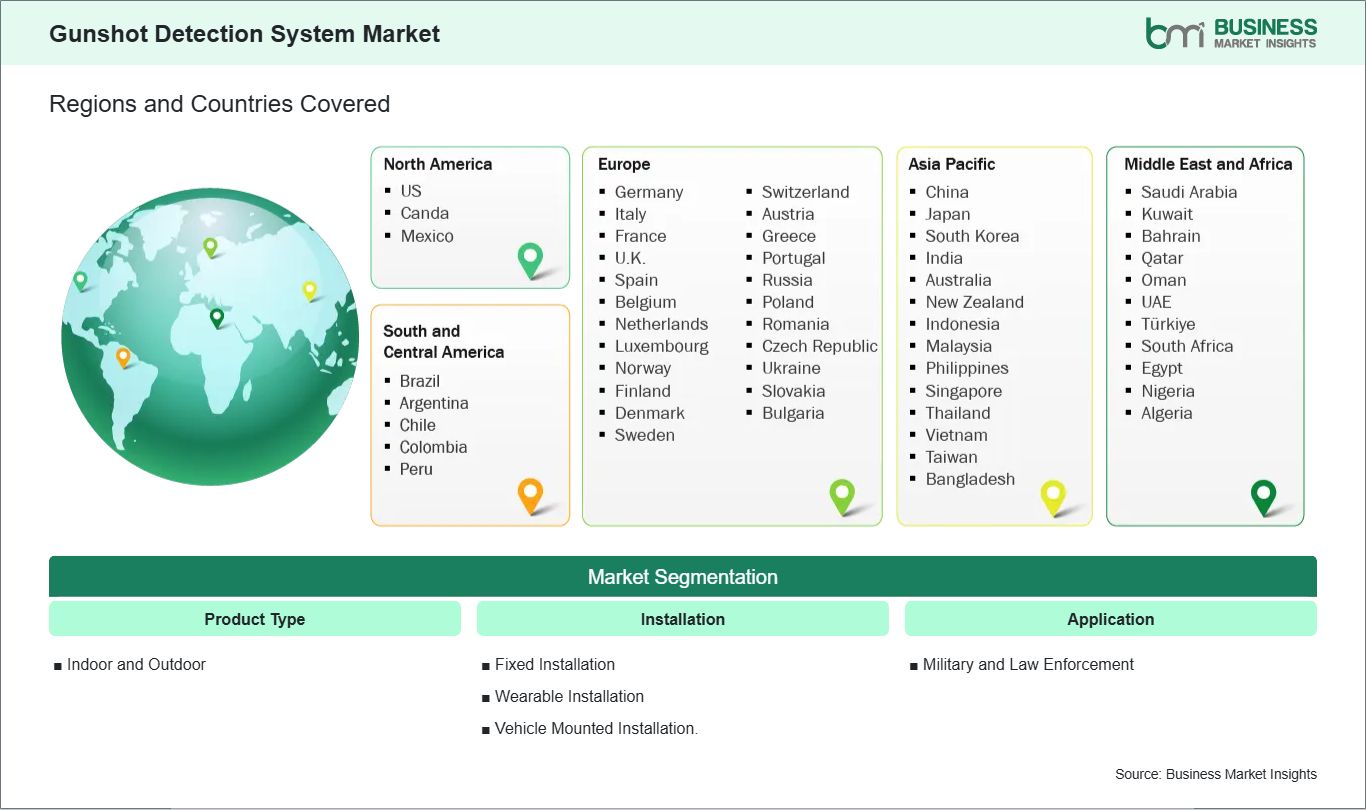
Key segments that contributed to the derivation of the Gunshot Detection System market analysis are product type, installation, and application.
- By Product Type, the market is segmented into Indoor and Outdoor.
- By Installation, the market is divided into Fixed Installation, Wearable Installation, and Vehicle Mounted Installation.
- By Application, the market is categorized into Military and Law Enforcement.
Market Forces
Gunshot Detection System Market Drivers and Opportunities
Rising Demand for Public Safety, Law Enforcement, and Smart Security
The gunshot detection system market is being driven by the growing need for public safety, enhanced law enforcement capabilities, and smart security infrastructure across urban areas, educational institutions, commercial facilities, and defense sectors. Rising concerns about gun violence and mass shootings are amplifying adoption, as governments and municipalities invest in advanced technologies to improve emergency response times and reduce casualties. Law enforcement agencies are increasingly deploying gunshot detection systems to provide real‑time alerts, accurate location tracking, and forensic data for investigations. The expansion of smart city initiatives is reinforcing demand, with gunshot detection integrated into broader surveillance and public safety platforms. Educational institutions and corporate campuses are also adopting these systems to safeguard students and employees. Additionally, advancements in acoustic sensors, AI algorithms, and IoT connectivity are enhancing system accuracy and reliability, making them more cost‑effective and scalable. Collectively, public safety priorities, law enforcement needs, and smart infrastructure initiatives are fueling sustained growth in the global gunshot detection system market.
Rising Integration of AI, IoT, and Cross‑Industry Applications
Opportunities in the gunshot detection system market are expanding through the integration of artificial intelligence, IoT ecosystems, and cross‑industry applications. AI‑enabled detection platforms are opening lucrative opportunities by delivering adaptive analytics, automated alerts, and predictive insights for law enforcement and emergency response. IoT‑driven systems are gaining traction, enabling seamless connectivity with surveillance cameras, communication networks, and smart city infrastructure. The growing emphasis on school safety and workplace security is fueling demand for interoperable solutions that integrate with access control, alarm systems, and emergency protocols. Emerging applications in defense and military are driving innovation, as gunshot detection systems support battlefield awareness, perimeter security, and troop safety. Additionally, sustainability trends are encouraging deployment of energy‑efficient, eco‑friendly detection technologies that align with global infrastructure goals. The expansion of cloud‑based platforms and mobile applications is creating new pathways for adoption, offering real‑time alerts to law enforcement and civilians alike. Vendors who focus on AI‑driven, IoT‑ready, and industry‑specific gunshot detection solutions are well‑positioned to capture growth. The convergence of AI, IoT, and smart security underscores a transformative trajectory for the global gunshot detection system market.
Size and Share Analysis
Gunshot Detection System Market Size and Share Analysis
The Gunshot Detection System market demonstrates steady growth, with size and share analysis revealing evolving trends and competitive positioning among key players. The report examines subsegments categorized within product type, installation, and application, offering insights into their contribution to overall market performance.
Based on Product Type, the Indoor subsegment holds a strong presence, as gunshot detection systems are increasingly deployed in schools, government buildings, airports, and commercial facilities to enhance public safety. Indoor systems are indispensable for providing rapid alerts, enabling immediate lockdowns, and supporting law enforcement response. The Outdoor subsegment is essential for city surveillance, military bases, and border security, where wide‑area coverage and integration with public safety networks are critical. Outdoor systems anchor demand in smart city initiatives and defense applications, offering real‑time detection and situational awareness. Together, indoor systems ensure localized safety, while outdoor systems extend protection to larger environments.
Report Coverage
Gunshot Detection System Market Report Coverage and Deliverables
The “Gunshot Detection System Market Size and Forecast (2022–2033)” report provides a detailed analysis of the market covering below areas:
- Market size and forecast at global, regional, and country levels for all market segments covered under the scope
- Market trends, as well as drivers, restraints, and opportunities
- Market analysis covering key trends, global and regional framework, major players, and recent developments
- Market concentration, heat map analysis, prominent players, and recent developments
- Detailed company profiles, including SWOT analysis
Geographic Insights
Gunshot Detection System Market Geographic Insights
The geographical scope of the Gunshot Detection System market report is divided into five regions: North America, Asia Pacific, Europe, Middle East & Africa, and South & Central America.
North America maintains a preeminent position within the global industry, a status reinforced by the region's advanced public safety infrastructure and the rapid adoption of acoustic surveillance technologies. The regional landscape is characterized by significant investments in the United States and Canada, where the transition from manual emergency reporting to automated, real-time gunshot localization has become a strategic priority. This market leadership is supported by a robust ecosystem of technology pioneers, including SoundThinking (formerly ShotSpotter), Raytheon Technologies, and Shooter Detection Systems, who drive the commercialization of sophisticated sensors capable of identifying firearm discharges in complex acoustic environments.
Enterprise and municipal trends in the region reflect a decisive shift toward Cloud-Native Analytics and AI-Driven False-Alarm Filtering. The industry has transitioned toward software-defined platforms that leverage machine learning to distinguish gunshots from non-threatening urban noises such as fireworks or vehicle backfires. Furthermore, the region is witnessing an escalating demand for Indoor Gunshot Detection within educational institutions, commercial malls, and government facilities. This focus on Immediate Situational Awareness allows for the automated triggering of lockdown protocols and the instant dispatch of precise location data to law enforcement agencies, effectively reducing emergency response times.
Industry Activity
Recent Developments
The Gunshot Detection System market is evaluated by gathering qualitative and quantitative data post primary and secondary research, which includes important corporate publications, association data, and databases. A few of the key developments in the Gunshot Detection System market are:
- In October 2025, Eagle Eye Networks launched Eagle Eye Gun Detection, an AI-powered, triple-verified gun detection system that integrates with existing security cameras. The system combines rapid edge AI, advanced cloud AI, and human verification to proactively detect brandished firearms, providing schools, businesses, and public spaces with early alerts, enhanced situational awareness, and faster emergency response through integration with 911 systems and live monitoring.
- In October 2025, Lumana launched a behavior-aware AI upgrade for its gun detection platform, introducing Gun Brandished Detection. The system differentiates between holstered and actively brandished firearms by analyzing posture, motion, and orientation, reducing false alarms and enabling faster response times. Compatible with standard IP cameras, the feature enhances real-time threat monitoring, situational awareness, and operational efficiency for schools, businesses, and public spaces.
Trust & Transparency
Research Methodology
The market analysis combines proprietary research with secondary data from government agencies, company disclosures, regulatory filings, industry databases and expert interviews. Market estimates are validated through data triangulation, cross-market benchmarking and analyst
review.
View Full Research Methodology
Key Sources Referred:
World Bank & Global Trade Indicators World Trade Organization (WTO) International Monetary Fund (IMF) International Trade Administration (ITA) Company Websites Company Annual Reports Company Investor Presentations