Market Summary
Executive Summary and Global Market Analysis
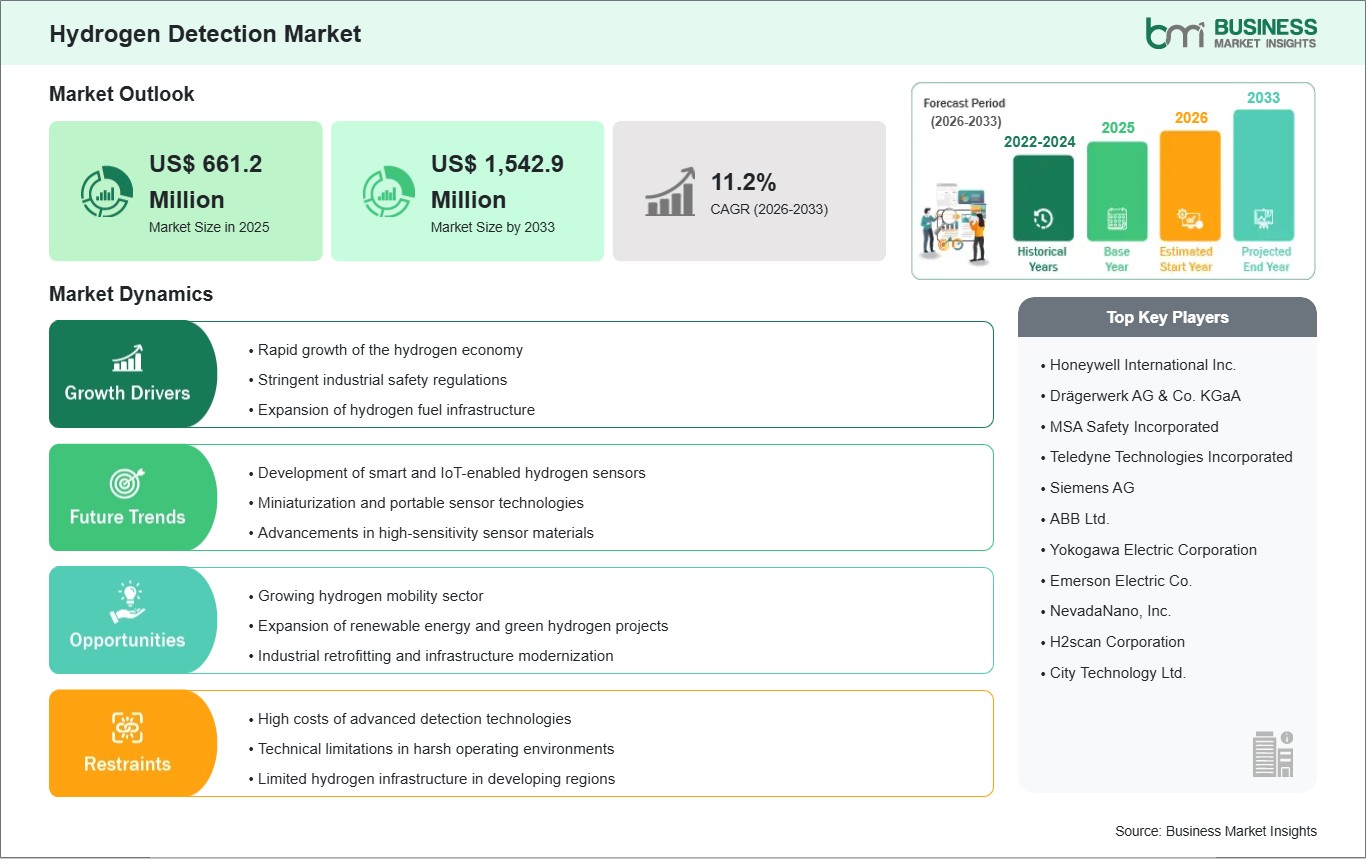
Hydrogen detection systems refer to the integrated application of sensing apparatus and monitoring software engineered to identify the presence of hydrogen gas, particularly in concentrations below the lower explosive limit. By utilizing diverse hardware, including electrochemical, catalytic, metal-oxide semiconductor (MOS), and optical fiber sensors, these systems facilitate the early identification of leaks and the automated activation of safety protocols. This technology is fundamental to the operational architecture of hydrogen refueling stations, fuel cell vehicle manufacturing, and industrial facilities such as petroleum refineries and ammonia production plants. Market expansion is being propelled by the rapid global transition toward a hydrogen-based energy economy, the rising institutional requirement for stringent safety compliance in high-risk environments, and the increasing integration of micro-electromechanical systems (MEMS) to create compact, low-power detection modules.
However, several factors may restrain market progression. The high capital intensity associated with advanced optical and MEMS-based sensing arrays, which offer superior precision but require specialized manufacturing, remains a primary hurdle for widespread commercial adoption. The industry also faces persistent technical challenges regarding cross-sensitivity, where the presence of other gases, such as carbon monoxide or humidity, can trigger false alarms or degrade sensor accuracy. Additionally, the requirement for periodic calibration and maintenance, particularly for electrochemical variants, has intensified concerns regarding the total cost of ownership in remote or large-scale infrastructure. These hurdles, compounded by the slow pace of hydrogen refueling station deployment in emerging economies and the strategic risks of fragmented global safety standards, increase the complexity of system validation and may lengthen the ROI period for infrastructure developers.
Despite these hurdles, the market outlook remains highly favorable as the sector transitions toward Intelligent and Interference-Resilient safety ecosystems. Opportunities are emerging through the adoption of Optical Fiber Sensors; the market is witnessing a surge in these spark-free solutions that use light interference to detect hydrogen, making them ideal for high-risk explosive atmospheres. The automotive segment is gaining significant traction, with a rising requirement for MEMS-based leak detectors that can be seamlessly integrated into fuel cell manifolds and storage tanks to provide sub-second response times. Furthermore, the growth of Edge-AI Pattern Recognition, using machine learning to filter out background noise and cross-gas interference, aligns with global goals for zero-fault industrial monitoring.
Segment Analysis
Hydrogen Detection Market Segmentation
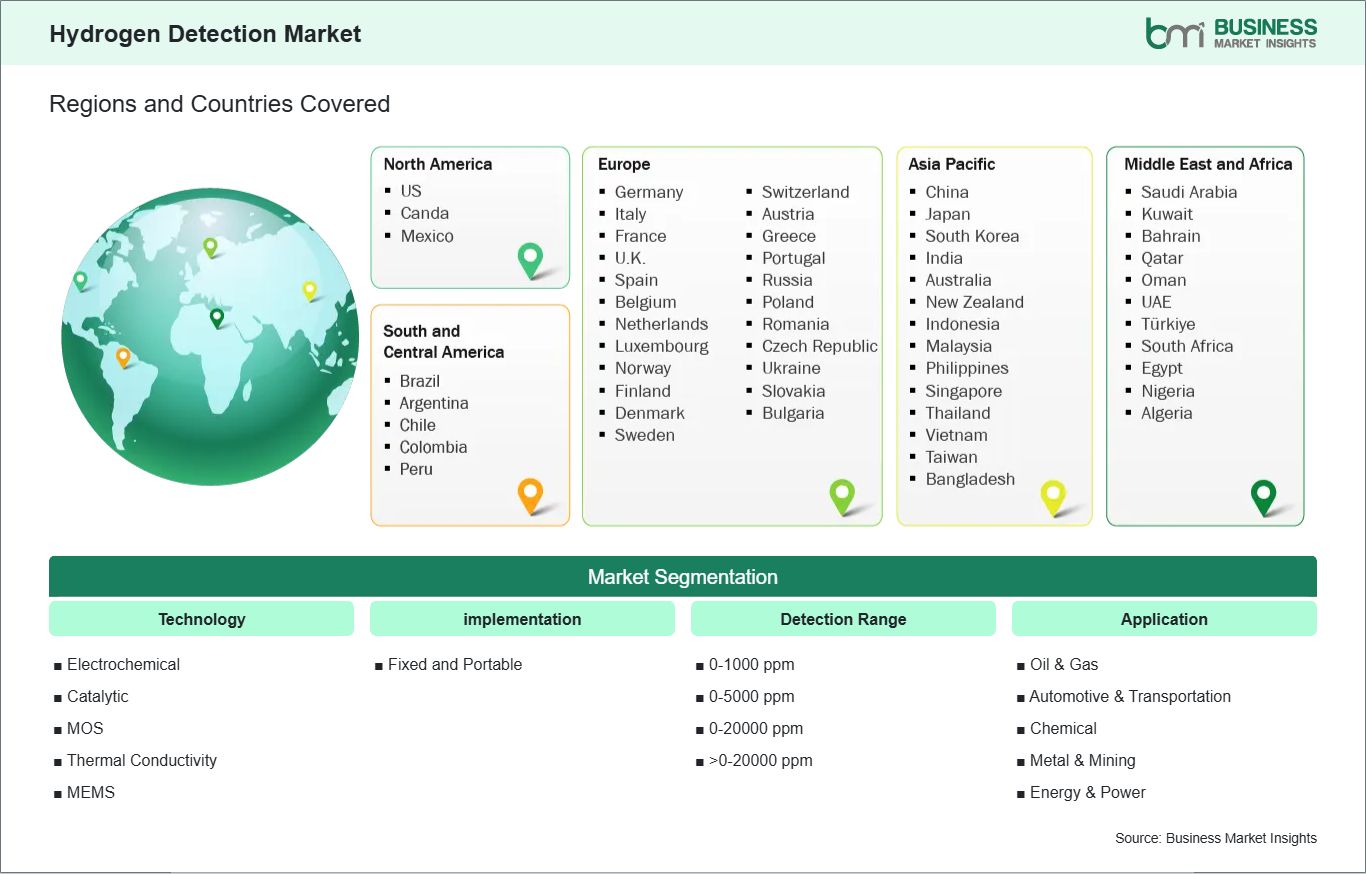
Key segments that contributed to the derivation of the Hydrogen Detection market analysis are technology, implementation, detection range, and application.
- By Technology, the market is segmented into Electrochemical, Catalytic, MOS, Thermal Conductivity, and MEMS.
- By Implementation, the market is divided into Fixed and Portable.
- By Detection Range, the market is categorized into 0-1000 ppm, 0-5000 ppm, 0-20000 ppm, and >0-20000 ppm.
- By Application, the market is segmented into Oil & Gas, Automotive & Transportation, Chemical, Metal & Mining, and Energy & Power.
Market Forces
Hydrogen Detection Market Drivers and Opportunities
Rising Demand for Safety, Sustainability, and Energy Transition
The hydrogen detection market is being driven by the growing need for safety, sustainability, and energy transition across industries such as oil & gas, chemicals, automotive, and power generation. Hydrogen, while a clean energy carrier, is highly flammable and requires precise monitoring to prevent leaks and explosions. The rapid expansion of hydrogen production, storage, and distribution infrastructure, particularly in support of fuel cells and green hydrogen projects, is amplifying the adoption of advanced detection systems. Automotive applications, including hydrogen fuel cell vehicles, are reinforcing demand, as detection technologies ensure passenger safety and compliance with stringent regulations. Industrial sectors such as refineries and chemical plants are also fueling growth, with hydrogen detection systems integrated into process safety frameworks. Additionally, stricter regulatory standards for workplace safety and environmental protection are propelling investment in reliable detection solutions. Collectively, safety priorities, sustainability goals, and clean energy initiatives are sustaining momentum in the global hydrogen detection market.
Rising Integration of IoT, AI, and Emerging Applications
Opportunities in the hydrogen detection market are expanding through the integration of IoT ecosystems, artificial intelligence, and emerging cross‑industry applications. IoT‑enabled detection systems are opening lucrative opportunities by offering real‑time monitoring, predictive analytics, and automated alerts for hydrogen leaks in industrial and transportation environments. AI‑driven platforms are gaining traction, enabling adaptive calibration, anomaly detection, and predictive maintenance for sensors and monitoring devices. The growing emphasis on clean energy transition is fueling demand for interoperable detection solutions that integrate seamlessly with hydrogen fueling stations, smart grids, and renewable energy projects. Emerging applications in aerospace and defense are driving innovation, as hydrogen detection ensures safety in advanced propulsion systems and mission‑critical operations. Healthcare and laboratory environments are reinforcing opportunities, where hydrogen detection supports controlled research and medical device applications. Additionally, sustainability trends are encouraging deployment of energy‑efficient, eco‑friendly detection systems that align with global environmental goals. The expansion of hydrogen mobility, industrial decarbonization, and smart infrastructure is creating new pathways for adoption. Vendors who focus on IoT‑ready, AI‑driven, and industry‑specific hydrogen detection solutions are well‑positioned to capture growth. The convergence of clean energy, smart technology, and safety underscores a transformative trajectory for the global hydrogen detection market.
Size and Share Analysis
Hydrogen Detection Market Size and Share Analysis
The Hydrogen Detection market demonstrates steady growth, with size and share analysis revealing evolving trends and competitive positioning among key players. The report examines subsegments categorized within technology, implementation, detection range, and application, offering insights into their contribution to overall market performance.
Based on Technology, the Electrochemical subsegment holds a strong presence, as it is widely adopted for its high sensitivity and accuracy in detecting low hydrogen concentrations. The Catalytic subsegment is essential for industrial environments, offering reliable detection in explosive atmospheres. The MOS (Metal Oxide Semiconductor) subsegment anchors demand in portable devices and consumer applications, providing cost‑effective solutions. The Thermal Conductivity subsegment is critical for measuring hydrogen concentration in gas mixtures, ensuring safety in chemical and energy industries. The MEMS (Micro‑Electro‑Mechanical Systems) subsegment supports demand in miniaturized sensors, enabling integration into automotive and portable electronics. Together, these technologies highlight the diversity of hydrogen detection solutions across industries.
Report Coverage
Hydrogen Detection Market Report Coverage and Deliverables
The “Hydrogen Detection Market Size and Forecast (2022–2033)” report provides a detailed analysis of the market covering below areas:
- Market size and forecast at global, regional, and country levels for all market segments covered under the scope
- Market trends, as well as drivers, restraints, and opportunities
- Market analysis covering key trends, global and regional framework, major players, and recent developments
- Market concentration, heat map analysis, prominent players, and recent developments
- Detailed company profiles, including SWOT analysis
Geographic Insights
Hydrogen Detection Market Geographic Insights
The geographical scope of the Hydrogen Detection market report is divided into five regions: North America, Asia Pacific, Europe, Middle East & Africa, and South & Central America.
North America maintains a preeminent position within the global industry, a status reinforced by the region's advanced energy infrastructure and substantial federal support for the clean hydrogen economy. The regional landscape is characterized by a mature innovation ecosystem in the United States and Canada, where the transition toward zero-emission fuel sources and rigorous safety protocols has become a strategic priority for both public and private sectors. This market leadership is supported by a robust presence of technology pioneers, including Honeywell International Inc., MSA Safety Incorporated, Teledyne Technologies, and Emerson Electric Co., who drive the commercialization of sophisticated electrochemical, metal-oxide semiconductor, and thermal conductivity sensors.
Industrial and enterprise trends in the region reflect a decisive shift toward Hydrogen Infrastructure Expansion and IoT-Enabled Safety Systems. Organizations are increasingly moving away from manual leak checks to adopt intelligent, connected detectors that provide real-time remote monitoring and predictive maintenance analytics. Furthermore, the region is witnessing an escalating demand for Portable and MEMS-Based Detection Solutions. This focus on Compact Mobility is particularly evident in the automotive and aerospace sectors, where lightweight, low-power sensors are essential for monitoring fuel cell vehicles, hydrogen refueling stations, and emerging hydrogen-powered aviation platforms.
Industry Activity
Recent Developments
The Hydrogen Detection market is evaluated by gathering qualitative and quantitative data post primary and secondary research, which includes important corporate publications, association data, and databases. A few of the key developments in the Hydrogen Detection market are:
- In May 2025, Honeywell launched its Hydrogen Leak Detector (HLD) sensor, capable of detecting microscopic hydrogen leaks with high precision. This development strengthens the hydrogen detection market by improving safety, reliability, and maintenance efficiency across industrial, vehicular, and energy infrastructure applications, supporting wider adoption of hydrogen-powered technologies.
- In May 2024, H2scan launched four hydrogen monitoring and sensing solutions, including GRIDSCAN 6000 and Sentinel PRO, designed to provide real-time detection, predictive maintenance, and enhanced safety. This development strengthens the hydrogen detection market by enabling continuous monitoring and smarter asset management across industrial, utility, and energy infrastructure applications.
Trust & Transparency
Research Methodology
The market analysis combines proprietary research with secondary data from government agencies, company disclosures, regulatory filings, industry databases and expert interviews. Market estimates are validated through data triangulation, cross-market benchmarking and analyst
review.
View Full Research Methodology
Key Sources Referred:
World Bank & Global Trade IndicatorsWorld Trade Organization (WTO)International Monetary Fund (IMF)International Trade Administration (ITA)Company WebsitesCompany Annual ReportsCompany Investor Presentations