
Spoil Detection Based Smart Label Market Outlook (2022-2033)

Historic Data: 2022-2024   |   Base Year: 2025   |   Forecast Period: 2026-2033
Report Content: Market Scope, Market Segmentation, Market Dynamics, and Competitive Analysis

Report Coverage:
  • Technology (Temperature Indicators, Time-Temperature Indicators, Biochemical Indicators, RFID Labels)
  • End Use (Food & Beverage, Pharmaceuticals, Logistics & Supply Chain, Agriculture)
  • Functionality (Monitoring, Tracking, Alerting, Reporting)
  • Material (Paper, Polymer, Metal, Composite)

No. of Pages: 401
Report Code: BMIPUB00034421
Category: Electronics and Semiconductor
Spoil Detection Based Smart Label Market

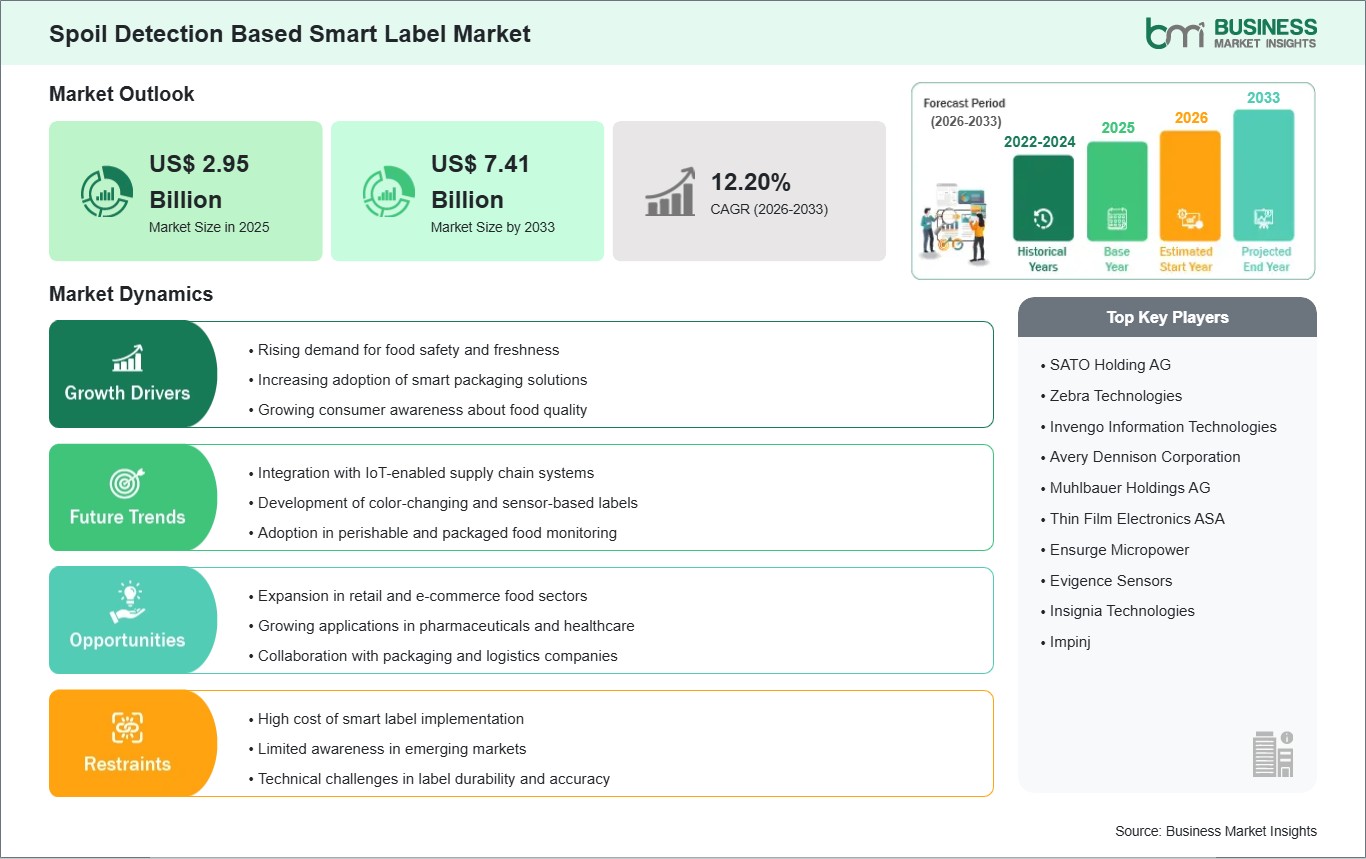
The Spoil Detection Based Smart Label Market size is expected to reach US$ 7.41 billion by 2033 from US$ 2.95 billion in 2025. The market is estimated to record a CAGR of 12.20% from 2026 to 2033.

Executive Summary and Global Market Analysis:

The global spoil detection-based smart label market is growing rapidly as food safety, supply chain transparency, and quality assurance become critical priorities for the food and pharmaceutical industries. These smart labels, embedded with sensors or chemical indicators, provide real-time monitoring of product freshness by detecting spoilage, microbial growth, temperature fluctuations, or chemical changes. This technology enables manufacturers, retailers, and consumers to ensure product integrity, reduce food waste, and maintain regulatory compliance. Technological advancements are expanding the functionality and affordability of smart labels. Innovations in bio-sensors, RFID/NFC integration, colorimetric indicators, and IoT connectivity allow for automated monitoring, traceability, and data-driven decision-making throughout the supply chain. The integration of blockchain and cloud-based monitoring systems is enhancing transparency, ensuring tamper-proof records of product storage and handling conditions.

The market is driven by increasing consumer awareness of food safety, rising e-commerce in perishable goods, and government regulations requiring quality monitoring and expiration tracking. Applications span fresh produce, meat, dairy, seafood, and pharmaceuticals, where spoilage detection can prevent health hazards and financial losses. As industries focus on sustainability, reducing waste, and improving product lifecycle management, spoil detection-based smart labels are becoming an essential tool for modern supply chains and consumer trust.

Spoil Detection Based Smart Label Market - Strategic Insights:

global-market-strategic-framework
Get more information on this report

Spoil Detection Based Smart Label Market Segmentation Analysis:

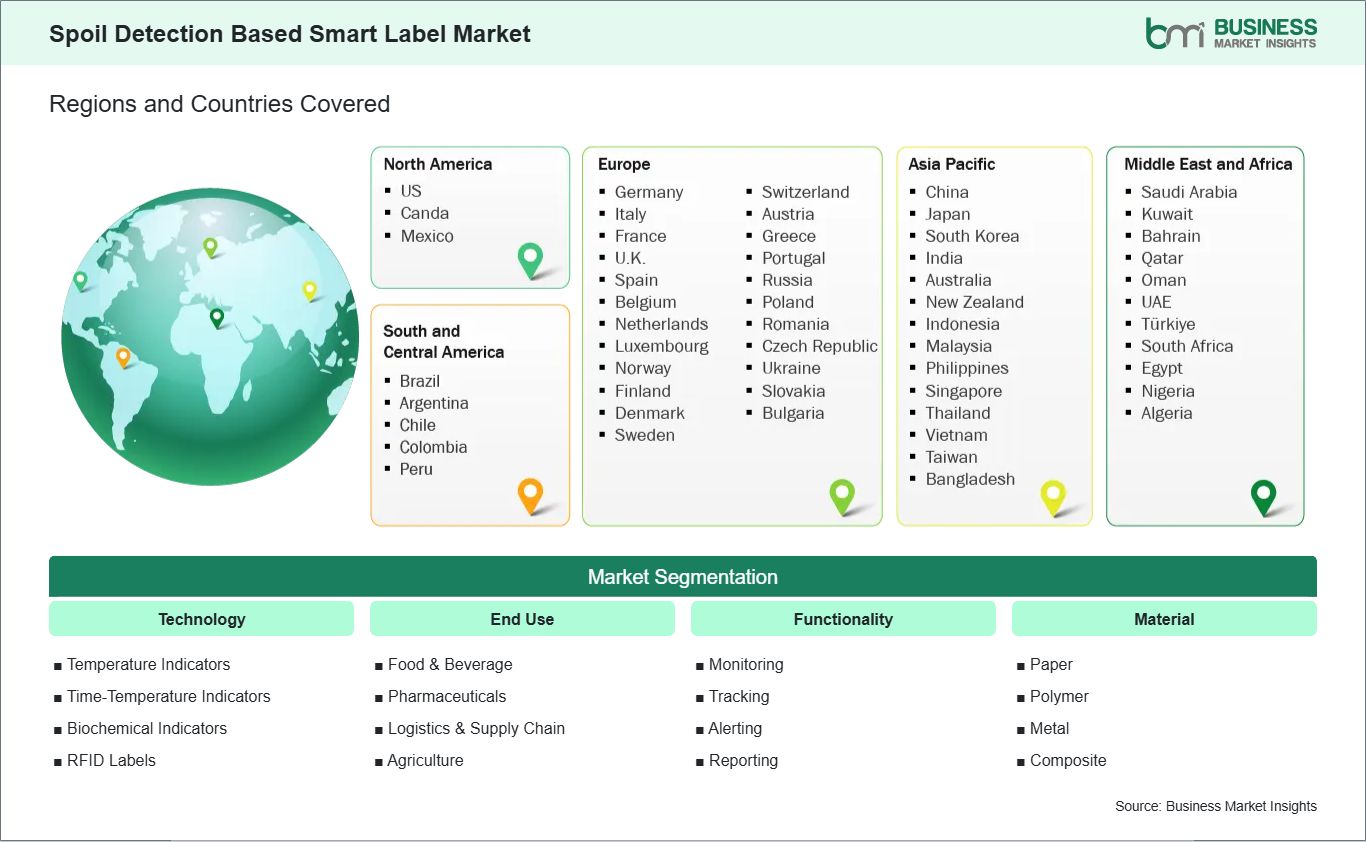
Key segments that contributed to the derivation of the spoil detection based smart label market analysis are technology, end use, functionality, and material.

  • Technology, the spoil detection based smart label market is segmented into temperature indicators, time‑temperature indicators, biochemical indicators, and rfid labels. The temperature indicators segment dominated the market in 2025.
  • End Use, the spoil detection based smart label market is categorized into food & beverage, pharmaceuticals, logistics & supply chain, and agriculture. The food & beverage segment dominated the market in 2025.
  • Functionality, the spoil detection based smart label market is classified into monitoring, tracking, alerting, and reporting. The tracking segment dominated the market in 2025.
  • Material, the spoil detection based smart label market is segmented into paper, polymer, metal, and composite. The polymer segment dominated the market in 2025.
Spoil Detection Based Smart Label Market Drivers and Opportunities:

Increasing demand for food safety monitoring

The global spoil detection-based smart label market is expanding due to rising awareness of food safety and quality among consumers and businesses. Retailers, distributors, and food producers are adopting smart labels to monitor freshness, ensure compliance with safety standards, and reduce the risk of foodborne illnesses. Real-time indicators of spoilage allow stakeholders to make informed decisions, minimizing health hazards and enhancing consumer trust. Technological advancements in sensors and colorimetric indicators have improved the accuracy and reliability of spoil detection labels. These innovations enable monitoring of temperature fluctuations, microbial growth, and product deterioration, providing actionable insights for supply chain management. The increasing focus on sustainability and waste reduction further drives adoption. Businesses are leveraging spoil detection smart labels to prevent unnecessary disposal of food, optimize inventory, and reduce operational costs. As demand for safe, high-quality food grows globally, these smart labels are becoming an essential tool across the food supply chain.

Expanding use in perishable product packaging

Spoil detection-based smart labels are increasingly integrated into packaging for perishable goods such as meat, seafood, dairy, and fresh produce. These labels provide visible indicators of product quality, helping manufacturers, distributors, and consumers track freshness and prevent spoilage during storage and transportation. The adoption of smart packaging solutions is driven by the need for enhanced supply chain visibility, inventory optimization, and improved customer confidence. By embedding spoil detection labels, companies can ensure products reach consumers in optimal condition while reducing returns, waste, and associated costs. Innovation in smart label technologies, including temperature-sensitive and time-temperature indicators, supports broader deployment in perishable product packaging. As consumer expectations for freshness rise and sustainability becomes a priority, spoil detection smart labels are becoming a critical component of modern packaging strategies, offering both operational and competitive advantages.

Spoil Detection Based Smart Label Market Size and Share Analysis:

The Spoil Detection Based Smart Label Market demonstrates steady growth, with size and share analysis highlighting evolving trends and competitive dynamics among key players. The report examines subsegments categorized within technology, end use, functionality, and material, offering insights into their contribution to overall market performance.

Technology, the temperature Indicators subsegment dominated the market in 2025, driven by their reliability, simplicity, and wide adoption for monitoring temperature exposure in perishable goods.

Based on End Use, the food & beverage subsegment dominated the market in 2025, driven by increasing demand for safety and freshness monitoring in food products.

Based on Functionality, the tracking subsegment dominated the market in 2025, driven by its ability to provide real‑time condition visibility throughout supply chains.

In terms of Material, the polymer subsegment dominated the market in 2025, driven by versatility, enhanced durability, and compatibility with advanced sensor technologies.

Spoil Detection Based Smart Label Market Report Highlights:

Report Attribute Details
Market size in 2025 US$ 2.95 Billion
Market Size by 2033 US$ 7.41 Billion
Global CAGR (2026 - 2033)12.20%
Historical Data 2022-2024
Forecast period 2026-2033
Segments Covered By Technology
  • Temperature Indicators
  • Time-Temperature Indicators
  • Biochemical Indicators
  • RFID Labels
By End Use
  • Food & Beverage
  • Pharmaceuticals
  • Logistics & Supply Chain
  • Agriculture
By Functionality
  • Monitoring
  • Tracking
  • Alerting
  • Reporting
By Material
  • Paper
  • Polymer
  • Metal
  • Composite
Regions and Countries Covered
North America US, Canada, Mexico
Europe Belgium, Austria, Finland, Denmark, Greece, Poland, Romania, Russia, Ukraine, Czech Republic, Slovakia, Bulgaria, Italy, Luxembourg, Germany, Switzerland, France, Netherlands, Norway, Portugal, Spain, Sweden, United Kingdom
Asia-Pacific Australia, China, India, Japan, South Korea, Indonesia, Malaysia, Philippines, Singapore, Thailand, Vietnam, Bangladesh, New Zealand, Taiwan
South and Central America Brazil, Argentina, Peru, Chile, Colombia
Middle East and Africa Bahrain, Kuwait, Oman, Qatar, Saudi Arabia, United Arab Emirates, Turkiye, South Africa, Egypt, Algeria, Nigeria
Market leaders and key company profiles
  • SATO Holding AG
  • Zebra Technologies
  • Invengo Information Technologies
  • Avery Dennison Corporation
  • Muhlbauer Holdings AG
  • Thin Film Electronics ASA
  • Ensurge Micropower
  • Evigence Sensors
  • Insignia Technologies
  • Impinj
Get more information on this report

Spoil Detection Based Smart Label Market Report Coverage and Deliverables:

The "Spoil Detection Based Smart Label Market Size and Forecast (2022 - 2033)" report provides a detailed analysis of the market covering below areas:

  • Spoil Detection Based Smart Label Market size and forecast at global, regional, and country levels for all the key market segments covered under the scope
  • Spoil Detection Based Smart Label Market trends, as well as drivers, restraints, and opportunities
  • Spoil Detection Based Smart Label Market analysis covering key trends, global and regional framework, major players, regulations, and recent developments
  • Industry landscape and competition analysis covering market concentration, heat map analysis, prominent players, and recent developments for the Spoil Detection Based Smart Label Market
  • Detailed company profiles, including SWOT analysis

Spoil Detection Based Smart Label Market Geographic Insights:

The geographical scope of the Spoil Detection Based Smart Label Market report is divided into North America, Asia Pacific, Europe, Middle East & Africa, and South & Central America. North America held the largest share in 2025.

Regional adoption of spoil detection-based smart labels varies based on supply chain sophistication, food safety regulations, and technological readiness. North America dominates the market due to stringent food safety standards, extensive cold chain infrastructure, and high consumer awareness. The United States and Canada are leading in integrating sensor-based labels for perishable foods, pharmaceuticals, and high-value products, supported by strong investment in IoT-enabled supply chain solutions.

Asia Pacific is experiencing rapid growth driven by large-scale food production, expanding e-commerce platforms, and rising demand for perishable goods. China, Japan, South Korea, and India are deploying smart labels in retail and logistics to improve traceability, reduce waste, and ensure compliance with evolving food safety regulations.

Europe emphasizes compliance with EU food safety standards, with Germany, France, and the Netherlands investing in sensor-integrated labels for meat, dairy, and seafood supply chains. These regions focus on combining spoil detection with sustainable packaging solutions.

Middle East & Africa is gradually adopting smart labels in high-value food imports, pharmaceutical storage, and cold chain logistics, particularly in the UAE, Saudi Arabia, and South Africa.

South & Central America is expanding adoption in fresh produce, dairy, and seafood supply chains, with Brazil, Mexico, and Chile emphasizing enhanced traceability and reduction of food spoilage through smart labeling technologies.

global-market-geography
Get more information on this report

Spoil Detection Based Smart Label Market Research Report Guidance:

  • The report includes qualitative and quantitative data in the Spoil Detection Based Smart Label Market across technology, end use, functionality, material and geography.
  • The report starts with the key takeaways (chapter 2), highlighting key trends and outlook of the Spoil Detection Based Smart Label Market.
  • Chapter 3 focuses on the research methodology of the study.
  • Chapter 4 includes ecosystem analysis.
  • Chapter 5 highlights the major industry dynamics in the Spoil Detection Based Smart Label Market, including factors that are driving the market, prevailing deterrents, potential opportunities, as well as future trends. Impact analysis of these drivers and restraints is also covered in this section.
  • Chapter 6 discusses the Spoil Detection Based Smart Label Market scenario, in terms of historical market revenues, and forecast till the year 2033.
  • Chapters 7 to 11 cover Spoil Detection Based Smart Label Market segments technology, end use, functionality, material and geography across North America, Asia Pacific, Europe, the Middle East & Africa, and South & Central America. They cover the market revenue forecast and factors driving the market.
  • Chapter 12 describes the competitive analysis along with the heat map analysis for the key players operating in the market.
  • Chapter 13 describes the industry landscape analysis. It provides detailed descriptions of business activities such as market initiatives, new developments, mergers, and joint ventures globally, along with a competitive landscape.
  • Chapter 14 provides detailed profiles of the major companies operating in the Spoil Detection Based Smart Label Market. Companies have been profiled on the basis of their key facts, business descriptions, products, financial overview, SWOT analysis, and key developments.
  • Chapter 15, i.e., the appendix, is inclusive of a brief overview of the company, a list of abbreviations, and a disclaimer.

Spoil Detection Based Smart Label Market News and Key Development:

The Spoil Detection Based Smart Label Market is evaluated by gathering qualitative and quantitative data post primary and secondary research, which includes important corporate publications, association data, and databases. A few of the key developments in the spatial light Modulator market are:

  • In January 2025, SpotSee LLC announced that it launched the WarmMark QR smart temperature sensor label, a single‑use, battery‑free spoilage monitoring solution that provides real‑time cold‑chain data (time, date, and location) via smartphone scan, enhancing temperature and freshness tracking for perishable products like food and pharmaceuticals.
  • In May 2025, Identiv, Inc. announced that it co‑developed a next‑generation Bluetooth Low Energy (BLE) smart label portfolio with InPlay Inc., designed to offer real‑time tracking and environmental condition monitoring (temperature, humidity, motion) across cold‑chain and logistics applications, advancing smart label use in spoil detection and IoT ecosystems.

Key Sources Referred:

  • World Health Organization (WHO)
  • Organisation for Economic Cooperation and Development (OECD)
  • The World Bank Group
  • Worldometer
  • The Lancet
  • International Bar Association
  • International Trade Administration
The List of Companies - Spoil Detection Based Smart Label Market
  • SATO Holding AG
  • Zebra Technologies
  • Invengo Information Technologies
  • Avery Dennison Corporation
  • Muhlbauer Holdings AG
  • Thin Film Electronics ASA
  • Ensurge Micropower
  • Evigence Sensors
  • Insignia Technologies
  • Impinj
Frequently Asked Questions
How big is the Spoil Detection Based Smart Label Market?

The Spoil Detection Based Smart Label Market is valued at US$ 2.95 Billion in 2025, it is projected to reach US$ 7.41 Billion by 2033.

What is the CAGR for Spoil Detection Based Smart Label Market by (2026 - 2033)?

As per our report Spoil Detection Based Smart Label Market, the market size is valued at US$ 2.95 Billion in 2025, projecting it to reach US$ 7.41 Billion by 2033. This translates to a CAGR of approximately 12.20% during the forecast period.

What segments are covered in this report?

The Spoil Detection Based Smart Label Market report typically cover these key segments-

  • Technology (Temperature Indicators, Time-Temperature Indicators, Biochemical Indicators, RFID Labels)
  • End Use (Food & Beverage, Pharmaceuticals, Logistics & Supply Chain, Agriculture)
  • Functionality (Monitoring, Tracking, Alerting, Reporting)
  • Material (Paper, Polymer, Metal, Composite)

What is the historic period, base year, and forecast period taken for Spoil Detection Based Smart Label Market?

The historic period, base year, and forecast period can vary slightly depending on the specific market research report. However, for the Spoil Detection Based Smart Label Market report:

  • Historic Period : 2022-2024
  • Base Year : 2025
  • Forecast Period : 2026-2033
  • Who are the major players in Spoil Detection Based Smart Label Market?

    The Spoil Detection Based Smart Label Market is populated by several key players, each contributing to its growth and innovation. Some of the major players include:

  • SATO Holding AG
  • Zebra Technologies
  • Invengo Information Technologies
  • Avery Dennison Corporation
  • Muhlbauer Holdings AG
  • Thin Film Electronics ASA
  • Ensurge Micropower
  • Evigence Sensors
  • Insignia Technologies
  • Impinj
  • Who should buy this report?

    The Spoil Detection Based Smart Label Market report is valuable for diverse stakeholders, including:

    • Investors: Provides insights for investment decisions pertaining to market growth, companies, or industry insights. Helps assess market attractiveness and potential returns.
    • Industry Players: Offers competitive intelligence, market sizing, and trend analysis to inform strategic planning, product development, and sales strategies.
    • Suppliers and Manufacturers: Helps understand market demand for components, materials, and services related to concerned industry.
    • Researchers and Consultants: Provides data and analysis for academic research, consulting projects, and market studies.
    • Financial Institutions: Helps assess risks and opportunities associated with financing or investing in the concerned market.

    Essentially, anyone involved in or considering involvement in the Spoil Detection Based Smart Label Market value chain can benefit from the information contained in a comprehensive market report.

    Available Report Formats

    pdf-format excel-format pptx-format
    Buy Now
    Sales Assistance
    +1 646 791 7070 (US & UK)
    Customization Form

    Please tell us your area of interest
    (Market Segments/ Regions and Countries/ Companies)