Market Summary
Executive Summary and Global Market Analysis
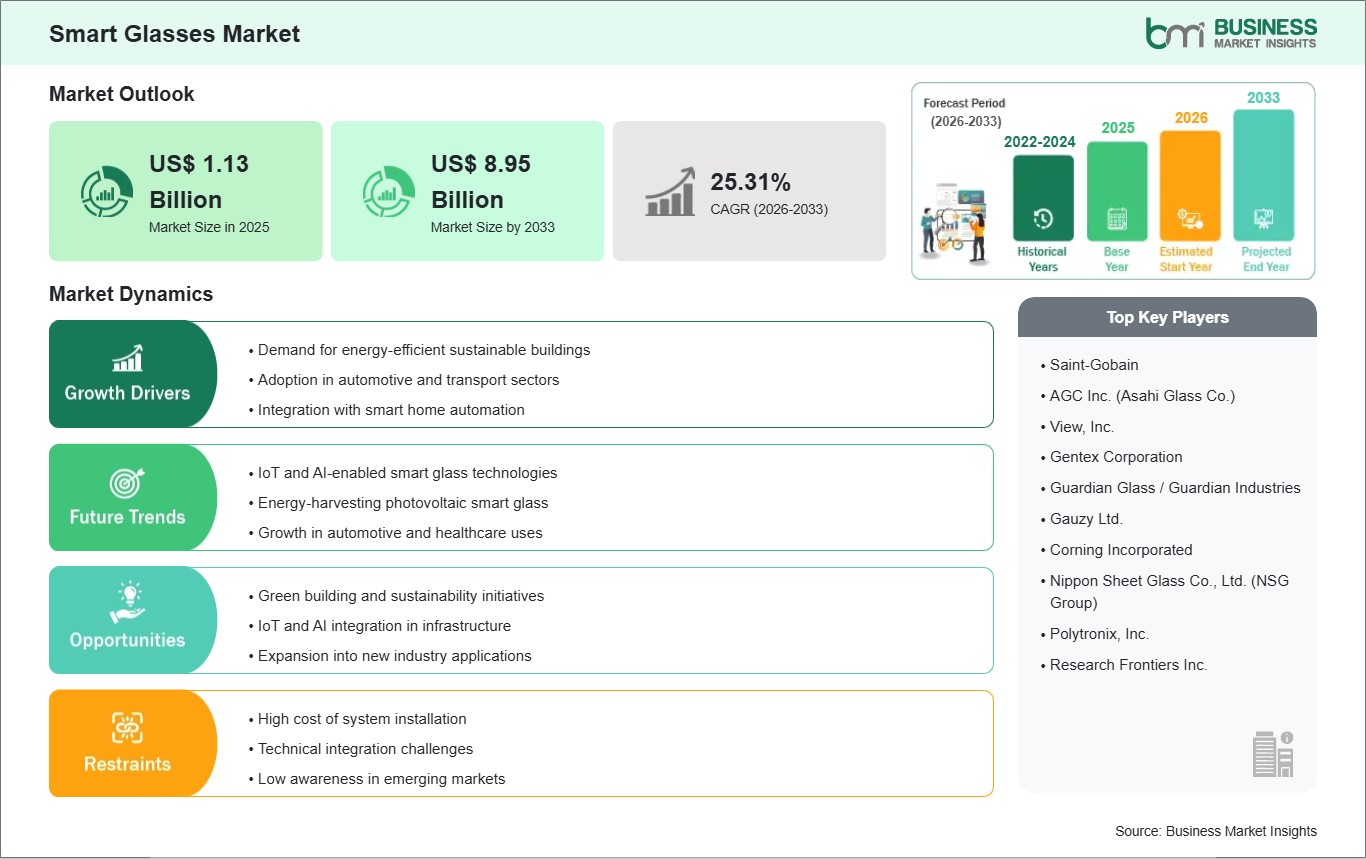
Smart glasses are wearable computing devices that augment the user's visual experience by overlaying information, such as three-dimensional (3D) holographic imagery and digital content, onto their field of view. These devices offer significant strategic advantages by shifting digital interaction from hand-held screens to a more intuitive, eye-level interface. Market growth is primarily driven by the global increase in AI-powered virtual assistants, rapid advancements in miniaturized display technologies such as MicroLED, and the widespread adoption of 5G connectivity, which enables low-latency data processing. Additionally, the emergence of fashion-oriented designs, resulting from collaborations between technology companies and established eyewear brands, is enhancing social acceptance and accelerating consumer adoption.
However, several challenges can restrain market growth. Limited battery life is a major obstacle, as the compact design of smart glasses restricts the capacity of power cells necessary for intensive augmented reality (AR) processing. Ongoing privacy and ethical concerns related to continuous camera operation and data collection have prompted regulatory scrutiny and contributed to public reluctance. Furthermore, the high production costs of specialized optical components, such as waveguides, often result in elevated retail prices that hinder widespread adoption, particularly in developing markets.
Despite these challenges, the market presents substantial opportunities, particularly in the adoption of hands-free industrial workflows and the increasing implementation of real-time language translation for international travelers. The advancement of assistive technologies for individuals with visual and hearing impairments, as well as the development of prescription-integrated smart lenses, is anticipated to drive long-term market growth.
Segment Analysis
Smart Glasses Market Segmentation
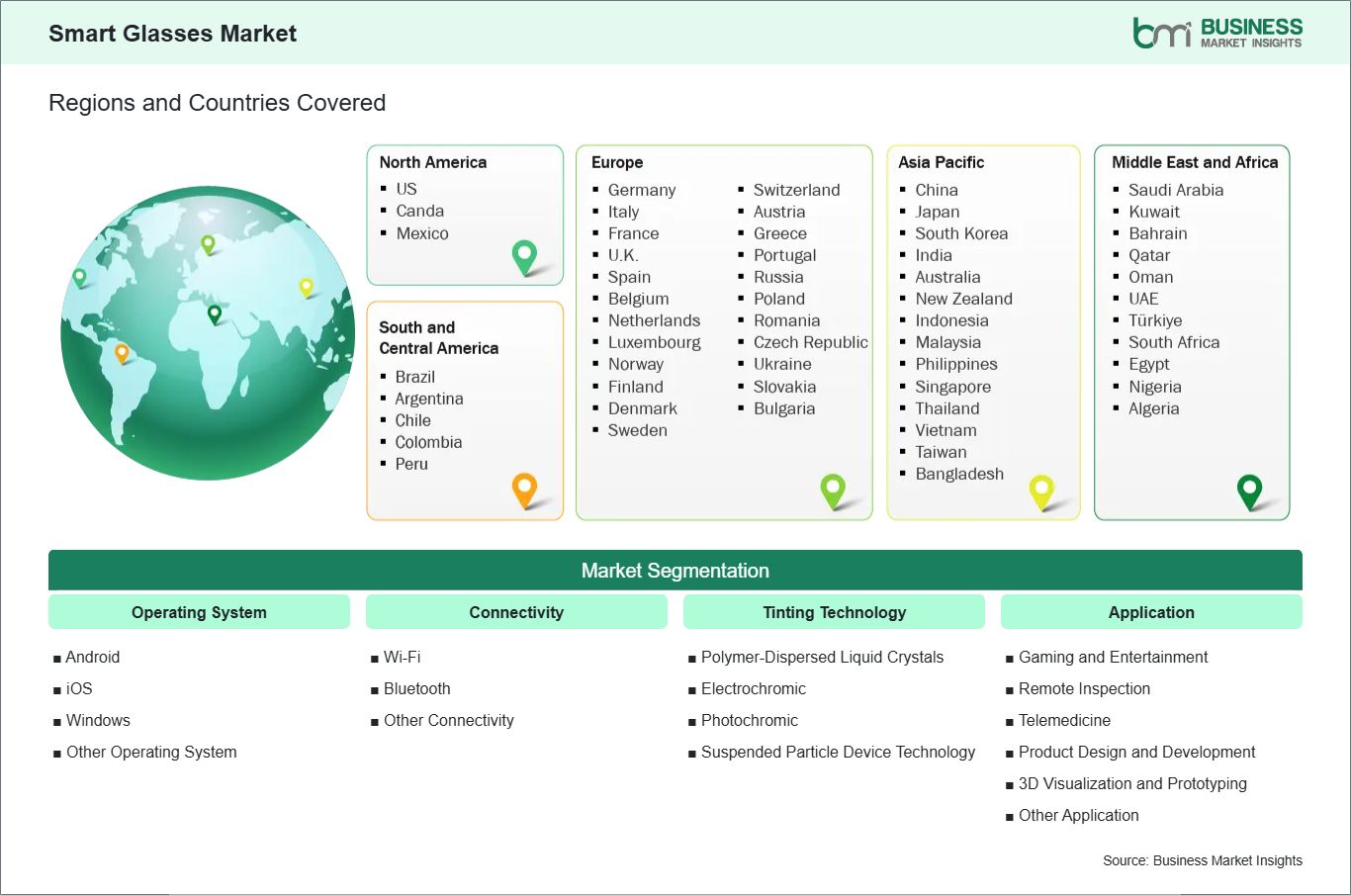
Key segments that contributed to the derivation of the Smart Glasses market analysis are operating system, connectivity, tinting technology, application, type, feature, and industry.
- By Operating System, the market is segmented into Android, iOS, Windows, and Others.
- By Connectivity, the market is divided into Wi-Fi, Bluetooth, and Others.
- By Tinting Technology, the market is categorized into Polymer-Dispersed Liquid Crystals, Electrochromic, Photochromic, and Suspended Particle Device Technology.
- By Application, the market is segmented into Gaming and Entertainment, Remote Inspection, Telemedicine, Product Design and Development, 3D Visualization and Prototyping, and Others.
- By Type, the market is divided into Monocular and Binocular.
- By Feature, the market is categorized into Basic and Advanced.
- By Industry, the market is segmented into Education & Research, Healthcare, Consumer, Automotive, Manufacturing, Warehousing, and Others.
Market Forces
Smart Glasses Market Drivers and Opportunities
Advancing Enterprise Efficiency and AI-Driven Consumer Utility
The primary driver of the smart glasses market is the rapid advancement of on-device artificial intelligence and edge computing, which enables real-time visual recognition, language translation, and voice-activated assistants without reliance on a tethered smartphone. In industrial and healthcare sectors, market growth is further supported by a necessary shift toward hands-free workflow optimization. Technicians and clinicians increasingly adopt smart glasses to access real-time schematics, receive remote expert assistance, and visualize digital twins, resulting in significant reductions in errors and training time. This trend is reinforced by the Ray-Ban Effect, referring to successful collaborations between technology companies and luxury eyewear brands that have addressed longstanding challenges related to social acceptance and aesthetic design. Additionally, the widespread availability of low-latency 5G connectivity facilitates seamless streaming of high-resolution augmented reality content, positioning smart glasses as a viable primary interface for navigation, social media, and continuous digital interactions. Collectively, these factors, including technological miniaturization, enterprise return on investment, and fashion-oriented designs, are driving rapid growth in the smart glasses market as it increasingly competes with smartphones.
Agentic AI Personal Assistants and B2B2C Hybrid Adoption
The convergence of smart glasses with agentic artificial intelligence (AI) personal assistants represents a significant high-value opportunity. Next-generation smart glasses are increasingly positioned as comprehensive cognitive companions, capable of proactively delivering contextually relevant information, such as identifying individuals at networking events or locating products on store shelves based on the user's visual input. Another major growth area is the development of prescription-integrated augmented reality (AR) solutions. Given that a substantial portion of the global population requires corrective lenses, integrating AR waveguides into standard prescription eyewear has the potential to unlock a vast, previously untapped consumer market.
Additionally, the expansion of remote healthcare and telemedicine is creating demand for specialized medical-grade smart glasses that enable surgeons to access vital signs or patient records within their direct line of sight during procedures. Beyond professional applications, the emergence of business-to-business-to-consumer (B2B2C) hybrid adoption models is accelerating market penetration. As employees become accustomed to using smart glasses for workplace training and logistics, they are more likely to adopt personal devices for activities such as fitness tracking, immersive gaming, and interactive travel. Manufacturers prioritizing extended battery life architectures and advancing eye-tracking sensors for intuitive gesture control are well positioned to lead the most innovative and high-margin segments of the global wearable technology market.
Size and Share Analysis
Smart Glasses Market Size and Share Analysis
The Smart Glasses market demonstrates steady growth, with size and share analysis revealing evolving trends and competitive positioning among key players. The report further examines subsegments categorized within operating system, connectivity, tinting technology, application, type, feature, and industry, offering insights into their contribution to overall market performance.
Based on operating system, Android and iOS subsegments hold a significant market presence, serving as the industry benchmark for consumer-facing wearable ecosystems. Android-based systems are indispensable for the Consumer electronics vertical, offering an open-source framework that allows a diverse range of manufacturers to launch affordable, AI-integrated eyewear. A notable trend is the surge in the Windows and Linux-based subsegments, which are registering higher traction in professional environments. These platforms are becoming essential for the Manufacturing and Healthcare sectors, providing the high levels of data security and operational stability required for HIPAA-compliant diagnostics and proprietary industrial workflow management.
Report Coverage
Smart Glasses Market Report Coverage and Deliverables
The "Smart Glasses Market Size and Forecast (2022 - 2033)" report provides a detailed analysis of the market covering below areas:
- Smart Glasses market size and forecast at global, regional, and country levels for all the key market segments covered under the scope
- Smart Glasses market trends, as well as market dynamics such as drivers, restraints, and key opportunities
- Smart Glasses market analysis covering key market trends, global and regional framework, major players, regulations, and recent market developments
- Industry landscape and competition analysis covering market concentration, heat map analysis, prominent players, and recent developments for the Smart Glasses market
- Detailed company profiles, including SWOT analysis
Geographic Insights
Smart Glasses Market Geographic Insights
The geographical scope of the Smart Glasses market report is divided into five regions: North America, Asia Pacific, Europe, Middle East & Africa, and South & Central America.
North America maintains the largest market share, supported by a high concentration of technology companies and a well-established ecosystem that encourages early adoption in both consumer and industrial markets. The Asia Pacific region is the fastest-growing market, propelled by extensive manufacturing capabilities and a technologically adept population that is increasingly incorporating wearable technology into everyday activities. Europe continues to play a significant role, emphasizing high-precision engineering and the integration of smart eyewear into healthcare and automotive professional settings.
The Asia-Pacific Smart Glasses Market is divided into China, Japan, South Korea, India, Australia, and the Rest of Asia. China functions as a primary center for manufacturing and innovation, with government programs such as Made in China promoting the development of affordable augmented reality solutions for logistics and heavy industry. Japan and South Korea are regional leaders in advanced display technologies and wearable devices designed to assist aging populations. In India, market expansion is driven by the rapid adoption of 5G technology and a youthful population interested in the latest fitness and entertainment wearables.
Industry Activity
Recent Developments
The Smart Glasses market is evaluated by gathering qualitative and quantitative data post primary and secondary research, which includes important corporate publications, association data, and databases. A few of the key developments in the Smart Glasses market are:
- In January 2026, Rokid launched the Rokid Ai Glasses Style, the world’s first open AI ecosystem smart glasses, featuring ultra-light design, prescription-first lenses, and support for ChatGPT, Qwen, DeepSeek, and more, accelerating mainstream adoption of AI-powered smart eyewear.
- In January 2026, Mentra launched Mentra Live, its first smart glasses featuring an open-source OS and the industry’s first app store for smart glasses, enabling AI integration, livestreaming, and developer-built miniapps, accelerating ecosystem-driven adoption of smart eyewear.
Trust & Transparency
Research Methodology
The market analysis combines proprietary research with secondary data from government agencies, company disclosures, regulatory filings, industry databases and expert interviews. Market estimates are validated through data triangulation, cross-market benchmarking and analyst
review.
View Full Research Methodology
Key Sources Referred:
World Bank - Global Trade IndicatorsWorld Trade Organization (WTO)International Monetary Fund (IMF)International Trade Administration (ITA)Company websiteCompany annual reportsCompany investor presentations