Smart Labels Market Outlook (2022-2033)

Historic Data: 2022-2024   |   Base Year: 2025   |   Forecast Period: 2026-2033
Report Content: Market Scope, Market Segmentation, Market Dynamics, and Competitive Analysis

Report Coverage:
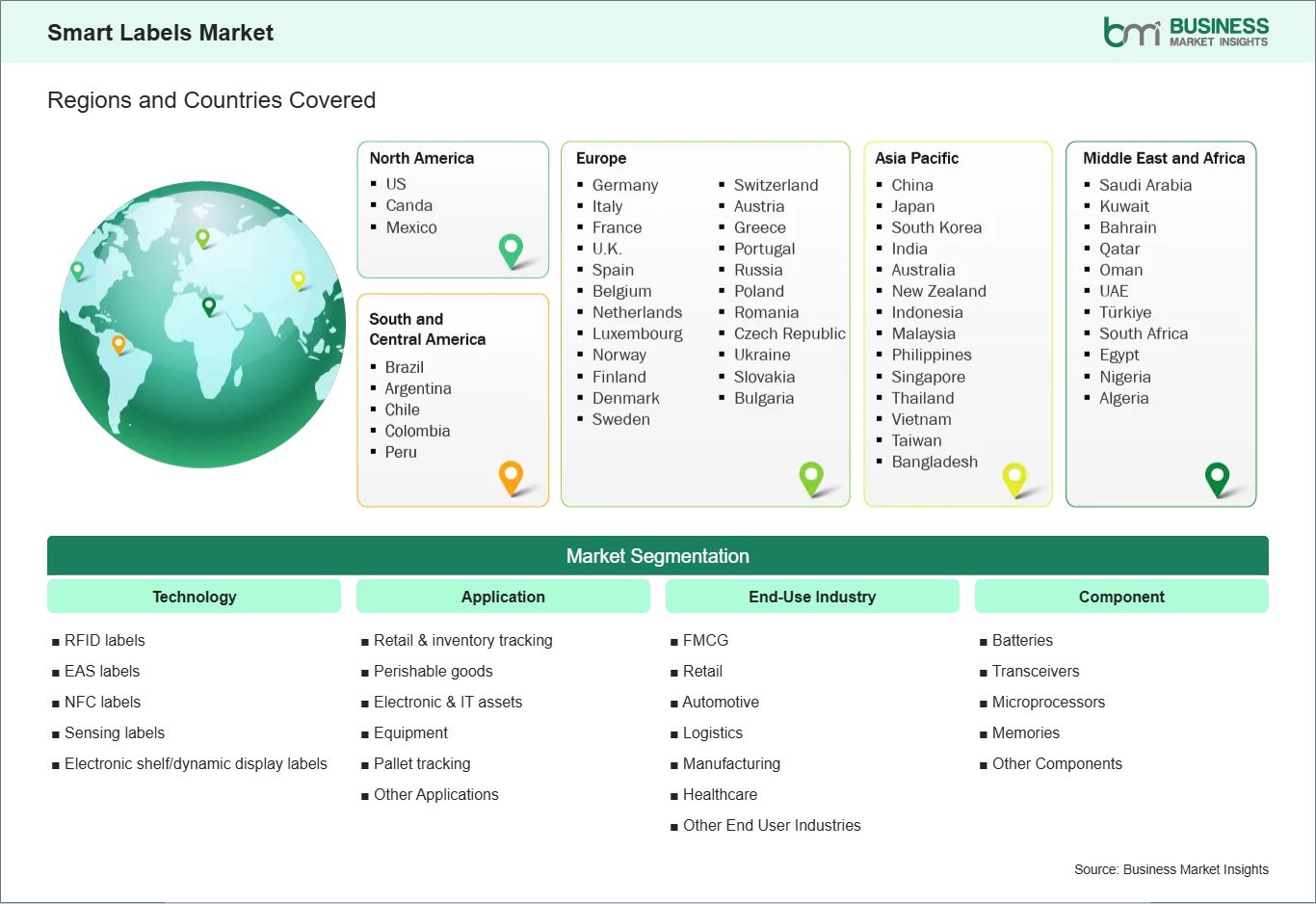
  • Technology (RFID labels, EAS labels, NFC labels, Sensing labels, Electronic shelf/dynamic display labels)
  • Application (Retail & inventory tracking, Perishable goods, Electronic & IT assets, Equipment, Pallet tracking, Other Applications)
  • End-Use Industry (FMCG, Retail, Automotive, Logistics, Manufacturing, Healthcare, Other End User Industries)
  • Component (Batteries, Transceivers, Microprocessors, Memories, Other Components)

No. of Pages: 389
Report Code: BMIPUB00034369
Category: Electronics and Semiconductor
Smart Labels Market

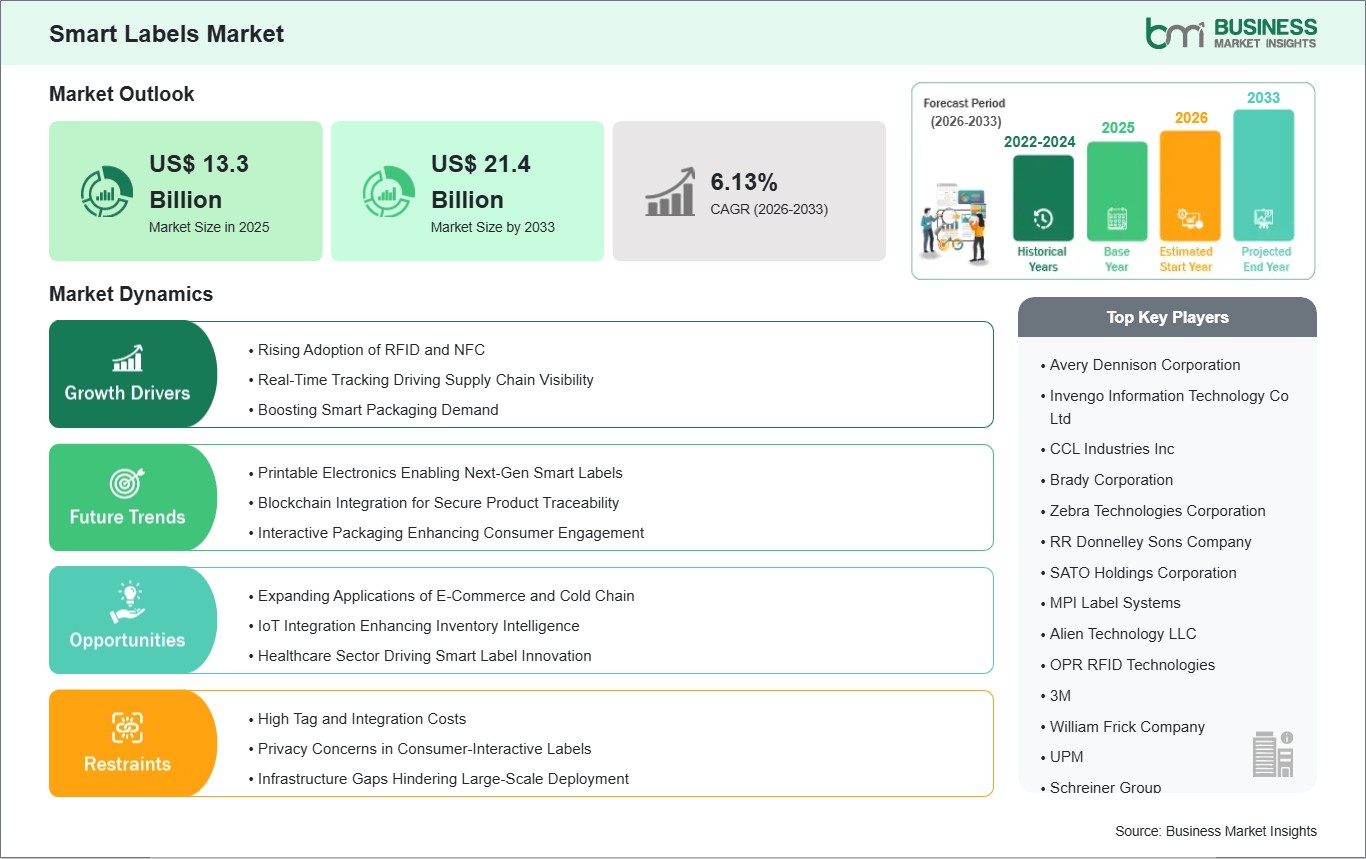
The Smart Labels Market size is expected to reach US$ 21.4 billion by 2033 from US$ 13.3 billion in 2025. The market is estimated to record a CAGR of 6.13% from 2026 to 2033.

Executive Summary and Global Market Analysis:

The smart labels market is also growing as a global phenomenon, as industries are looking for more intelligent ways of tracking, authenticating, and engaging with products. Smart labels, which use technologies such as RFID, NFC, QR codes, and sensor technology, are more intelligent than traditional labels as they can exchange data in real time. These smart labels are being increasingly used in industries such as retail, logistics, healthcare, and food & beverage, where traceability, transparency, and efficiency are becoming the norm. Organizations are increasingly using smart labels for better inventory management, counterfeiting, customer engagement, and regulatory compliance, especially in industries where product authenticity and safety are of utmost importance.

One of the strongest drivers of the smart labels market is the increasing demand for transparency and digital tracking in the supply chain, especially in a world where the logistics network is becoming more complex. Organizations are also using smart labels as a tool for creating engaging consumer experiences, where consumers can access content, authenticate products, or engage with digital content using their smartphones. However, challenges such as the cost of implementation, integration issues, and security issues may affect the adoption of smart labels by businesses. Nevertheless, the development of printing technologies, chip miniaturization, and the availability of cost-effective sensors are making smart labels more accessible. The market is gradually moving towards a promising future where the concept of labeling will become dynamic and data-driven.

Smart Labels Market - Strategic Insights:

global-market-strategic-framework
Get more information on this report

Smart Labels Market Segmentation Analysis:

Key segments that contributed to the derivation of the smart labels market analysis are technology, application, end-use industry, and component.

  • By technology, the smart label market is segmented into RFID labels, EAS labels, NFC labels, sensing labels, and electronic shelf/dynamic display labels. The RFID labels subsegment dominated the market in 2025.
  • Based on application, the smart label market is segmented into retail & inventory tracking, perishable goods, electronic & it assets, equipment, pallet tracking, and other applications. The retail & inventory tracking subsegment dominated the market in 2025.
  • In terms of end-use industry, the smart label market is segmented into FMCG, retail, automotive, logistics, manufacturing, healthcare, and other end user industries. The retail subsegment dominated the market in 2025.
  • On the basis of component, the smart label market is categorized into batteries, transceivers, microprocessors, memories, and other components. The batteries subsegment dominated the market in 2025.

Smart Labels Market Drivers and Opportunities:

Rising Adoption of RFID and NFC

The growing use of RFID and NFC technologies is transforming how products are identified, tracked, and interacted with across everyday life. Businesses are moving away from traditional labeling methods toward smart labels that can communicate wirelessly, offering real-time insights into where products are and how they are moving. This shift is making supply chains more transparent and efficient, helping companies reduce errors while improving visibility from production to delivery.

At the same time, NFC-enabled labels are creating new ways for brands to connect directly with consumers. With a simple tap on a smartphone, people can access product details, verify authenticity, or even explore interactive content. This turns packaging into more than just a container it becomes a digital touchpoint that enhances trust and engagement. For consumers, this added layer of information makes purchasing decisions easier and more informed.

Beyond retail and consumer goods, RFID and NFC are becoming essential in industries where accuracy and traceability matter most. From tracking sensitive medical supplies to managing high-value industrial assets, smart labels help ensure that the right products reach the right place at the right time. As these technologies become more embedded in daily operations, they are shaping a more connected and intelligent global ecosystem.

Expanding Applications of E-Commerce and Cold Chain

The rapid growth of e-commerce has created new demands for speed, accuracy, and transparency in logistics, opening up significant opportunities for smart labels. As more products move through complex delivery networks, businesses need better ways to track shipments and ensure that orders are fulfilled correctly. Smart labels provide real-time tracking and detailed insights, helping companies keep customers informed and maintain confidence in the delivery process.

Cold chain logistics is another area where smart labels are proving especially valuable. Products like fresh food, pharmaceuticals, and other temperature-sensitive goods require careful handling throughout their journey. Smart labels equipped with sensing capabilities can monitor conditions such as temperature and humidity, ensuring that products remain safe and effective. If something goes wrong, alerts can be triggered quickly, allowing for immediate action and reducing waste.

As e-commerce and cold chain systems continue to evolve, smart labels are becoming more sophisticated and multifunctional. They are no longer just tools for identification but are evolving into intelligent systems that provide insights into product quality and handling conditions. This shift is helping businesses operate more efficiently while also supporting sustainability by minimizing losses and improving resource management. In a world where supply chains are becoming increasingly complex, smart labels are emerging as a key enabler of smarter, more responsive logistics.

Smart Labels Market Size and Share Analysis:

The smart labels market is experiencing steady growth, with market size and share analysis reflecting evolving treatment preferences and competitive dynamics among key players. The report evaluates important subsegments categorized within technology, application, end-use industry, and component, highlighting their respective contributions to overall market performance.

By technology, the RFID labels subsegment dominated the Smart Label market in 2025. RFID technology enables real-time tracking, improved inventory visibility, and enhanced supply chain efficiency, making it the most widely adopted solution across industries.

Based on application, the retail & inventory tracking subsegment dominated the Smart Label market in 2025. The growing need for accurate stock management, loss prevention, and seamless supply chain operations has driven the extensive use of smart labels in retail and inventory tracking applications.

In terms of end-use industry, the retail subsegment dominated the Smart Label market in 2025. Retailers increasingly rely on smart labeling solutions to enhance operational efficiency, improve customer experience, and enable real-time product tracking, which supports strong adoption in this segment.

On the basis of component, the batteries subsegment dominated the Smart Label market in 2025. Batteries are essential for powering active smart labels, ensuring continuous data transmission and functionality, particularly in advanced tracking and monitoring applications.

Smart Labels Market Report Highlights:

Report Attribute Details
Market size in 2025 US$ 13.3 Billion
Market Size by 2033 US$ 21.4 Billion
Global CAGR (2026 - 2033)6.13%
Historical Data 2022-2024
Forecast period 2026-2033
Segments Covered By Technology
  • RFID labels
  • EAS labels
  • NFC labels
  • Sensing labels
  • Electronic shelf/dynamic display labels
By Application
  • Retail & inventory tracking
  • Perishable goods
  • Electronic & IT assets
  • Equipment
  • Pallet tracking
  • Other Applications
By End-Use Industry
  • FMCG
  • Retail
  • Automotive
  • Logistics
  • Manufacturing
  • Healthcare
  • Other End User Industries
By Component
  • Batteries
  • Transceivers
  • Microprocessors
  • Memories
  • Other Components
Regions and Countries Covered
North America US, Canada, Mexico
Europe Belgium, Austria, Finland, Denmark, Greece, Poland, Romania, Russia, Ukraine, Czech Republic, Slovakia, Bulgaria, Italy, Luxembourg, Germany, Switzerland, France, Netherlands, Norway, Portugal, Spain, Sweden, United Kingdom
Asia-Pacific Australia, China, India, Japan, South Korea, Indonesia, Malaysia, Philippines, Singapore, Thailand, Vietnam, Bangladesh, New Zealand, Taiwan
South and Central America Brazil, Argentina, Peru, Chile, Colombia
Middle East and Africa Bahrain, Kuwait, Oman, Qatar, Saudi Arabia, United Arab Emirates, Turkiye, South Africa, Egypt, Algeria, Nigeria
Market leaders and key company profiles
  • Avery Dennison Corporation
  • Invengo Information Technology Co Ltd
  • CCL Industries Inc
  • Brady Corporation
  • Zebra Technologies Corporation
  • RR Donnelley Sons Company
  • SATO Holdings Corporation
  • MPI Label Systems
  • Alien Technology LLC
  • OPR RFID Technologies
Get more information on this report

Smart Labels Market Report Coverage and Deliverables:

The "Smart Labels Market Size and Forecast (2022 - 2033)" report provides a detailed analysis of the market covering below areas:

  • Smart Labels market size and forecast at global, regional, and country levels for all the key market segments covered under the scope
  • Smart Labels market trends, as well as drivers, restraints, and opportunities
  • Smart Labels market analysis covering key trends, regional framework, major players, regulations, and recent developments
  • Industry landscape and competition analysis covering market concentration, heat map analysis, prominent players, and recent developments for the Smart Labels market
  • Detailed company profiles, including SWOT analysis

Smart Labels Market Geographic Insights:

The geographical scope of the Smart Labels market report is divided into five regions: North America, Asia Pacific, Europe, Middle East & Africa, and South & Central America. The Smart Labels market in North America is expected to grow during the forecast period.

North America is at the forefront of the smart labels market thanks to its advanced supply chain systems, focus on new technology, and strong need for product traceability. More companies in the United States and Canada are using smart labels to make logistics more efficient, cut down on losses, and keep a better track of inventory in real time. Retailers are especially turning to RFID labels to simplify their operations, manage stock, and offer smoother shopping experiences. Other industries, like pharmaceuticals and food and beverages, also depend on smart labels to meet safety rules and show where products come from and how they are handled.

The region is also known for its focus on engaging consumers. Many brands use NFC and QR labels to connect with customers, share product details, verify authenticity, and offer personalized digital content. This move is part of a larger trend toward interactive packaging and connected products. Even with its strong tech base, North America still faces issues like data privacy, cybersecurity, and the need for common standards across labeling technologies. Still, the region leads the way globally, showing how smart labels can improve supply chains, build brand trust, and create a more open and connected market.

global-market-geography
Get more information on this report

Smart Labels Market Research Report Guidance:

  • The report includes qualitative and quantitative data in the Smart Labels market across technology, application, end-use industry, component, and geography.
  • The report starts with the key takeaways (chapter 2), highlighting the key trends and outlook of the Smart Labels market.
  • Chapter 3 focuses on the research methodology of the study.
  • Chapter 4 includes ecosystem analysis.
  • Chapter 5 highlights the major industry dynamics in the Smart Labels market, including factors that are driving the market, prevailing deterrents, potential opportunities, as well as future trends. Impact analysis of these drivers and restraints is also covered in this section.
  • Chapter 6 discusses the Smart Labels market scenario, in terms of historical market revenues, and forecast till the year 2033.
  • Chapters 7 to 1 cover the Smart Labels market segments by technology, application, end-use industry, component, and geography across North America, Europe, Asia Pacific, Middle East and Africa, and South and Central America. They cover the market volume, revenue forecast, and factors driving the market.
  • Chapter 12 describes the competitive analysis with the heat map analysis for the key players operating in the market.
  • Chapter 13 describes the industry landscape analysis. It provides detailed descriptions of business activities such as market initiatives, new developments, mergers, and joint ventures globally, along with a competitive landscape.
  • Chapter 14 provides detailed profiles of the major companies operating in the Smart Labels market. Companies have been profiled on the basis of their key facts, business descriptions, products, financial overview, SWOT analysis, and key developments.
  • Chapter 15, i.e., the appendix, is inclusive of a brief overview of the company, list of abbreviations, and disclaimer.

Smart Labels Market News and Key Development:

The smart labels market is evaluated by gathering qualitative and quantitative data post primary and secondary research, which includes important corporate publications, association data, and databases. A few of the key developments in the smart labels market are:

  • In October 2025, Avery Dennison announced that it had collaborated with Walmart to introduce first-of-its-kind RFID-enabled smart labels for fresh food categories (meat, bakery, and deli), enabling real-time inventory tracking, improved freshness management, and reduced food waste through item-level digital identification.
  • In September 2025, Avery Dennison announced that it had expanded its strategic partnership with Wiliot to scale ambient IoT-based smart label solutions, including the manufacturing of next-generation Bluetooth-enabled sensor labels to enhance real-time supply chain visibility and accelerate global adoption of intelligent labeling technologies.

Key Sources Referred:

  • International Organization for Standardization (ISO)
  • American Society for Testing and Materials (ASTM International)
  • Bureau of Indian Standards (BIS)
  • Environmental Protection Agency (EPA), USA
  • European Chemicals Agency (ECHA)
  • Central Pollution Control Board (CPCB), India
  • Ministry of Chemicals and Fertilizers, India
  • American Chemistry Council (ACC)
  • Indian Chemical Council (ICC)
  • European Chemical Industry Council (Cefic)
  • Specialty Chemical Association of India (SCAI)
  • Company Websites
  • Company Annual Reports
  • Company Investor Presentations
The List of Companies - Smart Labels Market
  • Avery Dennison Corporation
  • Invengo Information Technology Co Ltd
  • CCL Industries Inc
  • Brady Corporation
  • Zebra Technologies Corporation
  • RR Donnelley Sons Company
  • SATO Holdings Corporation
  • MPI Label Systems
  • Alien Technology LLC
  • OPR RFID Technologies
  • 3M
  • William Frick Company
  • UPM
  • Schreiner Group
  • TOPPAN Holdings Inc
Frequently Asked Questions
How big is the Smart Labels Market?

The Smart Labels Market is valued at US$ 13.3 Billion in 2025, it is projected to reach US$ 21.4 Billion by 2033.

What is the CAGR for Smart Labels Market by (2026 - 2033)?

As per our report Smart Labels Market, the market size is valued at US$ 13.3 Billion in 2025, projecting it to reach US$ 21.4 Billion by 2033. This translates to a CAGR of approximately 6.13% during the forecast period.

What segments are covered in this report?

The Smart Labels Market report typically cover these key segments-

  • Technology (RFID labels, EAS labels, NFC labels, Sensing labels, Electronic shelf/dynamic display labels)
  • Application (Retail & inventory tracking, Perishable goods, Electronic & IT assets, Equipment, Pallet tracking, Other Applications)
  • End-Use Industry (FMCG, Retail, Automotive, Logistics, Manufacturing, Healthcare, Other End User Industries)
  • Component (Batteries, Transceivers, Microprocessors, Memories, Other Components)

What is the historic period, base year, and forecast period taken for Smart Labels Market?

The historic period, base year, and forecast period can vary slightly depending on the specific market research report. However, for the Smart Labels Market report:

  • Historic Period : 2022-2024
  • Base Year : 2025
  • Forecast Period : 2026-2033
  • Who are the major players in Smart Labels Market?

    The Smart Labels Market is populated by several key players, each contributing to its growth and innovation. Some of the major players include:

  • Avery Dennison Corporation
  • Invengo Information Technology Co Ltd
  • CCL Industries Inc
  • Brady Corporation
  • Zebra Technologies Corporation
  • RR Donnelley Sons Company
  • SATO Holdings Corporation
  • MPI Label Systems
  • Alien Technology LLC
  • OPR RFID Technologies
  • 3M
  • William Frick Company
  • UPM
  • Schreiner Group
  • TOPPAN Holdings Inc
  • Who should buy this report?

    The Smart Labels Market report is valuable for diverse stakeholders, including:

    • Investors: Provides insights for investment decisions pertaining to market growth, companies, or industry insights. Helps assess market attractiveness and potential returns.
    • Industry Players: Offers competitive intelligence, market sizing, and trend analysis to inform strategic planning, product development, and sales strategies.
    • Suppliers and Manufacturers: Helps understand market demand for components, materials, and services related to concerned industry.
    • Researchers and Consultants: Provides data and analysis for academic research, consulting projects, and market studies.
    • Financial Institutions: Helps assess risks and opportunities associated with financing or investing in the concerned market.

    Essentially, anyone involved in or considering involvement in the Smart Labels Market value chain can benefit from the information contained in a comprehensive market report.

    Available Report Formats

    pdf-format excel-format pptx-format
    Buy Now
    Sales Assistance
    +1 646 791 7070 (US & UK)
    Customization Form

    Please tell us your area of interest
    (Market Segments/ Regions and Countries/ Companies)