Market Summary
Executive Summary and Global Market Analysis
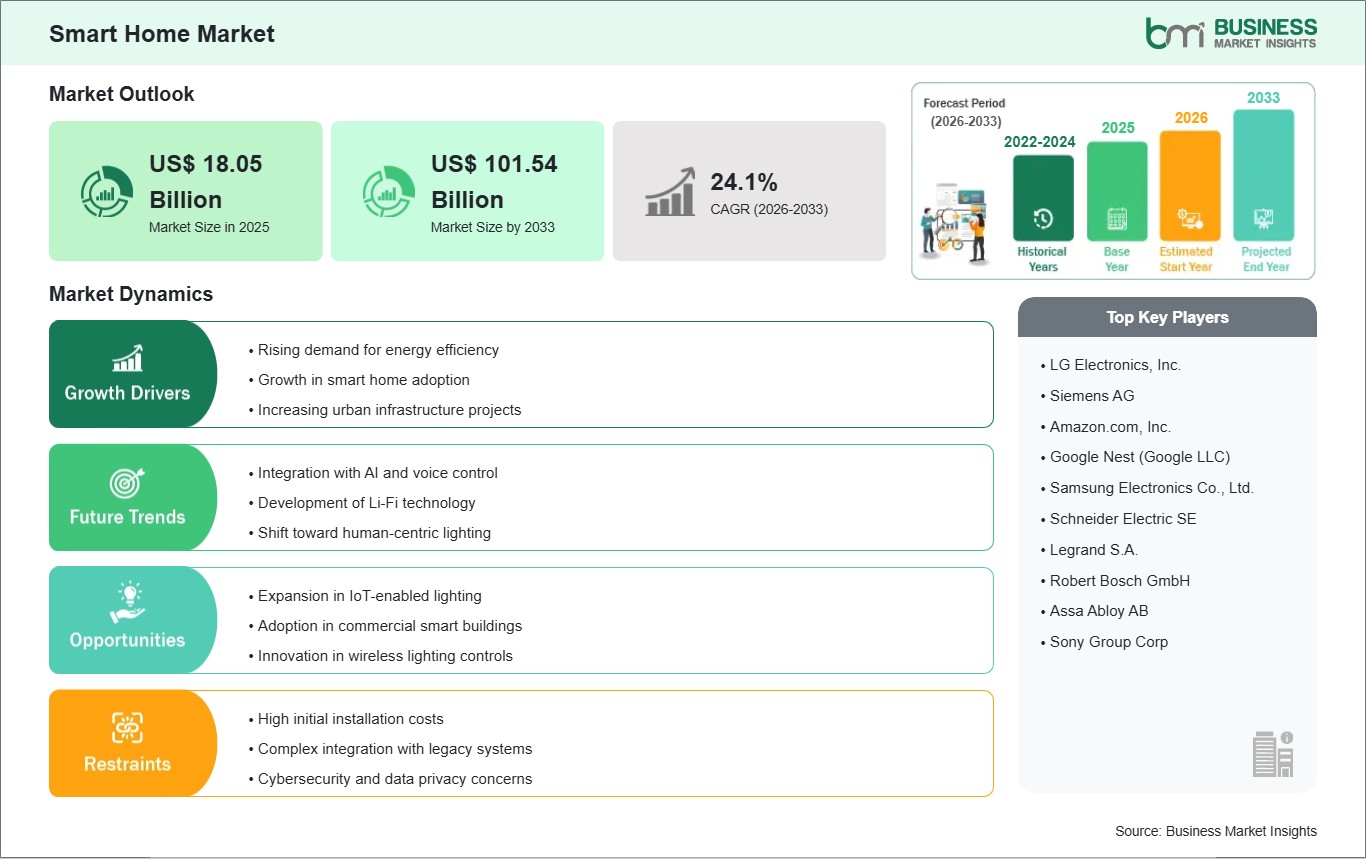
The Smart Home market represents the ecosystem of connected devices and systems that automate and remotely control various functions within a residence, such as lighting, temperature, entertainment, and security.
The Smart Home market is experiencing robust expansion driven by the exponential global demand for convenience, enhanced security features, and energy efficiency benefits. This growth is fueled by the rapid adoption of the Internet of Things (IoT), advancements in Artificial Intelligence (AI), and the proliferation of high-speed internet access, particularly 5G networks. Smart homes are transitioning from luxury items to mainstream consumer products, offering a seamless and integrated user experience.
Segment Analysis
Smart Home Market Segmentation
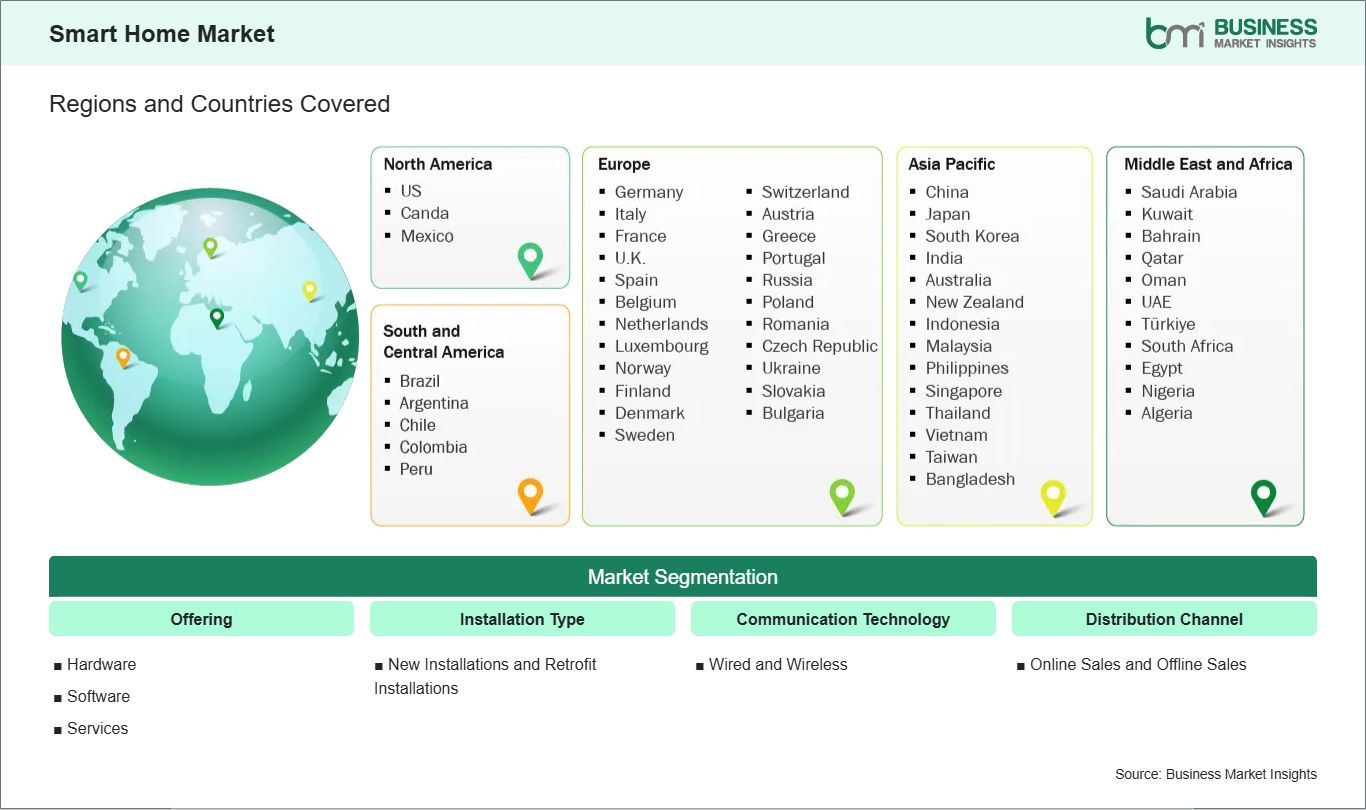
Key segments that contributed to the derivation of the Smart Home Market analysis are offering, product, installation type, and distribution channel.
- By Offering, the market is segmented into Hardware, Software, and Services.
- By Product, the market is segmented into Lighting Controls, Security & Access Controls, HVAC Controls, Energy Management Systems, and Others.
- By Installation Type, the market is segmented into New and Retrofit.
- By Distribution Channel, the market is segmented into Online Sales and Offline Sales.
Market Forces
Smart Home Market Drivers and Opportunities
Rising Adoption of the Internet of Things (IoT) and AI Integration
The proliferation of the Internet of Things (IoT) platform is a fundamental global economic factor driving the Smart Home market's expansion. IoT enables everyday objects to connect and exchange data, which is the very foundation of a smart home ecosystem. With billions of connected devices expected by 2025, this trend creates a massive, interconnected network of sensors, gadgets, and appliances.
- Enhanced Functionality: IoT-based technology offers energy-saving features, remote monitoring, and advanced automation. For example, a smart thermostat (an IoT device) learns occupant behavior to optimize heating and cooling, leading to significant energy savings.
- Seamless Interoperability: The growing push for industry standards like Matter is breaking down barriers, allowing devices from different brands to communicate seamlessly.
- AI for Personalization: The integration of Artificial Intelligence (AI) transforms simple automation into predictive automation. AI-driven systems learn user behaviors, adapt to individual preferences, and anticipate needs (e.g., proactively adjusting security settings or ambient lighting), making the smart home experience more intuitive, hands-free, and indispensable for the consumer. This seamless, personalized experience is a critical driver for first-time adopters and repeat purchasers.
Expansion of Home Healthcare and Assisted Living Solutions
The aging global population and the increasing demand for "aging-in-place" solutions present a significant, high-growth opportunity for the Smart Home Market. Home healthcare solutions leverage smart home technology to monitor and assist elderly residents and individuals with chronic conditions from the comfort and safety of their homes.
- Remote Monitoring: Smart health monitoring systems use IoT and AI to track vital signs, detect falls, monitor medication adherence, and manage chronic conditions. Connected stethoscopes and smart glucose monitors can stream real-time patient data to clinicians, enabling remote health assessments and telehealth services.
- Safety and Assistance: Voice-controlled hubs can double as medical-alert systems, allowing users to call for help instantly. Smart locks and access control can grant temporary, secure access to caregivers or emergency services.
Size and Share Analysis
Smart Home Market Size and Share Analysis
The Smart Home Market demonstrates consistent growth, with size and share analysis revealing strong positioning for material and product leaders amid customization trends. The report examines subsegments within offering, product, installation type, and distribution channel, providing insights into their contribution to overall market performance.
For instance, the Hardware subsegment holds a significant share due to the tangible demand for smart appliances, sensors, and controllers. Security & Access Controls lead product revenues, driven by the global priority for residential safety. Online Sales remain a top distribution channel, supported by the convenience of e-commerce platforms and technical reviews, while the Retrofit segment currently holds a significant share as owners of existing homes upgrade to smart technology.
Report Coverage
Smart Home Market Report Coverage and Deliverables
The "Smart Home Market Size and Forecast (2022 - 2033)" report provides a detailed analysis of the market covering below areas:
- Smart Home Market size and forecast at global, regional, and country levels for all the key market segments covered under the scope
- Smart Home Market trends, as well as market dynamics such as drivers, restraints, and key opportunities
- Smart Home Market analysis covering key market trends, global and regional framework, major players, regulations, and recent market developments
- Industry landscape and competition analysis covering market concentration, heat map analysis, prominent players, and recent developments for the Smart Home Market
- Detailed company profiles, including SWOT analysis
Geographic Insights
Smart Home Market Geographic Insights
The geographical scope of the Smart Home Market report is divided into five regions: North America, Asia Pacific, Europe, Middle East & Africa, and South & Central America.
North America holds a significant share due to high consumer spending, mature IoT infrastructure, and the strong presence of major technology firms. The US drives adoption through demand for security, convenience, and energy-saving solutions. Asia Pacific is projected to be the fastest-growing region. This rapid acceleration is fueled by increasing disposable income, swift urbanization, massive government investment in Smart City projects (China, India, South Korea), and a large, tech-savvy consumer base.
Europe represents a mature, substantial market driven by stringent energy efficiency regulations and a high demand for advanced HVAC and lighting controls. European consumers prioritize data privacy and interoperability, further accelerated by the Matter standard adoption. The Middle East & Africa and South & Central America regions currently hold smaller shares. Growth in the Middle East is tied to high-end new construction and Smart City ventures, while South & Central America are gradually expanding, primarily focusing on smart security and access control systems.
Industry Activity
Recent Developments
The Smart Home Market is evaluated by gathering qualitative and quantitative data post-primary and secondary research, which includes important corporate publications, association data, and databases. A few of the key developments in the Smart Home Market are:
- In October 2025, Amazon announced a new lineup of devices that introduced innovations across entertainment, reading, smart home security, and voice assistance that work together to create more intelligent, personalised experiences for customers. The new collection spans everything from an affordable 4K streaming device to the first-ever color Kindle Scribe, plus security cameras that deliver cinema-quality clarity and Echo devices engineered for the future of AI.
- In March 2025, Samsung Electronics unveiled its refreshed “AI Home” vision and innovative appliance lineup at its global launch event, Welcome to Bespoke AI, in Seoul, Korea. With a focus on providing a more secure and intuitive user experience, the company introduced an AI Home experience, showcasing advanced AI features and a wider range of screen-enabled appliances.
Trust & Transparency
Research Methodology
The market analysis combines proprietary research with secondary data from government agencies, company disclosures, regulatory filings, industry databases and expert interviews. Market estimates are validated through data triangulation, cross-market benchmarking and analyst
review.
View Full Research Methodology
Key Sources Referred:
World Bank - Global Trade IndicatorsWorld Trade Organization (WTO)International Monetary Fund (IMF)International Trade Administration (ITA)Company WebsiteCompany Annual ReportsCompany Investor Presentations