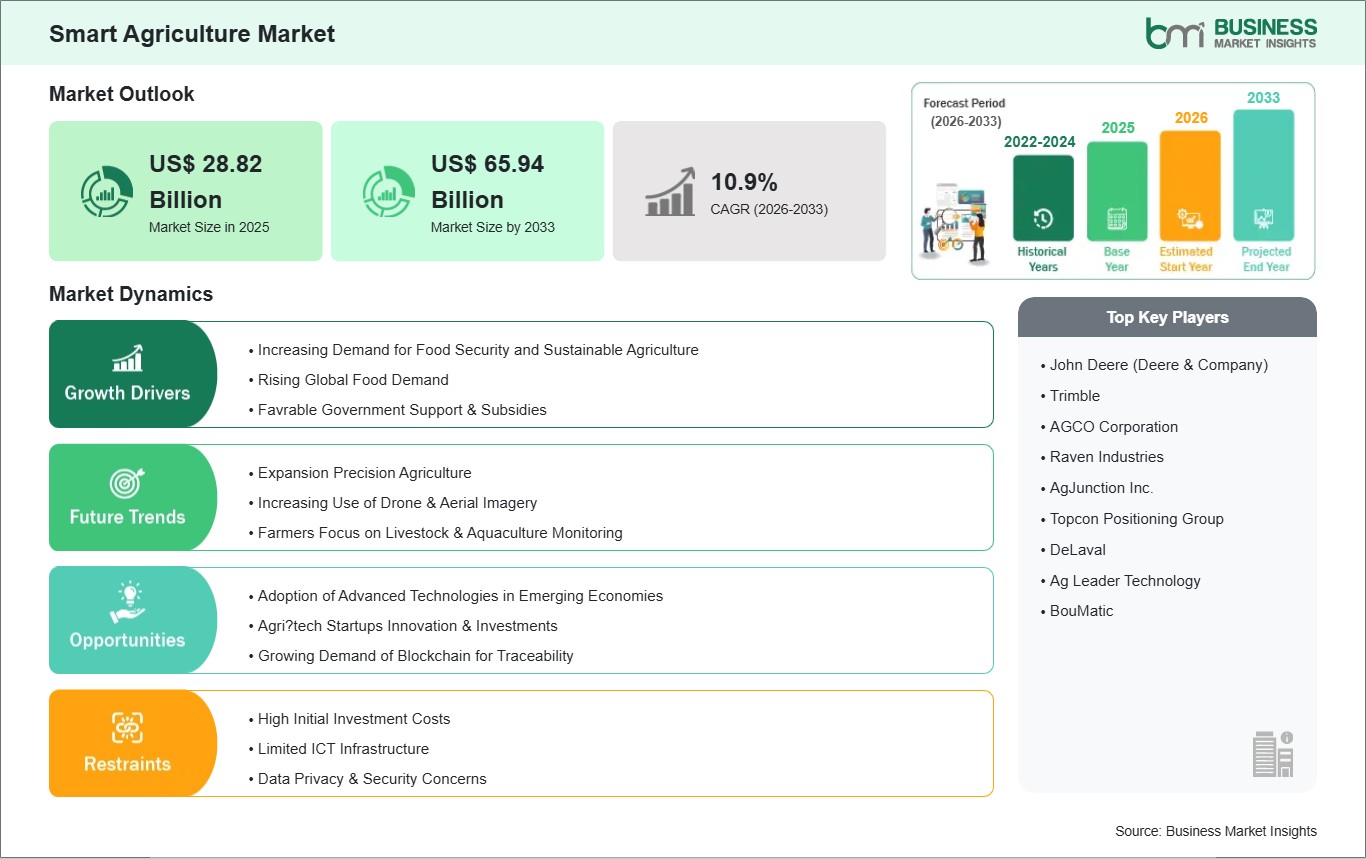
The smart agriculture market size is expected to reach US$ 65.94 billion by 2033 from US$ 28.82 billion in 2025. The market is estimated to record a CAGR of 10.9% from 2026 to 2033.
Smart agriculture refers to the integration of advanced technologies such as the Internet of Things (IoT), artificial intelligence (AI), drones, precision sensors, and data analytics into traditional farming practices to enhance productivity, sustainability, and efficiency. It is used to monitor crop health, optimize irrigation, manage soil quality, automate machinery, and predict yields by collecting and analyzing real‑time data from fields. The benefits of smart agriculture are extensive: it reduces input costs by applying water, fertilizers, and pesticides only where needed; increases crop yields through precise resource management; minimizes environmental impact by lowering waste and runoff; and enhances decision‑making with predictive insights. Major drivers of the smart agriculture market include the growing global demand for food due to population expansion, increasing scarcity of arable land and water, rising labor costs, and government policies supporting digital farming innovations.
Additionally, advancements in connectivity (like 5G), falling sensor costs, and the need for climate‑adapted farming solutions are accelerating adoption. However, restraints such as high initial investment costs, limited digital infrastructure in rural areas, data privacy concerns, and the need for technical skills among farmers pose challenges to widespread implementation. Despite these restraints, significant opportunities exist in developing affordable technology solutions for smallholder farmers, expanding precision agriculture services in emerging markets, and leveraging big data for supply chain optimization. Current market trends include the proliferation of autonomous farming equipment, AI‑driven crop management platforms, blockchain for traceability, and increased use of satellite imagery, all of which are reshaping how agriculture meets the demands of a sustainable and resilient future.

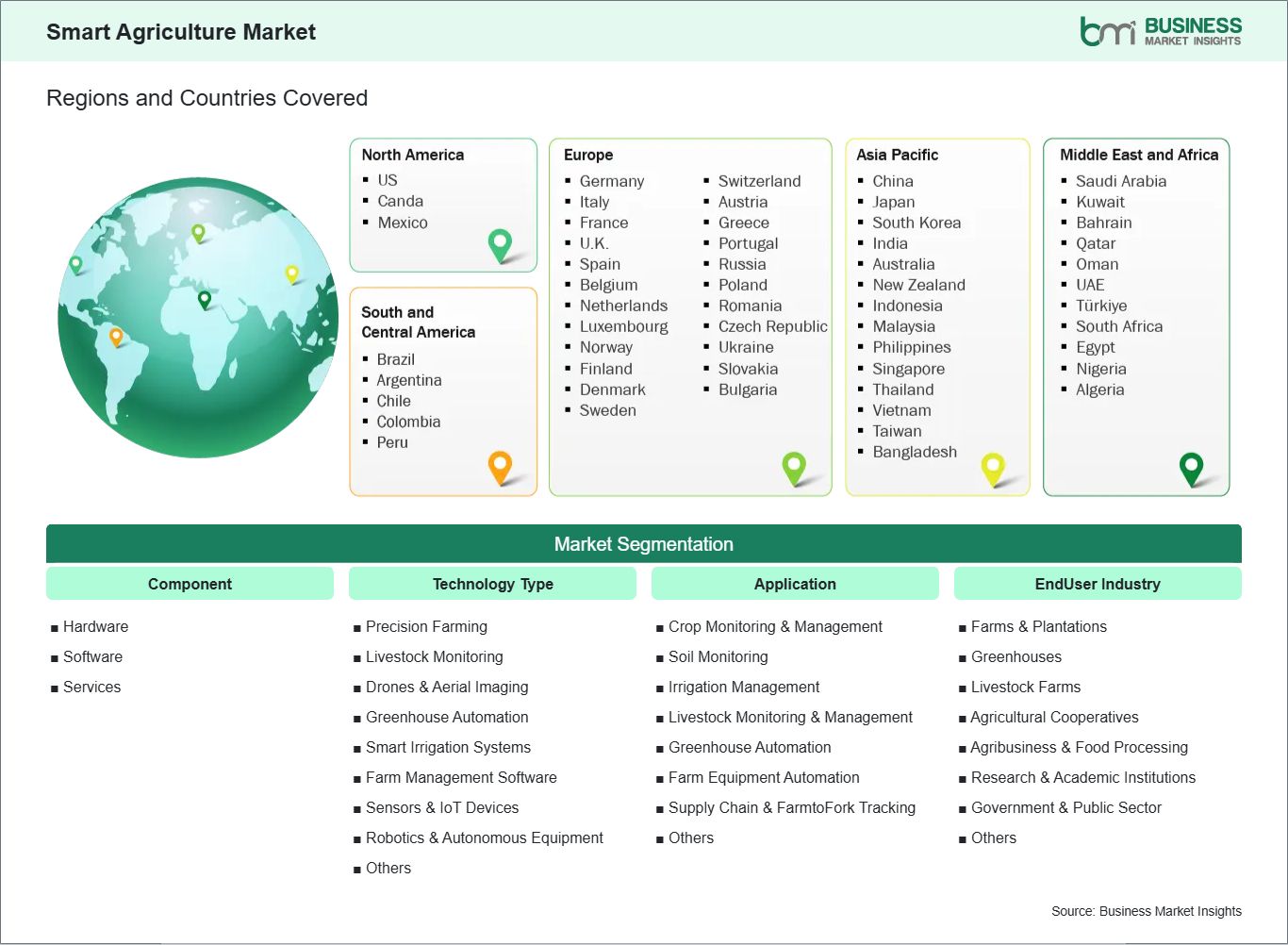
Key segments that contributed to the derivation of the smart agriculture market analysis are component, technology type, application, and end-use industry.
One of the primary drivers of the smart agriculture market is the rising global demand for food, coupled with the pressing need for sustainable agricultural practices. As the world population is projected to surpass 9 billion by 2050, traditional farming methods are insufficient to meet the escalating food requirements. This surge in demand has compelled farmers, agribusinesses, and governments to adopt advanced technologies that can optimize crop yields while minimizing resource consumption. Smart agriculture leverages innovations such as precision farming, IoT-enabled sensors, drones, and AI-driven analytics to monitor soil health, water usage, pest infestations, and crop growth patterns. These technologies enable real-time decision-making, reducing waste and enhancing productivity. Moreover, environmental concerns, such as climate change, soil degradation, and water scarcity, have reinforced the necessity for sustainable farming solutions. Smart agriculture provides data-driven insights that allow for the precise application of fertilizers, pesticides, and irrigation, thereby conserving natural resources and reducing environmental impact. Governments worldwide are also incentivizing the adoption of these technologies through subsidies, grants, and policy frameworks, further propelling market growth. The integration of big data analytics, cloud computing, and automated machinery ensures that farmers can maximize efficiency and profitability while meeting the growing global food demand responsibly. Overall, the convergence of population growth, food security concerns, and environmental sustainability forms a robust driver for the widespread adoption and expansion of smart agriculture technologies.
Emerging economies present a significant growth opportunity for the smart agriculture market due to increasing mechanization, government support, and technology adoption in these regions. Many developing countries rely heavily on agriculture as a major economic sector, yet they face challenges such as labor shortages, low crop productivity, and inefficient supply chains. The introduction of smart agriculture solutions—including precision farming tools, remote sensing devices, automated irrigation systems, and AI-driven crop management platforms—can transform traditional farming into a more productive and profitable sector. Governments and international organizations are increasingly investing in digital infrastructure and training programs to encourage farmers to adopt these technologies.
Additionally, the proliferation of affordable IoT devices, cloud-based platforms, and mobile applications makes it feasible for small and medium-scale farmers to implement smart farming practices. These technologies not only optimize resource utilization but also provide access to real-time data, market insights, and predictive analytics, which empower farmers to make informed decisions, reduce operational risks, and improve crop quality. Furthermore, the rising penetration of smartphones and internet connectivity in rural areas facilitates the dissemination of agricultural knowledge and technology, creating a digitally enabled farming ecosystem. With increasing awareness about the benefits of smart agriculture and supportive policies in emerging markets, companies have a significant opportunity to expand their footprint, introduce scalable solutions, and drive market growth while contributing to sustainable development and food security.
By component, the market is segmented into hardware, software, and services. The hardware segment held the largest share of the market in 2025. The global demand for hardware is rising due to rapid technological advancements, increased reliance on digital infrastructure, and growing adoption of cloud computing, artificial intelligence, and IoT devices. Additionally, expanding data centers, remote work trends, and consumer electronics growth contribute to continuous hardware consumption, driving worldwide market expansion and innovation.
By technology type, the market is segmented into precision farming, livestock monitoring, drones & aerial imaging, greenhouse automation, smart irrigation systems, farm management software, sensors & IoT devices, robotics & autonomous equipment, others. The sensors & IoT devices segment held the largest share of the market in 2025. The demand for sensors and IoT devices in smart agriculture is rising due to the need for precision farming, real-time monitoring, and resource optimization. These technologies enable efficient water use, soil health tracking, crop yield prediction, and pest control, reducing costs and environmental impact while improving productivity and sustainability.
By application, the market is segmented into crop monitoring & management, soil monitoring, irrigation management, livestock monitoring & management, greenhouse automation, farm equipment automation, supply chain & farm-to-fork tracking, and others. The crop monitoring & management segment held the largest share of the market in 2025. The demand for smart agriculture components in crop monitoring and management is rising due to the need for higher efficiency, precise resource utilization, and reduced labor costs. Advanced sensors, drones, and IoT devices enable real-time monitoring, early disease detection, and optimized irrigation, ensuring improved crop yield, sustainability, and data-driven decision-making.
By end-use industry, the market is segmented into farms & plantations, greenhouses, livestock farms, agricultural cooperatives, agribusiness & food processing, research & academic institutions, government & public sector, and others. The farms & plantations segment held the largest share of the market in 2025. The rising demand for smart agriculture components in farms and plantations is driven by the need for higher crop yields, efficient resource management, and reduced labor costs. Advanced sensors, automated irrigation, and precision farming technologies help monitor soil, weather, and crop health, ensuring sustainable practices and maximizing productivity in modern agriculture.

| Report Attribute | Details |
|---|---|
| Market size in 2025 | US$ 28.82 Billion |
| Market Size by 2033 | US$ 65.94 Billion |
| Global CAGR (2026 - 2033) | 10.9% |
| Historical Data | 2022-2024 |
| Forecast period | 2026-2033 |
| Segments Covered | By Component
|
| Regions and Countries Covered | North America
|
| Market leaders and key company profiles |
|
The Smart Agriculture Market Size and Forecast (2022–2033) report provides a detailed analysis of the market covering below areas:
The geographical scope of the smart agriculture market report is divided into five regions: North America, Asia Pacific, Europe, Middle East & Africa, and South & Central America. The smart agriculture market in Asia Pacific is expected to grow significantly during the forecast period.
The demand for smart agriculture in North America is being driven by a combination of technological, economic, environmental, and societal factors that are reshaping the agricultural landscape. One of the primary drivers is the need for increased efficiency and productivity to meet the rising food demand from a growing population. Precision agriculture technologies, such as GPS-guided machinery, drones, and IoT-enabled sensors, allow farmers to optimize resource usage, monitor crop health, and reduce waste, making farming more profitable and sustainable. Economic incentives also play a significant role; rising labor costs and the need to reduce operational expenses encourage the adoption of automation and data-driven farming solutions. Environmental concerns are another critical factor, as climate change, water scarcity, and soil degradation push farmers to adopt practices that minimize environmental impact while maintaining high yields. Smart agriculture technologies enable better water management, precise fertilization, and reduced chemical usage, aligning with sustainability goals.
Additionally, government policies and subsidies in North America that support technological innovation in agriculture further fuel adoption. Consumer preferences for high-quality, safe, and traceable food products also influence the demand for smart agriculture, as technologies like blockchain and remote monitoring enhance transparency throughout the supply chain. Moreover, the increasing penetration of smartphones, cloud computing, and AI in rural areas has made smart farming tools more accessible, allowing farmers to leverage real-time data for decision-making. Collectively, these technological, economic, environmental, and social factors create a strong and growing demand for smart agriculture solutions across North America, positioning the region as a leader in modern agricultural innovation.

The smart agriculture market is evaluated by gathering qualitative and quantitative data post primary and secondary research, which includes important corporate publications, association data, and databases. A few of the key developments in the smart agriculture market are:
The Smart Agriculture Market is valued at US$ 28.82 Billion in 2025, it is projected to reach US$ 65.94 Billion by 2033.
As per our report Smart Agriculture Market, the market size is valued at US$ 28.82 Billion in 2025, projecting it to reach US$ 65.94 Billion by 2033. This translates to a CAGR of approximately 10.9% during the forecast period.
The Smart Agriculture Market report typically cover these key segments-
The historic period, base year, and forecast period can vary slightly depending on the specific market research report. However, for the Smart Agriculture Market report:
The Smart Agriculture Market is populated by several key players, each contributing to its growth and innovation. Some of the major players include:
The Smart Agriculture Market report is valuable for diverse stakeholders, including:
Essentially, anyone involved in or considering involvement in the Smart Agriculture Market value chain can benefit from the information contained in a comprehensive market report.
Please tell us your area of interest
(Market Segments/ Regions and Countries/ Companies)