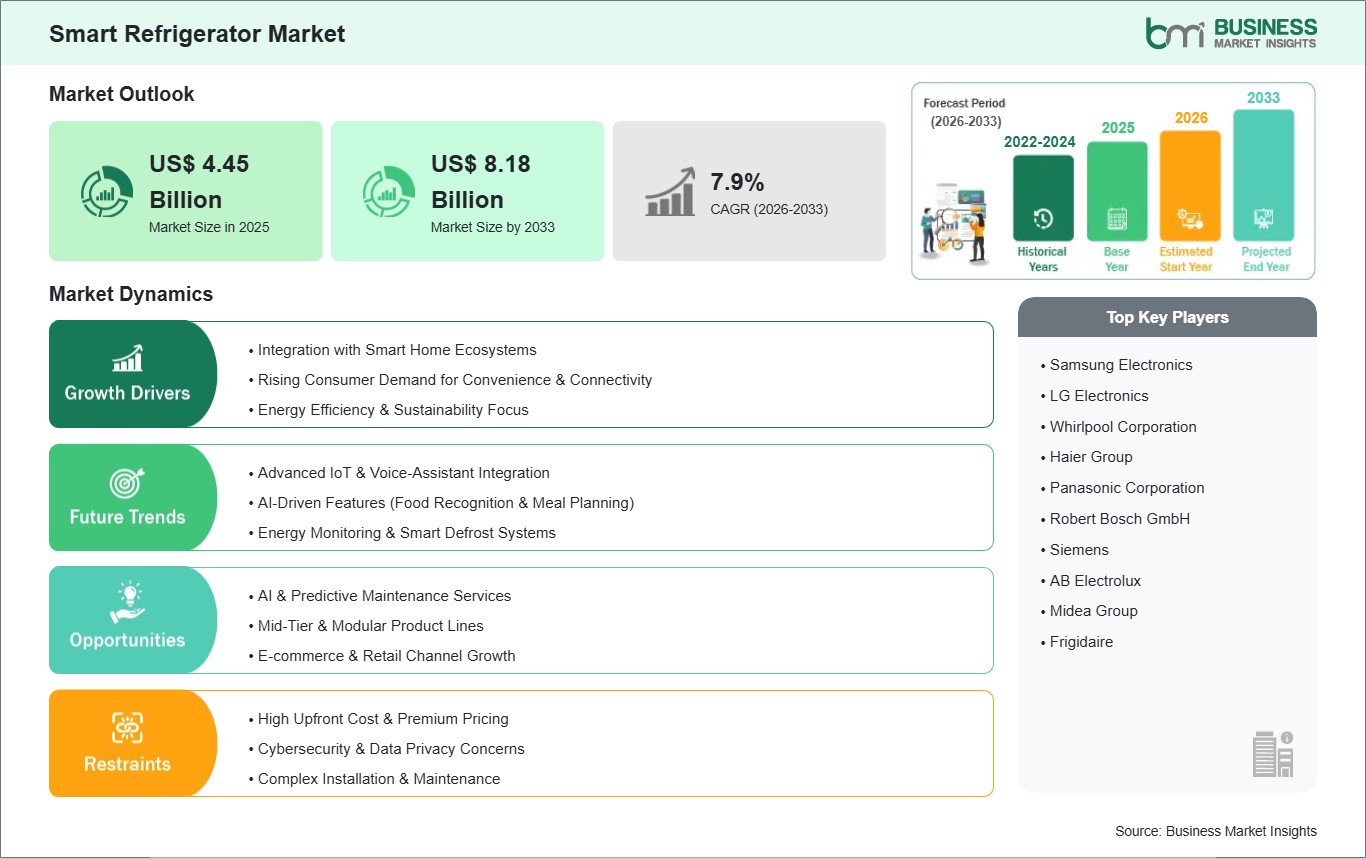
The smart refrigerator market size is expected to reach US$ 8.18 billion by 2033 from US$ 4.45 billion in 2025. The market is estimated to record a CAGR of 7.9% from 2026 to 2033.
A Smart Refrigerator is an advanced kitchen appliance that integrates digital technology, connectivity, and intelligent features to enhance food storage, convenience, and efficiency. At its core, a smart refrigerator uses sensors, Wi-Fi connectivity, and often an intuitive user interface or companion app to monitor internal conditions, manage inventory, and interact with other smart home systems. The benefits of smart refrigerators include real-time temperature control for optimal food preservation, automated inventory tracking to reduce waste, voice or app-controlled access, and features like touchscreens that display recipes, calendars, and reminders. Users can track expiration dates, receive alerts when the door is left open, and even order groceries online directly from the fridge interface. The usage of smart refrigerators extends from homes to commercial kitchens, where seamless monitoring and control improve efficiency, reduce energy consumption, and support better food safety practices.
Demand for smart refrigerators is growing globally, driven by increasing consumer preference for connected devices, rising disposable incomes, and the expansion of smart homes. Key drivers in the smart refrigerator market include rapid technological advancements in IoT (Internet of Things) and artificial intelligence, heightened awareness about food wastage, and the desire for energy-efficient appliances. However, restraints such as high initial costs, concerns over data privacy, and the complexity of use for some segments of consumers can limit adoption. Opportunities arise from continuous innovation—like integration with voice assistants, enhanced security features, and advanced food recognition technologies—and untapped markets in developing regions. Current market trends indicate a shift toward eco-friendly models, predictive maintenance features, and seamless integration with wider smart home ecosystems, suggesting robust future growth.

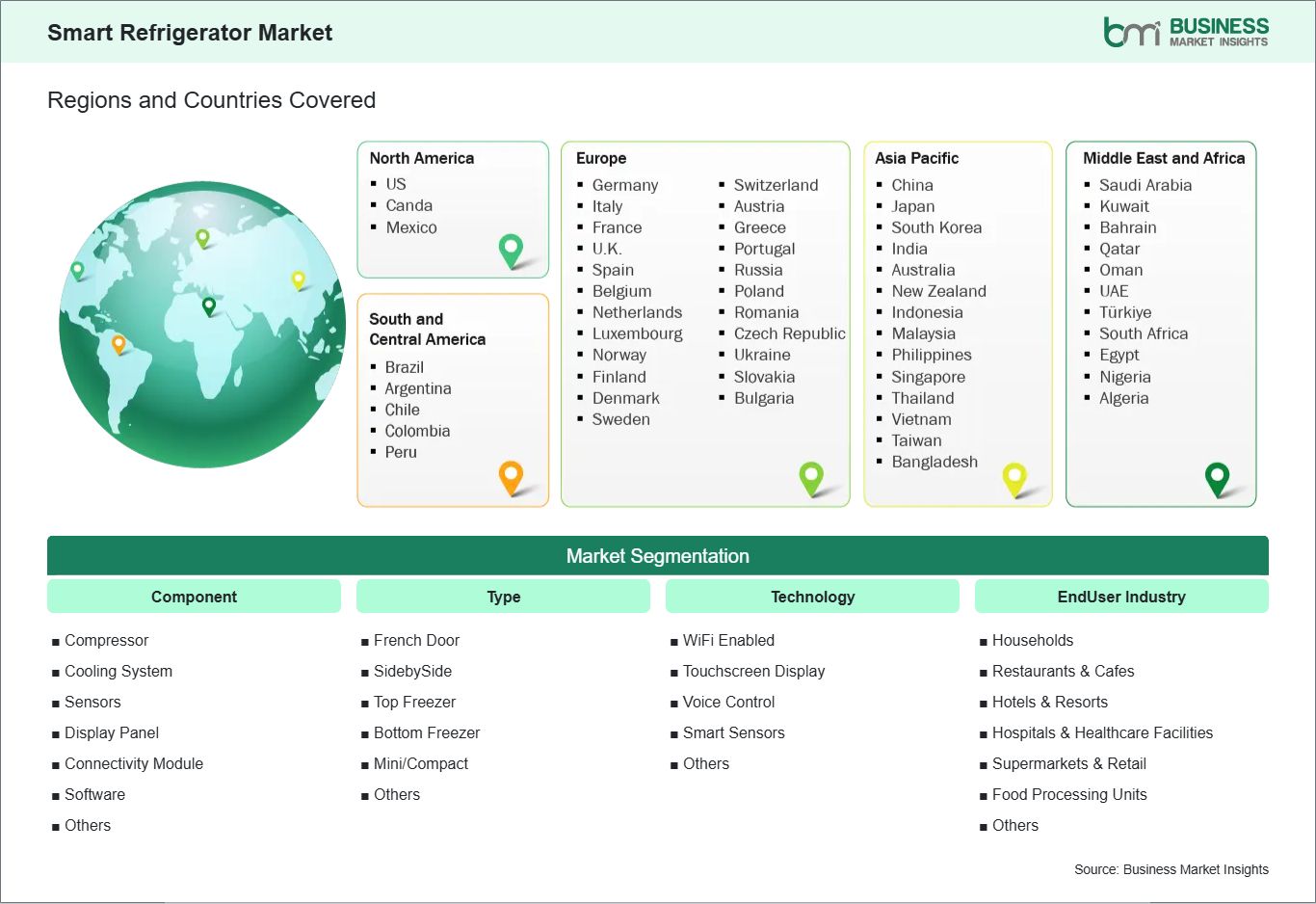
Key segments that contributed to the derivation of the smart refrigerator market analysis are component, type, technology, and end-user industry.
The integration of smart refrigerators with broader smart home ecosystems is a critical factor driving the growth of the smart refrigerator market. Modern consumers increasingly seek appliances that not only perform their core functions but also enhance the efficiency, convenience, and intelligence of their entire household. By connecting with Internet of Things (IoT) platforms, mobile applications, and popular voice assistants such as Amazon Alexa, Google Assistant, and Apple HomeKit, smart refrigerators evolve from standalone appliances into central hubs of the connected home. This connectivity allows users to monitor and manage their refrigerators remotely, receive alerts about spoilage or maintenance needs, and even adjust temperature settings from anywhere using a smartphone. Furthermore, the integration enables seamless coordination with other smart devices, such as smart ovens, pantries, or grocery apps, allowing for features like automated inventory tracking, meal planning, and smart notifications for grocery replenishment. The enhanced convenience and personalization offered by these connected systems appeals to tech-savvy consumers seeking time-saving solutions and greater control over their domestic environments. Additionally, as households increasingly adopt comprehensive smart home ecosystems, the demand for appliances capable of interoperating within these systems rises, fueling market expansion. This trend is further reinforced by the growing awareness of energy efficiency and sustainability, as connected refrigerators can optimize energy consumption through intelligent monitoring and adaptive cooling. Overall, the integration with smart home ecosystems positions smart refrigerators as indispensable components of modern, connected living spaces, significantly boosting market adoption and long-term growth prospects.
In the rapidly evolving smart refrigerator market, the integration of Artificial Intelligence (AI) and predictive maintenance services represents one of the most compelling growth opportunities for manufacturers, service providers, and technology partners. Traditionally, refrigerators have been evaluated solely on their cooling performance and energy efficiency, but AI‑enabled systems transform them into proactive, intelligent household hubs. By harnessing machines learning algorithms and data from embedded sensors, smart refrigerators can predict potential faults before they occur, notifying users and service teams about compressor inefficiencies, coolant leaks, or sensor malfunctions well in advance. This predictive fault detection not only reduces downtime and costly repairs but also significantly extends product lifespan, enhancing overall customer satisfaction and brand loyalty.
Beyond reliability, AI unlocks innovative inventory management and food tracking capabilities. Using image recognition, barcode scanning, and consumption patterns, smart refrigerators can monitor what’s inside in real‑time, alerting users when items are nearing expiration, suggesting recipes based on available ingredients, or even generating automated shopping lists. This level of food management not only reduces waste—a major concern for environmentally conscious consumers—but also adds genuine everyday convenience, positioning smart refrigerators as indispensable kitchen assistants rather than mere appliances. From a market perspective, these AI‑driven features open new monetization and value channels, such as subscription‑based maintenance plans, premium AI feature tiers, and partnerships with grocery delivery or recipe platforms. Service contracts for predictive maintenance can create recurring revenue streams, while enhanced food management can be bundled with lifestyle‑oriented digital services. As consumer demand for connected, intelligent home solutions grow, embedding AI with predictive maintenance and inventory insights will be a key differentiator driving adoption and long‑term growth in the smart refrigerator segment.
By component, the market is segmented into compressor, cooling system, sensors, display panel, connectivity module, software, and others. The compressor segment held the largest share of the market in 2025. A compressor is a key component in refrigerators that circulate refrigerant to regulate temperature, ensuring efficient cooling and food preservation. The demand for compressors in the smart refrigerator market is rising due to energy efficiency, advanced cooling technologies, smart connectivity, longer appliance lifespan, and growing consumer preference for intelligent, eco-friendly home appliances.
By type, the market is segmented into French door, side-by-side, top freezer, bottom freezer, mini/compact, and others. The side-by-side segment held the largest share of the market in 2025. A side-by-side refrigerator features two vertical compartments, one for fresh food and the other for frozen items—offering convenient organization and easy access. The smart refrigerator market is growing due to rising consumer preference for energy efficiency, advanced features like touchscreens, Wi-Fi connectivity, inventory management, and remote monitoring for enhanced kitchen convenience.
By technology, the market is segmented into Wi-Fi Enabled, touchscreen display, voice control, smart sensors, and others. The Wi-Fi Enabled segment held the largest share of the market in 2025. The demand for Wi-Fi-enabled smart refrigerators is rising due to growing consumer preference for connected home appliances, enabling remote monitoring, inventory management, and energy efficiency. Integration with smartphones, voice assistants, and smart home ecosystems enhances convenience, while increasing awareness of sustainable energy use and innovative features drives adoption in modern households.
By end-user industry, the market is segmented into households, restaurants & cafes, hotels & resorts, hospitals & healthcare facilities, supermarkets & retail, food processing units, and others. The households segment held the largest share of the market in 2025. The demand for smart refrigerators in households is rising due to their advanced features, such as energy efficiency, remote monitoring, and inventory management. Consumers value convenience, seamless integration with smart home systems, and health-conscious options like temperature-controlled compartments. Growing awareness of technology-driven lifestyle improvements further drives adoption and popularity.

| Report Attribute | Details |
|---|---|
| Market size in 2025 | US$ 4.45 Billion |
| Market Size by 2033 | US$ 8.18 Billion |
| Global CAGR (2026 - 2033) | 7.9% |
| Historical Data | 2022-2024 |
| Forecast period | 2026-2033 |
| Segments Covered | By Component
|
| Regions and Countries Covered | North America
|
| Market leaders and key company profiles |
|
The Smart Refrigerator Market Size and Forecast (2022–2033) report provides a detailed analysis of the market covering below areas:
The geographical scope of the smart refrigerator market report is divided into five regions: North America, Asia Pacific, Europe, Middle East & Africa, and South & Central America. The smart refrigerator market in Asia Pacific is expected to grow significantly during the forecast period.
The Asia Pacific region has witnessed a significant surge in demand for smart refrigerators, driven by rapid urbanization, rising disposable incomes, and increasing consumer awareness about energy-efficient and technologically advanced home appliances. With the region’s growing middle class and the proliferation of smart homes, consumers are increasingly seeking appliances that offer convenience, connectivity, and enhanced food management capabilities. Smart refrigerators, equipped with features such as Wi-Fi connectivity, touchscreens, temperature control, inventory tracking, and integration with IoT devices, allow users to monitor and manage food storage remotely, receive notifications about expiry dates, and even automate grocery orders. The trend is particularly pronounced in countries such as China, India, Japan, and South Korea, where tech-savvy consumers are adopting connected appliances to enhance lifestyle convenience.
Furthermore, rising concerns about food wastage and energy consumption have prompted governments and manufacturers to promote energy-efficient smart refrigerators, which align with sustainable living goals. Retailers and e-commerce platforms in the region have also contributed to the growing adoption by offering easy access, competitive pricing, and attractive financing options. Additionally, the COVID-19 pandemic accelerated the shift toward smart kitchen appliances, as more consumers sought contactless, efficient, and automated solutions for home cooking and food storage. As a result, the smart refrigerator market in Asia Pacific is expected to maintain strong growth, fueled by technological advancements, increasing awareness of energy conservation, and the desire for enhanced lifestyle convenience among urban households. This rising demand reflects a broader shift toward connected and intelligent home appliances in the region.

The smart refrigerator market is evaluated by gathering qualitative and quantitative data post primary and secondary research, which includes important corporate publications, association data, and databases. A few of the key developments in the smart refrigerator market are:
The Smart Refrigerator Market is valued at US$ 4.45 Billion in 2025, it is projected to reach US$ 8.18 Billion by 2033.
As per our report Smart Refrigerator Market, the market size is valued at US$ 4.45 Billion in 2025, projecting it to reach US$ 8.18 Billion by 2033. This translates to a CAGR of approximately 7.9% during the forecast period.
The Smart Refrigerator Market report typically cover these key segments-
The historic period, base year, and forecast period can vary slightly depending on the specific market research report. However, for the Smart Refrigerator Market report:
The Smart Refrigerator Market is populated by several key players, each contributing to its growth and innovation. Some of the major players include:
The Smart Refrigerator Market report is valuable for diverse stakeholders, including:
Essentially, anyone involved in or considering involvement in the Smart Refrigerator Market value chain can benefit from the information contained in a comprehensive market report.
Please tell us your area of interest
(Market Segments/ Regions and Countries/ Companies)