Market Summary
Executive Summary and Global Market Analysis
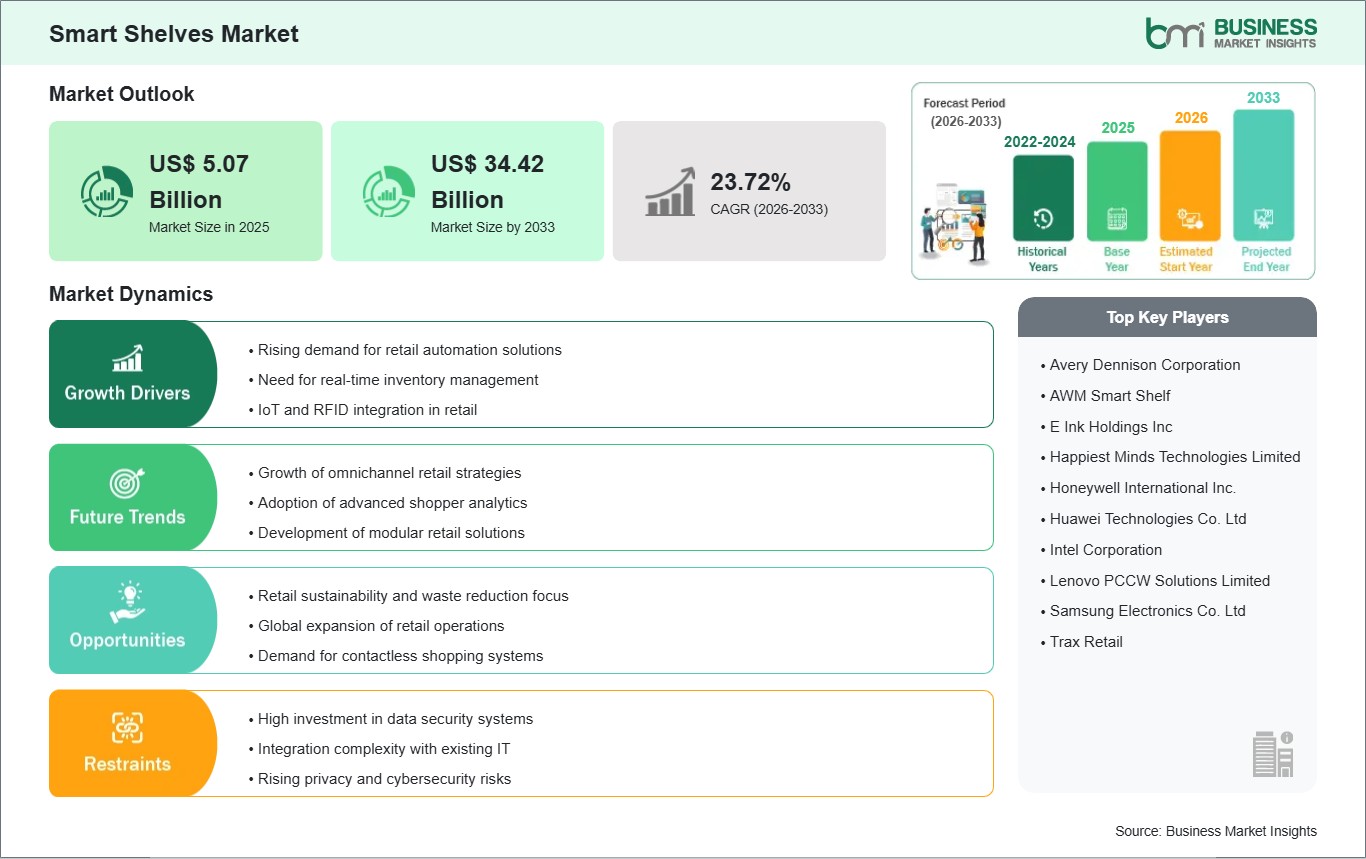
Smart shelves are at the forefront of the retail digital transformation, utilizing a network of sensors, Internet of Things (IoT), and data analytics to provide real-time shelf-edge intelligence. These systems are critical for modern retailers to automate inventory tracking, ensure pricing accuracy, and deliver interactive content to shoppers. Smart shelves offer distinct advantages, such as the virtual elimination of manual inventory counts, significant reductions in out-of-stock (OOS) rates, and the ability to instantly synchronize in-store prices with online platforms. Increasing global demand for retail automation, the rapid expansion of omnichannel commerce, and the need for granular data on consumer behavior are primary drivers for this market. Additionally, innovations in Computer Vision, RFID technology, and low-power Electronic Shelf Labels (ESL) are enhancing the operational efficiency of global retail chains.
However, several challenges can restrain market growth, including high initial capital expenditure (CAPEX) for hardware deployment, the technical complexity of integrating smart systems with legacy Point of Sale (POS) software, and ongoing concerns regarding consumer data privacy. Despite these hurdles, the market holds significant opportunities driven by the rise of autonomous/cashless stores, the adoption of 5G-enabled edge computing, and the growing demand for sustainable, paperless retail operations. Investment in AI-driven predictive analytics and interactive customer engagement tools is expected to open new avenues for market expansion.
Segment Analysis
Smart Shelves Market Segmentation
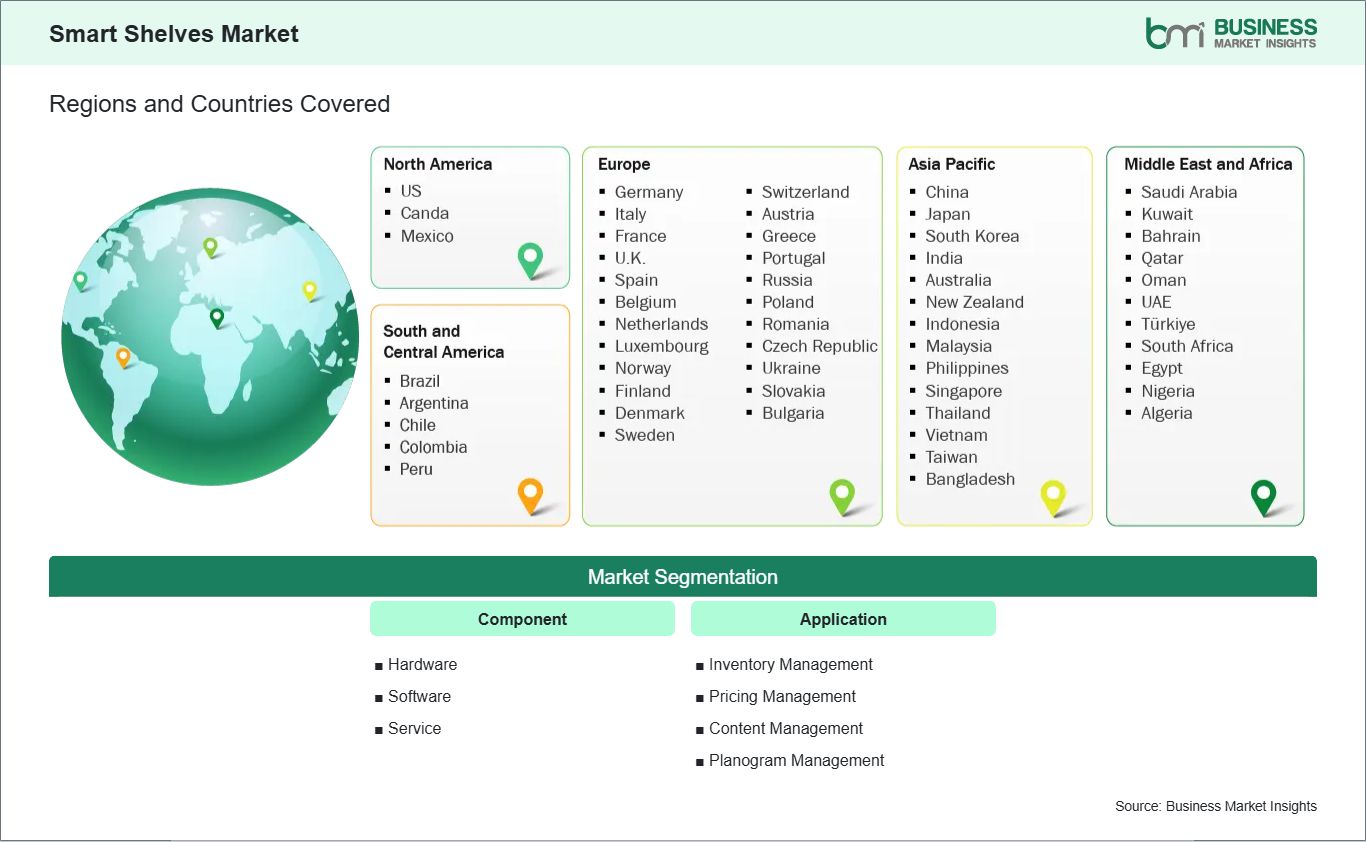
Key segments that contributed to the derivation of the Smart Shelf market analysis are component and application.
- By Component, the market is segmented into Hardware, Software, and Service.
- By Application, the market is categorized into Inventory Management, Pricing Management, Content Management, and Planogram Management.
Market Forces
Smart Shelves Market Drivers and Opportunities
Escalating Global Demand for Retail Automation and Operational Efficiency
The rapid escalation of global retail automation acts as a primary catalyst for the smart shelf market. In an era of rising labor costs and thinning margins, retailers are increasingly compelled to adopt autonomous systems that eliminate the inefficiencies of manual shelf management. Traditional stock-taking is prone to human error and often results in "phantom inventory," where a product is listed as available but is missing from the physical shelf. Smart shelves address this by providing continuous, automated visibility into stock levels via weight sensors and RFID tags. This shift is not merely about replacing labor but about enhancing the speed of the supply chain.
For example, major supermarket chains now utilize smart shelving to facilitate rapid "click-and-collect" services, ensuring that store associates can locate items instantly without searching through backrooms. Furthermore, the automation of pricing via Electronic Shelf Labels (ESLs) reduces the hundreds of man-hours typically spent on manual price labeling. As global retailers like Walmart and Carrefour continue to roll out these technologies across thousands of locations, the demand for integrated smart shelf systems is expected to surge, setting a new operational standard for the modern retail industry.
Rising Demand for Sustainable Retail and Waste Reduction Initiatives
Sustainability has emerged as a critical opportunity for the smart shelf market, driven by both regulatory mandates and shifting consumer preferences for greener business practices. Smart shelves play a vital role in reducing retail waste, particularly in the grocery and pharmaceutical sectors. By utilizing automated "first-expiry, first-out" tracking, these systems ensure that products nearing their expiration dates are highlighted for quick sale or dynamic price discounting, significantly reducing the volume of goods sent to landfills.
Furthermore, the mass adoption of Electronic Shelf Labels (ESLs) eliminates the need for millions of paper price tags, which are traditionally discarded every time a promotion changes. This alignment with "green logistics" and ESG (Environmental, Social, and Governance) goals is increasingly becoming a prerequisite for investment in large-scale retail projects. Retailers are also leveraging smart shelf data to optimize their transport and delivery routes, ensuring that replenishment trucks are only dispatched when necessary, thereby lowering the overall carbon footprint of the retail supply chain. As governments worldwide introduce stricter regulations on food waste and packaging, the demand for technologies that provide precise, real-time control over inventory lifecycle management is expected to grow, positioning smart shelves as a foundational component of the sustainable retail ecosystem of the future.
Size and Share Analysis
Smart Shelves Market Size and Share Analysis
Based on component, the Hardware segment is driven by the extensive deployment of physical sensors and ESLs.
In terms of application, the Inventory Management segment remains the leading application, as large-scale retail environments prioritize the reduction of stockouts.
Report Coverage
Smart Shelves Market Report Coverage and Deliverables
The "Smart Shelf Market Size and Forecast (2022 - 2033)" report provides a detailed analysis of the market covering below areas:
- Smart Shelf market size and forecast at global, regional, and country levels for all the key market segments covered under the scope
- Smart Shelf market trends, as well as market dynamics such as drivers, restraints, and key opportunities
- Smart Shelf market analysis covering key market trends, global and regional framework, major players, regulations, and recent market developments
- Industry landscape and competition analysis covering market concentration, heat map analysis, prominent players, and recent developments for the Smart Shelf market
- Detailed company profiles, including SWOT analysis
Geographic Insights
Smart Shelves Market Geographic Insights
The geographical scope of the smart shelf market report is divided into five regions: North America, Asia Pacific, Europe, Middle East & Africa, and South & Central America.
North America market is led by the U.S. and Canada. The region's dominance is attributed to early adoption of IoT and AI by retail giants like Amazon and Walmart, alongside a high demand for cashierless store formats. Europe market represents the most mature market for Electronic Shelf Labels (ESL), with France, Germany, and the UK leading in deployment. European retailers are heavily focused on sustainability and labor cost reduction, driving steady growth.
Asia Pacific region is the fastest-growing market. Rapid urbanization in China and India, the expansion of organized retail, and massive investments in 5G infrastructure are key growth drivers. Middle East & Africa market growth is driven by luxury retail and "Smart City" projects in the GCC countries, particularly the UAE and Saudi Arabia, where retailers are investing in premium, high-tech customer experiences. In the South & Central America market, Brazil and Mexico are emerging as key markets as retail chains begin to modernize their inventory systems to compete with rising e-commerce penetration.
Industry Activity
Recent Developments
The Smart Shelf market is evaluated by gathering qualitative and quantitative data post primary and secondary research, which includes important corporate publications, association data, and databases. A few of the key developments in the smart shelf market are:
- In January 2026, Pricer announced the sales launch of Pricer Avenue™, its new shelf-edge communication platform, at the National Retail Federation (NRF) flagship event in New York. First introduced as a concept last year, the powered-rail solution has since been refined through extensive development and pilot testing and is now commercially ready for deployment.
- In March 2025, Huawei and SOLUM unveiled a built-in Internet of Things (IoT) solution for the retail industry at Huawei's special session titled "Digital and Intelligent Innovation Unlocks New Retail Growth". This solution resolves the challenges encountered in the large-scale deployment of electronic shelf labels (ESLs), offering a simplified and efficient digital approach for global retailers.
Trust & Transparency
Research Methodology
The market analysis combines proprietary research with secondary data from government agencies, company disclosures, regulatory filings, industry databases and expert interviews. Market estimates are validated through data triangulation, cross-market benchmarking and analyst
review.
View Full Research Methodology
Key Sources Referred:
World Bank - Global Trade IndicatorsWorld Trade Organization (WTO)International Monetary Fund (IMF)International Trade Administration (ITA)Company websiteCompany annual reportsCompany investor presentations