Market Summary
Executive Summary and Global Market Analysis
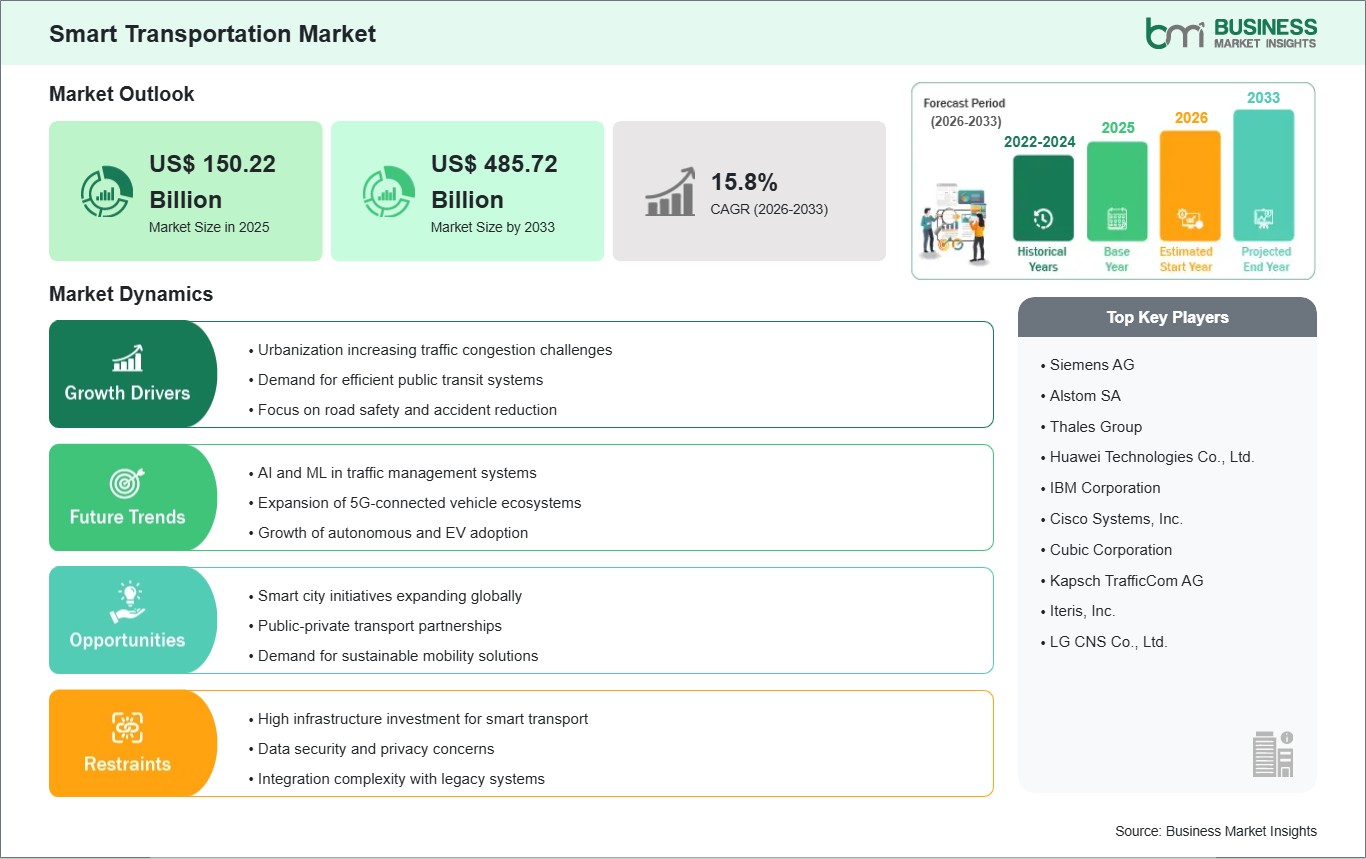
Smart transportation involves the integrated application of advanced sensing, communication, and automation technologies to surface transportation systems. These systems provide significant strategic value by maximizing the capacity of existing infrastructure, thereby reducing the need for physical road expansions and mitigating chronic urban congestion. The expansion of the smart transportation market is driven by rapid urban population growth, accelerated adoption of 5G-enabled vehicle connectivity, and increased deployment of artificial intelligence-based digital twin modeling to optimize city-wide traffic flow. Additionally, the adoption of integrated multimodal payment gateways enhances user convenience by enabling seamless transitions among rail, bus, and micro-mobility options.
However, several challenges can restrain market growth. High implementation costs for professional-grade roadside units and sensors can place significant strain on municipal budgets, especially in developing regions. Interoperability issues between legacy hardware and modern software-defined platforms frequently complicate the scaling of unified regional networks. Furthermore, the industry is constrained by cybersecurity and data privacy concerns, as the continuous transmission of location and commuter data introduces vulnerabilities that necessitate advanced encryption and comprehensive regulatory oversight.
Despite these hurdles, the market holds immense opportunities in the universal mandate for decarbonized logistics and the accelerating deployment of autonomous trucking corridors. The expansion of predictive maintenance for public fleets and the development of dynamic tolling and congestion pricing algorithms are expected to create significant opportunities for long-term market growth.
Segment Analysis
Smart Transportation Market Segmentation
Key segments that contributed to the derivation of the Smart Transportation market analysis are system and services.
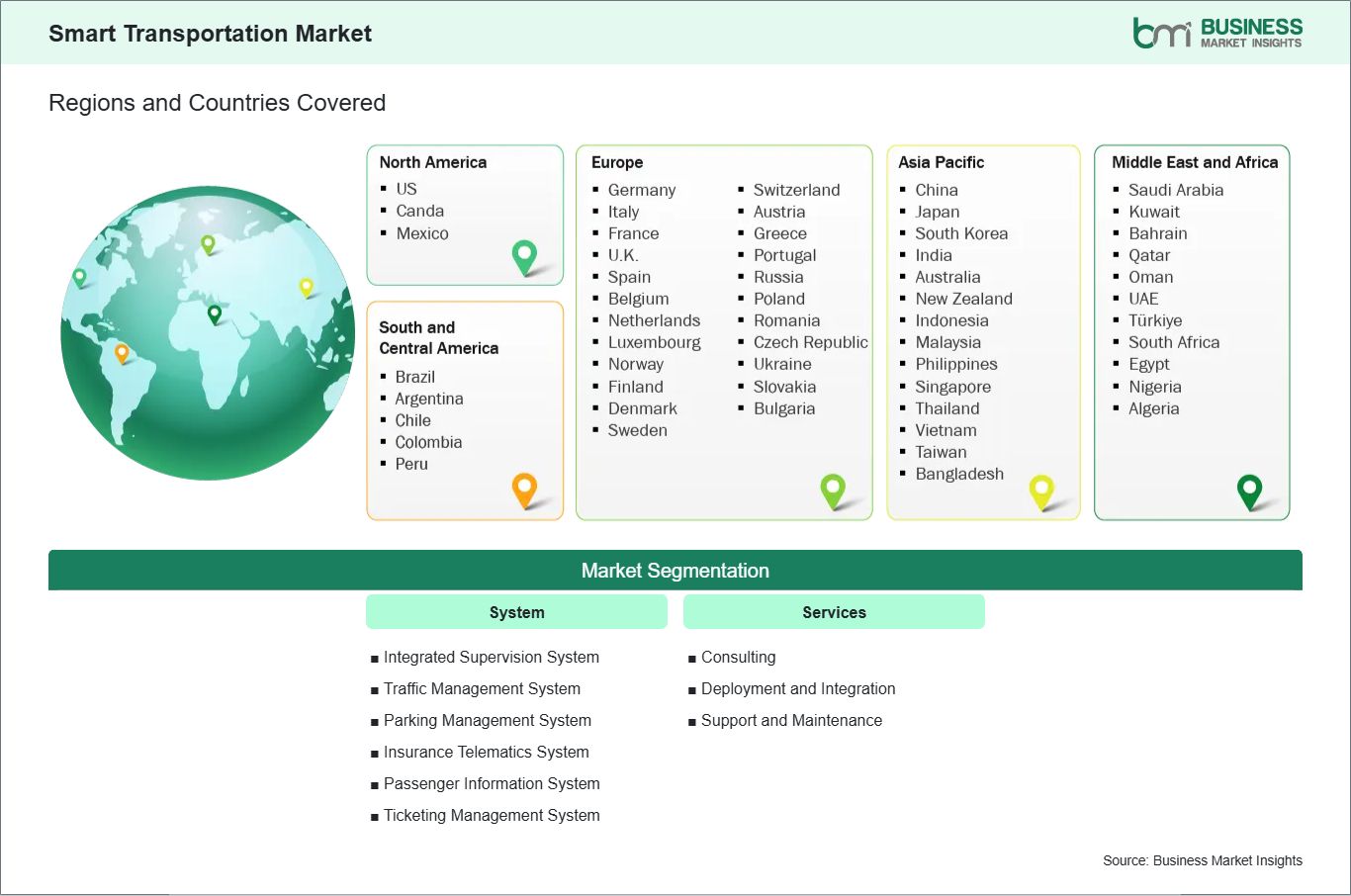
- By System, the market is segmented into Integrated Supervision System, Traffic Management System, Parking Management System, Insurance Telematics System, Passenger Information System, and Ticketing Management System
- By Services, the market is divided into Consulting, Deployment and Integration, and Support and Maintenance.
Market Forces
Smart Transportation Market Drivers and Opportunities
Advancing Urban Efficiency and Agentic AI Integration
The primary driver for the Smart Transportation Market is the systemic requirement to resolve chronic urban congestion that currently erodes a portion of the GDP in many global economies. As urban populations increase, municipalities are increasingly implementing AI-driven traffic optimization rather than investing in costly road expansion. The adoption of Agentic AI has accelerated, with autonomous systems managing signal timings, rerouting traffic during incidents, and overseeing vehicle-to-infrastructure (V2I) communication with minimal human intervention. Substantial government funding, including grants for intelligent mobility, is facilitating the large-scale deployment of Advanced Transportation Management Systems (ATMS).
Additionally, the decreasing cost of AI-enabled edge sensors and the expansion of 5G and C-V2X connectivity are critical enablers, supporting real-time data exchange and the development of Digital Twins for entire transport networks. Collectively, these advancements have established smart transportation as essential for economic productivity, public safety, and environmental sustainability.
Multimodal Journey Orchestration and Sustainable Mobility-as-a-Service
A significant high-value opportunity lies in the convergence of Smart Transportation with Mobility-as-a-Service (MaaS) and Digital Ticketing Platforms. Next-generation solutions provide a unified digital interface for planning, booking, and payment across buses, rail, scooters, and ride-sharing, enabling operators to capture integrated revenue streams. Growth is also accelerating in Sustainable and Low-Carbon Mobility Solutions, where smart traffic optimization and dynamic wireless EV charging lanes help reduce carbon emissions and address range anxiety. The expansion of Autonomous Commercial Logistics in closed environments such as ports, campuses, and industrial hubs creates new prospects for software providers to automate fleet dispatch and yard management.
In addition, Urban Air Mobility (UAM) Traffic Management is emerging as a long-term opportunity as cities integrate low-altitude aerial vehicles with existing control systems. Manufacturers and service providers that prioritize interoperable data standards and develop blockchain-based micro-payment systems for tolling and parking are well-positioned to lead high-margin, innovative segments of the global mobility market.
Size and Share Analysis
Smart Transportation Market Size and Share Analysis
The Smart Transportation market demonstrates steady growth, with size and share analysis revealing evolving trends and competitive positioning among key players. The report further examines subsegments categorized within system and services, offering insights into their contribution to overall market performance.
Based on systems, the Traffic Management Systems and Passenger Information Systems subsegment holds a significant market presence, serving as the industry benchmark for modernizing public roadways. Traffic Management Systems are indispensable for the Urban Planning sector, utilizing AI-driven signal control and adaptive routing to mitigate gridlock and reduce vehicle idling. A notable trend is the surge in the Passenger Information System subsegment, which is registering higher traction as transit agencies prioritize the "User Experience." These systems are becoming essential for Multimodal Transit Hubs, providing commuters with real-time, cross-platform updates on schedules and delays directly via mobile applications, marking a strategic shift toward data-driven passenger engagement.
Report Coverage
Smart Transportation Market Report Coverage and Deliverables
The "Smart Transportation Market Size and Forecast (2022 - 2033)" report provides a detailed analysis of the market covering below areas:
- Smart Transportation market size and forecast at global, regional, and country levels for all the key market segments covered under the scope
- Smart Transportation market trends, as well as market dynamics such as drivers, restraints, and key opportunities
- Smart Transportation market analysis covering key market trends, global and regional framework, major players, regulations, and recent market developments
- Industry landscape and competition analysis covering market concentration, heat map analysis, prominent players, and recent developments for the Smart Transportation market
- Detailed company profiles, including SWOT analysis
Geographic Insights
Smart Transportation Market Geographic Insights
The geographical scope of the Smart Transportation market report is divided into five regions: North America, Asia Pacific, Europe, Middle East & Africa, and South & Central America.
The Asia-Pacific Smart Transportation Market includes China, Japan, South Korea, India, Australia, and the Rest of Asia. This region drives market volume through significant investment in intelligent traffic management systems to reduce congestion in megacities. China leads in electric vehicle infrastructure and autonomous bus fleets. Japan continues to excel in advanced railway signaling and disaster-resilient transport monitoring.
Growth is further supported by the shift to 5G-enabled Vehicle-to-Everything communication and increased adoption of Edge AI for real-time traffic signal optimization. The move toward unified multimodal platforms, which combine public transit, ride-sharing, and micro-mobility in a single digital interface, along with the expansion of green hydrogen and electric rail, positions Asia-Pacific as a key hub for innovation and future growth in the Smart Transportation industry.
Report Guidance
Smart Transportation Market Report Guidance
The report includes qualitative and quantitative data in the Smart Transportation market across system and services, and geography.The report starts with the key takeaways (chapter 2), highlighting the key trends and outlook of the Smart Transportation market.Chapter 3 includes the research methodology of the study.Chapter 4 further includes ecosystem analysis.Chapter 5 highlights the major industry dynamics in the Smart Transportation market, including factors that are driving the market, prevailing deterrents, potential opportunities, as well as future trends. Impact analysis of these drivers and restraints is also covered in this section.Chapter 6 discusses the Smart Transportation market scenario, in terms of historical market revenues, and forecast till the year 2033.Chapters 7 to 10 cover Smart Transportation market segments by system and services, and geography across North America, Europe, Asia Pacific, Middle East and Africa, and South and Central America. They cover the market revenue, forecast, and factors driving the market.Chapter 11 describes the competitive analysis along with the heat map analysis for the key players operating in the market.Chapter 12 describes the industry landscape analysis. It provides detailed descriptions of business activities such as market initiatives, new developments, mergers, and joint ventures globally, along with a competitive landscape.Chapter 13 provides detailed profiles of the major companies operating in the Smart Transportation market. Companies have been profiled on the basis of their key facts, business descriptions, products and services, financial overview, SWOT analysis, and key developments.Chapter 14, i.e., the appendix, is inclusive of a brief overview of the company, list of abbreviations, and disclaimer.
Industry Activity
Recent Developments
The Smart Transportation market is evaluated by gathering qualitative and quantitative data post primary and secondary research, which includes important corporate publications, association data, and databases. A few of the key developments in the Smart Transportation market are:
- In September 2025, Transporeon introduced its AI-driven Transport Planner along with next-generation Freight Marketplace, Dock & Yard Management, and Execution & Visibility tools. The modular platform enhances transport planning, operational efficiency, and real-time shipment visibility, empowering shippers and carriers with smarter, cost-effective logistics solutions.
- In May 2025, Foresight Autonomous announced a partnership with StreamRail to integrate its AI-powered 3D perception technology into urban rail transit systems, enhancing obstacle detection and operational safety. The agreement is expected to generate up to $12 million in revenue, marking a significant step in smart rail transportation innovation.
Trust & Transparency
Research Methodology
The market analysis combines proprietary research with secondary data from government agencies, company disclosures, regulatory filings, industry databases and expert interviews. Market estimates are validated through data triangulation, cross-market benchmarking and analyst
review.
View Full Research Methodology
Key Sources Referred:
World Bank - Global Trade IndicatorsWorld Trade Organization (WTO)International Monetary Fund (IMF)International Trade Administration (ITA)Company websiteCompany annual reportsCompany investor presentations