Smart Camera Market Outlook (2022-2033)

Historic Data: 2022-2024   |   Base Year: 2025   |   Forecast Period: 2026-2033
Report Content: Market Scope, Market Segmentation, Market Dynamics, and Competitive Analysis

Report Coverage:
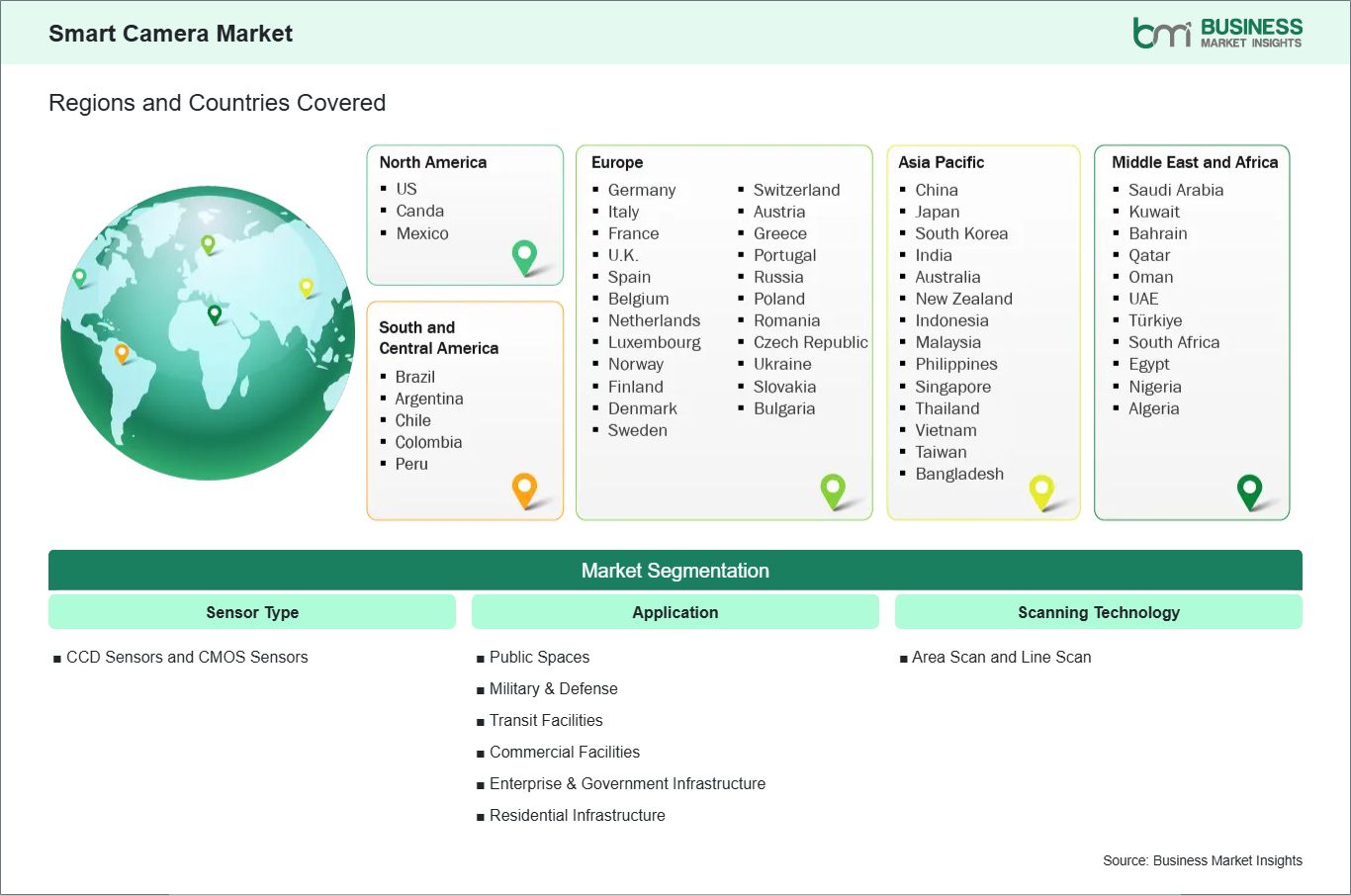
  • Sensor Type (CCD Sensors and CMOS Sensors)
  • Application (Public Spaces, Military & Defense, Transit Facilities, Commercial Facilities, Enterprise & Government Infrastructure, Residential Infrastructure)
  • Scanning Technology (Area Scan and Line Scan)

No. of Pages: 429
Report Code: BMIPUB00034359
Category: Electronics and Semiconductor
Smart Camera Market

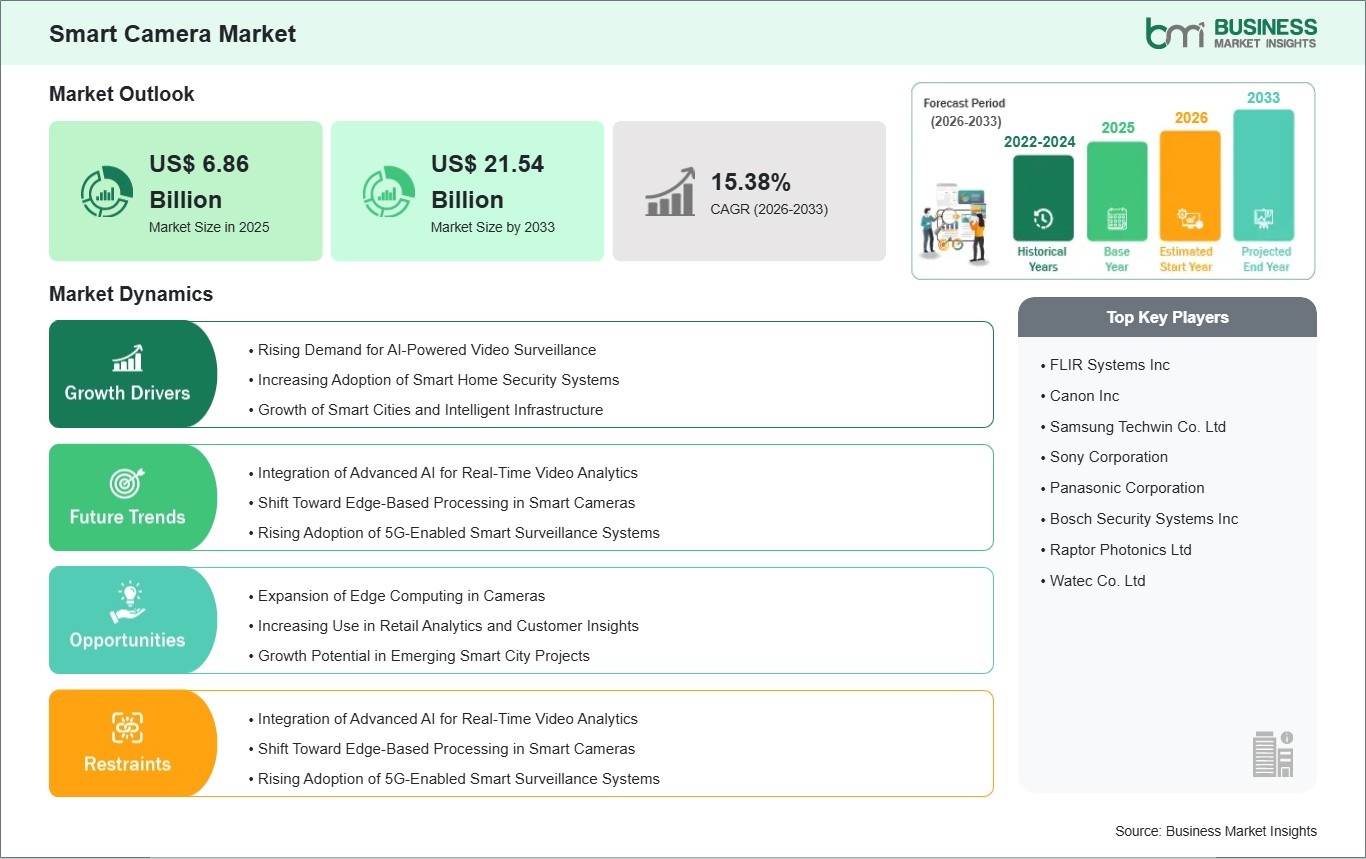
The Smart Camera Market size is expected to reach US$ 21.54 billion by 2033 from US$ 6.86 billion in 2025. The market is estimated to record a CAGR of 15.38% from 2026 to 2033.

Executive Summary and Global Market Analysis:

The global smart camera market is witnessing robust growth as more and more businesses are using smart camera technology for enhancing automation, security, and overall business operations. Smart cameras differ from regular cameras in that they have an image sensor that can process information internally, enabling the camera to process information internally. Smart cameras have the capability to process information internally, which makes it easier for businesses to implement these cameras for various purposes. Smart cameras have been used by many industries, such as manufacturing, retail, transportation, healthcare, and infrastructure, among many others. The increasing trend of using technology such as artificial intelligence, machine learning, and edge computing is enhancing the capabilities of smart cameras. Smart cameras have greatly impacted industries, especially in machine vision, as it helps in performing tasks such as product verification, defect detection, and robotic guidance, among many others. The global digital transformation initiatives are encouraging many industries to implement smart camera technology for enhancing their operations.

However, some of the major challenges facing the smart camera market include high costs of deployment, as well as increasing concerns about data privacy and cybersecurity.

Smart Camera Market - Strategic Insights:

global-market-strategic-framework
Get more information on this report

Smart Camera Market Segmentation Analysis:

Key segments that contributed to the derivation of the smart camera market analysis are sensor type, application, and scanning technology.

  • By sensor type, the Smart Camera market is segmented into CCD sensors and CMOS sensors. The CMOS sensors segment dominated the market in 2025.
  • Based on application, the Smart Camera market is classified into public spaces, military & defense, transit facilities, commercial facilities, enterprise & government infrastructure, and residential infrastructure. The public spaces segment dominated the market in 2025.
  • In terms of scanning technology, the Smart Camera market is categorized into area scan and line scan. The area scan segment dominated the market in 2025.

Smart Camera Market Drivers and Opportunities:

Rising Demand for AI-Powered Video Surveillance

The market for smart cameras is increasing, and this is because organizations are increasingly adopting smart cameras that can process and interpret visual information in real-time. Unlike regular cameras, smart cameras use AI to interpret and understand the information they capture. They can identify objects and detect unusual activities, and this has enabled organizations to move from reactive to proactive approaches to security. With the increasing need for enhanced security in various sectors, smart cameras have become a necessity in modern surveillance.

Another aspect of technology that is impacting the implementation of surveillance systems within operational environments relates to AI-driven smart cameras. With the aid of computer vision technology, smart cameras are able to differentiate between various objects, detect movement, and even establish patterns of behavior. By filtering out mundane events and only highlighting interesting events, they are able to greatly alleviate the labor that would be required by human observers of video feeds.

In addition to traditional surveillance, there are increasing uses of smart cameras to derive operation-related insights from visual information. There are organizations using smart cameras to analyze customer movements, safety practices at the workplace, and operation-related activities. Smart cameras are transforming raw video into structured and actionable information, which aids organizations in decision-making and operation-related activities. As AI technology progresses, smart cameras are no longer just simple monitoring tools but are transforming into intelligent tools to provide not only security but also business intelligence.

Expansion of Edge Computing in Cameras

Edge computing is transforming the functionality of smart cameras by enabling data processing directly within the device. Instead of sending all captured footage to centralized servers for analysis, edge-enabled cameras can process video streams locally using integrated computing capabilities. This approach allows the system to interpret visual data instantly, reducing delays and enabling quicker responses to critical events. Immediate processing is particularly valuable in scenarios where timely alerts are essential for safety, security, or operational continuity.

Local processing also improves system efficiency by reducing the amount of video data that must be transmitted across networks. Smart cameras equipped with edge capabilities can analyze footage on-site and transmit only relevant alerts or summarized data rather than continuous video streams. This approach helps lower bandwidth usage, decreases storage requirements, and makes large-scale deployments easier to manage. As organizations deploy increasing numbers of connected cameras, the ability to process data locally becomes a key advantage.

Another important benefit of edge-based processing is enhanced data privacy and security. When analysis occurs directly on the device, less sensitive footage needs to be transmitted or stored externally, reducing the potential exposure to cyber threats. This localized approach to data handling aligns with growing expectations for responsible data management and stronger cybersecurity practices. With ongoing advancements in embedded processors and AI acceleration technologies, smart cameras are becoming more capable of performing complex analytics independently while maintaining efficiency, reliability, and secure operation.

Smart Camera Market Size and Share Analysis:

The smart camera market is experiencing steady growth, with market size and share analysis reflecting evolving treatment preferences and competitive dynamics among key players. The report evaluates important subsegments categorized within sensor type, application, and scanning technology, highlighting their respective contributions to overall market performance.

By sensor type, the CMOS sensors segment dominated the Smart Camera market in 2025. This is driven by the increasing demand for high-resolution imaging, faster data processing, and improved energy efficiency in modern camera systems. CMOS sensors offer advantages such as lower power consumption, compact design, and high-speed image capture, making them a key revenue driver for manufacturers and ensuring consistent demand across surveillance, industrial inspection, and smart monitoring applications.

Based on application, the public spaces segment dominated the market in 2025. The leadership of public space applications is attributed to the rising need for enhanced security, crowd management, and real-time monitoring in locations such as airports, railway stations, city streets, and commercial complexes. Smart cameras equipped with advanced analytics and AI capabilities are widely adopted to improve public safety, making them highly preferred by governments and municipal authorities for large-scale surveillance systems.

In terms of scanning technology, the area scan segment dominated the market in 2025. The strong adoption of area scan technology is driven by its ability to capture complete images in a single frame, enabling efficient and accurate monitoring in surveillance, machine vision, and quality inspection applications. Its capability to provide detailed imaging and real-time analysis makes area scan cameras highly suitable for diverse operational environments, reinforcing their dominance in the smart camera market.

Smart Camera Market Report Highlights:

Report Attribute Details
Market size in 2025 US$ 6.86 Billion
Market Size by 2033 US$ 21.54 Billion
Global CAGR (2026 - 2033)15.38%
Historical Data 2022-2024
Forecast period 2026-2033
Segments Covered By Sensor Type
  • CCD Sensors and CMOS Sensors
By Application
  • Public Spaces
  • Military & Defense
  • Transit Facilities
  • Commercial Facilities
  • Enterprise & Government Infrastructure
  • Residential Infrastructure
By Scanning Technology
  • Area Scan and Line Scan
Regions and Countries Covered
North America US, Canada, Mexico
Europe Belgium, Austria, Finland, Denmark, Greece, Poland, Romania, Russia, Ukraine, Czech Republic, Slovakia, Bulgaria, Italy, Luxembourg, Germany, Switzerland, France, Netherlands, Norway, Portugal, Spain, Sweden, United Kingdom
Asia-Pacific Australia, China, India, Japan, South Korea, Indonesia, Malaysia, Philippines, Singapore, Thailand, Vietnam, Bangladesh, New Zealand, Taiwan
South and Central America Brazil, Argentina, Peru, Chile, Colombia
Middle East and Africa Bahrain, Kuwait, Oman, Qatar, Saudi Arabia, United Arab Emirates, Turkiye, South Africa, Egypt, Algeria, Nigeria
Market leaders and key company profiles
  • FLIRSystemsInc
  • CanonInc
  • SamsungTechwinCoLtd
  • SonyCorporation
  • PanasonicCorporation
  • BoschSecuritySystemsInc
  • RaptorPhotonicsLtd
  • WatecCoLtd
Get more information on this report

Smart Camera Market Report Coverage and Deliverables:

The "Smart Camera Market Size and Forecast (2022 - 2033)" report provides a detailed analysis of the market covering below areas:

  • Smart Camera market size and forecast at global, regional, and country levels for all the key market segments covered under the scope
  • Smart Camera market trends, as well as drivers, restraints, and opportunities
  • Smart Camera market analysis covering key trends, regional framework, major players, regulations, and recent developments
  • Industry landscape and competition analysis covering market concentration, heat map analysis, prominent players, and recent developments for the Smart Camera market
  • Detailed company profiles, including SWOT analysis

Smart Camera Market Geographic Insights:

The geographical scope of the Smart Camera market report is divided into five regions: North America, Asia Pacific, Europe, Middle East & Africa, and South & Central America. The Smart Camera market in North America is expected to grow during the forecast period.

North America continues to lead the smart camera market, driven by a mature technology ecosystem, robust digital infrastructure, and widespread integration of automation across industries. This region provides an environment that encourages rapid deployment of intelligent camera systems, enabling businesses to improve operational efficiency, streamline monitoring, and leverage data-driven decision-making. The industries including manufacturing, logistics, electronics, and aerospace have adopted smart cameras extensively to maintain high production standards, optimize processes, and enhance quality control. These systems are widely used in machine vision applications such as product inspection, defect detection, process verification, and automated quality assurance.

Beyond industrial applications, smart cameras are increasingly employed in public safety initiatives, retail analytics, transportation monitoring, and broader operational oversight. Intelligent surveillance and monitoring solutions help organizations enhance security, improve traffic and workflow management, and maintain situational awareness in complex operational environments.

The expansion of e-commerce, large-scale distribution operations, and automated warehouses has further accelerated adoption, with smart vision systems supporting inventory tracking, process automation, and security monitoring. While evolving data privacy and security regulations shape implementation strategies, North America remains a hub for technological innovation and continues to influence the development and adoption of smart camera solutions on a global scale.

global-market-geography
Get more information on this report

Smart Camera Market Research Report Guidance:

  • The report includes qualitative and quantitative data in the Smart Camera market across sensor type, application, scanning technology, and geography.
  • The report starts with the key takeaways (chapter 2), highlighting the key trends and outlook of the Smart Camera market.
  • Chapter 3 focuses on the research methodology of the study.
  • Chapter 4 includes ecosystem analysis.
  • Chapter 5 highlights the major industry dynamics in the Smart Camera market, including factors that are driving the market, prevailing deterrents, potential opportunities, as well as future trends. Impact analysis of these drivers and restraints is also covered in this section.
  • Chapter 6 discusses the Smart Camera market scenario, in terms of historical market revenues, and forecast till the year 2033.
  • Chapters 7 to 10 cover the Smart Camera market segments by sensor type, application, scanning technology, and geography across North America, Europe, Asia Pacific, Middle East and Africa, and South and Central America. They cover the market volume, revenue forecast, and factors driving the market.
  • Chapter 11 describes the competitive analysis with the heat map analysis for the key players operating in the market.
  • Chapter 12 describes the industry landscape analysis. It provides detailed descriptions of business activities such as market initiatives, new developments, mergers, and joint ventures globally, along with a competitive landscape.
  • Chapter 13 provides detailed profiles of the major companies operating in the Smart Camera market. Companies have been profiled on the basis of their key facts, business descriptions, products, financial overview, SWOT analysis, and key developments.
  • Chapter 14, i.e., the appendix, is inclusive of a brief overview of the company, list of abbreviations, and disclaimer.

Smart Camera Market News and Key Development:

The smart camera market is evaluated by gathering qualitative and quantitative data post primary and secondary research, which includes important corporate publications, association data, and databases. A few of the key developments in the smart camera market are:

  • In December 2025, Samsung Electronics announced that its SmartThings platform became the first in the industry to support Matter 1.5 cameras, enabling broad compatibility with Matter‑standard smart cameras from partner brands and expanding its smart home ecosystem.
  • In June 2025, Honeywell announced that it had launched its first‑ever locally designed and produced CCTV camera portfolio in India, the 50 Series line of intelligent cameras, built to meet enterprise‑grade security needs and aligned with India’s Make in India/Atmanirbhar Bharat initiative.

Key Sources Referred:

  • International Electrotechnical Commission
  • Institute of Electrical and Electronics Engineers
  • International Organization for Standardization
  • Bureau of Indian Standards
  • Central Electricity Authority
  • Ministry of Power
  • Indian Electrical and Electronics Manufacturers' Association
  • European Committee for Electrotechnical Standardization
  • VDE Association for Electrical Electronic & Information Technologies
  • Company Websites
  • Company Annual Reports
  • Company Investor Presentations
The List of Companies - Smart Camera Market
  • FLIRSystemsInc
  • CanonInc
  • SamsungTechwinCoLtd
  • SonyCorporation
  • PanasonicCorporation
  • BoschSecuritySystemsInc
  • RaptorPhotonicsLtd
  • WatecCoLtd
Frequently Asked Questions
How big is the Smart Camera Market?

The Smart Camera Market is valued at US$ 6.86 Billion in 2025, it is projected to reach US$ 21.54 Billion by 2033.

What is the CAGR for Smart Camera Market by (2026 - 2033)?

As per our report Smart Camera Market, the market size is valued at US$ 6.86 Billion in 2025, projecting it to reach US$ 21.54 Billion by 2033. This translates to a CAGR of approximately 15.38% during the forecast period.

What segments are covered in this report?

The Smart Camera Market report typically cover these key segments-

  • Sensor Type (CCD Sensors and CMOS Sensors)
  • Application (Public Spaces, Military & Defense, Transit Facilities, Commercial Facilities, Enterprise & Government Infrastructure, Residential Infrastructure)
  • Scanning Technology (Area Scan and Line Scan)

What is the historic period, base year, and forecast period taken for Smart Camera Market?

The historic period, base year, and forecast period can vary slightly depending on the specific market research report. However, for the Smart Camera Market report:

  • Historic Period : 2022-2024
  • Base Year : 2025
  • Forecast Period : 2026-2033
  • Who are the major players in Smart Camera Market?

    The Smart Camera Market is populated by several key players, each contributing to its growth and innovation. Some of the major players include:

  • FLIRSystemsInc
  • CanonInc
  • SamsungTechwinCoLtd
  • SonyCorporation
  • PanasonicCorporation
  • BoschSecuritySystemsInc
  • RaptorPhotonicsLtd
  • WatecCoLtd
  • Who should buy this report?

    The Smart Camera Market report is valuable for diverse stakeholders, including:

    • Investors: Provides insights for investment decisions pertaining to market growth, companies, or industry insights. Helps assess market attractiveness and potential returns.
    • Industry Players: Offers competitive intelligence, market sizing, and trend analysis to inform strategic planning, product development, and sales strategies.
    • Suppliers and Manufacturers: Helps understand market demand for components, materials, and services related to concerned industry.
    • Researchers and Consultants: Provides data and analysis for academic research, consulting projects, and market studies.
    • Financial Institutions: Helps assess risks and opportunities associated with financing or investing in the concerned market.

    Essentially, anyone involved in or considering involvement in the Smart Camera Market value chain can benefit from the information contained in a comprehensive market report.

    Available Report Formats

    pdf-format excel-format pptx-format
    Buy Now
    Sales Assistance
    +1 646 791 7070 (US & UK)
    Customization Form

    Please tell us your area of interest
    (Market Segments/ Regions and Countries/ Companies)