Market Summary
Executive Summary and Global Market Analysis
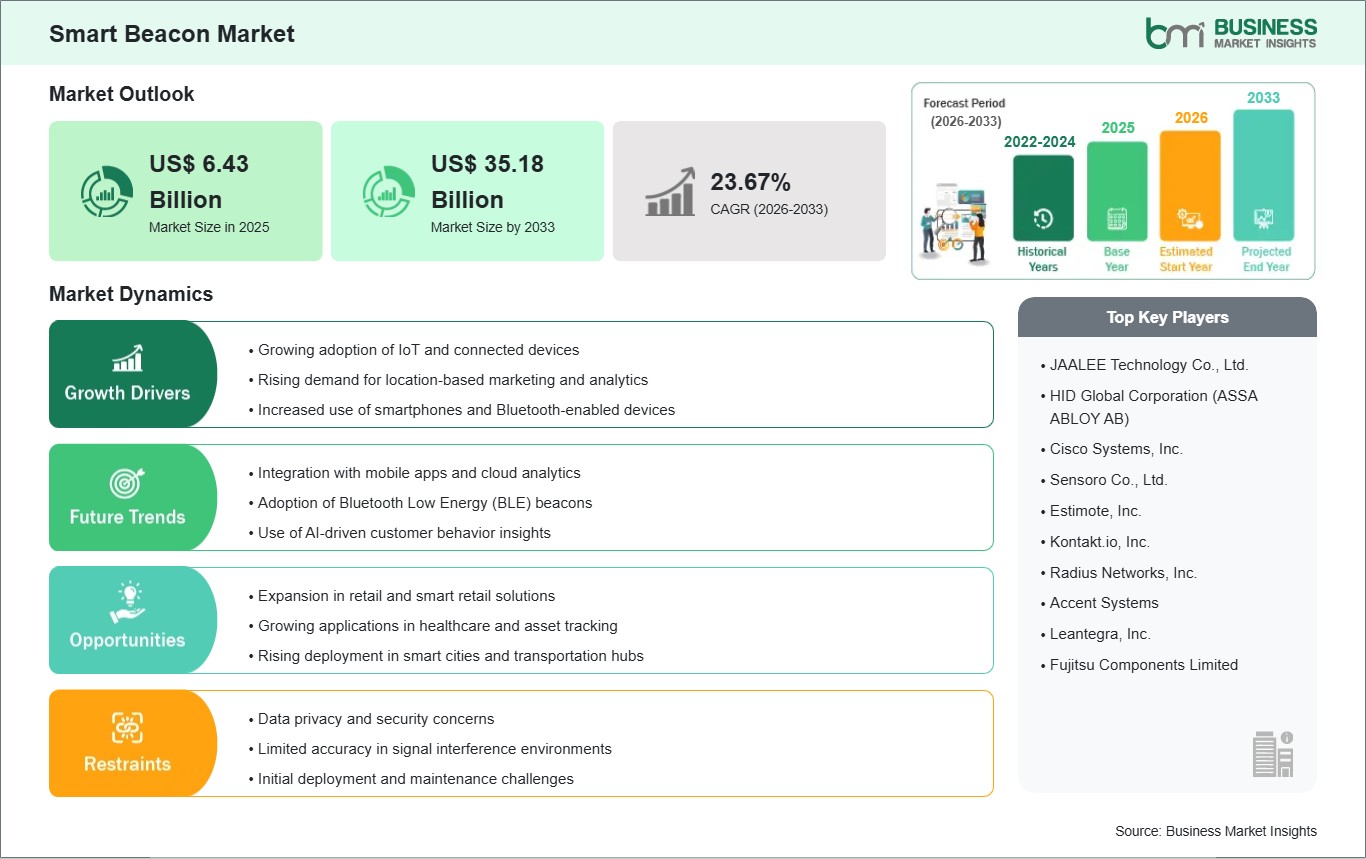
Smart beacons are compact, wireless transmitters that utilize Bluetooth Low Energy (BLE) technology to broadcast signals to nearby smart devices. They serve as a vital link between the physical and digital worlds, enabling high-precision indoor positioning and personalized engagement. These devices are increasingly essential across diverse sectors, including retail, transportation and logistics, public gathering spaces, sports, and automotive. Smart beacons offer distinct advantages such as hyper-localized communication, extreme energy efficiency, and the ability to capture granular real-time analytics on user movement and asset location. The market is primarily fueled by the massive proliferation of smartphones, the rapid expansion of the Internet of Things (IoT), and a growing demand for data-driven proximity marketing. Technological advancements, such as the integration of AI-powered spatial analytics and the development of hybrid connectivity (BLE + Wi-Fi), are further optimizing service reliability and operational insights.
Despite its robust growth, the market faces certain restraints. Significant concerns regarding data privacy and unauthorized tracking can limit consumer opt-in rates. Additionally, high initial setup costs for expansive infrastructures and the technical complexity of integrating multi-vendor beacon protocols pose challenges for small and medium enterprises. However, the market continues to hold immense potential through the rise of Industry 4.0, the expansion of smart city initiatives, and the increasing need for contactless services. Ongoing investments in energy-harvesting, battery-free beacon hardware are also expected to reduce long-term maintenance costs and open new avenues for large-scale industrial deployments.
Segment Analysis
Smart Beacon Market Segmentation
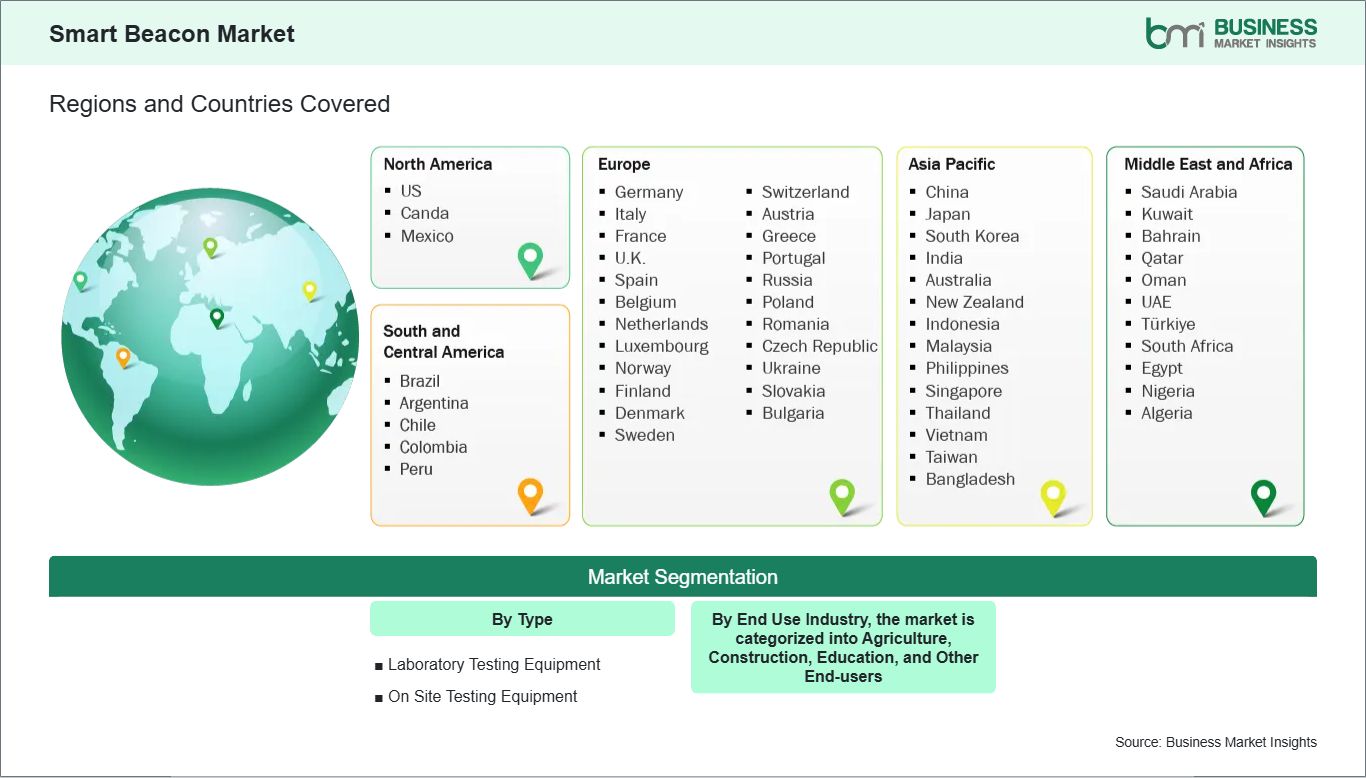
Key segments that contributed to the derivation of the Smart Beacon market analysis are offering, connectivity type, beacon standard, and end-use.
- By Offering, the market is segmented into Hardware, Software, and Services.
- By Connectivity Type, the market is divided into Bluetooth Low Energy (BLE) and Hybrid.
- By Beacon Standard, the market is categorized into iBeacon and Eddystone.
- By End-use, the market is categorized into Retail, Transportation and Logistics, Public Gathering and Spaces, Sports, and Automotive.
Market Forces
Smart Beacon Market Drivers and Opportunities
Surging Demand for Precision Proximity Marketing and Personalization
The rapid adoption of proximity marketing has emerged as a primary driver of the smart beacon market. As the global retail landscape shifts toward omnichannel strategies, businesses are increasingly leveraging beacons to deliver context-aware content directly to shoppers' smartphones. This technology allows for the transmission of hyper-localized coupons, product details, and personalized welcome messages based on a consumer's exact aisle location. For instance, physical retailers are adopting beacon technology to remain competitive by mirroring the digital world`s personalization.
Major retail giants like Macy's and Walmart have successfully implemented beacon networks to enhance customer engagement, leading to a measurable increase in dwell time and conversion rates. Unlike traditional advertising, proximity marketing triggered by smart beacons offers a non-intrusive way to engage users at the most critical moment, when they are physically near the product. By utilizing the BLE (Bluetooth Low Energy) protocol, these beacons provide a seamless bridge between a brand's mobile app and the physical store layout. This robust expansion directly supports the market growth as retailers strive to meet evolving consumer expectations for immediate, relevant, and value-added shopping experiences across the globe.
Rising Integration within Global IoT and Smart City Infrastructures
In an increasingly interconnected world, municipalities and industrial operators rely on smart beacons to provide the necessary spatial data for complex urban and logistics ecosystems. In smart cities, beacons are integrated into public transport hubs, airports, and municipal buildings to provide indoor navigation, wayfinding for the visually impaired, and real-time crowd management.
In the industrial sector, the shift toward Industry 4.0 demands granular visibility over supply chains. Smart beacons enable just-in-time inventory practices by providing real-time tracking of assets, automotive parts, and pallet movements within large-scale warehouses. This level of transparency reduces operational bottlenecks and optimizes the flow of goods across international borders. As multinational companies diversify their manufacturing strategies and cities become more data-centric, the demand for reliable, low-power beacon networks is expected to grow steadily. The ability of beacons to function in GPS-denied environments makes them an indispensable asset for the future of global logistics and intelligent urban planning.
Size and Share Analysis
Smart Beacon Market Size and Share Analysis
The smart beacon market demonstrates explosive growth, with size and share analysis revealing evolving trends among key players. The report examines subsegments categorized by offering, connectivity, standard, and end-use, offering insights into their contribution to overall market performance.
Based on offering, the Hardware segment, used for the physical deployment of transmitters, is the prerequisite for any location-aware network. However, the Software segment is witnessing a higher growth rate as businesses invest in advanced backend analytics platforms to interpret spatial data.
Bluetooth Low Energy (BLE) remains the leading connectivity type due to its universal smartphone compatibility and low power draw.
From a beacon perspective, the iBeacon segment is benefiting from its early-mover advantage and integration within the Apple ecosystem.
In terms of end-use, Retail leads the market, while Transportation and Logistics is the fastest-growing sector as logistics providers prioritize real-time asset visibility.
Report Coverage
Smart Beacon Market Report Coverage and Deliverables
The "Smart Beacon Market Size and Forecast (2022 - 2033)" report provides a detailed analysis of the market covering below areas:
- Smart Beacon market size and forecast at global, regional, and country levels for all the key market segments covered under the scope
- Smart Beacon market trends, as well as market dynamics such as drivers, restraints, and key opportunities
- Smart Beacon market analysis covering key market trends, global and regional framework, major players, regulations, and recent market developments
- Industry landscape and competition analysis covering market concentration, heat map analysis, prominent players, and recent developments for the Smart Beacon market
- Detailed company profiles, including SWOT analysis
Geographic Insights
Smart Beacon Market Geographic Insights
The geographical scope of the smart beacon market is divided into five regions: North America, Asia Pacific, Europe, Middle East and Africa, and South and Central America.
North America currently holds the largest market share, driven by a highly mature retail landscape and significant investments in healthcare IoT. The U.S. leads in proximity marketing adoption, with thousands of retail locations and major airports utilizing beacons for passenger guidance and targeted advertising. Europe is also a major contributor, characterized by strong smart city initiatives in Germany, the UK, and France, though growth is strictly balanced with rigorous GDPR compliance.
Asia-Pacific is estimated to record the fastest CAGR from 2026 to 2033. This growth is fueled by massive urbanization and government-backed "Smart City" projects in China and India. The region's dominant position is further solidified by the presence of a vast manufacturing hub and a rapidly growing smartphone user base. In LAMEA (Latin America, Middle East and Africa), the market is expanding through the modernization of tourism and hospitality in the UAE and Saudi Arabia, alongside a rising focus on industrial automation in Brazil and Mexico.
Industry Activity
Recent Developments
The Smart Beacon market is evaluated by gathering qualitative and quantitative data post primary and secondary research, which includes important corporate publications, association data, and databases. A few of the key developments in the smart beacon market are:
- In June 2025, Blecon, in collaboration with MOKO SMART, announces the launch of the L02S-BCN, a next-generation Smart Beacon co-designed by Blecon and MOKO SMART to meet the growing demands of sensing and connectivity in industrial and commercial environments. The L02S-BCN demonstrates what's possible when established and trusted beacon design meets Bluetooth cloud connectivity.
- In May 2025, Nokia launched two new Wi-Fi 7 gateways designed to deliver reliable, ultra-fast broadband to every corner of the home. Nokia`s entry-level Beacon 4 and mid-tier Beacon 9 offer gigabit speeds over Wi-Fi - essential for supporting the expanding demands of streaming, online gaming, video, smart home, and security applications in the home.
Trust & Transparency
Research Methodology
The market analysis combines proprietary research with secondary data from government agencies, company disclosures, regulatory filings, industry databases and expert interviews. Market estimates are validated through data triangulation, cross-market benchmarking and analyst
review.
View Full Research Methodology
Key Sources Referred:
World Bank - Global Trade Indicators World Trade Organization (WTO) International Monetary Fund (IMF) International Trade Administration (ITA) Company website Company annual reports Company investor presentations