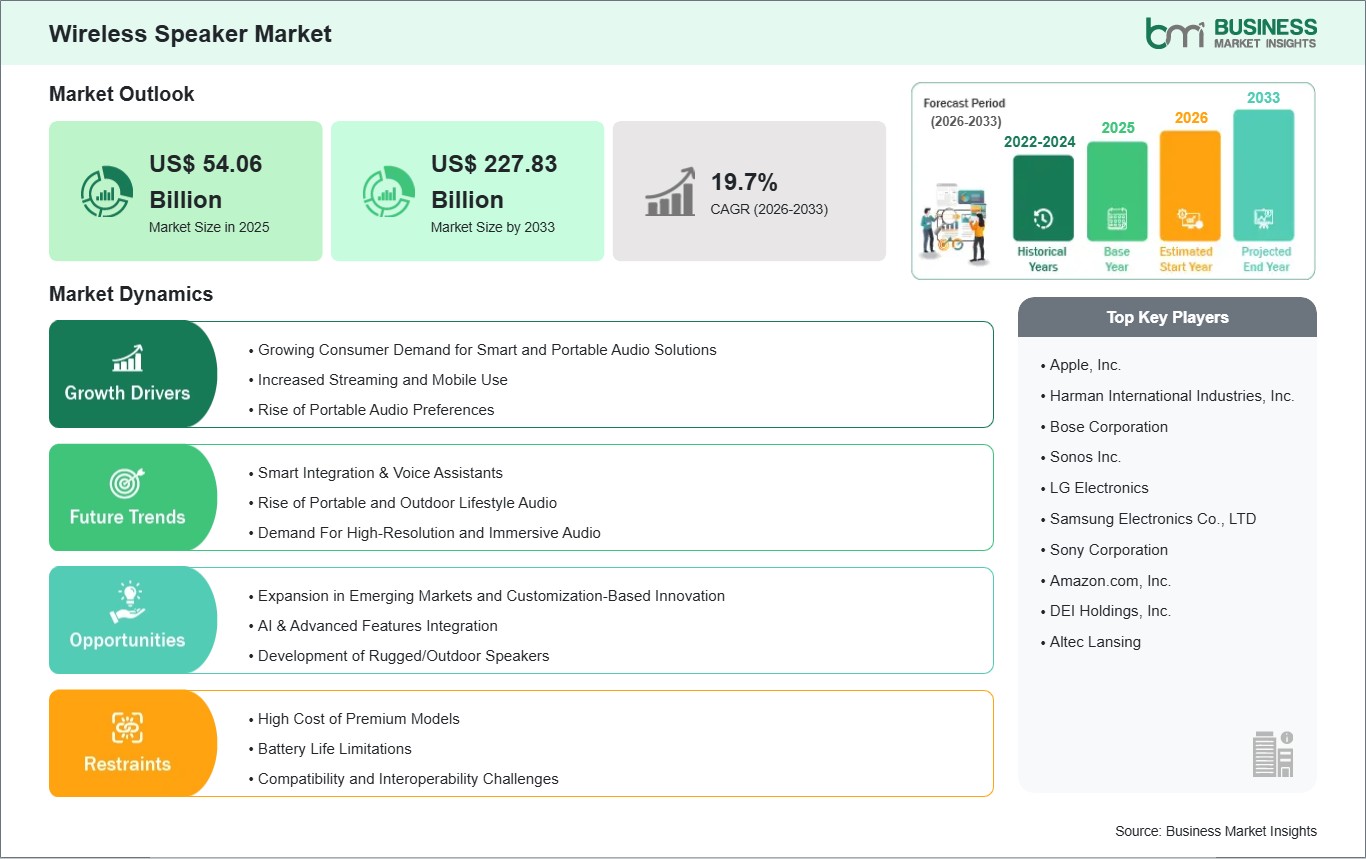
The wireless speaker market size is expected to reach US$ 227.83 billion by 2033 from US$ 54.06 billion in 2025. The market is estimated to record a CAGR of 19.7% from 2026 to 2033.
A wireless speaker is an audio playback device that uses wireless technologies such as Bluetooth, Wi-Fi, or other radio frequencies to receive sound signals from a source without physical cables. Unlike traditional speakers that require wired connections to audio sources, wireless speakers offer portability and flexibility, making them ideal for use at home, outdoors, or on the move. Their primary uses include streaming music from smartphones, tablets, or computers, enhancing home entertainment systems, facilitating hands-free calls, and supporting multi-room audio setups. The benefits of wireless speakers are significant: they provide clutter-free installation, ease of connectivity, mobility, and often integrated smart features like voice assistants and app control. High sound quality, along with compact and stylish designs, further boosts their appeal.
Several factors influence the wireless speaker market’s dynamics. Key drivers include the increasing adoption of smart devices, rising disposable incomes, and consumer demand for seamless connectivity and enhanced audio experiences. Growing urban lifestyles and the popularity of on-the-go entertainment also fuel market growth. However, the market faces restraints such as battery life limitations, interference issues in congested wireless environments, and the higher cost of premium models that may deter price-sensitive buyers. Despite these challenges, there are ample opportunities for innovation—advancements in battery technology, integration with IoT ecosystems, and expansion into emerging markets can unlock new consumer segments. Current trends shaping the wireless speaker landscape include the rise of voice-enabled smart speakers, multi-room synchronized systems, eco-friendly materials, and modular designs that allow customization. Additionally, manufacturers are focusing on enhanced durability, water resistance for outdoor use, and immersive audio technologies like spatial sound, positioning the wireless speaker market for continued evolution and growth.

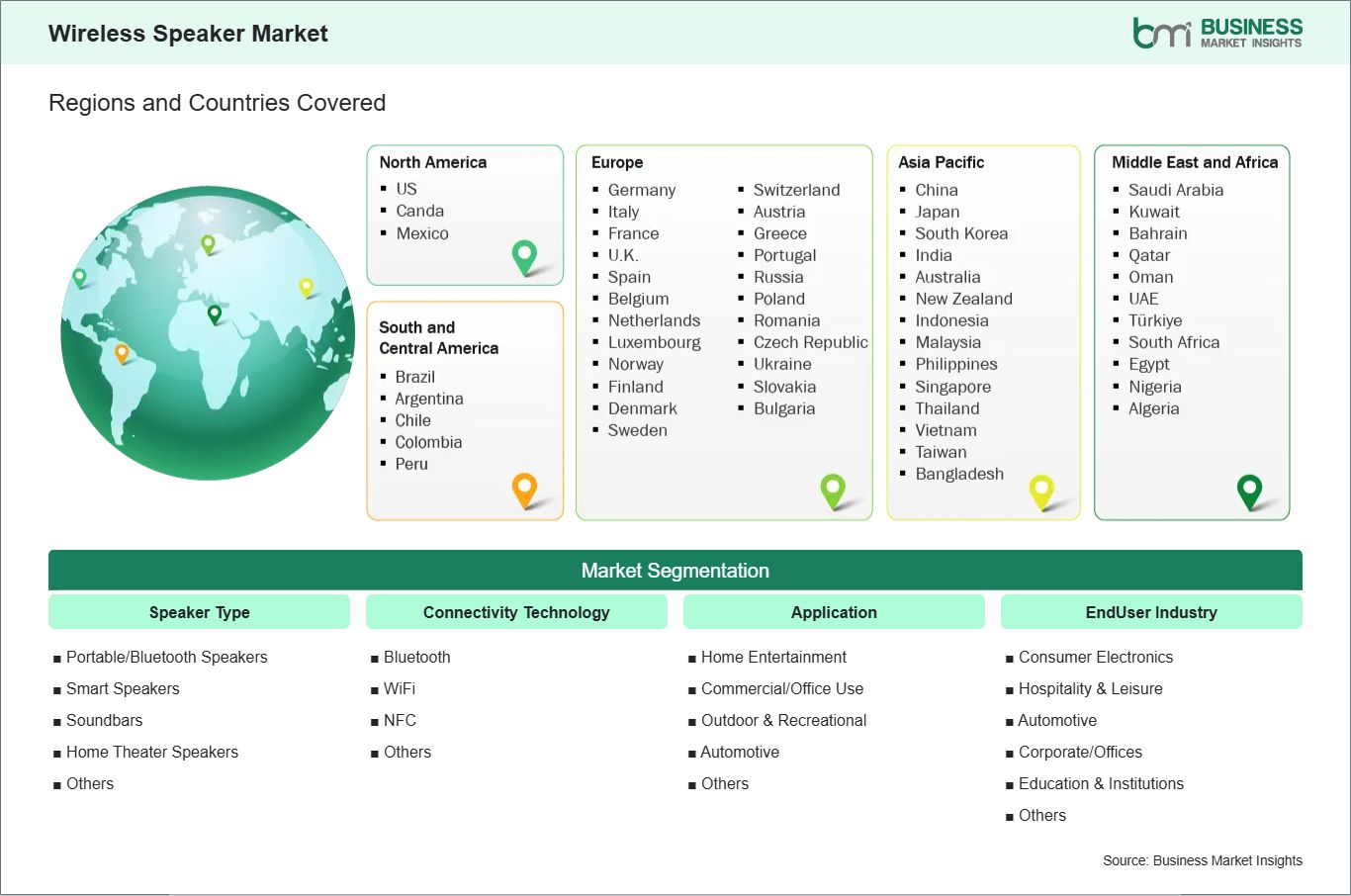
Key segments that contributed to the derivation of the wireless speaker market analysis are speaker type, connectivity technology, and application.
One of the primary drivers of the wireless speaker market is the rapidly growing consumer demand for portable, smart, and cable-free audio devices that integrate seamlessly with modern lifestyles. As consumers increasingly prioritize convenience and mobility, wireless speakers have emerged as a preferred alternative to traditional wired sound systems. The widespread adoption of smartphones, tablets, and streaming platforms has significantly boosted the need for audio devices that support Bluetooth, Wi-Fi, and voice-enabled connectivity. In addition, the rise of smart homes and voice assistants such as Amazon Alexa, Google Assistant, and Apple Siri has accelerated demand for smart wireless speakers. Consumers are drawn to hands-free control, multi-room audio, and the ability to manage home automation, music streaming, and information access through a single device. This convergence of entertainment and functionality has positioned wireless speakers as a central component of connected living environments. Technological advancements in battery efficiency, sound quality, and compact design have further strengthened market growth. Modern wireless speakers now offer longer battery life, water resistance, noise optimization, and immersive sound performance, making them suitable for both indoor and outdoor use. Moreover, declining prices and a wide range of product offerings across premium and budget segments have expanded the consumer base. Collectively, these factors continue to drive strong and sustained demand for wireless speakers across global markets.
A major opportunity in the wireless speaker market lies in the expansion across emerging economies and the growing scope for product differentiation and customization. Rapid urbanization, rising disposable incomes, and increasing internet penetration in regions such as Asia-Pacific, Latin America, and Africa are creating a large base of first-time consumers for wireless audio products. As younger, tech-savvy populations adopt digital entertainment and streaming services, demand for affordable and feature-rich wireless speakers is expected to rise significantly.
Manufacturers have the opportunity to tap into these markets by offering region-specific pricing strategies, localized voice assistant support, and durable designs tailored to local usage conditions. Additionally, the increasing popularity of personalized and lifestyle-oriented electronics opens avenues for innovation in design, color options, modular features, and smart integrations. Consumers are increasingly seeking products that reflect their identity and usage preferences, creating room for customizable sound profiles, app-based controls, and aesthetic differentiation. Another promising opportunity is the integration of advanced technologies such as artificial intelligence, spatial audio, and IoT connectivity. These innovations can enhance user experience and enable premium positioning. Furthermore, partnerships with music streaming platforms, gaming companies, and smart home ecosystem providers can unlock new revenue streams. By focusing on emerging markets and innovation-driven customization, companies can achieve long-term growth and competitive advantage in the wireless speaker market.

By speaker type, the market is segmented into portable/Bluetooth speakers, smart speakers, soundbars, home theater speakers, and others. The home theater speakers segment held the largest share of the market in 2025. Worldwide demand for home theater speakers is rising due to growing streaming content, affordable smart TVs, and improved audio technologies. Consumers seek immersive cinematic experiences at home, driven by urban lifestyles, remote entertainment habits, wireless connectivity, compact designs, and falling prices across global markets, supported by e-commerce expansion and innovation.
By connectivity technology, the market is segmented into Bluetooth, Wi-Fi, NFC, and others. The Bluetooth segment held the largest share of the market in 2025. The increasing demand for Bluetooth wireless speakers is driven by their portability, convenience, and cable-free connectivity. They easily pair with smartphones and laptops, offering high-quality sound anywhere. Long battery life, affordable prices, and stylish designs also attract users for home, travel, and outdoor entertainment.
By application, the market is segmented into home entertainment, commercial/office use, outdoor & recreational, education & institutions, and others. The home entertainment segment held the largest share of the market in 2025. The demand and adoption of wireless speakers in home entertainment is increasing due to convenience, portability, and easy connectivity. Advancements in Bluetooth and Wi-Fi technology, smart home integration, improved sound quality, and affordable pricing also encourage consumers to upgrade their home audio experience.
| Report Attribute | Details |
|---|---|
| Market size in 2025 | US$ 54.06 Billion |
| Market Size by 2033 | US$ 227.83 Billion |
| Global CAGR (2026 - 2033) | 19.7% |
| Historical Data | 2022-2024 |
| Forecast period | 2026-2033 |
| Segments Covered | By Speaker Type
|
| Regions and Countries Covered | North America
|
| Market leaders and key company profiles |
|
The Wireless Speaker Market Size and Forecast (2022–2033) report provides a detailed analysis of the market covering below areas:
The geographical scope of the wireless speaker market report is divided into five regions: North America, Asia Pacific, Europe, Middle East & Africa, and South & Central America. The wireless speaker market in Asia Pacific is expected to grow significantly during the forecast period.
The demand for wireless speakers in the North American market is driven by a combination of technological, lifestyle, and economic factors that align with evolving consumer preferences. One of the most significant drivers is the widespread adoption of smartphones, tablets, and other smart devices, which has increased the need for seamless, wireless audio solutions that integrate easily with existing ecosystems. The rapid growth of smart homes and the popularity of voice-enabled virtual assistants such as Amazon Alexa, Google Assistant, and Apple Siri have further accelerated demand, as many wireless speakers now function as central hubs for home automation and digital services. Rising consumer preference for portability and convenience also plays a critical role, with compact, battery-powered wireless speakers appealing to users for both indoor and outdoor use.
Additionally, strong internet penetration and widespread access to high-speed Wi-Fi and Bluetooth connectivity across North America support the smooth operation of wireless audio devices, enhancing user experience. Changing lifestyle trends, including increased spending on home entertainment, remote work, and social gatherings at home, have boosted demand for high-quality audio products. The presence of major market players, continuous product innovation, and frequent product launches with improved sound quality, longer battery life, and rugged designs also stimulate consumer interest. Moreover, increasing disposable income and a strong culture of consumer electronics adoption in the region encourage regular upgrades to newer audio technologies. Together, these factors create a favorable environment that continues to drive the growth of the wireless speaker market in North America.

The wireless speaker market is evaluated by gathering qualitative and quantitative data post primary and secondary research, which includes important corporate publications, association data, and databases. A few of the key developments in the wireless speaker market are:
The Wireless Speaker Market is valued at US$ 54.06 Billion in 2025, it is projected to reach US$ 227.83 Billion by 2033.
As per our report Wireless Speaker Market, the market size is valued at US$ 54.06 Billion in 2025, projecting it to reach US$ 227.83 Billion by 2033. This translates to a CAGR of approximately 19.7% during the forecast period.
The Wireless Speaker Market report typically cover these key segments-
The historic period, base year, and forecast period can vary slightly depending on the specific market research report. However, for the Wireless Speaker Market report:
The Wireless Speaker Market is populated by several key players, each contributing to its growth and innovation. Some of the major players include:
The Wireless Speaker Market report is valuable for diverse stakeholders, including:
Essentially, anyone involved in or considering involvement in the Wireless Speaker Market value chain can benefit from the information contained in a comprehensive market report.
Please tell us your area of interest
(Market Segments/ Regions and Countries/ Companies)