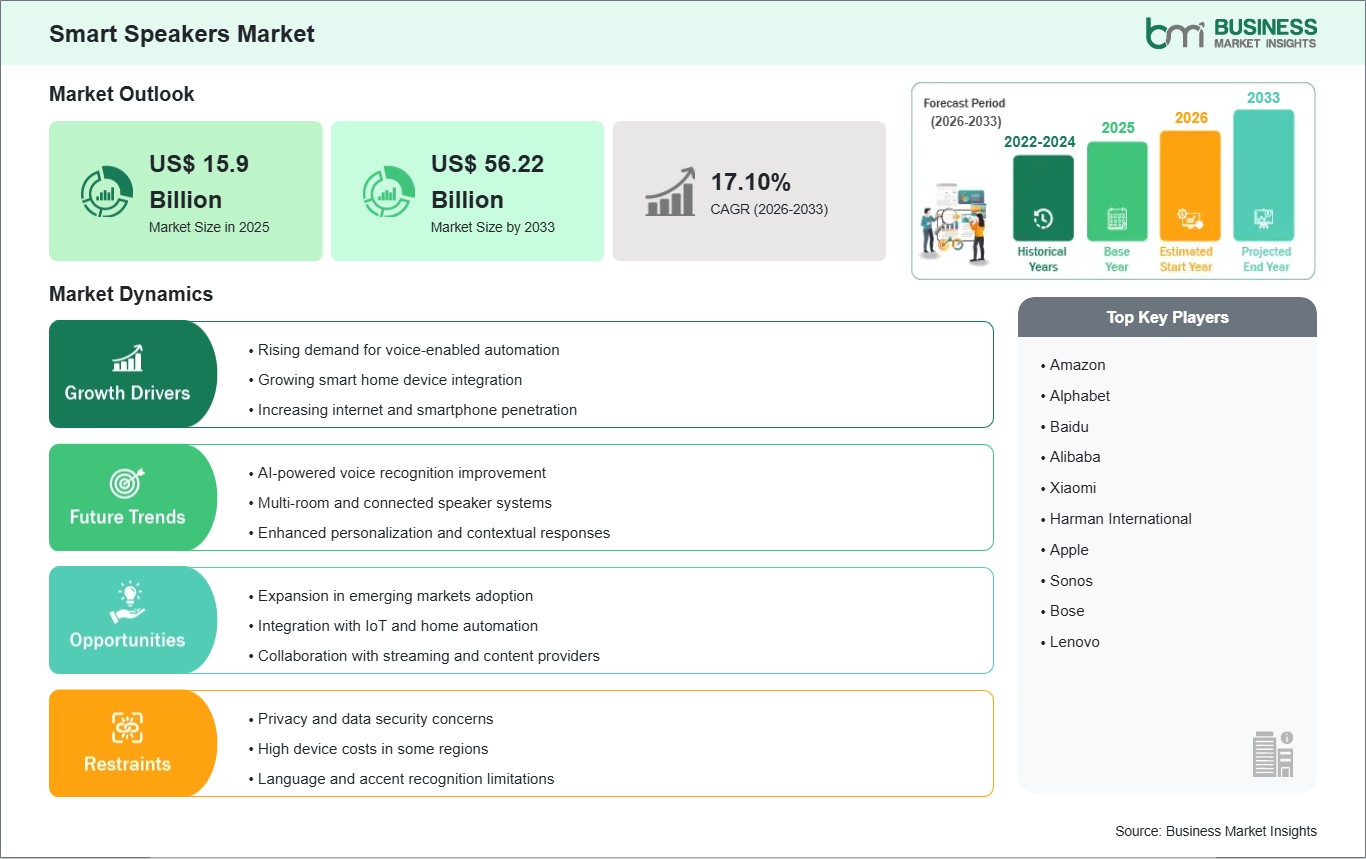
The Smart Speakers Market size is expected to reach US$ 56.22 billion by 2033 from US$ 15.9 billion in 2025. The market is estimated to record a CAGR of 17.10% from 2026 to 2033.
The smart speakers market is experiencing dynamic growth as consumers and businesses increasingly embrace voice-enabled, connected devices. These devices combine high-quality audio, voice recognition, and artificial intelligence to offer hands-free control over streaming services, smart home devices, information retrieval, and everyday tasks. The integration of AI-powered virtual assistants and cloud platforms allows smart speakers to deliver personalized recommendations, predictive responses, and smooth interoperability with multiple digital services. As smart home adoption and IoT ecosystems expand, these devices are becoming central to modern, connected living environments. Adoption in commercial sectors is also on the rise, with offices, retail stores, and hospitality establishments deploying smart speakers for workflow management, interactive customer experiences, and enhanced operational efficiency.
Advances in far-field voice recognition, multi-room audio, and natural language processing continue to improve usability and functionality, while ongoing software updates enable devices to adapt and learn over time. Consumer expectations around privacy, data protection, and seamless compatibility with other smart systems are shaping product development strategies. The market is further supported by growing internet connectivity, smartphone proliferation, and AI-enabled ecosystems. Companies that combine superior audio performance, intelligent voice services, and cross-device integration are well-positioned to capture market share in this highly competitive, fast-evolving landscape.

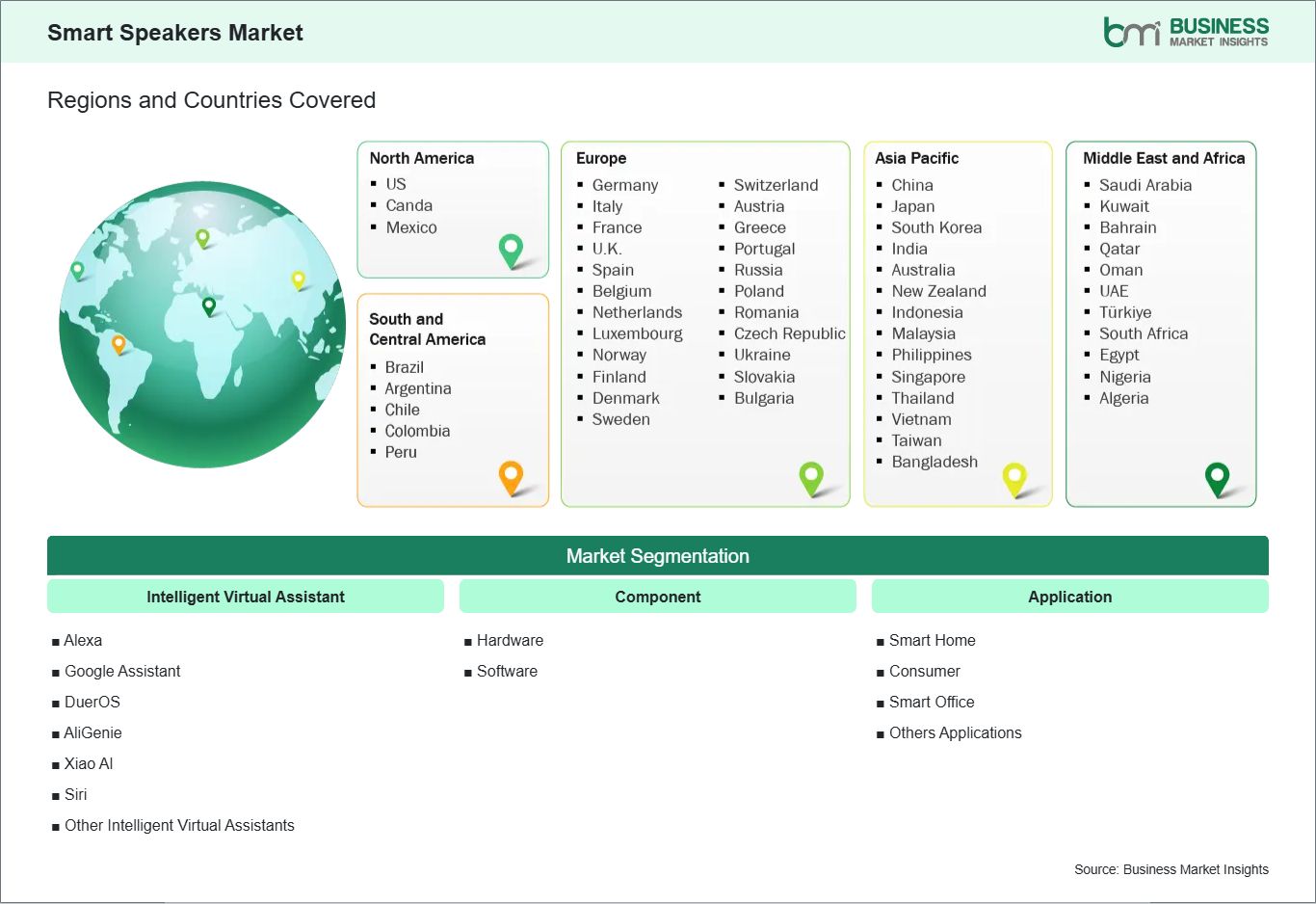
Key segments that contributed to the derivation of the smart speakers market analysis are Intelligent virtual assistant, component, application.
The global smart speaker market is experiencing robust growth as voice-enabled automation becomes a standard feature in both consumer and commercial environments. Users are increasingly relying on voice commands to manage everyday tasks such as entertainment, home systems, scheduling, and online interactions. Innovations in AI, natural language processing, and multilingual support are improving accuracy, responsiveness, and usability. Seamless integration with smart home and IoT ecosystems is enhancing convenience and productivity. Additionally, growing adoption in offices, hospitality, and other commercial settings is broadening applications, positioning voice automation as a key driver of global smart speaker demand.
Smart speaker adoption is rising worldwide as devices become more affordable and digital connectivity expands. Markets with growing internet access and increasing consumer awareness are embracing smart speakers for home automation, entertainment, and productivity. Companies are developing localized voice assistants to cater to diverse languages and cultural preferences, enhancing relevance and usability. Entry-level devices attract first-time buyers, while retail and online distribution channels increase accessibility. As a result, emerging markets are contributing significantly to overall market growth, fueling global adoption and providing new opportunities for smart speaker manufacturers and ecosystem partners.
The Smart Speakers Market demonstrates steady growth, with size and share analysis highlighting evolving trends and competitive dynamics among key players. The report examines subsegments categorized within Intelligent virtual assistant, component, application offering insights into their contribution to overall market performance.
Intelligent virtual assistant, the alexa sub segment dominated the market in 2025, driven by its widespread adoption and robust ecosystem in the intelligent virtual assistant segment.
Based on component, the software sub segment dominated the market in 2025, driven by the increasing demand for advanced voice recognition and AI integration in smart speakers.
In terms of application, the smart home sub segment dominated the market in 2025, driven by growing consumer preference for connected devices and home automation in the smart speaker market.
| Report Attribute | Details |
|---|---|
| Market size in 2025 | US$ 15.9 Billion |
| Market Size by 2033 | US$ 56.22 Billion |
| Global CAGR (2026 - 2033) | 17.10% |
| Historical Data | 2022-2024 |
| Forecast period | 2026-2033 |
| Segments Covered | By Intelligent Virtual Assistant
|
|
Regions and Countries Covered
| |
| North America | US, Canada, Mexico |
| Europe | Belgium, Austria, Finland, Denmark, Greece, Poland, Romania, Russia, Ukraine, Czech Republic, Slovakia, Bulgaria, Italy, Luxembourg, Germany, Switzerland, France, Netherlands, Norway, Portugal, Spain, Sweden, United Kingdom |
| Asia-Pacific | Australia, China, India, Japan, South Korea, Indonesia, Malaysia, Philippines, Singapore, Thailand, Vietnam, Bangladesh, New Zealand, Taiwan |
| South and Central America | Brazil, Argentina, Peru, Chile, Colombia |
| Middle East and Africa | Bahrain, Kuwait, Oman, Qatar, Saudi Arabia, United Arab Emirates, Turkiye, South Africa, Egypt, Algeria, Nigeria |
| Market leaders and key company profiles |
|
The "Smart Speakers Market Size and Forecast (2022 - 2033)" report provides a detailed analysis of the market covering below areas:
The geographical scope of the Smart Speakers Market report is divided into North America, Asia Pacific, Europe, Middle East & Africa, and South & Central America. North America held the largest share in 2025.
North America leads the smart speakers market, driven by its advanced technological infrastructure, widespread industrial automation, and the presence of major semiconductor and electronics companies. Key sectors, including aerospace, automotive, healthcare, and advanced manufacturing, are increasingly leveraging smart sensors to enhance operational efficiency, enable predictive maintenance, and foster innovation. Robust investments in research and development, particularly in artificial intelligence, robotics, and connected device networks, further strengthen the region’s dominance. The growing deployment of smart homes, wearable health devices, and intelligent transportation systems continues to fuel demand across the United States and Canada.
Europe is a mature market with strong emphasis on industrial automation and sustainability-driven initiatives. Countries across the region are integrating smart sensors into manufacturing processes, energy management solutions, and environmental monitoring systems. The adoption of Industry 4.0 and digital manufacturing platforms is accelerating the use of intelligent sensing solutions in production and operational management.
Asia Pacific is expanding rapidly due to rising industrial automation, electronics manufacturing, and the proliferation of connected consumer devices. Nations such as China, Japan, South Korea, and India are driving sensor adoption across automotive manufacturing, smart infrastructure, and consumer electronics sectors.
Middle East and Africa are gradually embracing smart sensor technologies, with applications focused on energy management, urban infrastructure monitoring, and smart city initiatives.
South and Central America are steadily increasing adoption in industrial monitoring, agriculture technology, and transportation infrastructure projects, reflecting growing investment in modernization and efficiency improvements.

The Smart Speakers Market is evaluated by gathering qualitative and quantitative data post primary and secondary research, which includes important corporate publications, association data, and databases. A few of the key developments in the smart speakers market are:
The Smart Speakers Market is valued at US$ 15.9 Billion in 2025, it is projected to reach US$ 56.22 Billion by 2033.
As per our report Smart Speakers Market, the market size is valued at US$ 15.9 Billion in 2025, projecting it to reach US$ 56.22 Billion by 2033. This translates to a CAGR of approximately 17.10% during the forecast period.
The Smart Speakers Market report typically cover these key segments-
The historic period, base year, and forecast period can vary slightly depending on the specific market research report. However, for the Smart Speakers Market report:
The Smart Speakers Market is populated by several key players, each contributing to its growth and innovation. Some of the major players include:
The Smart Speakers Market report is valuable for diverse stakeholders, including:
Essentially, anyone involved in or considering involvement in the Smart Speakers Market value chain can benefit from the information contained in a comprehensive market report.
Please tell us your area of interest
(Market Segments/ Regions and Countries/ Companies)