Market Summary
Executive Summary and Global Market Analysis
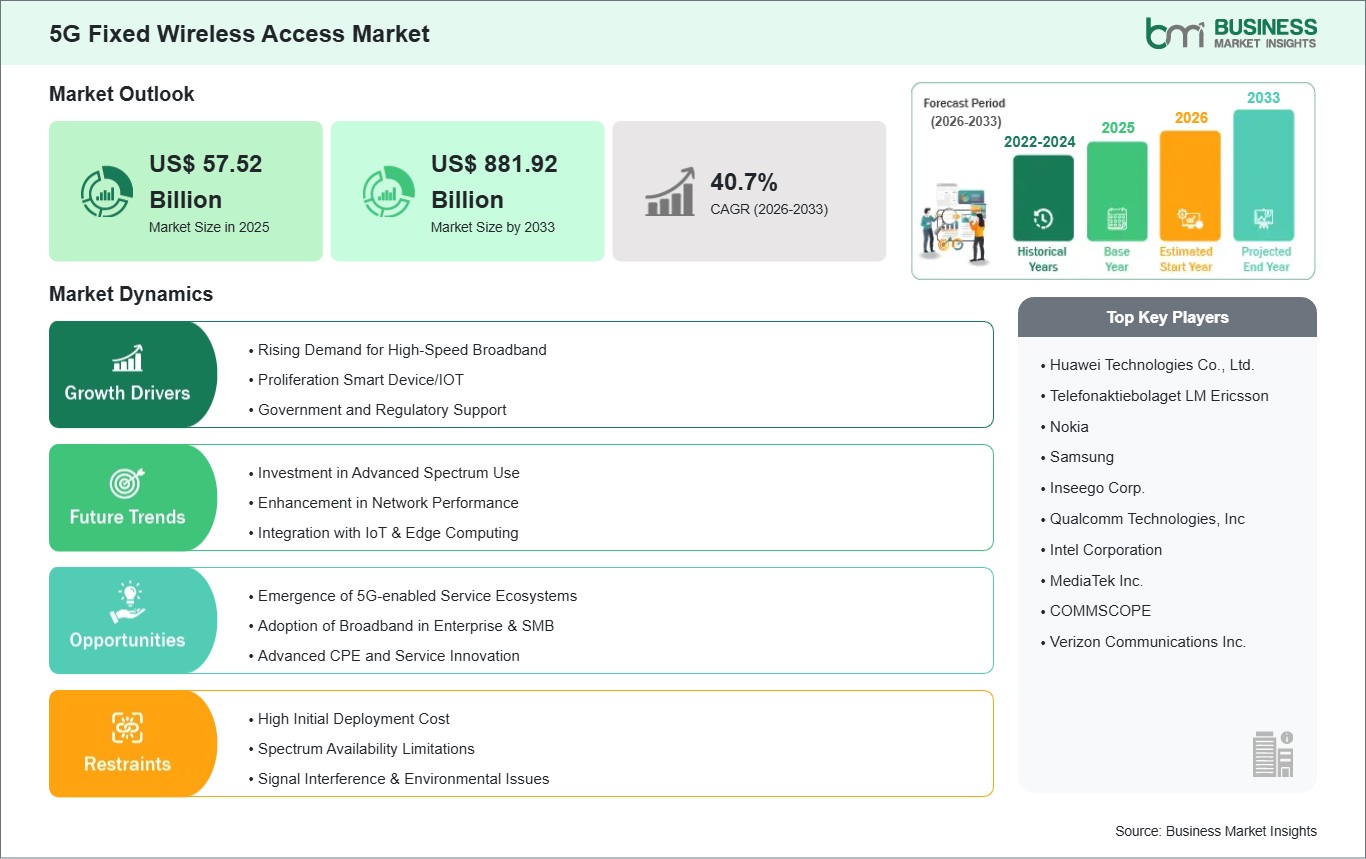
5G Fixed Wireless Access (FWA) is a high-speed internet service that leverages 5G mobile networks to deliver broadband connectivity to homes and businesses without relying on traditional fiber or cable infrastructure. Unlike conventional fixed-line broadband, 5G FWA uses wireless signals to provide ultra-fast internet, supporting activities such as streaming, online gaming, video conferencing, and cloud computing with low latency and high reliability. The usage of 5G FWA is expanding rapidly in both urban and rural areas where laying fiber is cost-prohibitive, enabling seamless connectivity in regions previously underserved. Several factors are driving the growing demand for 5G FWA. First, the increasing adoption of smart devices and Internet of Things (IoT) applications is boosting the need for faster and more stable internet connections. Second, the rising trend of remote work, online education, and digital entertainment is creating pressure for high-capacity broadband services. Third, government initiatives promoting digital inclusion and network expansion are accelerating 5G deployments. Additionally, businesses seeking scalable, flexible, and cost-effective connectivity solutions prefer 5G FWA over traditional wired options. Collectively, these technological, economic, and social factors are fueling the rapid growth of the 5G Fixed Wireless Access market globally, positioning it as a key driver in the evolution of next-generation broadband infrastructure.
Segment Analysis
5G Fixed Wireless Access Market Segmentation
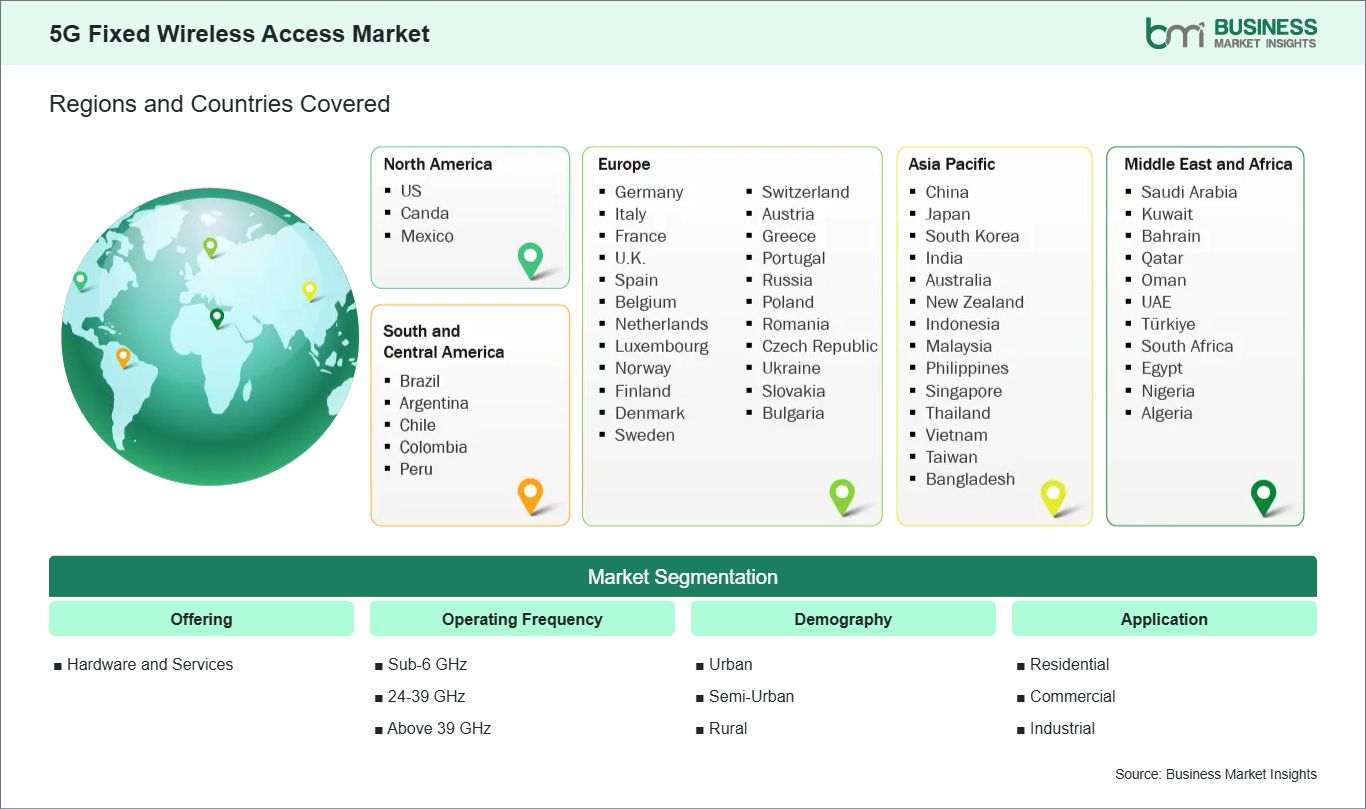
Key segments that contributed to the derivation of the 5G fixed wireless access market analysis are offering, operating frequency, demography, and application.
- By offering, the market is segmented into hardware and services. The hardware segment held the largest share of the market in 2025.
- By operating frequency, the market is divided into below sub-6 GHz, 24-39 GHz, and above 39 GHz. The sub-6 GHz segment held the largest share of the market in 2025.
- By demography, the market is segmented into urban, semi-urban, and rural. The urban segment held the largest share of the market in 2025.
- By application, the market is segmented into residential, commercial, and industrial. The residential segment held the largest share of the market in 2025.
Market Forces
5G Fixed Wireless Access Market Drivers and Opportunities
Rising Demand for High-Speed Broadband
Rising demand for high-speed broadband is a major driver of the 5G fixed wireless access (FWA) market, as consumers and businesses increasingly rely on data-intensive digital services. The rapid growth of video streaming platforms, cloud-based applications, and online gaming requires fast, low-latency, and reliable internet connections to ensure seamless user experiences. At the same time, the expansion of remote and hybrid work models has increased the need for stable broadband that can support video conferencing, real-time collaboration, and secure access to enterprise systems. In many regions, traditional wired broadband such as fiber or cable is either unavailable, expensive, or slow to deploy. 5G FWA addresses this gap by delivering high-speed internet using wireless networks, enabling quick installation and flexible coverage. Its ability to provide fiber-like speeds without extensive infrastructure investment makes it an attractive solution for households and small businesses, thereby accelerating adoption and driving growth in the 5G fixed wireless access market.
Emergence of 5G-enabled Service Ecosystems
The emergence of 5G-enabled service ecosystems is a major catalyst for the growth of the 5G Fixed Wireless Access (FWA) market. By providing ultra-fast, low-latency, and highly reliable connectivity, 5G FWA serves as a robust foundation for innovative services across sectors. Telehealth platforms, for instance, can leverage 5G FWA to deliver real-time remote consultations, high-definition medical imaging, and continuous patient monitoring, expanding healthcare access beyond traditional facilities. Similarly, e-education benefits from seamless interactive learning experiences, virtual classrooms, and augmented reality-based lessons, all of which rely on consistent high-speed connections. In industrial contexts, smart manufacturing solutions, including real-time automation, IoT monitoring, and predictive maintenance, thrive on the bandwidth and responsiveness 5G FWA provides. As these service ecosystems grow, demand for reliable, high-capacity FWA solutions rises, creating a virtuous cycle: advanced services drive FWA adoption, while expanded FWA networks enable increasingly sophisticated digital applications, accelerating the market’s expansion.
Size and Share Analysis
5G Fixed Wireless Access Market Size and Share Analysis
By offering, the market is segmented into hardware and services. The hardware segment held the largest share of the market in 2025. Rising 5G fixed wireless access adoption accelerates demand for advanced hardware, including antennas, routers, and base stations, driven by broadband expansion, rural connectivity needs, and cost-effective high-speed deployment globally worldwide.
By operating frequency, the market is divided into below sub-6 GHz, 24-39 GHz, and above 39 GHz. The below sub-6 GHz segment held the largest share of the market in 2025. Rising demand for sub-6 GHz frequencies in the 5G fixed wireless access market reflects wider coverage, better penetration, cost efficiency, and reliable performance for mass broadband deployment globally nationwide.
By demography, the market is segmented into urban, semi-urban, and rural. The urban segment held the largest share of the market in 2025. Urban areas are witnessing increasing demand for 5G fixed wireless access as residents seek faster broadband, deployment, cost efficiency, and reliable connectivity supporting remote work, streaming, and smart city services.
By application, the market is segmented into residential, commercial, and industrial. The residential segment held the largest share of the market in 2025. Increasing demand for 5G fixed wireless access reflects residents seeking faster broadband, rapid deployment, lower costs, flexible connectivity, and reliable performance, especially where fiber is limited or unavailable today worldwide.
Report Coverage
5G Fixed Wireless Access Market Report Coverage and Deliverables
The "5G Fixed Wireless Access Market Size and Forecast (2022–2033)" report provides a detailed analysis of the market covering below areas:
- 5G fixed wireless access market size and forecast at global, regional, and country levels for all the key market segments covered under the scope
- 5G fixed wireless access market trends, as well as market dynamics such as drivers, restraints, and key opportunities
- 5G fixed wireless access market analysis covering key market trends, global and regional framework, major players, regulations, and recent market developments
- Industry landscape and competition analysis covering market concentration, heat map analysis, prominent players, and recent developments for the 5G fixed wireless access market
- Detailed company profiles, including SWOT analysis
Geographic Insights
5G Fixed Wireless Access Market Geographic Insights
The geographical scope of the 5G fixed wireless access market report is divided into five regions: North America, Asia Pacific, Europe, Middle East & Africa, and South & Central America. The 5G fixed wireless access market in North America is expected to grow significantly during the forecast period.
The North America 5G fixed wireless access market is segmented into United States, Canada, and Mexico. The increasing demand and adoption of 5G fixed wireless access (FWA) in North America is driven by a convergence of technological, economic, and policy factors. Rapid growth in data-intensive applications such as streaming, cloud gaming, remote work, and IoT has intensified the need for high-speed, low-latency broadband, especially in suburban and rural areas underserved by fiber. 5G FWA offers faster deployment and lower capital expenditure than wired alternatives, enabling operators to expand coverage quickly without extensive trenching. Competitive pressure among telecom providers and supportive spectrum availability, including mid-band deployments, have improved performance and reliability.
Government initiatives and funding aimed at closing the digital divide further accelerate adoption by incentivizing last-mile solutions. For consumers and small businesses, 5G FWA provides flexible, scalable, and often more affordable connectivity with rapid installation. Together, these drivers position 5G FWA as a compelling broadband alternative, supporting North America’s growing digital economy and evolving connectivity expectations.
Industry Activity
Recent Developments
The 5G fixed wireless access market is evaluated by gathering qualitative and quantitative data post primary and secondary research, which includes important corporate publications, association data, and databases. A few of the key developments in the 5G fixed wireless access market are:
- In January 2026, Telefonaktiebolaget LM Ericsson partnered with Three Sweden to make their 5G Standalone strategy and vision a reality. Powered by Ericsson technology end-to-end, this deployment will help Three Sweden to drive productivity, sustainability, and innovation across sectors.
- In October 2024, Ericsson and Wipro Limited announced the successful transformation of the billing experience for all Odido brand mobile customers in the Netherlands by migrating to the cloud-native Ericsson Billing platform hosted on Amazon Web Services (AWS). This achievement allows Odido to offer innovative 5G services, including the newly launched Klik&Klaar fixed-wireless access (FWA) solution, with improved operational efficiency and customer experience.
Trust & Transparency
Research Methodology
The market analysis combines proprietary research with secondary data from government agencies, company disclosures, regulatory filings, industry databases and expert interviews. Market estimates are validated through data triangulation, cross-market benchmarking and analyst
review.
View Full Research Methodology
Key Sources Referred:
World Bank – Global Trade IndicatorsWorld Trade Organization (WTO)International Monetary Fund (IMF)International Trade Administration (ITA)Company websiteCompany annual reportsCompany investor presentations