Market Summary
Executive Summary and Global Market Analysis
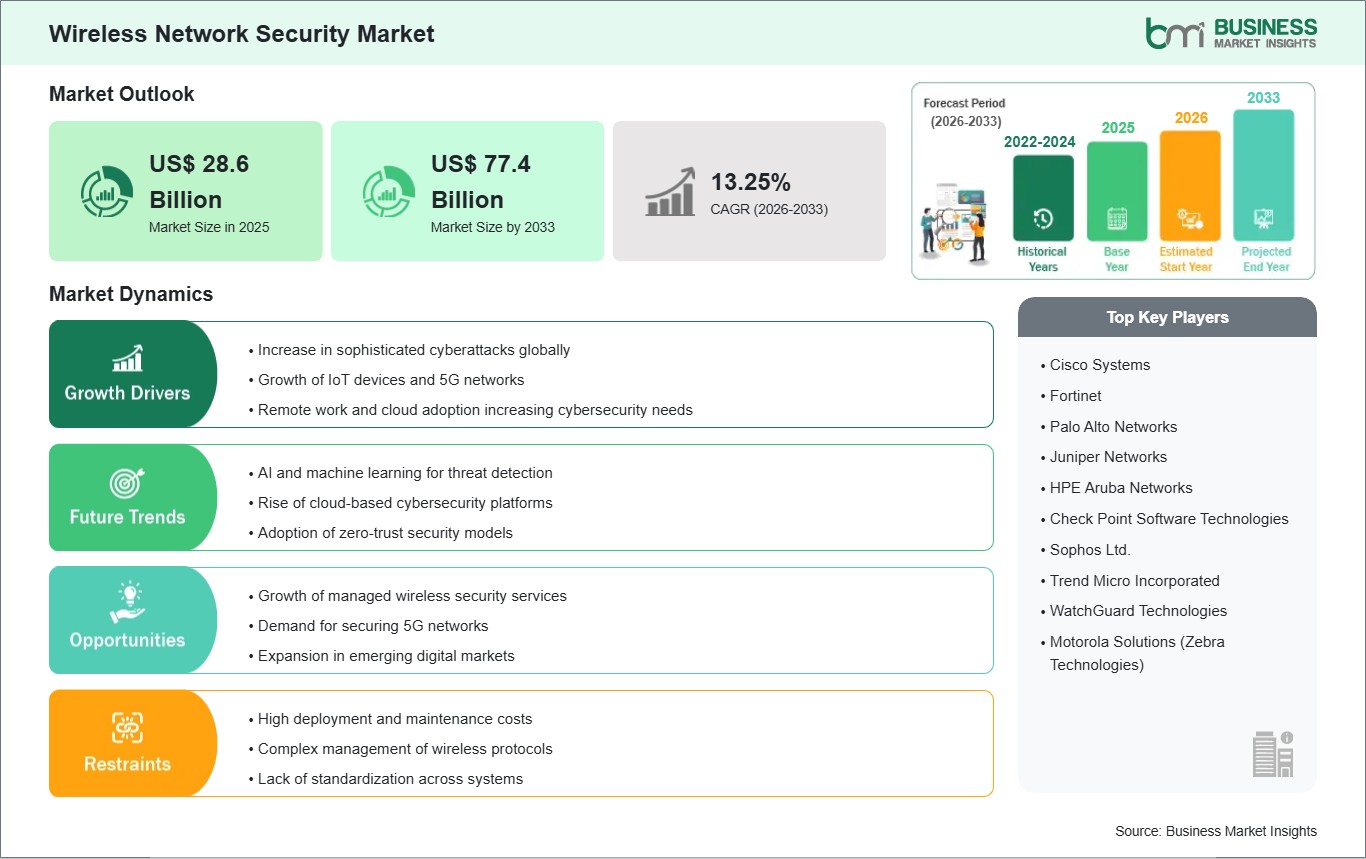
Wireless network security is a critical defense layer in global telecommunications, evolving from basic perimeter protection toward a decentralized, zero-trust architecture. This market encompasses an extensive range of solutions, including Next-Generation Firewalls (NGFW), Secure Access Service Edge (SASE), Identity and Access Management (IAM), and advanced encryption protocols, essential for protecting data as it traverses increasingly complex Wi-Fi, 5G, and IoT environments. These technologies deliver immense strategic value by safeguarding sensitive corporate and personal information from unauthorized access, eavesdropping, and sophisticated cyberattacks like malware injection and phishing. Market expansion is currently driven by the global surge in connected devices (IoT), the accelerating deployment of high-speed Wi-Fi 7 and 5G networks, and the rising frequency of sophisticated data breaches. Furthermore, the transition toward AI-driven threat detection and automated incident response is significantly improving the ability of security systems to identify and neutralize anomalies in real-time, often without human intervention.
However, several challenges can restrain market growth: high implementation and integration costs remain a significant barrier, particularly for small and medium-sized enterprises (SMEs) with limited cybersecurity budgets. The acute shortage of skilled cybersecurity professionals can hinder the effective deployment and management of complex security stacks. Additionally, the industry faces constraints due to interoperability issues across diverse vendor platforms and the increasing difficulty of maintaining performance speeds while performing deep-packet inspection on encrypted traffic.
Despite these hurdles, the market holds immense opportunities in the universal mandate for regulatory compliance (such as GDPR and HIPAA) and the deployment of edge-computing security nodes. The expansion of private 5G networks for industrial automation and the development of quantum-resistant encryption are expected to create significant opportunities for long-term market growth.
Segment Analysis
Wireless Network Security Market Segmentation
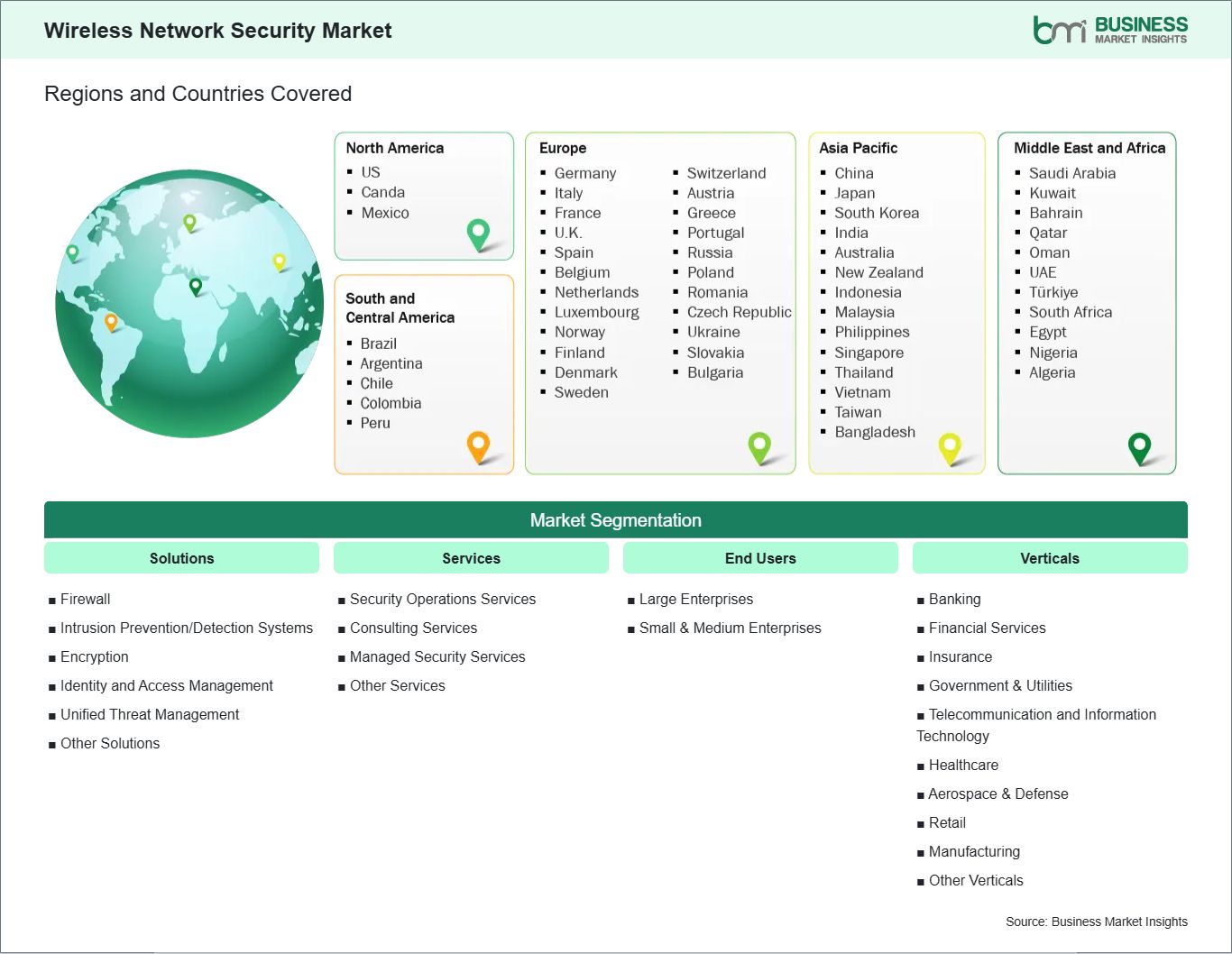
Key segments that contributed to the derivation of the Wireless Network Security market analysis are solutions, services, end users, and verticals.
- By Solutions, the market is segmented into Firewall, Intrusion Prevention/Detection Systems (IPS/IDS), Encryption, Identity and Access Management (I&AM), Unified Threat Management (UTM), and Others.
- By Services, the market is divided into Security Operations Services, Consulting Services, Managed Security Services, and Others.
- By End Users, the market is categorized into Large Enterprises and Small & Medium Enterprises (SMEs)
- By Verticals, the market is segmented into Banking, Financial Services, and Insurance (BFSI), Government & Utilities, Telecommunication and Information Technology, Healthcare, Aerospace & Defense, Retail, Manufacturing, and Others.
Market Forces
Wireless Network Security Market Drivers and Opportunities
Advancing Integrated Threat Intelligence and Zero-Trust Mobility
The primary driver for the Wireless Network Security Market is the systemic requirement to protect an exponentially expanding digital attack surface as organizations transition to "mobile-first" and cloud-native architectures. The market is characterized by a fundamental shift where the traditional boundary between networking and security has effectively disappeared, necessitating integrated stacks that can secure data in transit across diverse wireless protocols. This momentum is fueled by the rapid proliferation of 5G and Wi-Fi 7 networks, which offer record-breaking speeds but also introduce complex vulnerabilities that legacy firewalls are ill-equipped to handle. Consequently, financial institutions, healthcare providers, and government agencies are aggressively adopting Zero-Trust Network Access (ZTNA) frameworks, ensuring that every wireless connection is continuously verified regardless of its location. This "never trust, always verify" mandate is non-discretionary in a landscape where remote and hybrid work models have become permanent, turning secure wireless connectivity into a critical component of enterprise risk management. Furthermore, the surging volume of sensitive data transmitted over airwaves, ranging from intellectual property to personal financial records, compels industries to invest in high-performance encryption and identity management solutions to mitigate the rising frequency of sophisticated cyberattacks.
Agentic AI Defense and Private-5G Security Orchestration
A significant high-value opportunity lies in the convergence of Wireless Security with Agentic AI and Autonomous Response Systems. Advanced platforms are moving beyond reactive alerts to "no human in the loop" operations, where AI agents autonomously handle incident response, remediation, and software updates across wireless infrastructures. There is also a major growth frontier in the deployment of Private 5G and LTE Networks for Industrial IoT (IIoT); these dedicated networks require specialized, micro-segmented security layers to protect mission-critical robotics and autonomous sensors from disruption. Furthermore, the rise of Secure Access Service Edge (SASE) presents a lucrative opportunity for vendors to offer unified, cloud-delivered security that simplifies the management of geographically distributed wireless endpoints. The expansion of Automotive and Transportation Cybersecurity also offers a substantial opportunity, as connected vehicles require robust protection against network intrusions that could compromise passenger safety. Manufacturers who focus on "post-quantum cryptography readiness" and those pioneering identity-first security planes that integrate seamlessly with Wi-Fi 7 hardware are positioned to lead the most innovative and high-margin segments of the global cybersecurity landscape.
Size and Share Analysis
Wireless Network Security Market Size and Share Analysis
The Wireless Network Security market demonstrates steady growth, with size and share analysis revealing evolving trends and competitive positioning among key players. The report further examines subsegments categorized within solutions, services, end users, and verticals, offering insights into their contribution to overall market performance.
Based on solutions, Firewall and Identity and Access Management (I&AM) subsegments hold a significant market presence, serving as the industry benchmark for foundational network protection. Firewall solutions are critical within the telecommunications sector, functioning as the primary defense against external threats in high-traffic 5G and Wi-Fi 7 environments. Additionally, there is a marked increase in the adoption of Intrusion Prevention/Detection Systems (IPS/IDS) and Encryption subsegments, reflecting the growing emphasis on data privacy worldwide. These solutions are increasingly vital in the healthcare sector, where they safeguard sensitive patient data across diverse medical IoT devices and support regulatory compliance and patient trust.
Report Coverage
Wireless Network Security Market Report Coverage and Deliverables
The "Wireless Network Security Market Size and Forecast (2022 - 2033)" report provides a detailed analysis of the market covering below areas:
- Wireless Network Security market size and forecast at global, regional, and country levels for all the key market segments covered under the scope
- Wireless Network Security market trends, as well as market dynamics such as drivers, restraints, and key opportunities
- Wireless Network Security market analysis covering key market trends, global and regional framework, major players, regulations, and recent market developments
- Industry landscape and competition analysis covering market concentration, heat map analysis, prominent players, and recent developments for the Wireless Network Security market
- Detailed company profiles, including SWOT analysis
Geographic Insights
Wireless Network Security Market Geographic Insights
The geographical scope of the Wireless Network Security market report is divided into five regions: North America, Asia Pacific, Europe, Middle East & Africa, and South & Central America.
North America holds the largest revenue share, sustained by a sophisticated cybersecurity infrastructure and the presence of major industry leaders. Asia Pacific is identified as the fastest-growing region, propelled by rapid digital transformation and the massive expansion of mobile internet users across emerging economies. Europe maintains a strong market position, driven by stringent data privacy mandates and the accelerating adoption of secure wireless protocols in industrial and automotive sectors.
The Asia-Pacific Wireless Network Security Market is segmented into China, Japan, South Korea, India, Australia, and the Rest of Asia. This region is undergoing a massive shift toward mobile-first enterprise architectures, making it a critical hub for wireless protection. China and India are the primary drivers, where government-led "Digital India" and "Smart City" initiatives necessitate robust security frameworks for public and private Wi-Fi networks. In Japan and South Korea, the market is characterized by the early integration of AI-driven threat detection to safeguard high-density 5G and Wi-Fi 7 deployments.
Industry Activity
Recent Developments
The Wireless Network Security market is evaluated by gathering qualitative and quantitative data post primary and secondary research, which includes important corporate publications, association data, and databases. A few of the key developments in the Wireless Network Security market are:
- In June 2025, NETGEAR announced the acquisition of cybersecurity company Exium to integrate its SASE platform with NETGEAR’s networking solutions for SMEs and MSPs. The combined offering will deliver a fully integrated, cloud-managed network and security solution that simplifies deployment and management. The move reflects the increasing adoption of unified networking and security solutions in the enterprise wireless security market.
- In Feb 2024, Palo Alto Networks launched integrated Private 5G security solutions in collaboration with key ecosystem partners, including Celona, Druid, NETSCOUT, NVIDIA, and NTT DATA. The offering enables secure deployment, management, and protection of enterprise private 5G networks. This development is significant for the wireless network security market as it strengthens ecosystem-driven 5G security adoption and supports the growing demand for secure private wireless infrastructure.
Trust & Transparency
Research Methodology
The market analysis combines proprietary research with secondary data from government agencies, company disclosures, regulatory filings, industry databases and expert interviews. Market estimates are validated through data triangulation, cross-market benchmarking and analyst
review.
View Full Research Methodology
Key Sources Referred:
World Bank - Global Trade IndicatorsWorld Trade Organization (WTO)International Monetary Fund (IMF)International Trade Administration (ITA)Company WebsitesCompany Annual ReportsCompany Investor Presentations