Market Summary
Executive Summary and Global Market Analysis
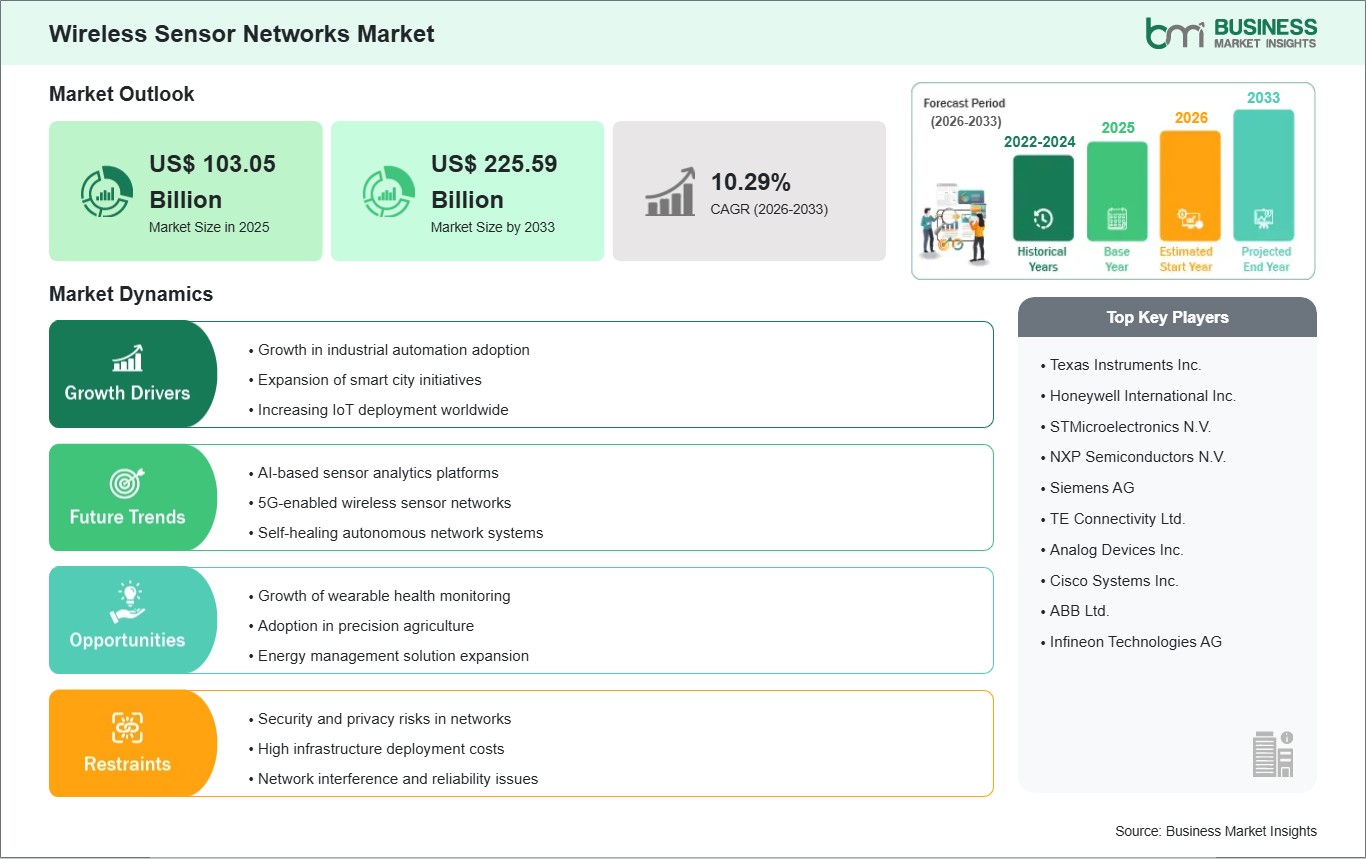
Wireless Sensor Networks (WSNs) are a key enabling technology within many Internet of Things (IoT) systems, moving from isolated data silos to interconnected networks of autonomous sensors. The market includes sensor nodes, wireless transceivers, and network management software, all essential for monitoring physical and environmental conditions such as vibration, temperature, and pressure without physical wiring. WSNs enable real-time data collection in remote or hazardous locations, including offshore oil rigs and industrial pipelines. These technologies are vital for advancing smart infrastructure, automated manufacturing, and digital healthcare monitoring. Market growth is driven by increased Industry 4.0 adoption, miniaturization of MEMS-based sensors, and rising demand for low-power, wide-area network (LPWAN) protocols. The adoption of energy-harvesting technologies, which allow sensors to draw power from ambient heat or vibrations, is also extending the lifespan and reliability of these networks.
However, several challenges can restrain market growth: security and data privacy concerns remain a primary hurdle, as the proliferation of wireless nodes creates numerous entry points for potential cyber-attacks on critical infrastructure. High installation and maintenance complexity for large-scale, high-density deployments can deter budget-conscious enterprises. Additionally, the industry faces constraints due to technical interference in dense industrial environments, where metallic surfaces and electromagnetic noise from heavy machinery can impair signal stability and data integrity.
Despite these hurdles, the market holds immense opportunities in the universal push for smart city digitalization and the deployment of AI-driven predictive maintenance. The expansion of autonomous transportation and the development of multi-sensor integrated platforms, capable of measuring multiple environmental metrics simultaneously, are expected to create significant opportunities for long-term market growth.
Segment Analysis
Wireless Sensor Networks Market Segmentation
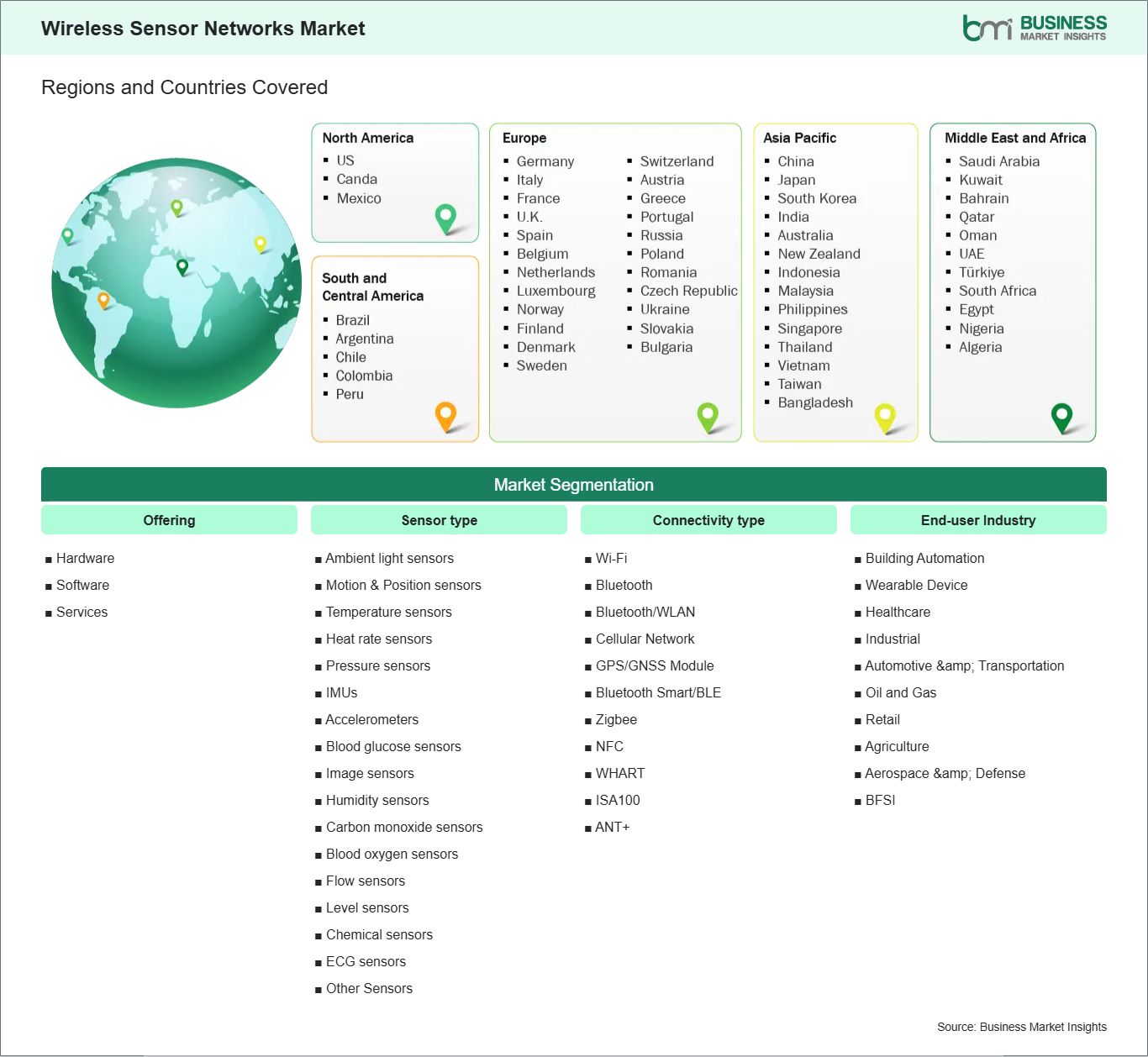
Key segments that contributed to the derivation of the Wireless Sensor Networks market analysis are offering, sensor type, connectivity and end-user industry.
- By Offering, the market is segmented into Hardware, Software, and Services.
- By Sensor type, the market is divided into Ambient light sensors, Motion & Position sensors, Temperature sensors, Heat rate sensors, Pressure sensors, IMUs (6-Axis, 9-Axis), Accelerometers (3-Axis), Blood glucose sensors, Image sensors, Humidity sensors, Carbon monoxide sensors, Blood oxygen sensors, Flow sensors, Level sensors, Chemical sensors, ECG sensors, Others (MRR, Ultrasonic sensors, vehicle detection sensors, pedestrian presence sensors, speed sensors, and soil moisturizer sensors)
- By Connectivity type, the market is categorized into Wi-Fi, Bluetooth, Bluetooth/WLAN, Cellular Network, GPS/GNSS Module, Bluetooth Smart/BLE, Zigbee, NFC, WHART, ISA100, and ANT+
- By End-user Industry, the market is segmented into Building Automation, Wearable Device, Healthcare, Industrial, Automotive & Transportation, Oil and Gas, Retail, Agriculture, Aerospace & Defense, and BFSI.
Market Forces
Wireless Sensor Networks Market Drivers and Opportunities
Advancing Global Connectivity and Industrial Intelligence Landscapes
The primary driver for the Wireless Sensor Networks (WSN) Market is the intensifying global demand for real-time data acquisition and autonomous monitoring across increasingly complex industrial, urban, and environmental landscapes. As organizations worldwide commit to comprehensive digital transformation, wireless sensor networks have become a non-discretionary foundation for the "Physical AI" movement, where intelligent sensors bridge the gap between the physical world and digital decision-making engines. This momentum is further propelled by the widespread adoption of Industry 4.0 standards, where dense grids of interconnected sensors are essential for monitoring equipment health, optimizing supply chain logistics, and ensuring worker safety through continuous environmental tracking. Unlike traditional wired systems, wireless architectures offer the flexibility and scalability required to instrument large-scale or high-risk environments, such as remote offshore energy platforms, sprawling agricultural fields, and massive manufacturing hubs, where physical cabling is structurally impossible or prohibitively expensive. Furthermore, the global shift toward smart city initiatives and the rapid electrification of the automotive sector necessitate a robust sensing layer to manage everything from intelligent traffic flow to electric vehicle battery management, ensuring a sustained and high-velocity growth path for the market.
Edge AI Integration and Sustainable Energy Harvesting
A significant high-value opportunity lies in the convergence of Wireless Sensor Networks with Edge Computing and Artificial Intelligence (AI). By embedding machine learning algorithms directly into sensor nodes and gateways, next-generation "Smart Sensors" can perform localized data processing, filtering out irrelevant noise and transmitting only actionable intelligence. This shift to the edge drastically reduces network latency and power consumption, making wireless networks viable for high-speed control loops and real-time anomaly detection that were previously restricted to wired connections. There is also a major growth frontier in the development of Sustainable and Maintenance-Free Sensor Nodes powered by energy-harvesting technologies. By capturing energy from ambient sources such as solar, thermal gradients, or mechanical vibrations, manufacturers can create "deploy-and-forget" systems that eliminate the need for periodic battery replacements in remote locations. Furthermore, the rise of the Internet of Medical Things (IoMT) presents a lucrative opportunity for specialized biosensors and wearable networks that provide continuous patient monitoring and early disease detection. Manufacturers who focus on miniaturized, multi-parameter sensing modules and those pioneering advanced encryption for "zero-trust" security environments are positioned to lead the most innovative and high-margin segments of the global sensing landscape.
Size and Share Analysis
Wireless Sensor Networks Market Size and Share Analysis
The Wireless Sensor Networks market demonstrates steady growth, with size and share analysis revealing evolving trends and competitive positioning among key players. The report further examines subsegments categorized within offering, sensor type, connectivity and end-user industry, offering insights into their contribution to overall market performance.
Based on offering, Hardware subsegment holds a significant market presence, serving as the industry benchmark for building robust, real-time data acquisition infrastructures. Hardware, encompassing sensor nodes, gateways, and routers, is indispensable for the Industrial sector, where durable and energy-efficient components are required for remote monitoring in technically unreachable locations. A notable trend is the surge in the Software subsegment, which is registering a higher CAGR as AI and machine learning are increasingly integrated at the edge for real-time anomaly detection. Software platforms are becoming essential for Healthcare, providing the analytical backbone needed to transform raw sensor data from wearables into critical health insights for proactive patient management.
Report Coverage
Wireless Sensor Networks Market Report Coverage and Deliverables
The "Wireless Sensor Networks Market Size and Forecast (2022 - 2033)" report provides a detailed analysis of the market covering below areas:
- Wireless Sensor Networks market size and forecast at global, regional, and country levels for all the key market segments covered under the scope
- Wireless Sensor Networks market trends, as well as market dynamics such as drivers, restraints, and key opportunities
- Wireless Sensor Networks market analysis covering key market trends, global and regional framework, major players, regulations, and recent market developments
- Industry landscape and competition analysis covering market concentration, heat map analysis, prominent players, and recent developments for the Wireless Sensor Networks market
- Detailed company profiles, including SWOT analysis
Geographic Insights
Wireless Sensor Networks Market Geographic Insights
The geographical scope of the Wireless Sensor Networks market report is divided into five regions: North America, Asia Pacific, Europe, Middle East & Africa, and South & Central America.
The Asia-Pacific Wireless Sensor Networks Market is segmented into China, Japan, South Korea, India, Australia, and the Rest of Asia. This region is a global leader in new deployments, particularly within the electronics and semiconductor manufacturing sectors. China and India are at the forefront, utilizing vast sensor grids to optimize public utility management and industrial energy efficiency. Japan and South Korea continue to push the boundaries of innovation, focusing on ultra-low-power sensors and high-frequency communication protocols for advanced robotics and autonomous transport systems.
Growth is further bolstered by a significant shift toward energy harvesting sensor nodes and the integration of 5G connectivity among industrial operators looking to eliminate the need for battery replacements in remote areas. The rising demand for real-time data acquisition in precision agriculture, alongside the expansion of connected healthcare and remote patient monitoring systems, solidifies Asia-Pacific as a critical hub for innovation and the future scaling of the Wireless Sensor Networks industry.
Industry Activity
Recent Developments
The Wireless Sensor Networks market is evaluated by gathering qualitative and quantitative data post primary and secondary research, which includes important corporate publications, association data, and databases. A few of the key developments in the Wireless Sensor Networks market are:
- In June 2025, Energous Corporation announced the launch of the e-Sense tag, a battery-free, wireless sensor for location and temperature monitoring across retail, supply chain, and logistics environments. This launch establishes a complete ambient IoT platform, including wirelessly-powered sensors, RF energy transmitters, and cloud-based monitoring software. The system enables real-time visibility and data collection without relying on batteries or wired infrastructure.
- In September 2025, MACO HAUTAU Germany partnered with smattex to offer its Sense smart window sensors through the DIY smart home platform. These wireless sensors, compatible with the Matter standard, provide real-time monitoring of doors and windows, enabling building automation, energy optimization, and enhanced residential security. This development highlights the growing adoption of connected wireless sensors in smart home applications, contributing to the expansion of the wireless sensor networks solutions.
Trust & Transparency
Research Methodology
The market analysis combines proprietary research with secondary data from government agencies, company disclosures, regulatory filings, industry databases and expert interviews. Market estimates are validated through data triangulation, cross-market benchmarking and analyst
review.
View Full Research Methodology
Key Sources Referred:
World Bank - Global Trade Indicators World Trade Organization (WTO) International Monetary Fund (IMF) International Trade Administration (ITA) Company website Company annual reports Company investor presentations