Market Summary
Executive Summary and Global Market Analysis
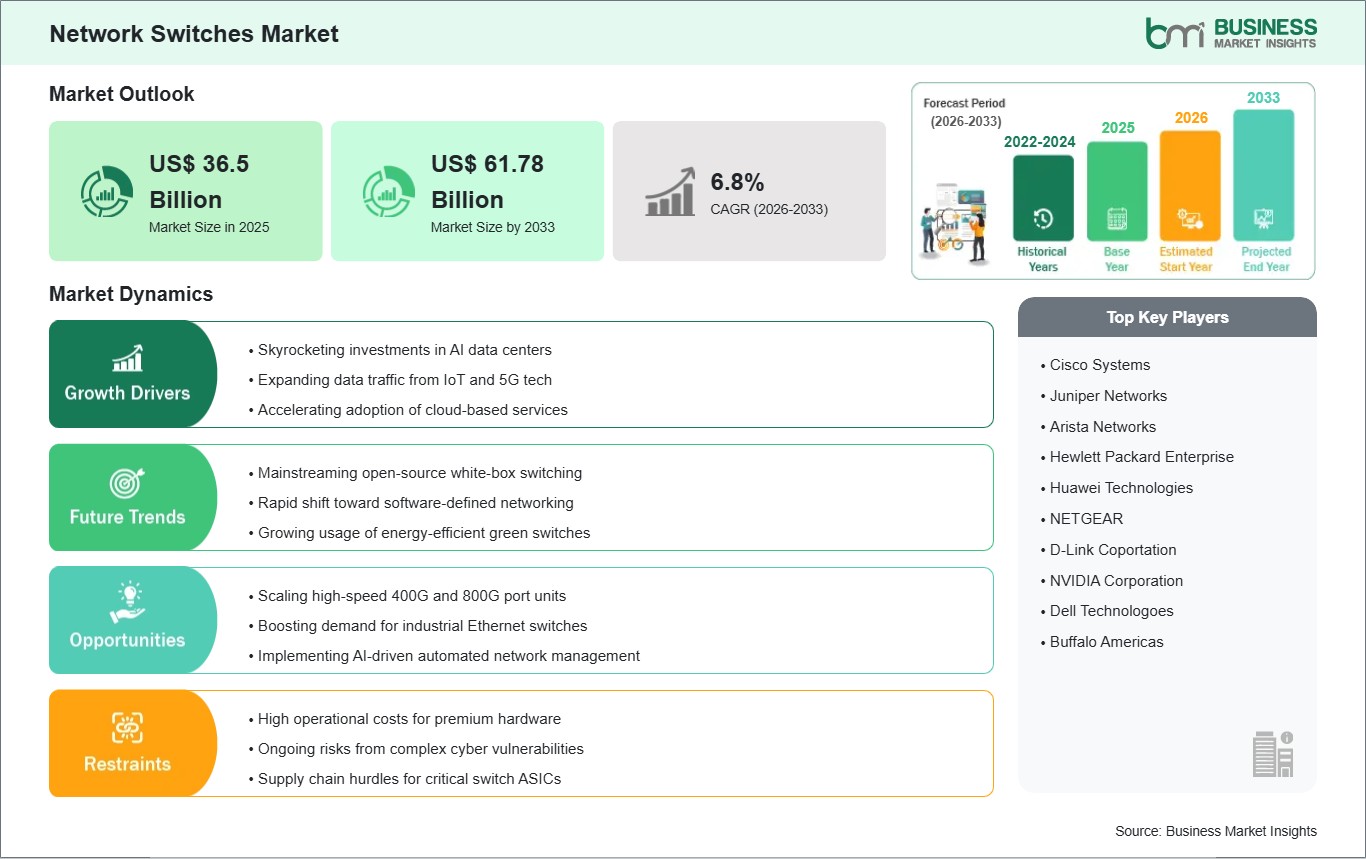
Network Switches play a critical role in providing the high-capacity, low-latency data plumbing and hardware foundation essential for the modern digital economy. It encompasses key equipment and services: managed and unmanaged switches, Fixed Configuration vs. Modular chassis, PoE-enabled devices, and high-bandwidth 400G/800G data center switches. Network switching offers advantages, including the elimination of data collisions, the ability to create secure virtual segments (VLANs), and the delivery of the massive "east-west" traffic throughput required by modern server clusters. The market is being fueled by the explosive rise of Generative AI and Machine Learning, which demand ultra-high-speed interconnects, the global rollout of 5G infrastructure, and the continuous expansion of hyperscale cloud data centers. Additionally, the shift toward Spine-Leaf architectures, replacing traditional three-tier models, is fundamentally enhancing the scalability and performance of enterprise fabrics.
However, several challenges can restrain market growth: the high initial capital expenditure and complexity associated with upgrading legacy 10G or 40G environments to next-generation 400G and 800G optics can be substantial for many mid-sized enterprises. Persistent supply chain sensitivities, particularly concerning advanced ASICs (Application-Specific Integrated Circuits) and high-performance semiconductors, pose a constant procurement and lead-time hurdle. Furthermore, the industry faces constraints due to a significant technical skills gap, as IT teams struggle to manage the transition from traditional hardware-centric configurations to automated, software-defined environments. Despite these hurdles, the market holds immense opportunities as a result of the accelerating adoption of Software-Defined Networking (SDN) for centralized control, the development of 1.6T Ethernet standards to meet future AI compute demands, and the increasing reliance on AI-driven telemetry for predictive fault detection and automated network optimization.
Segment Analysis
Network Switches Market Segmentation
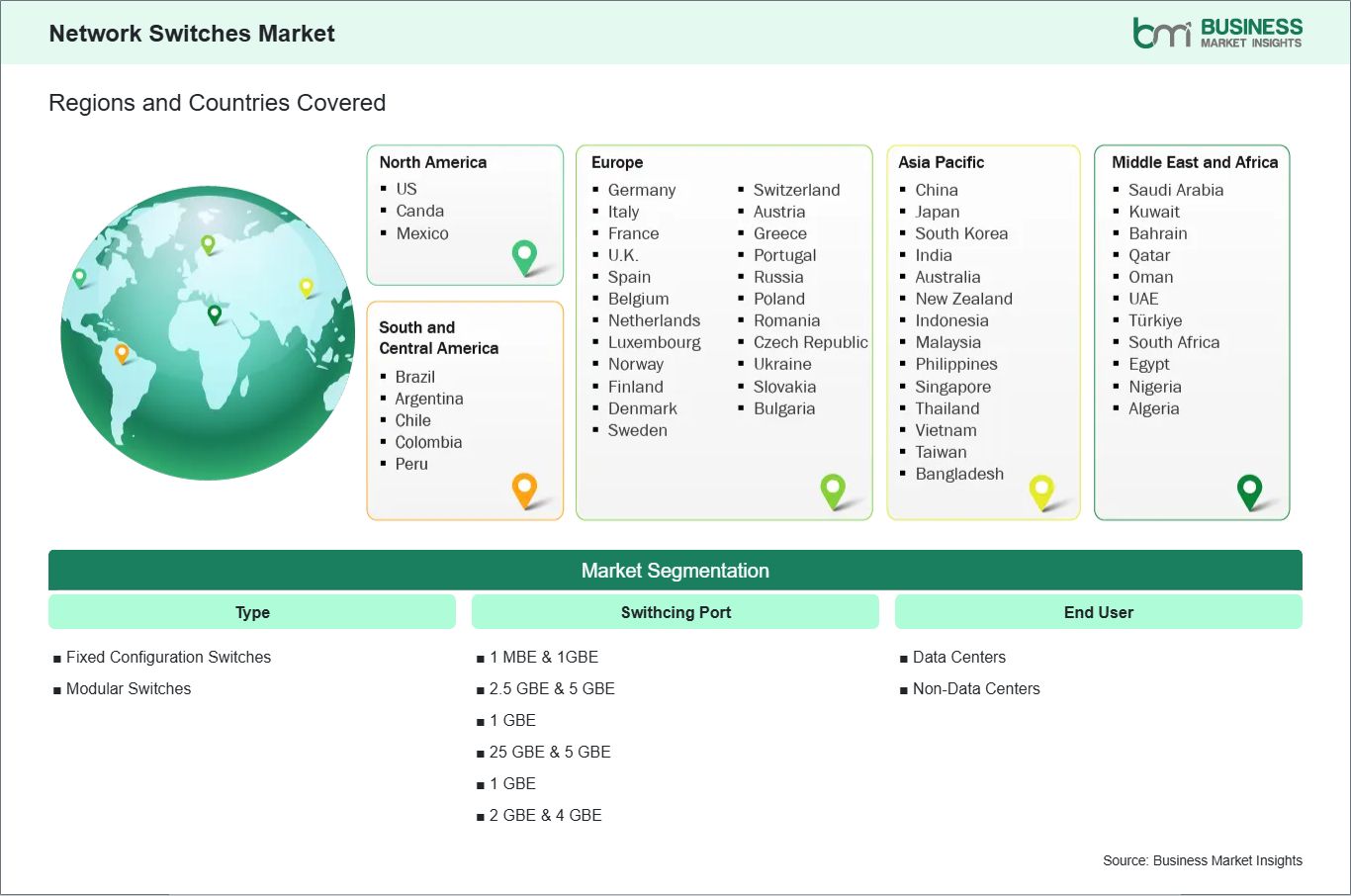
Key segments that contributed to the derivation of the Network Switches market analysis are type, switching port, and end user.
- By Type, the market is segmented into Fixed Configuration Switches and Modular Switches.
- By Switching Port, the market is segmented into 100 MBE & 1GBE, 2.5 GBE & 5 GBE, 10 GBE, 25 GBE & 50 GBE, 100 GBE, and 200 GBE & 400 GBE.
- By End User, the market is segmented into Data Centers (Telecom Service Providers, Cloud Service Providers, and Large Enterprise) and Non-Data Centers.
Market Forces
Network Switches Market Drivers and Opportunities
Expansion of Hyperscale Data Centers
The primary driver for the Network Switches market is the explosive growth of hyperscale data centers and the massive surge in data traffic generated by Artificial Intelligence (AI) and Machine Learning (ML) workloads. Modern enterprise and cloud environments are transitioning from traditional architectures to high-density spine-leaf fabrics to handle the intense "east-west" traffic typical of AI clusters. This shift necessitates the deployment of next-generation switches with significantly higher port densities and ultra-low latency. As organizations increase their computing power for training large language models and handling real-time big data analytics, high-bandwidth switches that support 400G and 800G speeds have become a standard requirement. These switches are now essential for keeping up with operational demands and preventing network bottlenecks.
Rapid Adoption of Software-Defined Networking
Software-Defined Networking (SDN) allows for the decoupling of the control plane from the physical hardware, enabling network administrators to manage complex infrastructures through automated, programmable software. This trend is opening doors for "white-box" switching and open-source networking, where hardware cost-efficiency meets high-level customization. Furthermore, as 5G rollouts and edge computing proliferate, there is a burgeoning opportunity for vendors to supply specialized, energy-efficient switches that can handle massive data throughput at the network's edge. Integrating AI-driven predictive analytics directly into switch firmware allows for self-healing networks and automated security threat detection, positioning advanced switching solutions as the intelligent backbone of the modern digital economy.
Size and Share Analysis
Network Switches Market Size and Share Analysis
The Network Switches market demonstrates steady growth, with size and share analysis revealing evolving trends and competitive positioning among key players. The report further examines subsegments categorized within type, switching port, and end user, offering insights into their contribution to overall market performance.
For instance, the Fixed Configuration Switches subsegment holds a significant share of the market. Fixed Configuration Switches are a primary choice for Non-Data Center environments, such as enterprise campus and branch networks. These units, often utilizing 1GBE and 10 GBE configurations, are valued for their cost-effectiveness and "plug-and-play" simplicity. In these settings, the focus is on providing reliable connectivity for a wide range of devices, including workstations, IP phones, and wireless access points, without the complexity of chassis-based systems.
Report Coverage
Network Switches Market Report Coverage and Deliverables
The "Network Switches Market Size and Forecast (2022 - 2033)" report provides a detailed analysis of the market covering below areas:
- Network Switches market size and forecast at global, regional, and country levels for all the key market segments covered under the scope
- Network Switches market trends, as well as market dynamics such as drivers, restraints, and key opportunities
- Network Switches market analysis covering key market trends, global and regional framework, major players, regulations, and recent market developments
- Industry landscape and competition analysis covering market concentration, heat map analysis, prominent players, and recent developments for the Network Switches market
- Detailed company profiles, including SWOT analysis
Geographic Insights
Network Switches Market Geographic Insights
The geographical scope of the Network Switches market report is divided into five regions: North America, Asia Pacific, Europe, Middle East & Africa, and South & Central America.
The Asia-Pacific Network Switches Market is segmented into China, Japan, South Korea, India, Australia, New Zealand, Indonesia, Malaysia, the Philippines, Singapore, Thailand, Vietnam, Taiwan, Bangladesh, and the Rest of Asia. The market is primarily driven by the region's aggressive 5G rollout and the massive expansion of hyperscale data centers.
Growth is further accelerated by the adoption of Industry 4.0 and the proliferation of IoT devices, which necessitate advanced Managed L3 switches for complex network orchestration. The rising trend of Software-Defined Networking (SDN) and the deployment of 400GbE/800GbE switches to support AI workloads solidify Asia-Pacific as the critical global hub for network infrastructure development.
Industry Activity
Recent Developments
The Network Switches market is evaluated by gathering qualitative and quantitative data post primary and secondary research, which includes important corporate publications, association data, and databases. A few of the key developments in the Network Switches market are:
- In February 2025, Cisco announced a family of data center Smart Switches, disrupting traditional data center network design by enabling networking and security services in a compact all-in-one solution. Utilizing programmable AMD Pensando™ data processing units (DPUs), the switch functions as a high-capacity, multifunctional service-hosting device, architecturally transforming data centers to simplify their design and make them more efficient. Cisco’s first integrated offering, the Smart Switch with Cisco Hypershield, introduces a new approach to securing AI data centers by fusing security directly into the network fabric.
- In February 2025, Juniper Networks (NYSE: JNPR), a leader in secure, AI-Native Networking, announced new additions to its leading wired access portfolio that enable companies of all sizes to scale their IT operations, proactively mitigate risks and successfully facilitate strategic digital transformation initiatives. Designed from the ground up to sustainably support modern wired and wireless access needs, the new Juniper Networks® EX4000 Series Switches leverage a groundbreaking AI- and cloud-native architecture to deliver exceptional Day 0, 1, and 2+ wired/wireless experiences, including fast deployment, maximized uptime, Zero Trust security, reduced operational costs, and seamless migration to Wi-Fi 7.
Trust & Transparency
Research Methodology
The market analysis combines proprietary research with secondary data from government agencies, company disclosures, regulatory filings, industry databases and expert interviews. Market estimates are validated through data triangulation, cross-market benchmarking and analyst
review.
View Full Research Methodology
Key Sources Referred:
World Bank - Global Trade IndicatorsWorld Trade Organization (WTO)International Monetary Fund (IMF)International Trade Administration (ITA)Company WebsitesCompany Annual ReportsCompany Investor Presentations