Market Summary
Executive Summary and Global Market Analysis
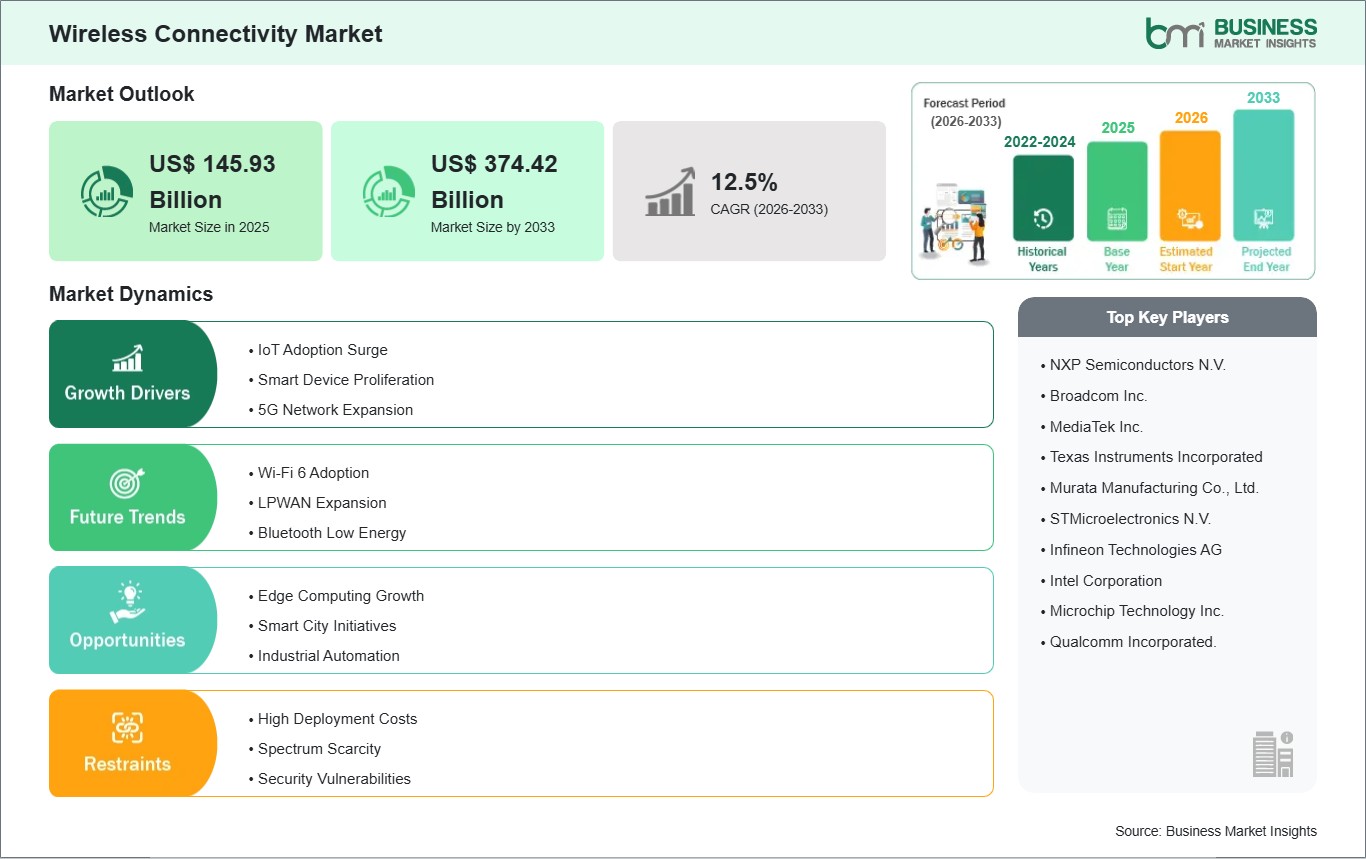
Wireless connectivity technology facilitates data exchange between electronic devices and networks without the use of physical cables, relying instead on radio waves, microwaves, or infrared signals. This includes widely adopted standards like Wi-Fi, Bluetooth, and cellular networks (4G/5G), enabling seamless data transfer and communication across a wide range of applications.
The Wireless Connectivity Market is undergoing robust expansion driven primarily by the exponential growth in the number of Internet of Things (IoT) devices and the global rollout of 5G networks. The increasing demand for mobile and flexible network access across consumer, enterprise, and industrial sectors is compelling significant investments in advanced wireless infrastructure, paving the way for ubiquitous, high-speed, and low-latency communication solutions critical for digital transformation globally.
Segment Analysis
Wireless Connectivity Market Segmentation
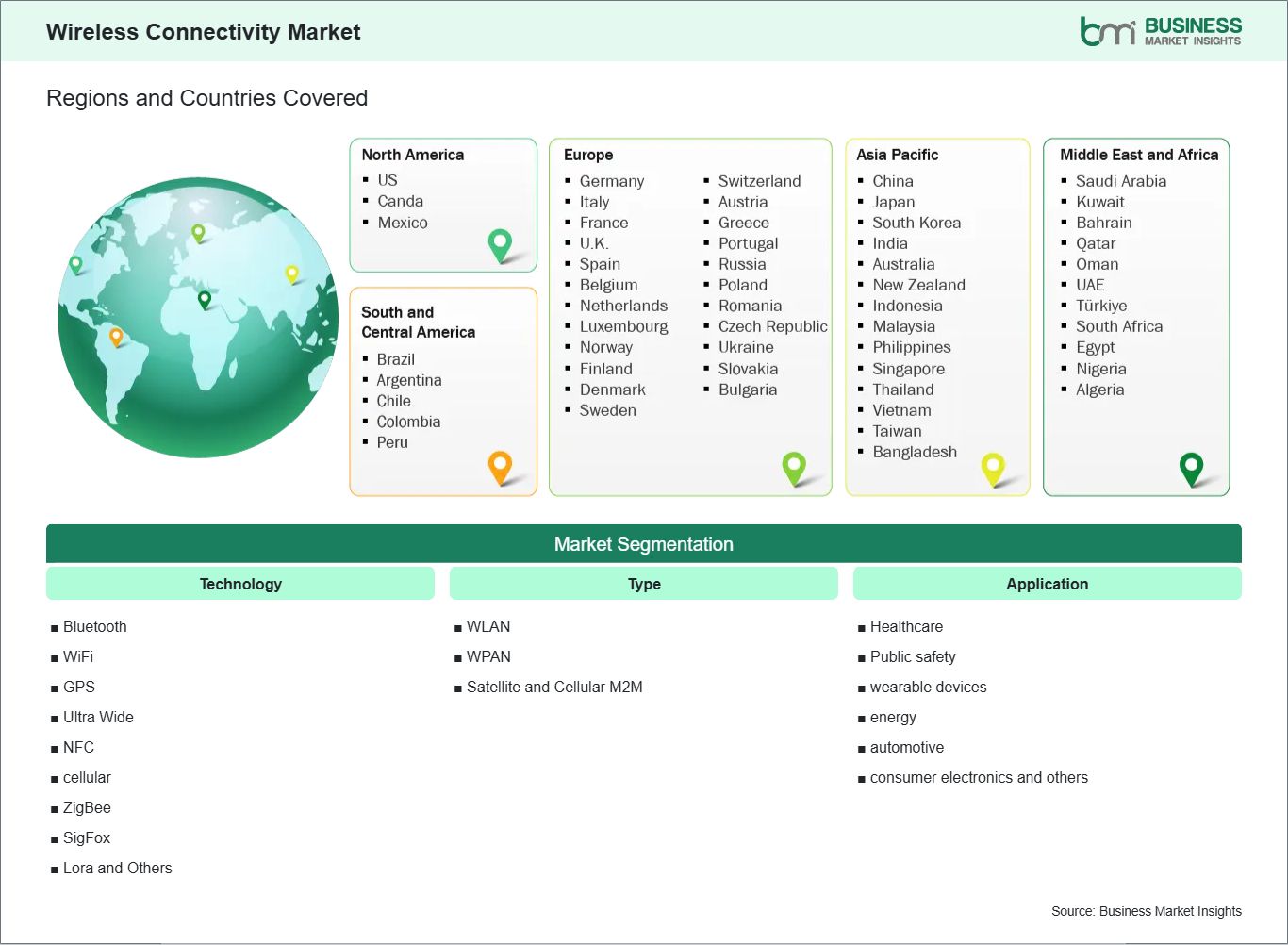
Key segments that contributed to the derivation of the Wireless Connectivity Market analysis are technology, type, and application.
- By Technology, the market is segmented into Bluetooth, WiFi, GPS, Ultra Wide, NFC, cellular, ZigBee, SigFox, Lora, and Others.
- By Type, the market is segmented into WLAN, WPAN, Satellite, and Cellular M2M.
- By Application, the market is segmented into Healthcare, Public Safety, Wearable Devices, Energy, Automotive, Consumer Electronics, and Others.
Market Forces
Wireless Connectivity Market Drivers and Opportunities
Proliferation of Internet of Things (IoT) and Connected Devices
The sheer volume of connected devices, including smartphones, smart home appliances, wearable technology, industrial sensors, and medical devices, is fundamentally driving the demand for advanced wireless connectivity.
The IoT ecosystem requires robust, scalable, and power-efficient wireless standards to facilitate real-time data exchange. Industries are integrating smart sensors and endpoints to enhance operational efficiency, automate processes (Industry 4.0), and gather critical data. This expanding ecosystem necessitates pervasive and efficient wireless communication solutions capable of managing vast data volumes and diverse connectivity requirements, creating a massive base demand for wireless chips, modules, and network infrastructure. According to industry reports, the number of connected IoT devices is expected to reach billions in the coming years, creating a sustained surge in demand for reliable wireless networks.
Global Deployment of 5G Networks and Evolution to 6G
The widespread global rollout of 5G technology and the nascent development of 6G represent a transformative growth opportunity across all sectors of the wireless market. 5G networks offer unprecedented capabilities, ultra-fast data speeds (up to 10 Gbps), ultra-low latency, and massive connection density. These capabilities directly enable complex, mission-critical use cases that were previously impossible, such as real-time remote surgery, autonomous vehicles (V2X communication), advanced AR/VR applications, and high-density industrial automation (Private 5G).
The evolution toward 6G promises even higher speeds, AI-driven network optimization, and the integration of sensing capabilities, opening up multi-billion dollar markets. This transformation fuels massive investments in new radio access networks, millimeter-wave technologies, and sophisticated network infrastructure, creating a powerful structural opportunity for the entire wireless connectivity value chain.
Size and Share Analysis
Wireless Connectivity Market Size and Share Analysis
The wireless connectivity market demonstrates steady growth, with size and share analysis revealing evolving trends and competitive positioning among key players. The report further examines subsegments categorized within technology, type, and application, offering insights into their contribution to overall market performance.
For instance, Wi-Fi technology typically holds a significant share due to its ubiquity in consumer electronics and enterprise networking. WLAN systems are widely utilized across various industries due to their ability to support high-density data traffic in indoor environments. Consumer Electronics continue to lead the application segment, while Healthcare utilizes wireless connectivity for critical remote patient monitoring and telemedicine services requiring high security and uptime.
Report Coverage
Wireless Connectivity Market Report Coverage and Deliverables
The "Wireless Connectivity Market Size and Forecast (2022 - 2033)" report provides a detailed analysis of the market covering below areas:
- Wireless Connectivity Market size and forecast at global, regional, and country levels for all the key market segments covered under the scope
- Wireless Connectivity Market trends, as well as market dynamics such as drivers, restraints, and key opportunities
- Wireless Connectivity Market analysis covering key market trends, global and regional framework, major players, regulations, and recent market developments
- Industry landscape and competition analysis covering market concentration, heat map analysis, prominent players, and recent developments for the Wireless Connectivity Market
- Detailed company profiles, including SWOT analysis
Geographic Insights
Wireless Connectivity Market Geographic Insights
The geographical scope of the Wireless Connectivity Market report is divided into five regions: North America, Asia Pacific, Europe, Middle East & Africa, and South & Central America.
North America significantly holds the market share in terms of revenue, driven by high technological maturity, rapid and early deployment of 5G networks (e.g., in the US and Canada), and significant enterprise spending on cloud computing, IoT, and Private 5G networks. Strong regulatory support and a high rate of digital adoption further bolster this market leadership. Asia Pacific is projected to be the fastest-growing market during the forecast period. This exponential growth is fueled by the world's largest consumer electronics manufacturing base (China, South Korea). Massive public and private investment in 5G infrastructure and Smart City projects.
Industry Activity
Recent Developments
The Wireless Connectivity Market is evaluated by gathering qualitative and quantitative data post primary and secondary research, which includes important corporate publications, association data, and databases. A few of the key developments in the Wireless Connectivity Market are:
- In October 2025, Broadcom Inc. announced the industry’s first Wi-Fi 8 silicon solutions for the broadband wireless edge ecosystem, including residential gateways, enterprise access points, and smart mobile clients. Broadcom’s Wi-Fi 8 solutions are purpose-built to address the stringent performance, reliability, intelligence, and efficiency demands of AI-era edge networks. Recognizing the need for rapid industry-wide deployment of AI-first wireless connectivity for the edge, Broadcom further announced the availability of its Wi-Fi 8 IP for license for Internet of Things (IoT), automotive, and mobile devices as a complement to the access ecosystem.
- In March 2025, MediaTek and TSMC announced that they had jointly demonstrated the first silicon-proven power management unit (PMU) and integrated power amplifier (iPA) on TSMC’s N6RF+ process. This achievement makes it possible to integrate these two essential components into a system-on-chip (SoC) on an advanced RF process for wireless connectivity products, enabling a significantly smaller form factor while enjoying performance competitive with stand-alone modules.
- In November 2024, NXP Semiconductors N.V., the trusted partner for innovative solutions in the automotive market, unveiled its new, industry-first wireless battery management system (BMS) solution with Ultra-Wideband (UWB) capabilities from one of the industry’s broadest UWB portfolios. The new UWB BMS solution marks the next step in overcoming development challenges, including costly and complex manufacturing processes, accelerating the adoption of electric vehicles (EVs).
Trust & Transparency
Research Methodology
The market analysis combines proprietary research with secondary data from government agencies, company disclosures, regulatory filings, industry databases and expert interviews. Market estimates are validated through data triangulation, cross-market benchmarking and analyst
review.
View Full Research Methodology
Key Sources Referred:
World Bank - Global Trade IndicatorsWorld Trade Organization (WTO)International Monetary Fund (IMF)International Trade Administration (ITA)Company WebsitesCompany Annual ReportsCompany Investor Presentations