Market Summary
Executive Summary and Global Market Analysis
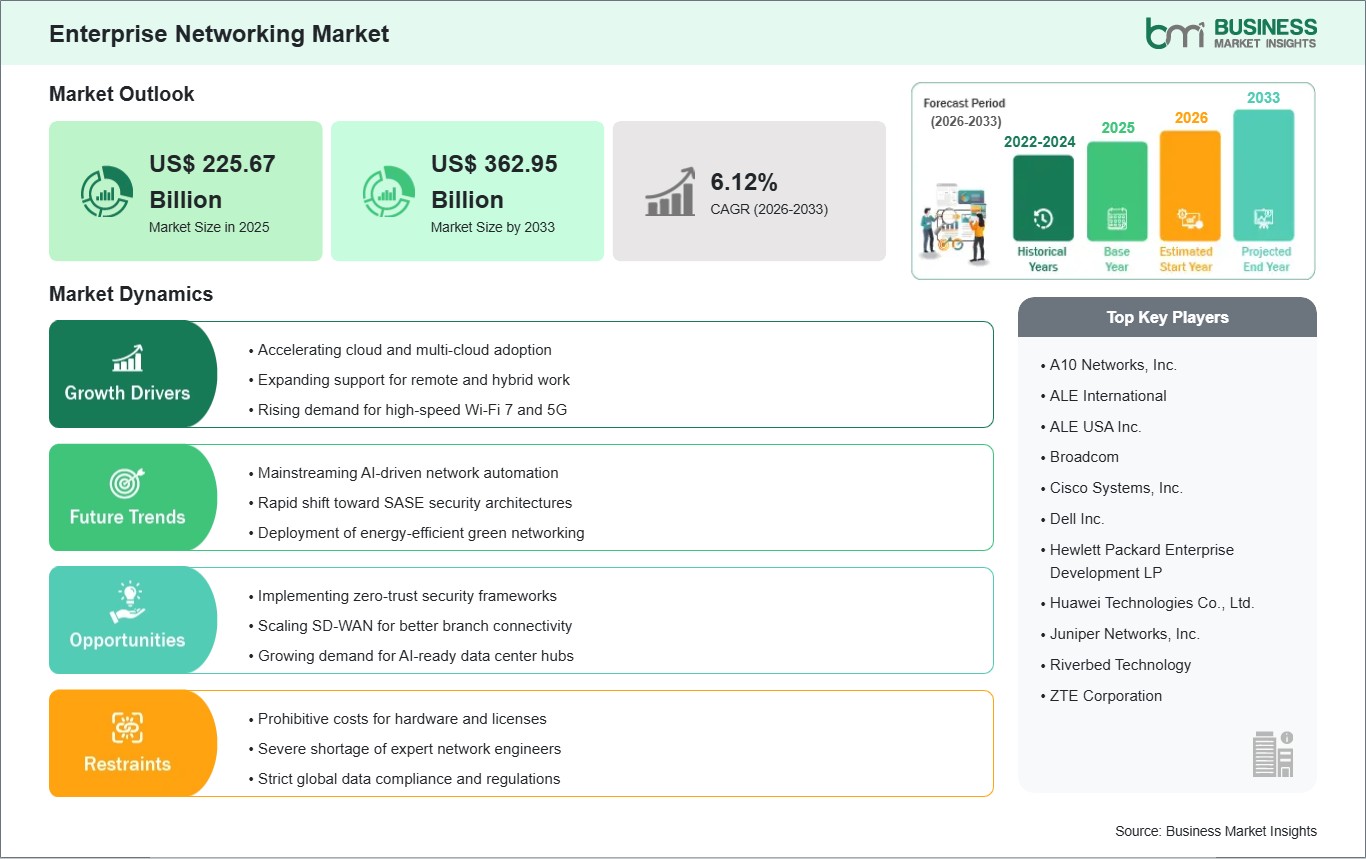
Enterprise Networking plays a critical role in providing secure and high-speed connectivity infrastructure essential for modern business operations. It encompasses key equipment and services: Ethernet switches, routers, Wireless LAN (WLAN) gear, and network security appliances. Enterprise networking offers advantages, including enabling global collaboration, supporting complex cloud services, and driving digital transformation initiatives. The market is being fueled by the massive adoption of cloud computing and hybrid work models, the exponential growth of data traffic from IoT devices, and the need for high-bandwidth, low-latency applications like video conferencing and AI. Additionally, the shift toward converged, cloud-native architectures such as Secure Access Service Edge (SASE) is fundamentally enhancing security and agility.
However, several challenges can restrain market growth: the high initial capital expenditure and complexity associated with migrating legacy Wide Area Network (WAN) infrastructure (e.g., MPLS) to modern, software-defined solutions (SD-WAN) can be substantial. Intensifying cybersecurity threats, particularly concerning securing remote access and decentralized cloud applications, pose a constant management and compliance hurdle. Furthermore, the industry faces constraints due to persistent network complexity and a talent gap in IT teams skilled in managing multi-cloud, automated, and zero-trust environments. Despite these hurdles, the market holds immense opportunities as a result of the universal mandate for Zero Trust Security architectures, the accelerating deployment of 5G and Wi-Fi 7 technologies for greater wireless capacity, and the increasing reliance on AI and Machine Learning (ML) for network automation and predictive fault detection.
Segment Analysis
Enterprise Networking Market Segmentation
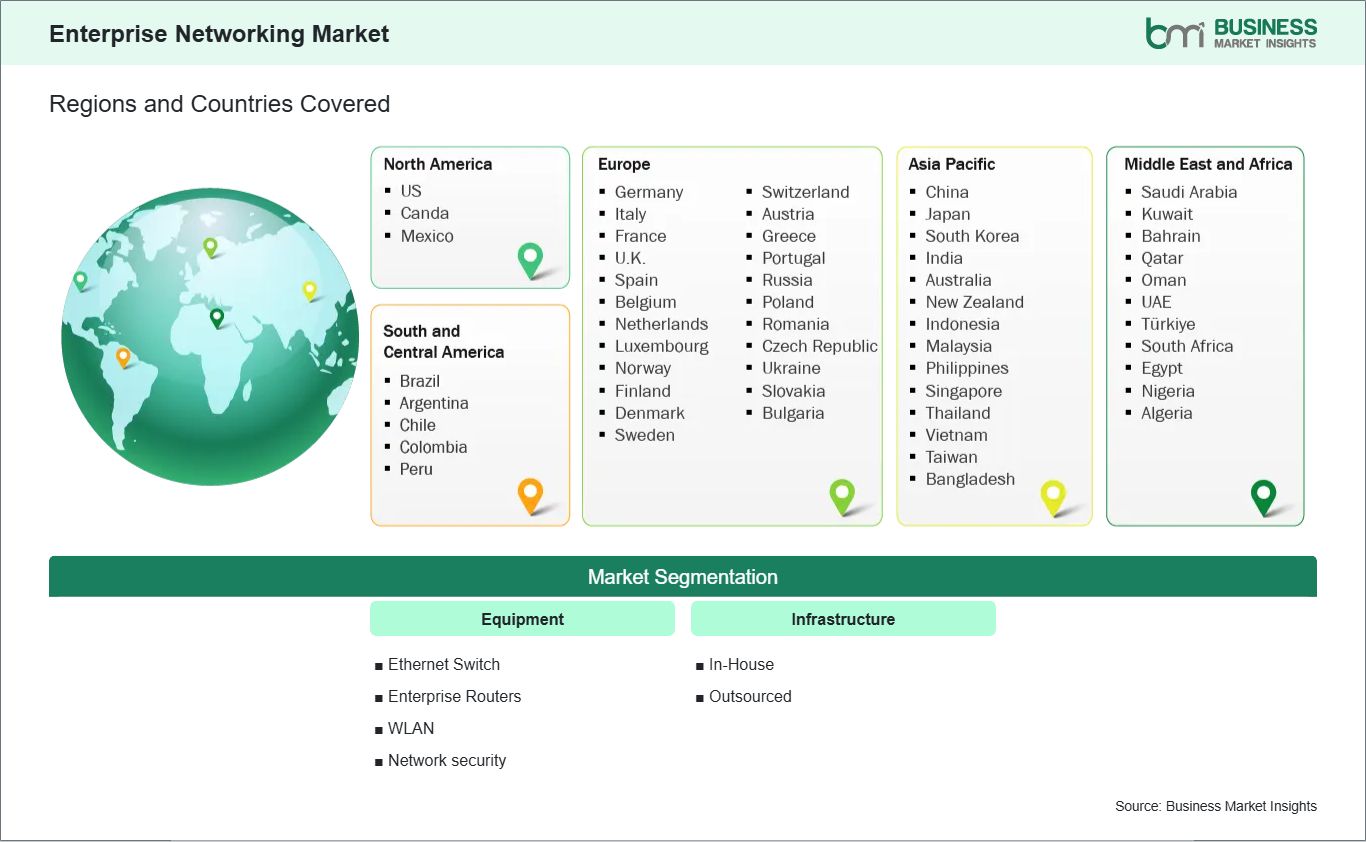
Key segments that contributed to the derivation of the Enterprise Networking market analysis are equipment and infrastructure.
- By Equipment, the market is segmented into Ethernet Switch, Enterprise Routers, WLAN, and Network Security.
- By Infrastructure, the market is segmented into In-House and Outsourced.
Market Forces
Enterprise Networking Market Drivers and Opportunities
Rising Momentum in Cloud Migration
The major force shaping the Enterprise Networking Market is the rapid move of business applications and data to the cloud, along with the rise of remote and hybrid work. These shifts have made traditional, perimeter-based network designs outdated. As more organizations use Software-as-a-Service (SaaS), Infrastructure-as-a-Service (IaaS), and multi-cloud approaches, they need networking solutions that connect users to resources securely and efficiently, not just inside a physical office. The rise of hybrid work further compounds this demand, requiring secure, high-performance connectivity for employees operating from any location, on any device. This necessitates major investment in advanced, cloud-delivered network technologies like Software-Defined Wide Area Networking (SD-WAN) and Secure Access Service Edge (SASE), which prioritize flexibility, performance, and robust, location-independent security.
Expanding Adoption of AI Automation
The most significant opportunities for innovation and growth in the enterprise networking sector stem from the integration of Artificial Intelligence (AI) for network automation and the wholesale adoption of Zero Trust Security architectures. As networks become increasingly complex, handling massive data volumes from IoT devices and multi-cloud traffic, AI and Machine Learning are becoming crucial for autonomous network management. This offers a chance to develop intelligent platforms that can perform predictive maintenance, automate fault resolution, and dynamically optimize traffic flow in real-time, drastically reducing manual operational costs and downtime. Simultaneously, the Zero Trust security model, which dictates that no user or device is trusted by default, is replacing legacy security measures. This creates an opportunity for vendors to integrate network and security functions (SASE) to verify every access request, segment the network aggressively, and provide granular policy enforcement, making the network itself the primary defense mechanism against evolving cyber threats.
Size and Share Analysis
Enterprise Networking Market Size and Share Analysis
The Enterprise Networking market demonstrates steady growth, with size and share analysis revealing evolving trends and competitive positioning among key players. The report further examines subsegments categorized within equipment and infrastructure, offering insights into their contribution to overall market performance.
For instance, the Ethernet Switch and Enterprise Routers are increasingly designed to support high-bandwidth applications such as AI workloads and cloud computing. The integration of Software-Defined Networking (SDN) is a significant trend, allowing for centralized management and improved agility, which is vital for businesses undergoing rapid digital transformation.
Report Coverage
Enterprise Networking Market Report Coverage and Deliverables
The "Enterprise Networking Market Size and Forecast (2022 - 2033)" report provides a detailed analysis of the market covering below areas:
- Enterprise Networking market size and forecast at global, regional, and country levels for all the key market segments covered under the scope
- Enterprise Networking market trends, as well as market dynamics such as drivers, restraints, and key opportunities
- Enterprise Networking market analysis covering key market trends, global and regional framework, major players, regulations, and recent market developments
- Industry landscape and competition analysis covering market concentration, heat map analysis, prominent players, and recent developments for the Enterprise Networking market
- Detailed company profiles, including SWOT analysis
Geographic Insights
Enterprise Networking Market Geographic Insights
The geographical scope of the Enterprise Networking market report is divided into five regions: North America, Asia Pacific, Europe, Middle East & Africa, and South & Central America.
The Asia-Pacific Enterprise Networking Market is segmented into China, Japan, South Korea, India, Australia, New Zealand, Indonesia, Malaysia, the Philippines, Singapore, Thailand, Vietnam, Taiwan, Bangladesh, and the Rest of Asia. The market is primarily driven by the region's rapid digital transformation and the massive emergence of enterprises transitioning to cloud-based infrastructures.
Growth is further supported by companies using 5G, SD-WAN, and Wi-Fi 7 to handle high-bandwidth needs and remote work. The strong BFSI, IT, and manufacturing sectors, along with more IoT devices, make Asia-Pacific a key global center for enterprise networking equipment like Ethernet switches, routers, and WLAN solutions.
Industry Activity
Recent Developments
The Enterprise Networking market is evaluated by gathering qualitative and quantitative data post primary and secondary research, which includes important corporate publications, association data, and databases. A few of the key developments in the Enterprise Networking market are:
- In November 2025, Cisco Supercharges its Secure Enterprise Network Architecture for the AI Era. Cisco is introducing innovations to modernize campus, branch, and industrial networks for the AI era. Cisco's solutions simplify operations, scale for evolving business needs, and enhance security—all critical for unlocking the full potential of enterprise AI.
- In February 2025, A10 Networks (NYSE: ATEN) acquired the assets and key personnel of ThreatX Protect, expanding its cybersecurity portfolio with web application and API protection (WAAP).
Trust & Transparency
Research Methodology
The market analysis combines proprietary research with secondary data from government agencies, company disclosures, regulatory filings, industry databases and expert interviews. Market estimates are validated through data triangulation, cross-market benchmarking and analyst
review.
View Full Research Methodology
Key Sources Referred:
World Bank - Global Trade IndicatorsWorld Trade Organization (WTO)International Monetary Fund (IMF)International Trade Administration (ITA)Company WebsitesCompany Annual ReportsCompany Investor Presentations