Market Summary
Executive Summary and Global Market Analysis
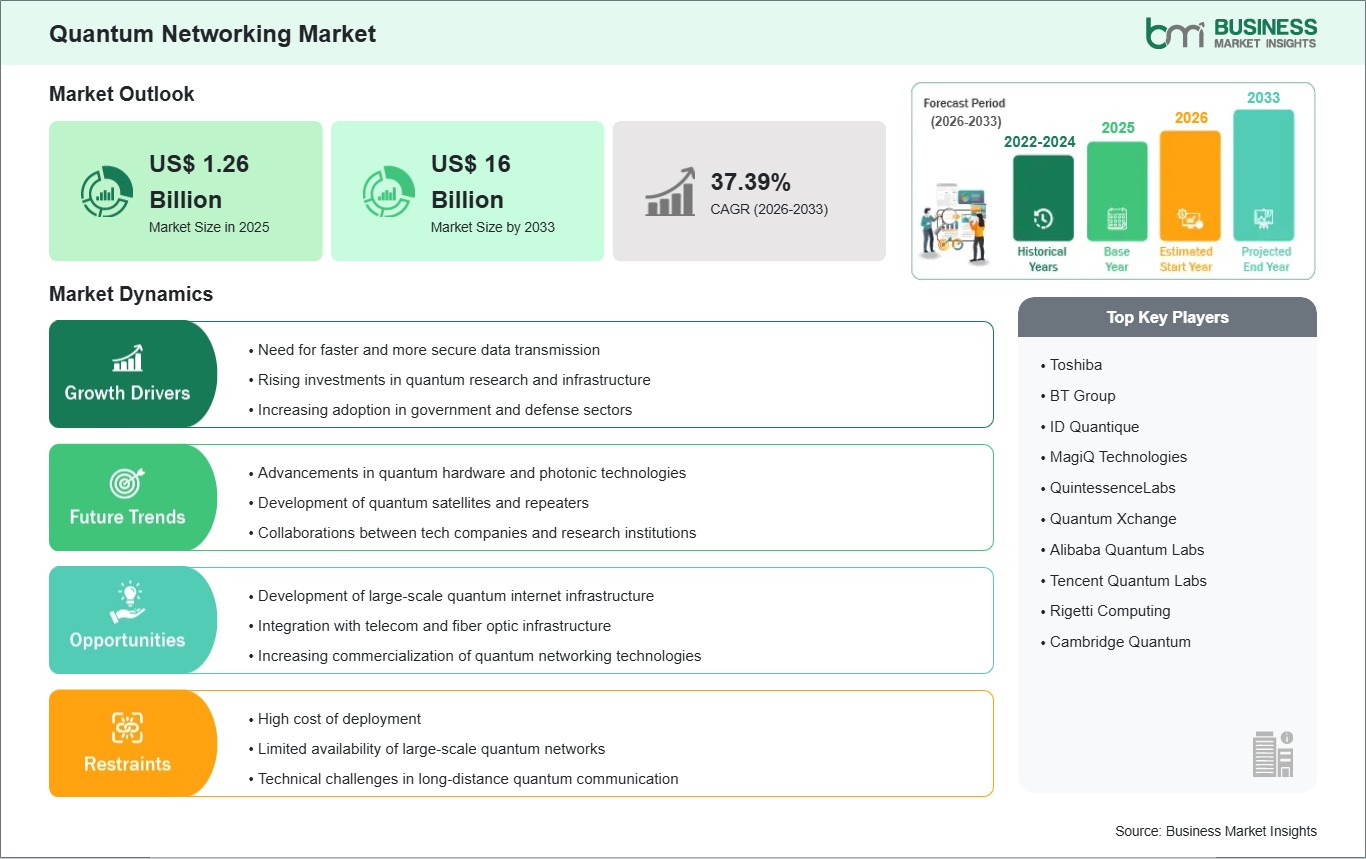
The global quantum networking market is emerging as a critical component of next-generation communication infrastructure, enabling highly secure data transmission through quantum technologies. Quantum networking uses principles of quantum mechanics, such as quantum entanglement and quantum key distribution, to enable ultra-secure communication channels that are resistant to conventional cyberattacks. This technology is expected to play a transformative role in protecting sensitive information across industries including government, defense, banking, and telecommunications.
The growing need for secure communication systems is one of the key factors driving the development of quantum networking technologies. Traditional encryption methods are becoming increasingly vulnerable to advanced cyber threats and the future capabilities of quantum computing. Quantum networking addresses these challenges by enabling cryptographic techniques that rely on the fundamental laws of physics rather than computational complexity.
Technological advancements in quantum hardware and networking protocols are accelerating the development of practical quantum communication networks. Research institutions, technology companies, and governments worldwide are investing heavily in quantum networking infrastructure, including quantum satellites, quantum repeaters, and secure optical communication networks. These technologies are designed to enable long-distance quantum communication and create large-scale quantum internet systems.
Competitive dynamics within the quantum networking market are characterized by collaborations between technology companies, telecommunications providers, research laboratories, and government agencies. These partnerships aim to accelerate the commercialization of quantum networking technologies and establish global quantum communication networks. As digital security becomes increasingly important in the era of quantum computing, quantum networking is expected to become a foundational technology for secure digital infrastructure.
Segment Analysis
Quantum Networking Market Segmentation
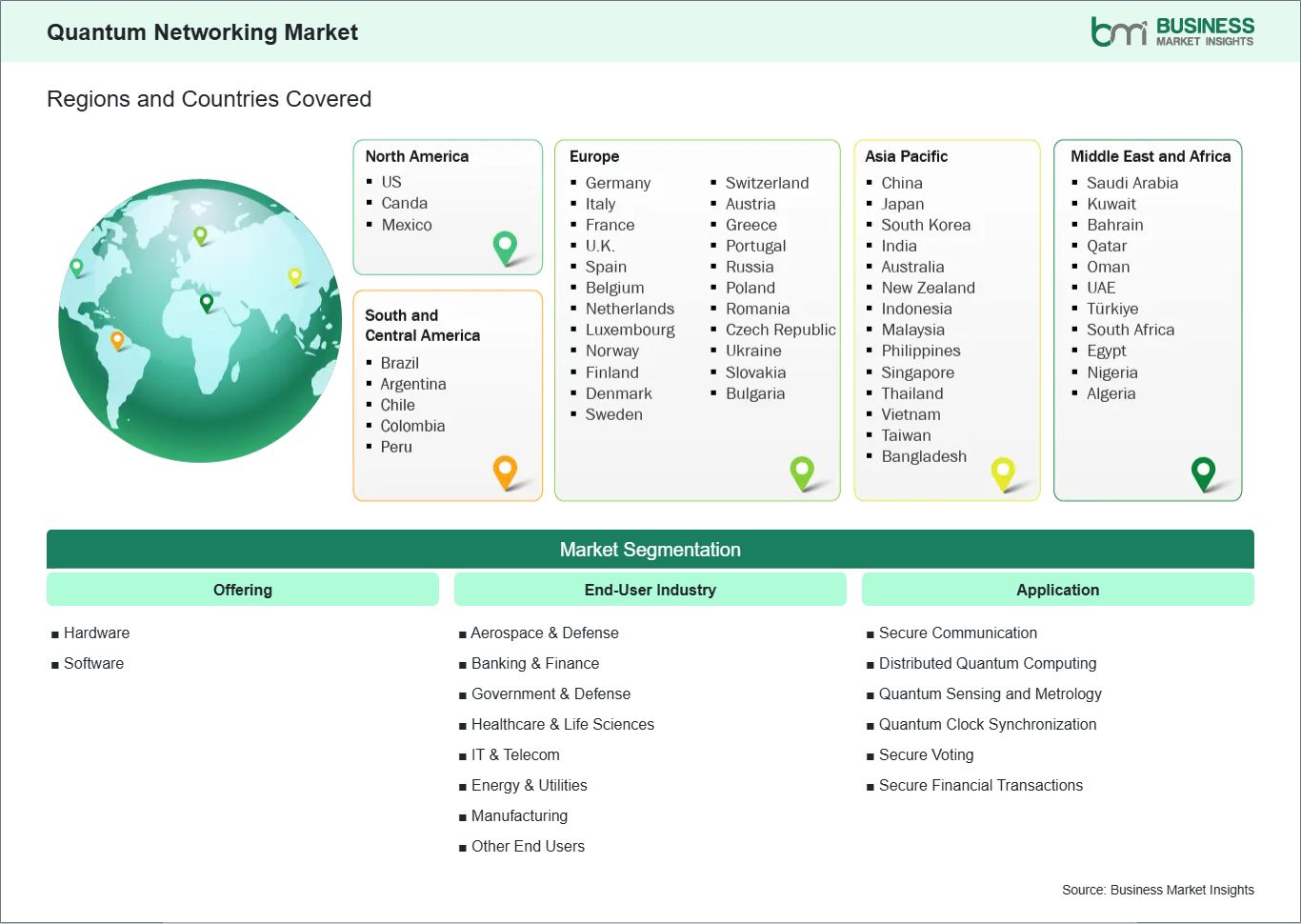
Key segments that contributed to the derivation of the quantum networking market analysis are offering, end-user industry, and application.
- By offering, the quantum networking market is segmented into hardware and software. The hardware segment dominated the market in 2025.
- Based on end-user industry, the market is segmented into aerospace & defense, banking & finance, government & defense, healthcare & life sciences, IT & telecom, energy & utilities, manufacturing, and other end users. The government & defense segment dominated the market in 2025.
- In terms of application, the market is segmented into secure communication, distributed quantum computing, quantum sensing and metrology, quantum clock synchronization, secure voting, and secure financial transactions. The secure communication segment dominated the market in 2025.
Market Forces
Quantum Networking Market Drivers and Opportunities
Increasing Demand for Ultra-Secure Communication Systems
The growing demand for ultra-secure communication systems is one of the major factors driving the growth of the quantum networking market. Quantum networking technologies offer a unique advantage by enabling encryption methods based on quantum mechanics. Quantum key distribution allows two parties to generate and share encryption keys with guaranteed security, as any attempt to intercept the communication can be detected immediately. Government agencies, defense organizations, and financial institutions are among the earliest adopters of quantum networking technologies.
Growing Investments in Quantum Research and Infrastructure
The rapid expansion of quantum research initiatives worldwide is creating significant opportunities for the quantum networking market. Governments and technology companies are investing heavily in quantum technologies as part of national innovation strategies aimed at developing next-generation computing and communication capabilities.
Telecommunication companies are exploring integration of quantum networking into existing fiber optic networks, while advancements in photonics, quantum repeaters, and satellite-based quantum communication systems are further expanding applications.
Size and Share Analysis
Quantum Networking Market Size and Share Analysis
The Quantum Networking Market demonstrates steady growth, with size and share analysis highlighting evolving trends and competitive dynamics among key players. The report examines subsegments categorized within offering, end-user industry, and application.
By offering, the hardware subsegment dominated the market in 2025, driven by deployment of quantum communication devices and networking infrastructure components.
Based on end-user industry, the government & defense subsegment dominated in 2025 due to investments in national security technologies and secure communication systems.
In terms of application, the secure communication subsegment dominated in 2025 driven by the need for highly secure encryption capable of protecting critical data from advanced cyber threats.
Report Coverage
Quantum Networking Market Report Coverage and Deliverables
The "Quantum Networking Market Size and Forecast (2022 - 2033)" report provides a detailed analysis of the market covering below areas:
- Quantum Networking Market size and forecast at global, regional, and country levels for all key market segments covered under the scope
- Quantum Networking Market trends, drivers, restraints, and opportunities
- Quantum Networking Market analysis covering key trends, global and regional framework, major players, regulations, and recent developments
- Industry landscape and competition analysis covering market concentration, heat map analysis, and prominent players
- Detailed company profiles including SWOT analysis
Geographic Insights
Quantum Networking Market Geographic Insights
The geographical scope of the Quantum Networking Market report is divided into North America, Asia Pacific, Europe, Middle East & Africa, and South & Central America. North America held the largest share in 2025.
North America leads due to strong R&D activities and presence of major technology companies. The United States has launched multiple national initiatives to develop quantum communication networks and strengthen cybersecurity infrastructure.
Europe is supported by collaborative research programs and investments in quantum communication infrastructure. Countries such as Germany, the United Kingdom, and France are actively developing quantum communication networks and large-scale research projects.
Asia Pacific is witnessing rapid growth due to investments in quantum research and telecommunications infrastructure in China, Japan, and South Korea.
Emerging regions such as Latin America and the Middle East & Africa are gradually exploring quantum networking technologies as part of broader digital infrastructure development initiatives.
Industry Activity
Recent Developments
The Quantum Networking Market is evaluated by gathering qualitative and quantitative data post primary and secondary research, which includes important corporate publications, association data, and databases. A few of the key developments in the quantum networking market are:
- In June 2024, Toshiba announced the deployment of a new quantum key distribution network designed to enable ultra-secure communication infrastructure for commercial and government users.
- In March 2024, BT Group expanded its quantum-secured metro network trial in the United Kingdom, enabling secure data transmission using quantum key distribution technologies across telecom infrastructure.
Trust & Transparency
Research Methodology
The market analysis combines proprietary research with secondary data from government agencies, company disclosures, regulatory filings, industry databases and expert interviews. Market estimates are validated through data triangulation, cross-market benchmarking and analyst
review.
View Full Research Methodology
Key Sources Referred:
International Telecommunication Union (ITU)National Institute of Standards and Technology (NIST)Organisation for Economic Co-operation and Development (OECD)World Economic ForumInternational Trade Administration