Market Summary
Executive Summary and Global Market Analysis
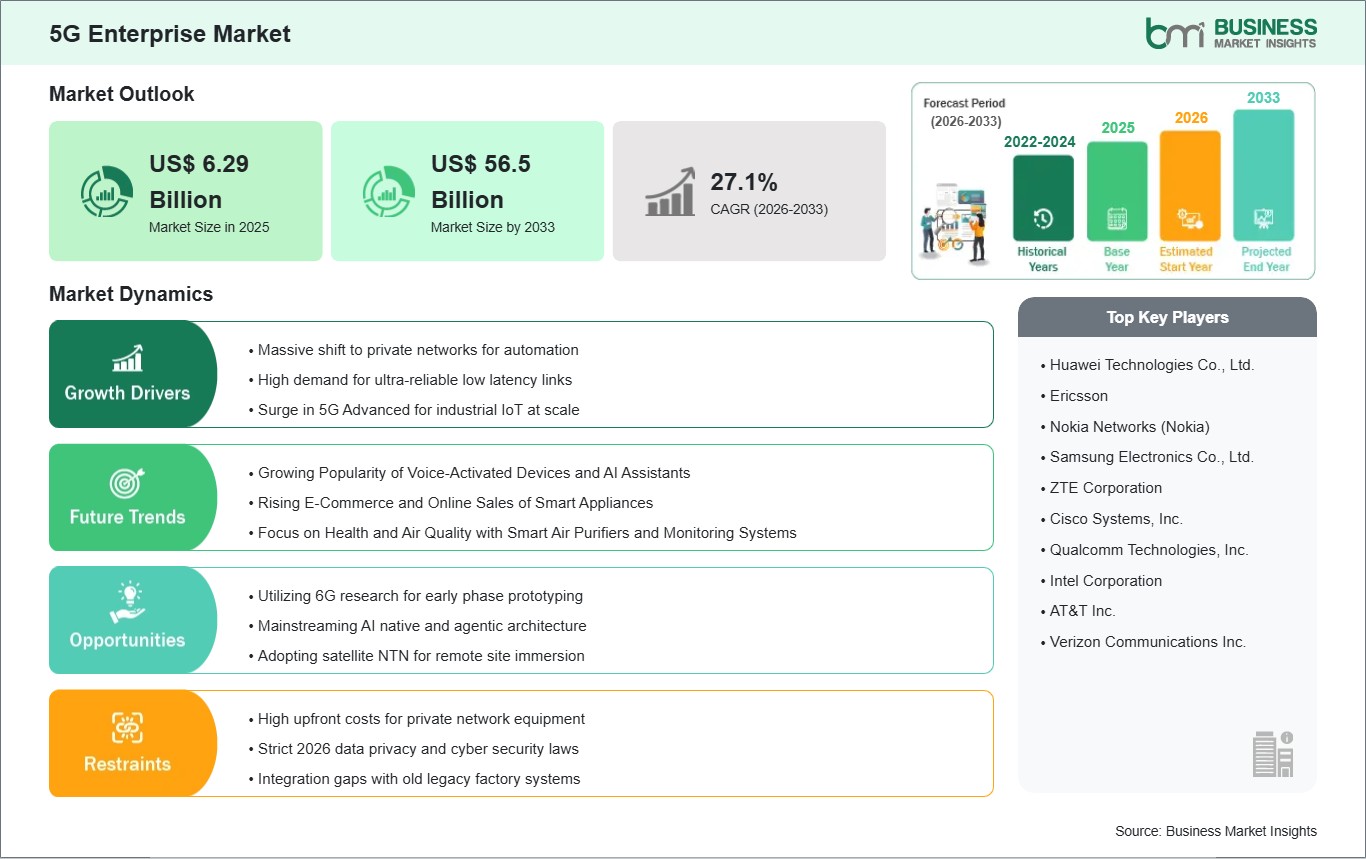
5G Enterprise solutions are advanced wireless networking architectures designed specifically to meet the high-performance connectivity demands of businesses and industrial organizations. These technologies deliver significant clinical and economic value by enabling near-zero latency for mission-critical robotics, offering efficient high-bandwidth solutions for massive sensor grids, and ensuring secure, dedicated connectivity that outperforms traditional Wi-Fi in dense industrial environments. Together, they form a critical portfolio that supports high-quality operational outcomes across manufacturing, healthcare, logistics, and smart city infrastructure. Market expansion is primarily attributed to the rising global demand for industrial automation, the increasing proliferation of AI-driven real-time analytics, and government initiatives that have streamlined spectrum access for private enterprise use. Furthermore, the integration of network slicing algorithms, which allow organizations to partition a single physical network into multiple virtual layers with customized performance tiers, is substantially improving procedural efficiency.
However, several challenges can restrain market growth: high initial procurement and maintenance costs, particularly for standalone private 5G infrastructure and specialized radio equipment, can limit adoption among small and medium-sized enterprises (SMEs). Stringent regulatory hurdles and the complexity of harmonizing spectrum across different global regions lengthen the time-to-market for multi-national deployments and increase development overhead. Additionally, the industry faces constraints due to a global shortage of specialized 5G/OT (Operational Technology) engineering talent and the technical difficulties associated with integrating next-generation wireless cores with legacy industrial control systems.
Despite these hurdles, the market holds immense opportunities in the universal mandate for hyper-connected and autonomous operations and the accelerating deployment of Open RAN (Radio Access Network) architectures that promote vendor interoperability. The expansion of 5G-enabled edge AI, where data is processed locally at the network edge to eliminate round-trip delays, and the development of next-generation ultra-compact 5G small cells for indoor campus coverage are expected to create significant opportunities for market growth.
Segment Analysis
5G Enterprise Market Segmentation
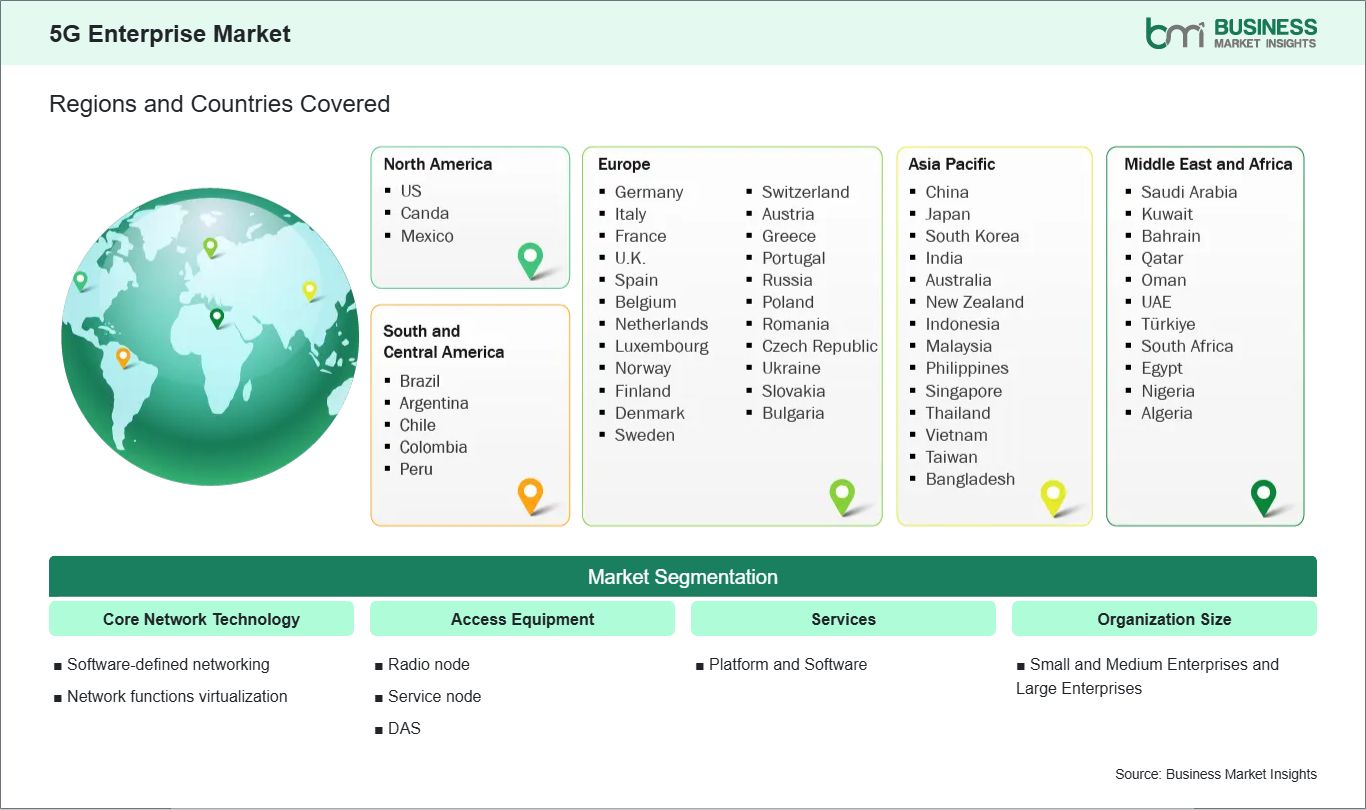
Key segments that contributed to the derivation of the 5G Enterprise market analysis are core network technology, access equipment, services, and organization size.
- By Core Network Technology, the market is segmented into software-defined networking and network functions virtualization.
- By Access Equipment, the market is divided into radio node, service node, and DAS.
- By Services, the market is categorized into platform and software.
- By Organization Size, the market is segmented into small and medium enterprises and large enterprises.
Market Forces
5G Enterprise Market Drivers and Opportunities
Industrial Automation and Mission-Critical Connectivity
The primary driver for the 5G Enterprise Market is the accelerating demand for ultra-reliable low-latency communication (URLLC) to support the next phase of industrial automation. As industries transition toward "Industry 4.0," the need for seamless, real-time data exchange between autonomous robots, sensors, and cloud-based management systems has become a critical operational requirement. Traditional wireless technologies often struggle with the density of devices and the precision required for high-speed manufacturing; 5G addresses these gaps by providing massive machine-type communications (mMTC) that can support up to a million devices per square kilometer. This capability is particularly vital for mission-critical applications where even a millisecond of delay can disrupt production or compromise safety, such as in remote machinery control or autonomous vehicle coordination within logistics hubs. Furthermore, the global push for digital transformation is compelling enterprises in the energy, healthcare, and transportation sectors to adopt 5G as a foundational layer for predictive maintenance and real-time asset tracking, ensuring a high-velocity growth path for the market.
Private Networking and Network Slicing Customization
A significant high-value opportunity lies in the rapid deployment of Private 5G Networks and the implementation of Network Slicing. Unlike public cellular networks, private 5G allows enterprises to maintain complete control over their data security, coverage, and performance, making it an ideal solution for sensitive environments like offshore oil platforms, high-security research facilities, and smart factories. Network slicing further enhances this by allowing a single physical network to be partitioned into multiple virtual networks, each tailored to specific service-level agreements (SLAs). For instance, a hospital could dedicate one "slice" to life-critical remote surgery and another to general patient data, ensuring that high-bandwidth traffic does not interfere with urgent medical procedures. Another major growth frontier is the integration of Edge Computing with 5G, which processes data closer to the source to further reduce latency and save bandwidth. Manufacturers who innovate in 5G-enabled "digital twins" and AI-driven video analytics for quality control are positioned to capture high-margin segments in an increasingly connected and data-intensive global landscape.
Size and Share Analysis
5G Enterprise Market Size and Share Analysis
The 5G Enterprise market demonstrates steady growth, with size and share analysis revealing evolving trends and competitive positioning among key players. The report further examines subsegments categorized within core network technology, access equipment, services, and organization size, offering insights into their contribution to overall market performance.
For instance, the Radio Node subsegment is experiencing rapid adoption, particularly through the deployment of small cells and Massive MIMO technology. These nodes are essential for providing the dense coverage and high-throughput required in high-traffic settings like smart warehouses and shipping ports. In 2026, the market is seeing a surge in Distributed Antenna Systems (DAS) and Service Nodes that integrate AI-powered automation to optimize signal distribution in real-time. This level of precision is critical for Industry 4.0 applications, where seamless connectivity for thousands of IoT sensors and autonomous guided vehicles (AGVs) is a prerequisite for maintaining operational efficiency.
Report Coverage
5G Enterprise Market Report Coverage and Deliverables
The "5G Enterprise Market Size and Forecast (2022 - 2033)" report provides a detailed analysis of the market covering below areas:
- 5G Enterprise market size and forecast at global, regional, and country levels for all the key market segments covered under the scope
- 5G Enterprise market trends, as well as market dynamics such as drivers, restraints, and key opportunities
- 5G Enterprise market analysis covering key market trends, global and regional framework, major players, regulations, and recent market developments
- Industry landscape and competition analysis covering market concentration, heat map analysis, prominent players, and recent developments for the 5G Enterprise market
- Detailed company profiles, including SWOT analysis
Geographic Insights
5G Enterprise Market Geographic Insights
The geographical scope of the 5G Enterprise market report is divided into five regions: North America, Asia Pacific, Europe, Middle East &Africa, and South &Central America.
The Asia-Pacific 5G Enterprise Market is segmented into China, Japan, South Korea, India, Australia, New Zealand, Indonesia, Malaysia, the Philippines, Singapore, Thailand, Vietnam, Taiwan, Bangladesh, and the Rest of Asia. The market is primarily anchored by the region's aggressive rollout of 5G infrastructure to support "Industry 4.0" and smart city projects.
Growth is further bolstered by the rising demand for private 5G networks in the manufacturing and healthcare sectors, where high-speed, low-latency connectivity is essential for real-time automation and remote monitoring. The integration of Edge Computing and AI-driven analytics into enterprise workflows, alongside government support for indigenous 5G technology development, solidifies Asia-Pacific as a critical global driver for innovation and widespread enterprise adoption of next-generation connectivity.
Industry Activity
Recent Developments
The 5G Enterprise market is evaluated by gathering qualitative and quantitative data post primary and secondary research, which includes important corporate publications, association data, and databases. A few of the key developments in the 5G Enterprise market are:
- In October 2025, Pegatron 5G expanded its enterprise 5G footprint through private network deployments, smart factory implementations, and Open RAN solutions across India and Southeast Asia. In 2024 - 2025, the company partnered with Tech Mahindra, Intel, Viettel, and Qualcomm to deliver low-latency, energy-efficient private 5G networks for manufacturing, smart infrastructure, and industrial use cases. Pegatron's Make-in-India 5G small cell manufacturing further supports localized enterprise deployments and supply chain resilience
- In June 2024, Hewlett Packard Enterprise introduced HPE Aruba Networking Enterprise Private 5G to help customers accelerate and simplify the deployment and management of private 5G networks, providing high levels of reliable wireless coverage across large campus and industrial environments and opening up new, untapped use cases for private cellular. The offering simplifies deployment and management by combining Athonet's mobile core technology, HPE ProLiant servers, small cells, and cloud-native automation, while supporting Wi-Fi integration and AI-driven data capture.
Trust & Transparency
Research Methodology
The market analysis combines proprietary research with secondary data from government agencies, company disclosures, regulatory filings, industry databases and expert interviews. Market estimates are validated through data triangulation, cross-market benchmarking and analyst
review.
View Full Research Methodology
Key Sources Referred:
World Bank - Global Trade IndicatorsWorld Trade Organization (WTO)International Monetary Fund (IMF)International Trade Administration (ITA)Company websiteCompany annual reportsCompany investor presentations