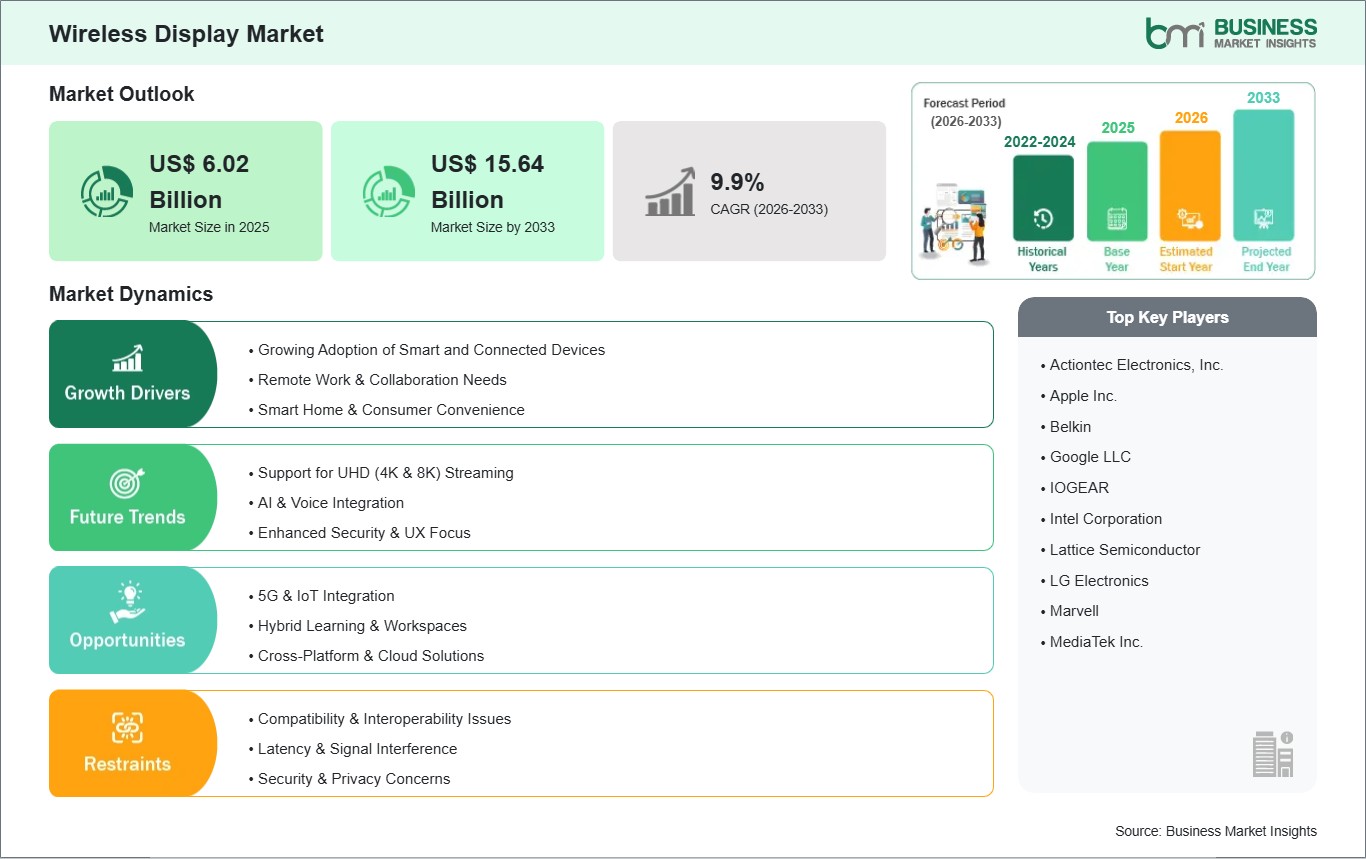
The wireless display market size is expected to reach US$ 15.64 billion by 2033 from US$ 6.02 billion in 2025. The market is estimated to record a CAGR of 9.90% from 2026 to 2033.
Wireless display technology refers to the ability to transmit video and audio signals from a device to a screen without physical cables, enabling seamless sharing of content across smartphones, laptops, and smart TVs. Its usage spans consumer entertainment, business presentations, digital signage, and education, where users can mirror or extend displays for enhanced interaction and convenience. The benefits of wireless display include improved flexibility, reduced clutter, and enhanced collaboration, allowing multiple users to share content effortlessly in meetings or classrooms. Additionally, the rise in remote working and smart home adoption has further intensified demand for wireless display solutions.
The wireless display market is influenced by several key factors: drivers such as increasing demand for high-definition content sharing, proliferation of smart devices, and advancements in Wi-Fi and Bluetooth connectivity; restraints including signal latency issues, security concerns, and compatibility challenges across diverse hardware. Meanwhile, opportunities emerge from the integration of 5G technology, growth in augmented and virtual reality applications, and expanding adoption in enterprise and healthcare sectors. Current trends shaping the market encompass the development of low-latency protocols, enhanced energy efficiency, and the convergence of wireless display with Internet of Things (IoT) ecosystems. As these technologies evolve, the wireless display market is poised for robust growth and broader innovation.

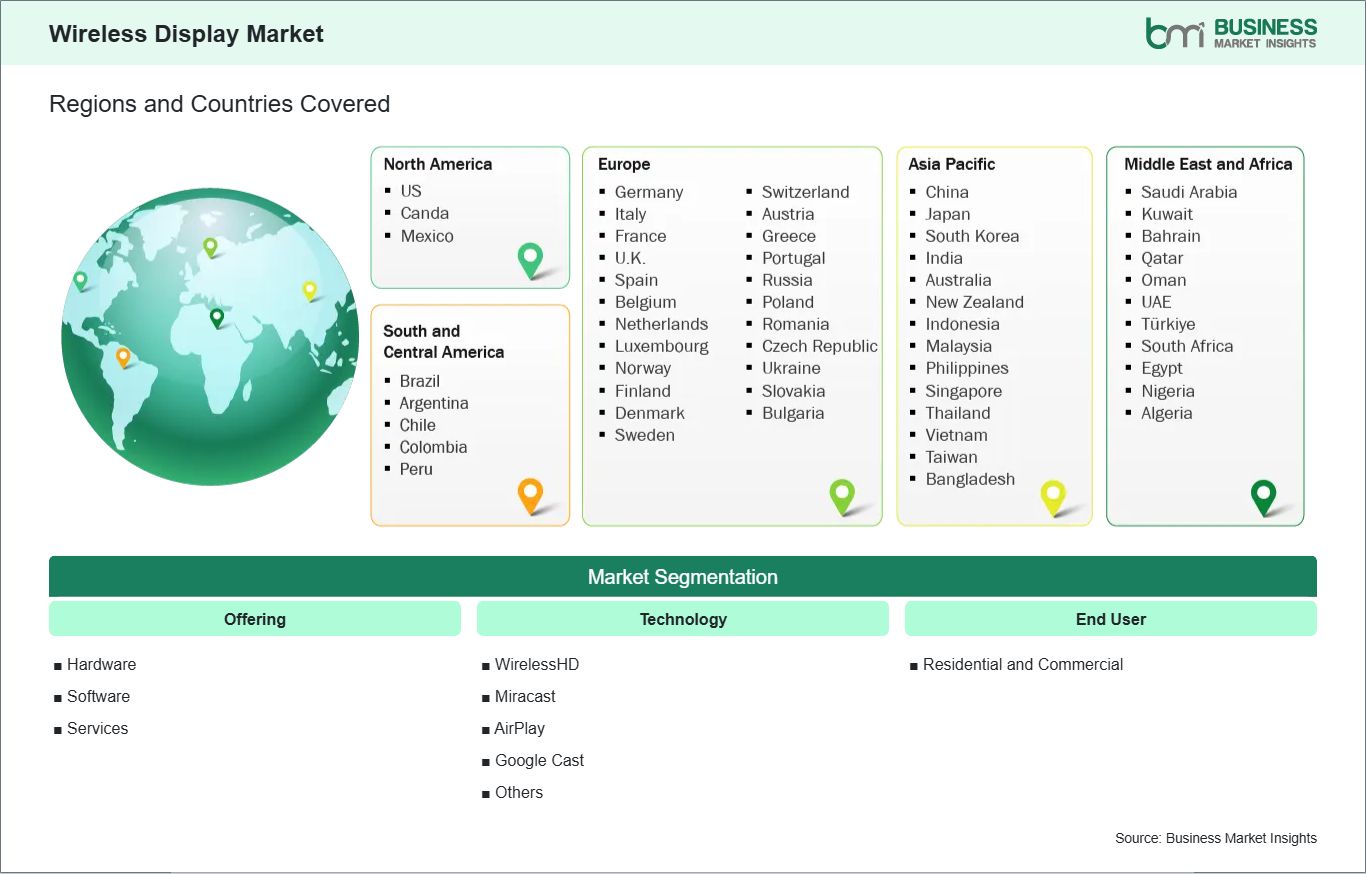
Key segments that contributed to the derivation of the wireless display market analysis are offering, technology, and end users.
A key driver propelling the wireless display market is the rapid adoption of smart and connected devices across consumer and enterprise segments. The proliferation of smartphones, tablets, smart TVs, laptops, and other IoT-enabled devices has fundamentally transformed how users consume and share digital content. Traditional wired connections such as HDMI and VGA restricted mobility and ease of use. In contrast, wireless display technologies like Miracast, Chromecast, AirPlay, and WiDi empower users to seamlessly mirror or cast content from their personal devices to larger screens without physical cables. This shift aligns closely with the broader trend toward mobility and flexibility in digital experiences. In the consumer space, households increasingly demand seamless integration of multimedia ecosystems. Streaming high-definition video, gaming, photo sharing, and online conferencing on larger displays without cables enhances the user experience, stimulating market demand. Millennials and Gen Z consumers, who favor wireless and minimalist setups, further influence this trend. Additionally, the surge in remote work and virtual learning has accentuated the need for flexible display solutions. Professionals and students alike seek to broadcast presentations, lecture materials, and workspaces throughout their homes or offices without the hassles of traditional wiring. Moreover, enterprises are embracing wireless display systems in meeting rooms, collaborative spaces, and digital signage. Such systems facilitate agile collaboration, reduce clutter, and improve overall productivity. The convergence of these drivers — consumer demand for high-quality multimedia streaming, remote work dynamics, and corporate digital transformation initiatives — ensures sustained growth for the wireless display market. As smart ecosystems continue to expand, the role of wireless display technologies in enabling effortless connectivity and content sharing becomes indispensable, reinforcing this driver’s impactful presence in the market landscape.
One of the most compelling opportunities for the wireless display market lies in its integration with augmented reality (AR), virtual reality (VR), and other immersive technologies. As AR/VR devices mature and find broader adoption across gaming, enterprise training, healthcare, and industrial applications, the demand for robust, high-performance wireless display solutions will grow exponentially. These immersive technologies thrive on rich visual content, low latency, and fluid interaction — characteristics that current wired setups can restrict. Wireless display technologies that can reliably transmit high-resolution, low-latency video streams will unlock new use cases and enhance user engagement. In gaming and entertainment, wireless display integration with AR/VR platforms could eliminate tethered headsets and cables, significantly improving user mobility and comfort. Players could stream lifelike virtual environments onto external displays or projection systems without being confined to a physical spot, reshaping home entertainment. In enterprise settings, AR combined with wireless display can revolutionize collaborative design, remote assistance, and virtual prototyping. Imagine engineers working with AR headsets while wirelessly sharing their perspective on large screens for team review — such seamless interactions could drastically improve productivity and decision-making. Healthcare also stands to benefit. Surgeons equipped with AR can project critical data, imaging, and patient metrics in real time onto nearby displays via wireless technology, streamlining workflows and reducing distractions. Training simulations in aviation, manufacturing, and defense use AR/VR to mimic high-risk scenarios. Wireless display solutions that support these simulations enhance flexibility and scalability of training environments. Furthermore, as 5G and Wi-Fi 6/7 technologies become widespread, they will provide the bandwidth and reliability necessary for sophisticated wireless display-AR/VR ecosystems. This technological synergy positions the wireless display market to evolve from a convenience-driven solution to a cornerstone of next-generation immersive experiences, presenting a substantial growth opportunity across industries.

By offering, the market is segmented into hardware, software, and services. The hardware segment held the largest share of the market in 2025. The demand for hardware in the wireless display market is increasing due to growing adoption of smart devices, advanced display technologies, and high-resolution screens. Rising use of wireless presentations, digital signage, and home entertainment systems is also driving the need for efficient, reliable hardware components.
By technology, the market is divided into WirelessHD, Miracast, AirPlay, Google Cast, and others. The AirPlay segment held the largest share of the market in 2025. The demand for AirPlay segment is rising due to seamless device integration, growing Apple ecosystem adoption, demand for cable-free screen sharing, improved Wi-Fi performance, remote work and education growth, enhanced streaming quality, ease of use, and increasing use of smart TVs in homes and enterprises.
By End users, the market is segmented into residential and commercial. The residential segment held the largest share of the market in 2025. The demand for wireless display in the residential sector is increasing due to the growing use of smart TVs, home entertainment systems, and mobile devices. Wireless displays offer convenience, easy screen sharing, reduced cable clutter, and seamless connectivity for streaming, gaming, remote work, and smart home applications.
| Report Attribute | Details |
|---|---|
| Market size in 2025 | US$ 6.02 Billion |
| Market Size by 2033 | US$ 15.64 Billion |
| Global CAGR (2026 - 2033) | 9.9% |
| Historical Data | 2022-2024 |
| Forecast period | 2026-2033 |
| Segments Covered | By Offering
|
| Regions and Countries Covered | North America
|
| Market leaders and key company profiles |
|
The Wireless Display Market Size and Forecast (2022–2033) report provides a detailed analysis of the market covering below areas:
The geographical scope of the wireless display market report is divided into five regions: North America, Asia Pacific, Europe, Middle East & Africa, and South & Central America. The wireless display market in Asia Pacific is expected to grow significantly during the forecast period.
The Asia-Pacific wireless display market is segmented into United States, Canada, and Mexico. The demand and adoption of wireless display technology in North America are increasing rapidly due to a combination of technological, economic, and social factors. One of the primary drivers is the widespread adoption of smart devices such as smartphones, tablets, laptops, and smart TVs, which are increasingly designed with built-in wireless display capabilities. As consumers and professionals seek seamless content sharing without the inconvenience of cables, wireless display solutions offer greater flexibility and ease of use. Additionally, the strong presence of advanced IT infrastructure and high-speed internet connectivity across North America supports smooth and reliable wireless transmission, making these technologies more practical and appealing. The growth of remote work, hybrid workplaces, and virtual collaboration has also significantly boosted demand, as businesses rely on wireless displays for presentations, video conferencing, and collaborative meetings. Educational institutions across the region are another major contributor, as schools and universities adopt wireless display systems to enable interactive learning, screen sharing, and digital classrooms.
Furthermore, the rapid digital transformation of enterprises and the increasing use of cloud-based applications encourage the integration of wireless display solutions to enhance productivity and workflow efficiency. Consumer demand is also influenced by the rising popularity of home entertainment systems, streaming services, and smart home ecosystems, where wireless displays enable multi-screen viewing and easy media sharing. The availability of advanced standards such as Miracast, AirPlay, and Chromecast, along with continuous innovation by key market players, has improved performance, security, and compatibility, further accelerating adoption. Government initiatives supporting digitalization and smart infrastructure, along with rising investments in research and development, also play a supportive role. Overall, the combination of strong technological readiness, evolving workplace and education models, and consumer preference for convenience continues to drive the growing demand for wireless display solutions across North America.

The wireless display market is evaluated by gathering qualitative and quantitative data post primary and secondary research, which includes important corporate publications, association data, and databases. A few of the key developments in the wireless display market are:
The Wireless Display Market is valued at US$ 6.02 Billion in 2025, it is projected to reach US$ 15.64 Billion by 2033.
As per our report Wireless Display Market, the market size is valued at US$ 6.02 Billion in 2025, projecting it to reach US$ 15.64 Billion by 2033. This translates to a CAGR of approximately 9.9% during the forecast period.
The Wireless Display Market report typically cover these key segments-
The historic period, base year, and forecast period can vary slightly depending on the specific market research report. However, for the Wireless Display Market report:
The Wireless Display Market is populated by several key players, each contributing to its growth and innovation. Some of the major players include:
The Wireless Display Market report is valuable for diverse stakeholders, including:
Essentially, anyone involved in or considering involvement in the Wireless Display Market value chain can benefit from the information contained in a comprehensive market report.
Please tell us your area of interest
(Market Segments/ Regions and Countries/ Companies)