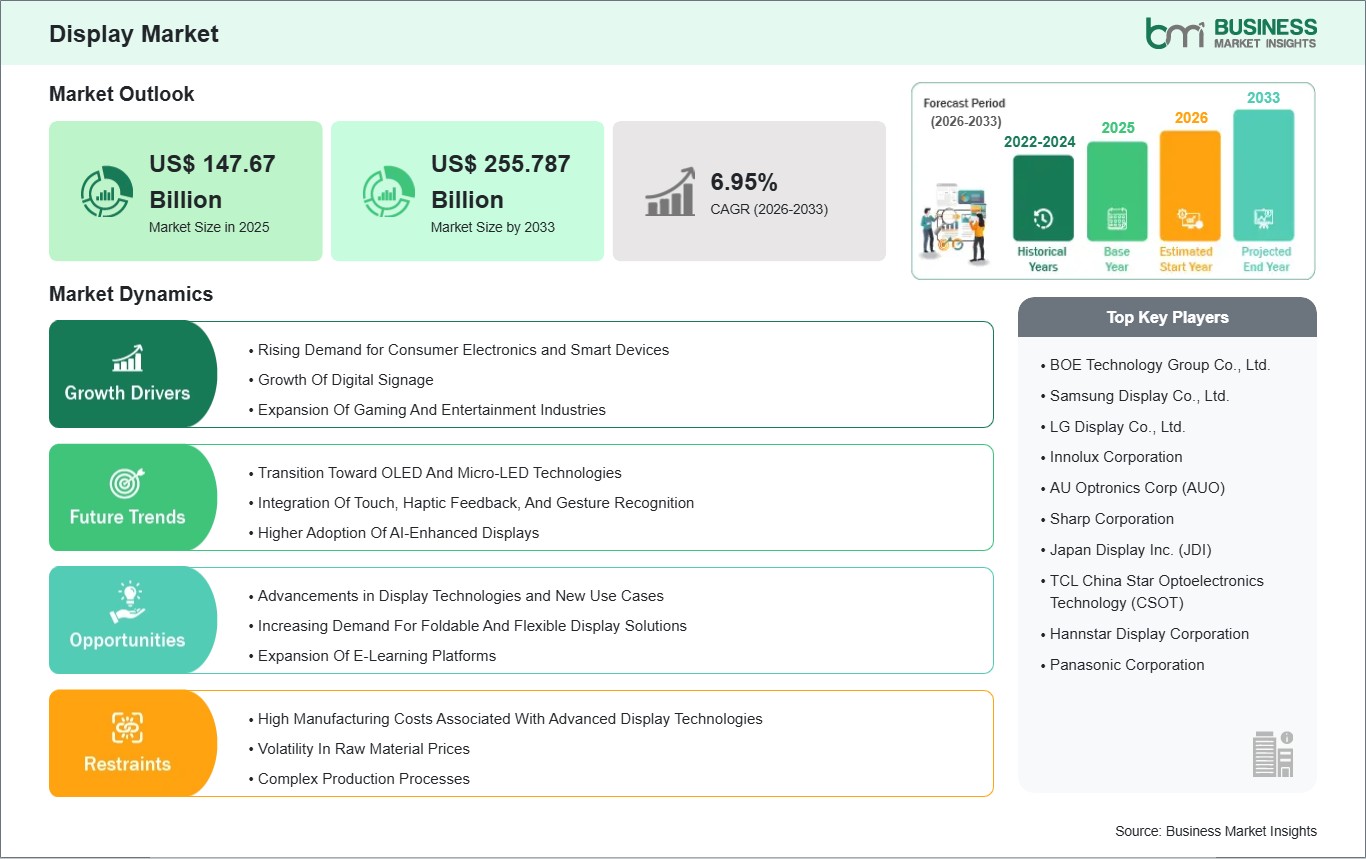
The display market size is expected to reach US$255,787.7 million by 2033 from US$147,671.7 million in 2025. The market is estimated to record a CAGR of 6.95% from 2026 to 2033.
The worldwide display industry is mainly influenced by the increased consumption of mobile phones, televisions, laptops, wearables, and car infotainment systems, which is further supported by the adoption of digital signage and interactive displays in business and public places. Besides this, the growth of the market is also powered by progressive changes in display devices, some of the examples being flexible and foldable panels, higher resolutions, better energy efficiency, and thinner form factors. On top of that, future applications such as AR/VR devices, smart homes, electric vehicles, and connected healthcare equipment are also significantly increasing demand.
Some of the major issues confronting the display sector are expensive manufacturing and capital investment, complicated supply chains, yield management in advanced technologies like OLED and MicroLED, and pricing pressures resulting from intense competition. Besides that, the emission of greenhouse gases and production of e-waste associated with the use of energy and electronic devices, respectively, are some of the challenges faced by the industry. Nevertheless, there are ample opportunities for expansion through path-breaking innovations in display technology, further market penetration in developing countries, growth of electric and autonomous vehicles, and increased demand for immersive and energy-efficient display solutions, fueling global market growth, which is not likely to stop anytime soon.

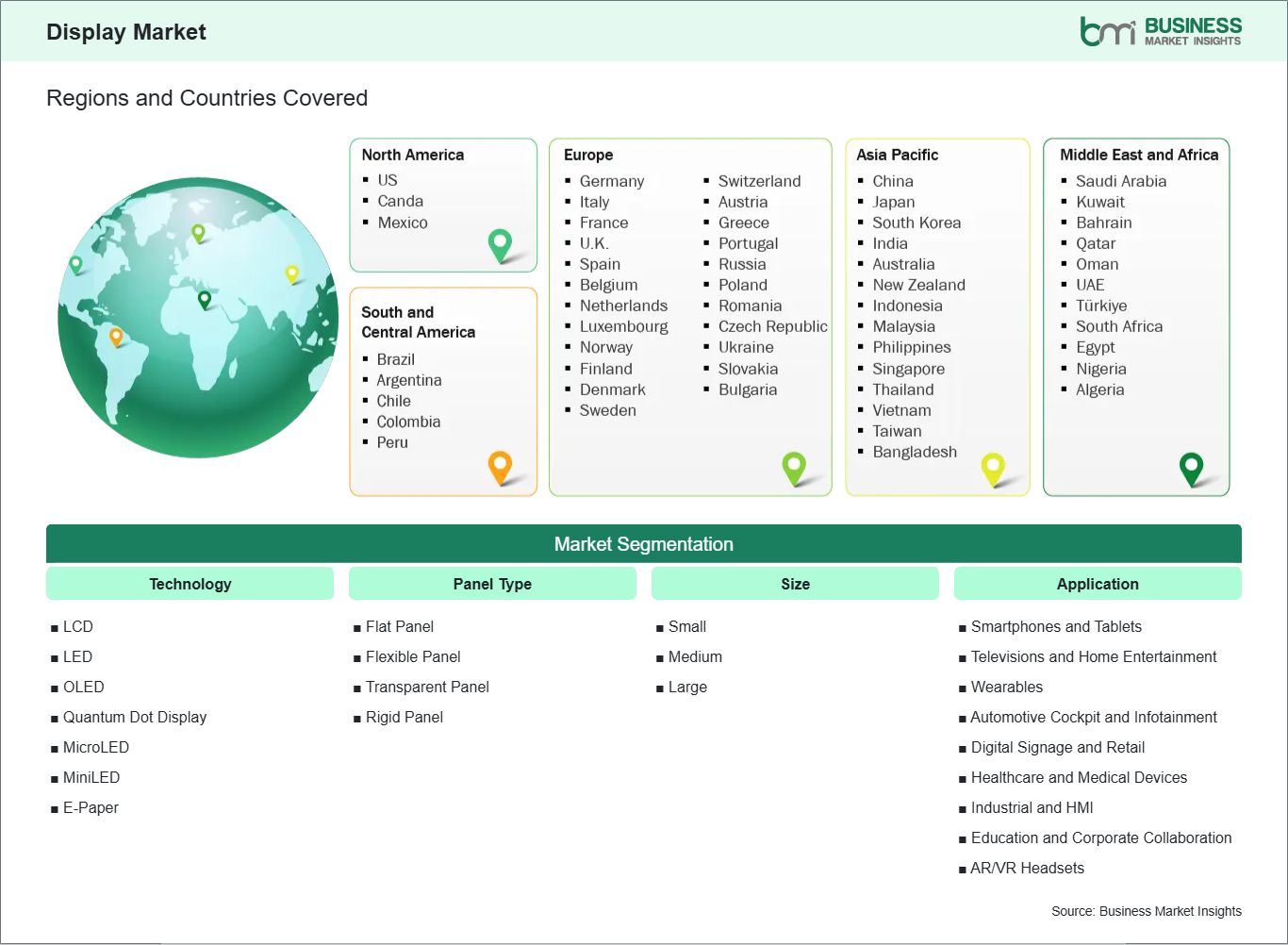
Key segments that contributed to the derivation of the display market analysis are technology, panel type, size, and application.
The growing use of consumer electronics products such as smartphones, televisions, laptops, tablets, and wearables has been the major factor driving the display market. Consumers want devices that can provide them with a higher resolution, better color accuracy, thinner form factors, and energy efficiency, which is thus enabling faster penetration of the sophisticated display technologies like OLED, MiniLED, and Quantum Dot displays. On the one hand, continuous product innovation and decreasing replacement cycles, and on the other hand, the increase in disposable income, especially in emerging countries, are together keeping alive a very strong demand for high-performance displays in all global markets.
Among the advanced features that fixed and foldable displays, MicroLED, transparent panels, and high-refresh-rate screens could boast of, there are also a lot of rapid upheavals in the field that are attracting the attention of buyers and investors and at the same time creating vast opportunities for the market. These innovations are helping the new applications to extend their boundaries in such areas as AR/VR headsets, automotive cockpits, digital signage, and smart wearables. Moreover, the demand for display integration in electric and autonomous vehicles, smart retail environments, and industrial automation systems is raising the market potential to a new level. With a continuous R&D investment to upgrade the product parameters, manufacturers will thus be contributing to the display market growth, which makes it a win-win situation for all market players, not only from the point of view of its evolution but also from its expansion into further industries.
By technology, the display market is segmented into LCD, LED, OLED, Quantum Dot Display, MicroLED, MiniLED, and E-Paper. LCD technology accounted for the largest share of the market, driven by its cost-effectiveness, mature manufacturing ecosystem, and widespread adoption across televisions, monitors, and industrial applications.
By panel type, the display market is categorized into flat panel, flexible panel, transparent panel, and rigid panel. Flat panel displays held the dominant market share, supported by their extensive use in TVs, monitors, laptops, and smartphones.
By size, the display market is segmented into small (less than 10 inches), medium (10–32 inches), and large (above 32 inches). The medium-sized display segment accounted for the largest share, driven by strong demand from monitors, laptops, and televisions.
By application, the display market is segmented into smartphones and tablets, televisions and home entertainment, wearables, automotive cockpit and infotainment, digital signage and retail, healthcare and medical devices, industrial and HMI, education and corporate collaboration, and AR/VR headsets. Smartphones and tablets represented the largest share of the market, driven by continuous innovation, high replacement cycles, and growing penetration in emerging markets.
| Report Attribute | Details |
|---|---|
| Market size in 2025 | US$ 147.67 Billion |
| Market Size by 2033 | US$ 255.787 Billion |
| Global CAGR (2026 - 2033) | 6.95% |
| Historical Data | 2022-2024 |
| Forecast period | 2026-2033 |
| Segments Covered | By Technology
|
|
Regions and Countries Covered
| |
| North America | US, Canada, Mexico |
| Europe | Belgium, Austria, Finland, Denmark, Greece, Poland, Romania, Russia, Ukraine, Czech Republic, Slovakia, Bulgaria, Italy, Luxembourg, Germany, Switzerland, France, Netherlands, Norway, Portugal, Spain, Sweden, United Kingdom |
| Asia-Pacific | Australia, China, India, Japan, South Korea, Indonesia, Malaysia, Philippines, Singapore, Thailand, Vietnam, Bangladesh, New Zealand, Taiwan |
| South and Central America | Brazil, Argentina, Peru, Chile, Colombia |
| Middle East and Africa | Bahrain, Kuwait, Oman, Qatar, Saudi Arabia, United Arab Emirates, Turkiye, South Africa, Egypt, Algeria, Nigeria |
| Market leaders and key company profiles |
|
The "Display Market Size and Forecast (2022–2033)" report provides a detailed analysis of the market covering below areas:
Display Market report offers a strategic geographic analysis that extends over five major regions: North America, Asia Pacific, Europe, Middle East & Africa, and South & Central America. As a result of its vibrant manufacturing base, strong consumer electronics demand, and continuous technological breakthroughs in display production, the Asia Pacific region is poised to record the highest and most significant growth during the forecast period.
The Asia-Pacific display market is composed of the following major countries: China, Japan, South Korea, Taiwan, India, Vietnam, Malaysia, Thailand, Indonesia, the Philippines, Singapore, Australia, and the Rest of Asia. The region is the world's center for display manufacturing, with panel producers leading the way and a supply chain that is well established. For instance, China, South Korea, and Taiwan are the main contributors to the mass production of LCD, OLED, and the latest display technologies, which are in turn supported by large-scale investments in fabrication facilities and government-backed industrial policies. The demand in the region is being supported by the rapid growth of smartphone usage, television adoption, electric vehicles, and digital signage.
Moreover, the market expansion to the Asia Pacific is being fast-tracked by the continuous research and development of OLED, MiniLED, MicroLED, and flexible display technologies, as well as by the increasing usage of these technologies in automotive, AR/VR, and industrial applications. Besides that, the region's position in the worldwide display market is still being reinforced by government incentives, the growing semiconductor and electronics ecosystems, readily available skilled labor, and strong export-oriented manufacturing capabilities. While North America and Europe are still the main markets for innovation, premium display adoption, and end-use demand, the Middle East & Africa and South & Central America are witnessing consistent growth fueled by rising digital infrastructure, urbanization, and increasing consumer electronics penetration.

The Display Market is evaluated by gathering qualitative and quantitative data post primary and secondary research, which includes important corporate publications, association data, and databases. A few of the key developments in the display market are:
The Display Market is valued at US$ 147.67 Billion in 2025, it is projected to reach US$ 255.787 Billion by 2033.
As per our report Display Market, the market size is valued at US$ 147.67 Billion in 2025, projecting it to reach US$ 255.787 Billion by 2033. This translates to a CAGR of approximately 6.95% during the forecast period.
The Display Market report typically cover these key segments-
The historic period, base year, and forecast period can vary slightly depending on the specific market research report. However, for the Display Market report:
The Display Market is populated by several key players, each contributing to its growth and innovation. Some of the major players include:
The Display Market report is valuable for diverse stakeholders, including:
Essentially, anyone involved in or considering involvement in the Display Market value chain can benefit from the information contained in a comprehensive market report.
Please tell us your area of interest
(Market Segments/ Regions and Countries/ Companies)