Market Summary
Executive Summary and Global Market Analysis
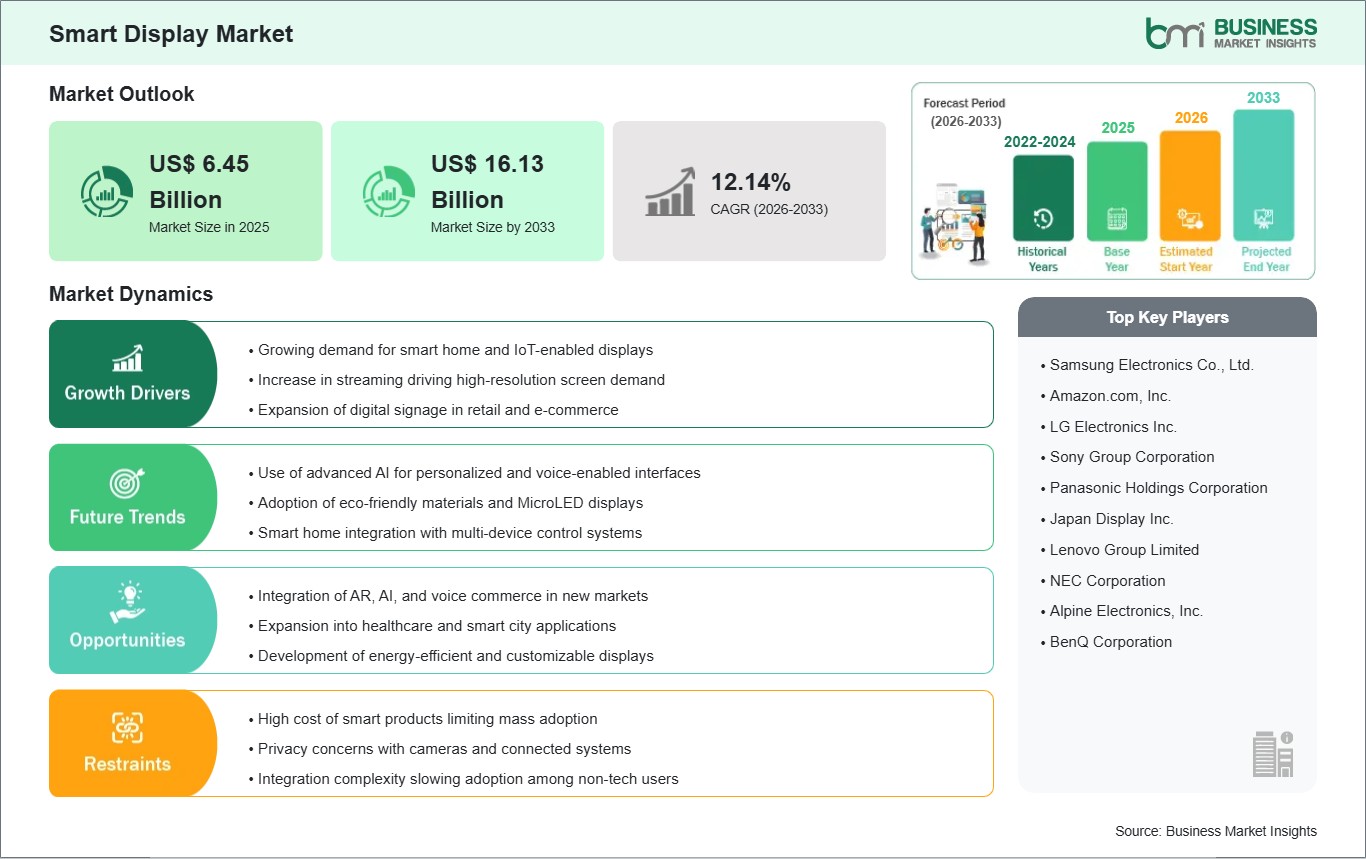
Smart displays have transitioned from niche smart home novelties to essential interactive hubs across residential and commercial landscapes. By integrating high-fidelity visual panels with sophisticated AI-driven voice assistants and IoT connectivity, these devices facilitate a seamless interface between users and their digital ecosystems. The market is propelled by a global surge in home automation, where consumers demand centralized control for security, lighting, and climate. Furthermore, the retail and healthcare sectors are adopting smart signage and bedside terminals to enhance customer engagement and patient care through real-time data visualization.
Despite robust growth, the market faces hurdles such as high procurement costs for premium Ultra High Definition (UHD) panels and persistent concerns regarding data security. As these devices often feature always-on microphones and cameras, manufacturers are increasingly focused on implementing edge-based AI processing to mitigate privacy risks. Opportunities abound in the automotive sector, where "pillar-to-pillar" cockpit displays and smart mirrors are becoming standard in electric vehicles. Additionally, the development of MicroLED and OLED technologies is expected to unlock new form factors, including foldable and transparent displays, driving the next wave of industry innovation.
Segment Analysis
Smart Display Market Segmentation
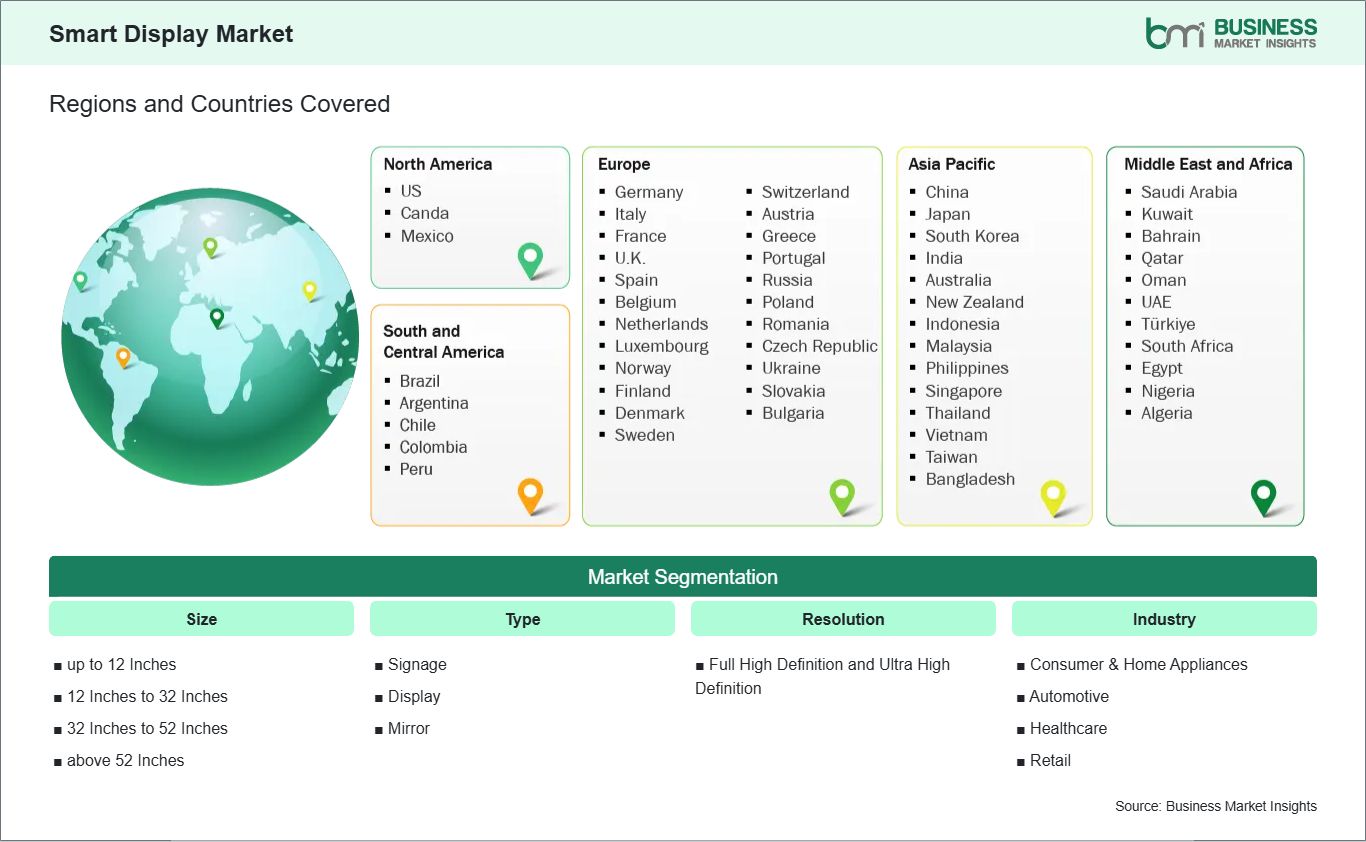
Key segments that contributed to the derivation of the Smart Display market analysis are size, type, resolution, and industry.
- By Size, the market is segmented into up to 12 Inches, above 12 Inches to 32 Inches, 32 Inches to 52 Inches, and above 52 Inches.
- By Type, the market is divided into Signage, Display, and Mirror.
- By Resolution, the market is categorized into Full High Definition (FHD) and Ultra High Definition (UHD).
- By Industry, the market is segmented into Consumer and Home Appliances, Automotive, Healthcare, and Retail.
Market Forces
Smart Display Market Drivers and Opportunities
Surging Global Adoption of AI-Integrated Smart Home Ecosystems
The proliferation of smart home ecosystems stands as the primary catalyst for the global smart display market. As households become increasingly interconnected, the smart display has evolved into the definitive command center for the Internet of Things (IoT). These devices offer more than just visual feedback; they serve as a multimodal interface where voice, touch, and gesture control converge. The integration of advanced virtual assistants like Amazon Alexa and Google Assistant has made these displays indispensable for managing security cameras, smart lighting, and energy systems.
Furthermore, the rise of the "Matter" protocol, a universal connectivity standard, is eliminating interoperability barriers, allowing consumers to mix and match devices from different brands within a single display interface. This standardization, coupled with the growing consumer desire for hands-free convenience in kitchens and home offices, is driving high-volume shipments. As generative AI continues to improve natural language processing, smart displays are becoming more proactive and conversational, further embedding them into the daily routines of millions of users worldwide, particularly in tech-savvy regions like North America and Western Europe.
Strategic Integration of Interactive Displays in Modern Retail
Retailers are fundamentally reimagining the physical shopping experience by deploying interactive smart displays to bridge the gap between e-commerce and brick-and-mortar stores. This digital transformation is driven by the need for frictionless customer journeys and personalized engagement. Smart signage and interactive kiosks allow consumers to browse extended inventories, access detailed product specifications, and even complete checkouts without human intervention. In the fashion and beauty sectors, the emergence of "Smart Mirrors" offers an innovative value proposition, enabling virtual try-ons through augmented reality (AR) and providing personalized styling recommendations based on AI analysis.
These high-tech installations not only enhance customer satisfaction but also provide retailers with invaluable data on consumer behavior and preferences. As global retail competition intensifies, the adoption of UHD and large-format displays for dynamic advertising has become a critical strategy for capturing consumer attention. The ability to update content remotely and in real-time allows for hyper-targeted marketing campaigns, ensuring that the smart display remains a cornerstone of the modern retail infrastructure, driving both foot traffic and digital-to-physical sales conversion.
Size and Share Analysis
Smart Display Market Size and Share Analysis
The smart display market demonstrates steady growth, with size and share analysis revealing evolving trends and competitive positioning among key players. The report further examines subsegments categorized within size, type, resolution, and industry, offering insights into their contribution to overall market performance.
Based on size, the Up to 12 Inches segment remains the volume leader in the segment, primarily used for bedside and kitchen smart hubs.
In terms of resolution, the Ultra High Definition (UHD) resolution is rapidly gaining share as production costs for 4K and 8K panels stabilize, making them accessible for premium consumer and medical-grade applications.
The Retail Industry currently commands a significant revenue share within the commercial sector, utilizing smart signage to replace traditional static posters.
Report Coverage
Smart Display Market Report Coverage and Deliverables
The "Smart Display Market Size and Forecast (2022 - 2033)" report provides a detailed analysis of the market covering below areas:
- Smart Display market size and forecast at global, regional, and country levels for all the key market segments covered under the scope
- Smart Display market trends, as well as market dynamics such as drivers, restraints, and key opportunities
- Smart Display market analysis covering key market trends, global and regional framework, major players, regulations, and recent market developments
- Industry landscape and competition analysis covering market concentration, heat map analysis, prominent players, and recent developments for the Smart Display market
- Detailed company profiles, including SWOT analysis
Geographic Insights
Smart Display Market Geographic Insights
The geographical scope of the Smart Display market is divided into five regions: North America, Asia Pacific, Europe, Middle East and Africa, and South and Central America.
The Asia-Pacific region holds the sigificant position in the market. This leadership is sustained by the presence of manufacturing giants in China, Japan, and South Korea, which control a significant portion of the global LCD and OLED supply chain. The region is witnessing an explosion in smart city initiatives and 5G infrastructure deployment, particularly in Southeast Asia, which facilitates the widespread use of IoT-connected displays.
North America follows as the second-largest market, characterized by the highest per-capita adoption of smart home devices and a mature retail sector that heavily utilizes UHD smart signage. Europe is expected to show steady growth, driven by stringent energy-efficiency regulations that favor the adoption of low-power LED and OLED smart displays in the automotive and industrial sectors. Meanwhile, emerging markets in the Middle East and Latin America are presenting new growth pockets through the expansion of luxury retail and modernizing healthcare infrastructure.
Industry Activity
Recent Developments
The smart display market is evaluated by gathering qualitative and quantitative data post primary and secondary research, which includes important corporate publications, association data, and databases. A few of the key developments in the smart display market are:
- In February 2026, at ISE 2026, LG Electronics showcases tailored B2B solutions that combine displays with software and AI for business settings such as hotels, control rooms, and drive-thrus. In the K-Culture zone, LG collaborated with leading Korean brands to recreate realistic retail spaces, demonstrating the versatility of the LG Business Cloud platform. LG introduced the integration of next-generation hardware, including the ultra-high-definition LG MAGNIT and ultra-low-power LG E-Paper. A spectacular entrance features a 4.2- by 5.6-meter LED tower and hanging transparent mesh (T-Mesh) LED to interpret Korean heritage through modern display technology.
- In January 2026, BenQ introduced the BenQ Board Pro RP05 and BenQ Board Master RM05 interactive displays. The two all-new series feature a 10 TOPS Neural Processing Unit (NPU) dedicated to AI workloads and BenQ AI, a suite of built-in AI tools designed to help educators create classroom experiences that are engaging, efficient, and conducive to learning.
Trust & Transparency
Research Methodology
The market analysis combines proprietary research with secondary data from government agencies, company disclosures, regulatory filings, industry databases and expert interviews. Market estimates are validated through data triangulation, cross-market benchmarking and analyst
review.
View Full Research Methodology
Key Sources Referred:
World Bank - Global Trade Indicators World Trade Organization (WTO) International Monetary Fund (IMF) International Trade Administration (ITA) Company Websites Company Annual Reports Company Investor Presentations