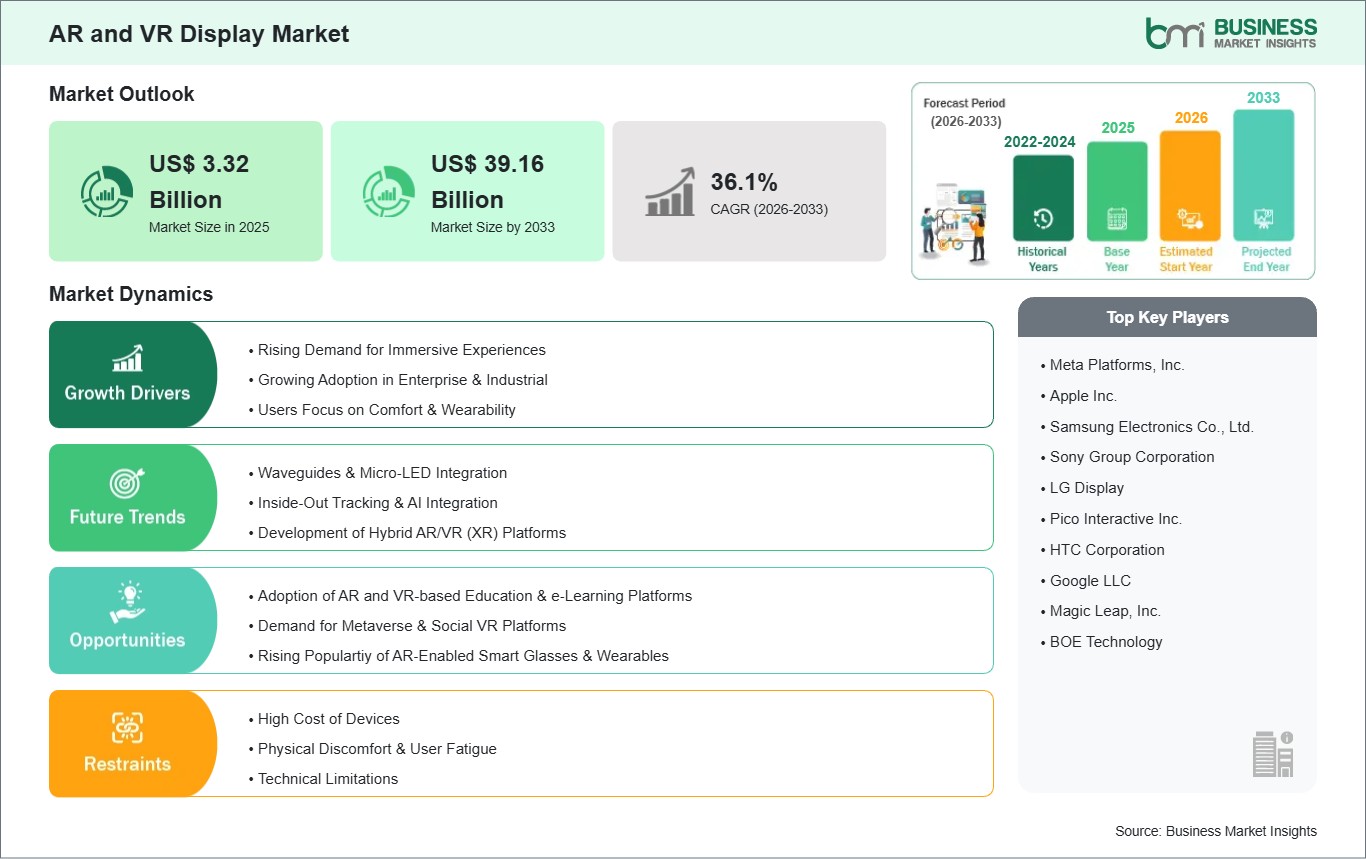
The AR and VR display market size is expected to reach US$ 39.16 billion by 2033 from US$ 3.32 billion in 2025. The market is estimated to record a CAGR of 36.1% from 2026 to 2033.
Augmented reality (AR) and virtual reality (VR) displays are transformative technologies that redefine human interaction with digital content. AR overlays digital information, such as images, videos, or 3D models, onto the real world, enhancing perception and interaction, while VR immerses users entirely in a computer-generated environment, creating a fully interactive simulated experience. These displays are widely used across industries, from gaming and entertainment to healthcare, education, manufacturing, and retail. In healthcare, AR assists in surgical visualization and medical training, while VR enables realistic simulations for skill development and therapy. The growing demand for immersive experiences in gaming, training, virtual meetings, and e-commerce drives the expansion of the AR and VR display market. Key factors fueling this growth include advancements in display resolution, sensor accuracy, and lightweight wearable designs, which enhance user comfort and visual quality. Additionally, the increasing adoption of smartphones, tablets, and AR/VR headsets, combined with supportive investments from technology companies, accelerates market penetration. Global interest in metaverse applications, remote collaboration tools, and interactive marketing further strengthens the demand. As consumers and enterprises seek more engaging, efficient, and interactive experiences, the AR and VR display market is expected to witness substantial growth worldwide in the coming years.

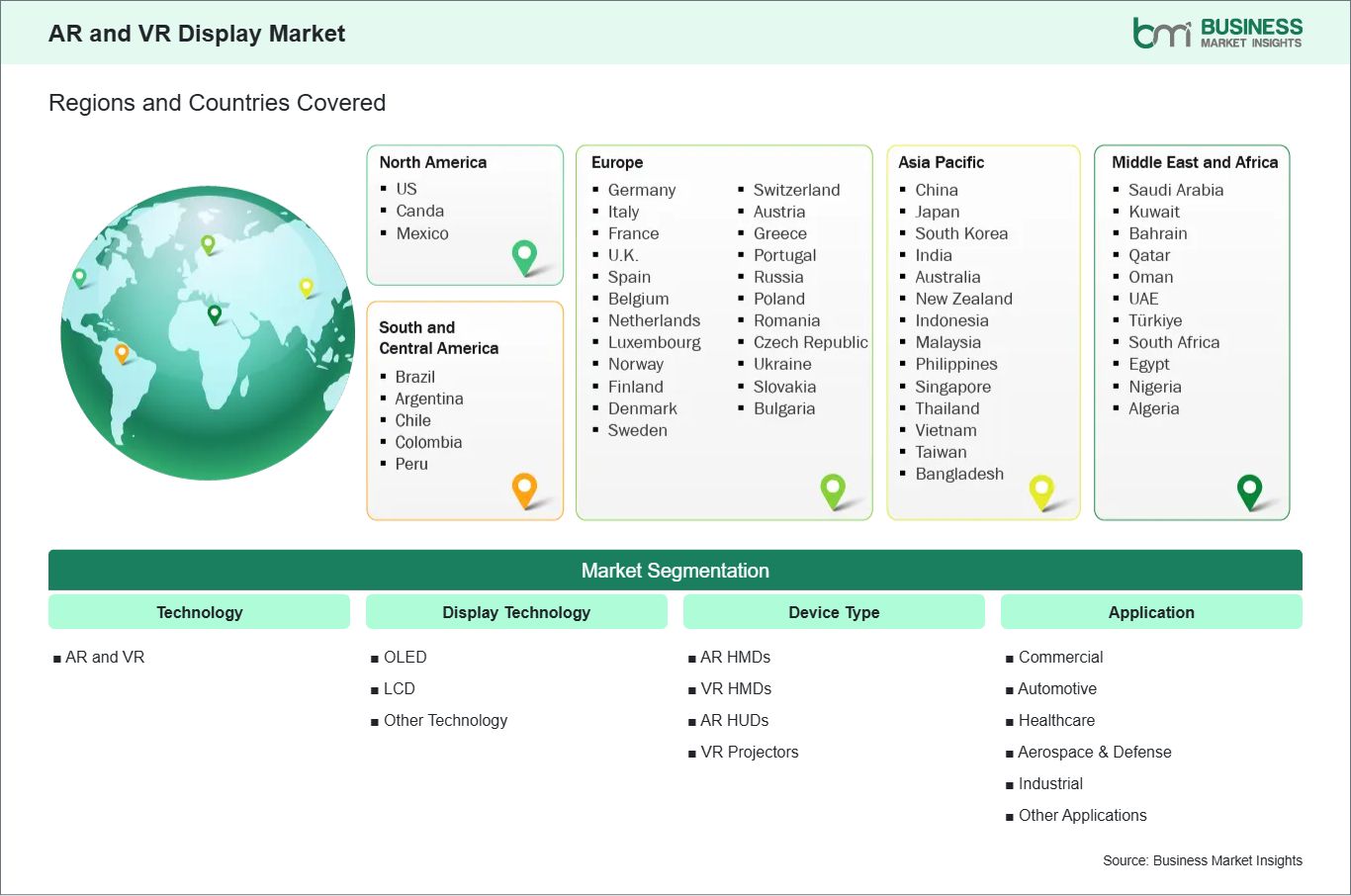
Key segments that contributed to the derivation of the AR and VR display market analysis are technology, display technology, device type, and application.
The rising demand for immersive experiences is a major driver of the AR and VR display market, as consumers increasingly seek more engaging and interactive ways to connect with digital content. Growth in gaming has been a particularly strong catalyst, with players expecting realistic graphics, smooth motion, and low-latency interactions, all of which require advanced display technologies. Similarly, the entertainment sector is embracing AR and VR for virtual concerts, 3D movies, and interactive storytelling, further pushing the need for high-resolution, wide-field-of-view displays. Virtual social interactions, including online meetings, virtual classrooms, and social VR platforms, are also expanding, creating demand for devices that deliver lifelike avatars, spatial audio, and immersive environments. As users prioritize realism and comfort, manufacturers are investing in higher pixel densities, improved refresh rates, and lightweight form factors, making the demand for immersive experiences a key growth engine for the AR/VR display market.
The adoption of AR and VR‑based education and e‑learning platforms is a significant driver of growth in the AR and VR display market because it fundamentally reshapes how learners interact with content, making remote and experiential education more engaging and effective. Immersive technologies allow students to visualize complex concepts in three dimensions, participate in virtual labs, and engage in interactive simulations that are not possible with traditional screens. This demand for richer educational experiences pushes institutions and e‑learning providers to invest in advanced AR/VR headsets and displays that offer higher resolution, wider fields of view, and comfortable long‑term wearability. In vocational training, AR overlays guide learners through hands‑on tasks, while VR scenarios replicate real‑world environments for safe, cost‑effective practice. As educational institutions, corporate training programs, and online platforms increasingly prioritize personalized and remote learning, they create sustained demand for improved AR/VR hardware. This broadens market adoption, incentivizes technological innovation, and accelerates economies of scale in the AR and VR display industry.
By technology, the market is segmented into AR and VR. The VR segment held the largest share of the market in 2025. The demand for VR is rising due to immersive experiences, advancements in hardware, growing gaming and entertainment sectors, remote collaboration needs, training applications, and increasing adoption in education, healthcare, real estate, and retail industries.
By display technology, the market is segmented into OLED, LCD, and others. The OLED segment held the largest share of the market in 2025. The demand for OLED is rising due to its superior contrast, faster response time, high color accuracy, flexible form factors, energy efficiency, and lightweight design, enhancing immersive experiences while enabling compact, high-performance wearable devices.
By device type, the market is divided into AR HMDs, VR HMDs, AR HUDs, and VR projectors. The VR HMDs segment held the largest share of the market in 2025. The demand for VR HMDs is rising due to growing adoption in gaming, training, and education, enhanced immersive experiences, advancements in display technology, decreasing device costs, and increasing interest from enterprises and consumers worldwide.
By application, the market is segmented into commercial, automotive, healthcare, aerospace & defense, industrial, and others. The aerospace & defense segment held the largest share of the market in 2025. The aerospace and defense industry increasingly adopts AR and VR displays due to enhanced pilot training, real-time mission simulation, improved maintenance efficiency, safer equipment testing, immersive situational awareness, and advanced design visualization, driving demand for these technologies.

| Report Attribute | Details |
|---|---|
| Market size in 2025 | US$ 3.32 Billion |
| Market Size by 2033 | US$ 39.16 Billion |
| Global CAGR (2026 - 2033) | 36.1% |
| Historical Data | 2022-2024 |
| Forecast period | 2026-2033 |
| Segments Covered | By Technology
|
|
Regions and Countries Covered
| |
| North America | US, Canada, Mexico |
| Europe | Belgium, Austria, Finland, Denmark, Greece, Poland, Romania, Russia, Ukraine, Czech Republic, Slovakia, Bulgaria, Italy, Luxembourg, Germany, Switzerland, France, Netherlands, Norway, Portugal, Spain, Sweden, United Kingdom |
| Asia-Pacific | Australia, China, India, Japan, South Korea, Indonesia, Malaysia, Philippines, Singapore, Thailand, Vietnam, Bangladesh, New Zealand, Taiwan |
| South and Central America | Brazil, Argentina, Peru, Chile, Colombia |
| Middle East and Africa | Bahrain, Kuwait, Oman, Qatar, Saudi Arabia, United Arab Emirates, Turkiye, South Africa, Egypt, Algeria, Nigeria |
| Market leaders and key company profiles |
|
The "AR and VR Display Market Size and Forecast (2022–2033)" report provides a detailed analysis of the market covering below areas:
The geographical scope of the AR and VR display market report is divided into five regions: North America, Asia Pacific, Europe, Middle East & Africa, and South & Central America. The AR and VR display market in Asia Pacific is expected to grow significantly during the forecast period.
The Asia Pacific AR and VR display market is segmented into China, Japan, South Korea, India, Australia, New Zealand, Indonesia, Malaysia, the Philippines, Singapore, Thailand, Vietnam, Taiwan, Bangladesh, and the Rest of Asia Pacific. The demand for AR and VR displays in the Asia Pacific region is rising rapidly due to several converging factors. First, the region has a booming technology adoption rate, with countries like China, Japan, South Korea, and India investing heavily in next-generation digital solutions. The growing gaming industry, along with increasing popularity of immersive entertainment experiences, is a major driver. Additionally, AR and VR are increasingly being integrated into sectors such as education, healthcare, retail, and real estate, enhancing training, virtual shopping, and remote learning, which boosts demand. Rising smartphone penetration, affordable VR/AR devices, and improved internet infrastructure also make these technologies more accessible. Moreover, government initiatives supporting digital innovation, coupled with the increasing interest of enterprises in using AR and VR for business operations and marketing, are further fueling market growth. Collectively, these factors position Asia Pacific as a leading hub for AR and VR expansion.

The AR and VR display market is evaluated by gathering qualitative and quantitative data post primary and secondary research, which includes important corporate publications, association data, and databases. A few of the key developments in the AR and VR display market are:
The AR and VR Display Market is valued at US$ 3.32 Billion in 2025, it is projected to reach US$ 39.16 Billion by 2033.
As per our report AR and VR Display Market, the market size is valued at US$ 3.32 Billion in 2025, projecting it to reach US$ 39.16 Billion by 2033. This translates to a CAGR of approximately 36.1% during the forecast period.
The AR and VR Display Market report typically cover these key segments-
The historic period, base year, and forecast period can vary slightly depending on the specific market research report. However, for the AR and VR Display Market report:
The AR and VR Display Market is populated by several key players, each contributing to its growth and innovation. Some of the major players include:
The AR and VR Display Market report is valuable for diverse stakeholders, including:
Essentially, anyone involved in or considering involvement in the AR and VR Display Market value chain can benefit from the information contained in a comprehensive market report.
Please tell us your area of interest
(Market Segments/ Regions and Countries/ Companies)