Display Material Market Outlook (2022–2033)

Historic Data: 2022-2024   |   Base Year: 2025   |   Forecast Period: 2026-2033
Report Content: Market Scope, Market Segmentation, Market Dynamics, and Competitive Analysis

Report Coverage:
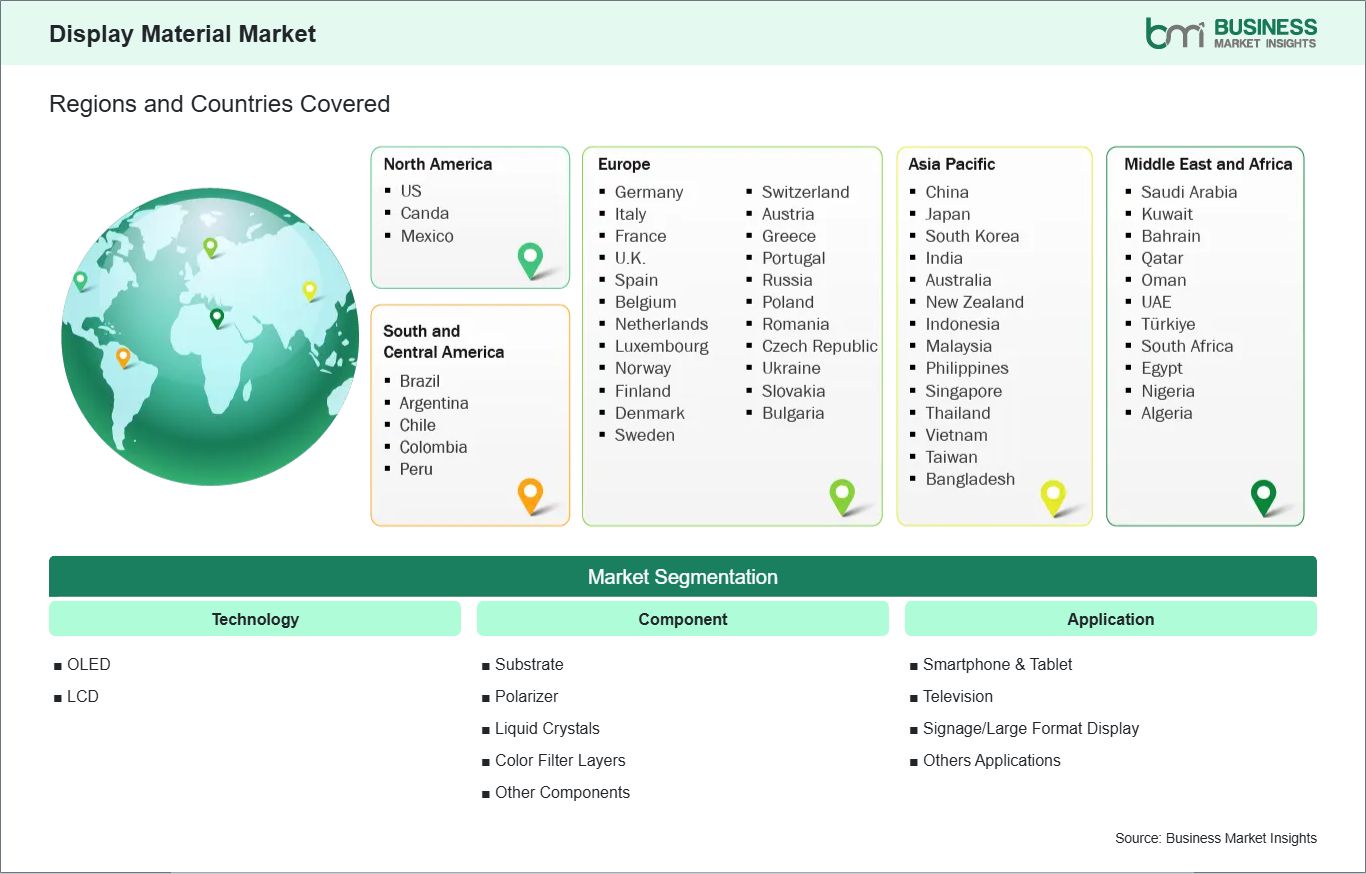
  • Technology (OLED, LCD)
  • Component (Substrate, Polarizer, Liquid Crystals, Color Filter Layers, Other Components)
  • Application (Smartphone & Tablet, Television, Signage/Large Format Display, Others Applications)

No. of Pages: 400
Report Code: BMIPUB00033593
Category: Electronics and Semiconductor
Display Material Market

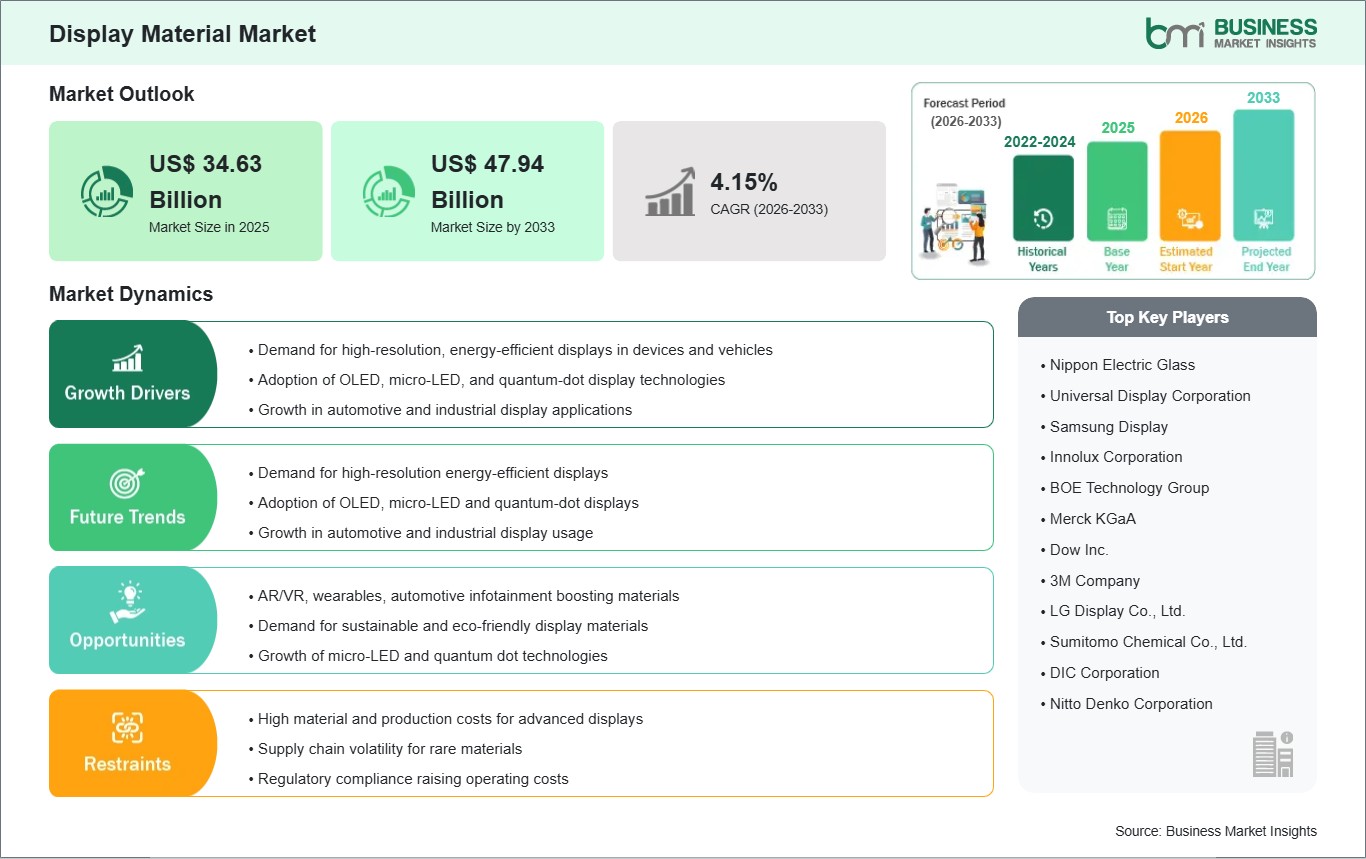
The Display Material size is expected to reach US$ 47.94 billion by 2033 from US$ 34.63 billion in 2025. The market is estimated to record a CAGR of 4.15% from 2026 to 2033.

Executive Summary and Global Market Analysis:

The Display Material Market encompasses the various materials, technologies, and solutions that are applied in the manufacture, improvement, and optimization of visual display devices. These materials are indispensable for use in TVs, monitors, smartphones, tablets, laptops, digital signage, automotive displays, wearable devices, and large, scale video walls. Display materials comprise various elements such as liquid crystals (for LCDs), organic light, emitting diodes (OLEDs), quantum dots, backlight units, thin, film transistors, polarizers, substrates, coatings, and touch panel materials. These components are crucial in influencing the displays brightness, color accuracy, contrast ratio, resolution, energy efficiency, and overall performance.

Display materials have a function beyond the making of displays, they also help in improving the visual experience, lowering power consumption, enhancing the lifespan of the display, and allowing for advanced features like flexible, transparent, or foldable screens. The market is observing a surge in the adoption of these materials and technologies across various sectors such as consumer electronics, automotive, healthcare, education, retail, and commercial signage where the demand for high, quality visual output is becoming an imperative factor for user engagement and operational efficiency.

Display Material Market - Strategic Insights:

global-market-strategic-framework
Get more information on this report

Display Material Market Segmentation Analysis:

Key segments that contributed to the derivation of the Display Material analysis are technology, wafer size, and application.

  • By Technology, the Display Material market is segmented into OLED, LCD. LCD segment held the largest share of the market in 2025.
  • By Component, the Display Material market is segmented into substrate, polarizer, liquid crystals, color filter layers, others. The polarizer segment held the largest share of the market in 2025.
  • By Application, the Display Material market is segmented into smartphone & tablet, television, signage/large format display, others. The smartphone & tablet segment held the largest share of the market in 2025.

Display Material Market Drivers and Opportunities:

Rising Adoption of Advanced Display Technologies

The rapid embracement of advanced display technologies such as OLED, microLED, quantum dot, and flexible displays is a major factor propelling the Display Material Market. These next generation technologies are increasingly being utilized in high, end smartphones, TVs, wearables, automotive displays, and other consumer electronics for their excellent color accuracy, contrast, energy saving, thinner form factor, and flexibility as compared to the traditional LCDs. Among the different display panels, the OLED ones now constitute the largest share of the premium device displays, and the shipments keep increasing every year as the main manufacturers use them for the flagship and the mid, range products. The desire for flexible and foldable screens is yet another reason for the increased materials demand since these displays require special substrates, encapsulation films, and organic compounds. Besides, the spread of digital devices and the consumers' demand for fantastic visual experiences are constant drivers of the need for high, performance display materials in different industries.

Expansion into AR/VR and Automotive Display Applications

A major opportunity for Display Material Market is to broaden the application of display materials beyond traditional consumer electronics to automotive and immersive technologies such as augmented reality (AR), virtual reality (VR), and head, mounted displays. These industries require materials of high resolution, low power consumption, light, weight, and ultra, mostly thin, thus creating fresh demand profiles for advanced compounds and substrates. To meet new demands, car manufacturers are equipping their vehicles with quite a few display devices integrated into dashboards, infotainment units, head, up displays, and digital clusters, which results in a rise of materials that must be capable of withstanding temperature variations, mechanical stress, and high durability standards. AR/VR devices, on the other hand, require display materials with extremely high brightness, pixel density, and color accuracy to provide hyper, realistic and deeply engaging experiences. As businesses deploy the next wave of wearable and mixed, reality technologies for games, training, health, and other uses, the suppliers of materials can come up with innovative and unique solutions meeting the needs of such newly emerging markets. Diversification brings a significant growth runway for the manufacturers of display materials on the global scale.

Display Material Market Size and Share Analysis:

By Technology, the Display Material market is segmented into OLED and LCD. LCD tech is dominating the market as it is used in almost all consumer electronics, TVs, laptops, smartphones, and in industrial displays. Most of the LCD components such as liquid crystals, polarizer, backlight unit, substrate, and thin film transistors can deliver dependable performance, offer high resolution, and are energy efficient, thus they can be used in various fields. Among other things, the cost, efficiency of LCD technology, the maturity of its production processes, and its compatibility with large, format displays have also helped its popularity, making it a reliable option for commercial and consumer applications. Meanwhile, OLED technology is quickly becoming popular because of its features which are a step ahead of the other technologies, such as extremely high contrast ratios, vivid colors, ultra, thin and light display panels, flexible and curved or foldable screens manufacturers' creativity knows no bounds. The main OLED working materials to mention are organic emissive layers, substrates, encapsulation materials, and electrodes which together allow to produce energy, efficient displays with extremely fast response times and wider viewing angles.

By Component, the Display Material market is segmented as on-premises, cloud.  Polarizers hold the biggest market share as they are the most important components for light control, contrast improvement, image clarity enhancement, and ensuring the best viewing angles in both LCD and OLED types of displays. Top, grade polarizers largely determine display performance, color fidelity, and energy saving, thus they are indispensable for consumer electronics, televisions, monitors, smartphones, automotive displays, and digital signage. Liquid Crystals continue to be a significant component, especially for LCD technology, as they control light to form images of high resolution, brightness, and contrast. Substrates such as glass and flexible polymers, in fact, are the structural support and durability, while Color Filter Layers enable accurate color reproduction and attractive visuals, which are indispensable for high, definition and professional displays.

By Application, the Display Material market is segmented as smartphone & tablet, television, signage/large format display, others. Smartphone & Tablet applications occupy the leading position in the market share, this is mainly due to the rapid proliferation of mobile devices in the hands of consumers, growing consumer demand for high resolution displays, and the fact that manufacturers want to make energy, efficient, compact, and lightweight screens. Display materials in smartphones and tablets such as polarizers, substrates, liquid crystals, and OLED layers are key in providing clear visuals, rich colors, wide viewing angles, and touch response, thus these gadgets are the main growth engine of the market. Televisions are another major segment supported by the adoption of HD, 4K, and 8K display technologies and the increased consumer demand for OLED and quantum, dot displays that deliver excellent color reproduction and level of contrast.

Display Material Market Report Highlights:

Report Attribute Details
Market size in 2025 US$ 34.63 Billion
Market Size by 2033 US$ 47.94 Billion
Global CAGR (2026 - 2033)4.15%
Historical Data 2022-2024
Forecast period 2026-2033
Segments Covered By Technology
  • OLED
  • LCD
By Component
  • Substrate
  • Polarizer
  • Liquid Crystals
  • Color Filter Layers
  • Other Components
By Application
  • Smartphone & Tablet
  • Television
  • Signage/Large Format Display
  • Others Applications
Regions and Countries Covered
North America US, Canada, Mexico
Europe Belgium, Austria, Finland, Denmark, Greece, Poland, Romania, Russia, Ukraine, Czech Republic, Slovakia, Bulgaria, Italy, Luxembourg, Germany, Switzerland, France, Netherlands, Norway, Portugal, Spain, Sweden, United Kingdom
Asia-Pacific Australia, China, India, Japan, South Korea, Indonesia, Malaysia, Philippines, Singapore, Thailand, Vietnam, Bangladesh, New Zealand, Taiwan
South and Central America Brazil, Argentina, Peru, Chile, Colombia
Middle East and Africa Bahrain, Kuwait, Oman, Qatar, Saudi Arabia, United Arab Emirates, Turkiye, South Africa, Egypt, Algeria, Nigeria
Market leaders and key company profiles
  • Nippon Electric Glass
  • Universal Display Corporation
  • Samsung Display
  • Innolux Corporation
  • BOE Technology Group
  • Merck KGaA
  • Dow Inc.
  • 3M Company
  • LG Display Co., Ltd.
  • Sumitomo Chemical Co., Ltd.
Get more information on this report

Display Material Market Report Coverage and Deliverables:

The "Display Material Size and Forecast (2022 - 2033)" report provides a detailed analysis of the market covering below areas:

  • Display Material size and forecast at global, regional, and country levels for all the key market segments covered under the scope
  • Display Material trends, as well as market dynamics such as drivers, restraints, and key opportunities
  • Display Material analysis covering key market trends, global and regional framework, major players, regulations, and recent market developments
  • Industry landscape and competition analysis covering market concentration, heat map analysis, prominent players, and recent developments for the Display Material
  • Detailed company profiles, including SWOT analysis

Display Material Market Geographic Insights:

The geographical scope of the Display Material report is divided into five regions: North America, Asia Pacific, Europe, the Middle East & Africa, and South & Central America.

The Asia Pacific region leads the Display Material Market as it houses major electronics manufacturing hubs in China, South Korea, Japan, and Taiwan. These places are the homes of leading display panel producers and material suppliers. The massive consumer electronics demand such as smartphones, TV, and wearables in these countries pushes a substantial amount of material consumption and innovation. North America and Europe are also important markets influenced by high demand for automotive displays, AR/VR devices, and top consumer products. On the other hand, emerging markets in Latin America and Middle East & Africa are slowly embracing display technologies, thus, opening new growth opportunities. Variations in regional infrastructure, production, and R&D investments impact the adoption rate, with Asia, Pacific still dominating due to the scale, cost advantages, and established supply chains.

global-market-geography
Get more information on this report

Display Material Market Research Report Guidance:

  • The report includes qualitative and quantitative data in the Display Material across technology, wafer size, application and geography.
  • The report starts with the key takeaways (chapter 2), highlighting the key trends and outlook of the Display Material.
  • Chapter 3 includes the research methodology of the study.
  • Chapter 4 further includes ecosystem analysis.
  • Chapter 5 highlights the major industry dynamics in the Display Material, including factors that are driving the market, prevailing deterrents, potential opportunities, as well as future trends. Impact analysis of these drivers and restraints is also covered in this section.
  • Chapter 6 discusses the Display Material scenario, in terms of historical market revenues, and forecast till the year 2031.
  • Chapters 7 to 10 cover Display Material segments by type, deployment, industry and geography across North America, Europe, Asia Pacific, Middle East and Africa, and South and Central America. They cover the market volume revenue forecast and factors driving the market.
  • Chapter 11 describes the competitive analysis along with the heat map analysis for the key players operating in the market.
  • Chapter 12 describes the industry landscape analysis. It provides detailed descriptions of business activities such as market initiatives, new developments, mergers, and joint ventures globally, along with a competitive landscape.
  • Chapter 13 provides detailed profiles of the major companies operating in the Display Material. Companies have been profiled on the basis of their key facts, business descriptions, products and services, financial overview, SWOT analysis, and key developments.
  • Chapter 14, i.e., the appendix is inclusive of a brief overview of the company, list of abbreviations, and disclaimer.

Display Material Market News and Key Development:

The Display Material is evaluated by gathering qualitative and quantitative data post primary and secondary research, which includes important corporate publications, association data, and databases. A few of the key developments in the Display Material are:

  • In January 2026, Samsung Electronics announced the global launch of the 13-inch Samsung Color E-Paper (EM13DX model), expanding its Color E-Paper lineup with the world’s first display designed with a bio-resin housing derived from phytoplankton. The paper‑thin display uses advanced digital ink technology and ultra‑low power to offer businesses a practical alternative to traditional printed signage.
  • In January 2026, Titan Intech Limited, a prominent player in Embedded Manufacturing Services (EMS) providing OEM/ODM solutions and sophisticated embedded systems, unveiled UltraLED Displays, its new high-end LED display brand. This launch highlights Titan Intech’s ongoing commitment to enhancing its in-house display technology expertise, aligning with India’s push to strengthen its domestic electronics manufacturing sector. With the introduction of UltraLED Displays, the company is expanding beyond mere assembly and distribution to take ownership of core LED display technologies and products.

Key Sources Referred:

  • Video Electronics Standards Association (VESA)
  • Society for Information Display (SID)
  • International Committee for Display Metrology (ICDM)
  • Taiwan Display Union Association (TDUA)
  • European Photonics Industry Consortium (EPIC)
  • American National Standards Institute (ANSI)
  • Company Annual Reports
  • Company Investor Presentations
The List of Companies - Display Material Market
  • <p>Nippon Electric Glass
  • Universal Display Corporation
  • Samsung Display
  • Innolux Corporation
  • BOE Technology Group
  • Merck KGaA
  • Dow Inc.
  • 3M Company
  • LG Display Co., Ltd.
  • Sumitomo Chemical Co., Ltd.
  • DIC Corporation
  • Nitto Denko Corporation
  • Toray Industries
  • Corning Incorporated
  • Asahi Glass Co., Ltd.
  • Idemitsu Kosan Co., Ltd.
  • AU Optronics Corp.
  • Sharp Corporation
  • Japan Display Inc.
  • Tianma Microelectronics Co., Ltd.
  • Visionox Technology Inc.
  • E Ink Holdings Inc.
  • Nanoco Group plc
  • Nanosys Inc.
  • Quantum Materials Corp
  • Suzhou Xingshuo Nano Technology Co., Ltd.
  • Najing Tech
  • Xingzi New Material Technology Development Co., Ltd</p>
Frequently Asked Questions
How big is the Display Material Market?

The Display Material Market is valued at US$ 34.63 Billion in 2025, it is projected to reach US$ 47.94 Billion by 2033.

What is the CAGR for Display Material Market by (2026 - 2033)?

As per our report Display Material Market, the market size is valued at US$ 34.63 Billion in 2025, projecting it to reach US$ 47.94 Billion by 2033. This translates to a CAGR of approximately 4.15% during the forecast period.

What segments are covered in this report?

The Display Material Market report typically cover these key segments-

  • Technology (OLED, LCD)
  • Component (Substrate, Polarizer, Liquid Crystals, Color Filter Layers, Other Components)
  • Application (Smartphone & Tablet, Television, Signage/Large Format Display, Others Applications)

What is the historic period, base year, and forecast period taken for Display Material Market?

The historic period, base year, and forecast period can vary slightly depending on the specific market research report. However, for the Display Material Market report:

  • Historic Period : 2022-2024
  • Base Year : 2025
  • Forecast Period : 2026-2033
  • Who are the major players in Display Material Market?

    The Display Material Market is populated by several key players, each contributing to its growth and innovation. Some of the major players include:

  • Nippon Electric Glass
  • Universal Display Corporation
  • Samsung Display
  • Innolux Corporation
  • BOE Technology Group
  • Merck KGaA
  • Dow Inc.
  • 3M Company
  • LG Display Co., Ltd.
  • Sumitomo Chemical Co., Ltd.
  • DIC Corporation
  • Nitto Denko Corporation
  • Toray Industries
  • Corning Incorporated
  • Asahi Glass Co., Ltd.
  • Idemitsu Kosan Co., Ltd.
  • AU Optronics Corp.
  • Sharp Corporation
  • Japan Display Inc.
  • Tianma Microelectronics Co., Ltd.
  • Visionox Technology Inc.
  • E Ink Holdings Inc.
  • Nanoco Group plc
  • Nanosys Inc.
  • Quantum Materials Corp
  • Suzhou Xingshuo Nano Technology Co., Ltd.
  • Najing Tech
  • Xingzi New Material Technology Development Co., Ltd
  • Who should buy this report?

    The Display Material Market report is valuable for diverse stakeholders, including:

    • Investors: Provides insights for investment decisions pertaining to market growth, companies, or industry insights. Helps assess market attractiveness and potential returns.
    • Industry Players: Offers competitive intelligence, market sizing, and trend analysis to inform strategic planning, product development, and sales strategies.
    • Suppliers and Manufacturers: Helps understand market demand for components, materials, and services related to concerned industry.
    • Researchers and Consultants: Provides data and analysis for academic research, consulting projects, and market studies.
    • Financial Institutions: Helps assess risks and opportunities associated with financing or investing in the concerned market.

    Essentially, anyone involved in or considering involvement in the Display Material Market value chain can benefit from the information contained in a comprehensive market report.

    Available Report Formats

    pdf-format excel-format pptx-format
    Buy Now
    Customization Form

    Please tell us your area of interest
    (Market Segments/ Regions and Countries/ Companies)