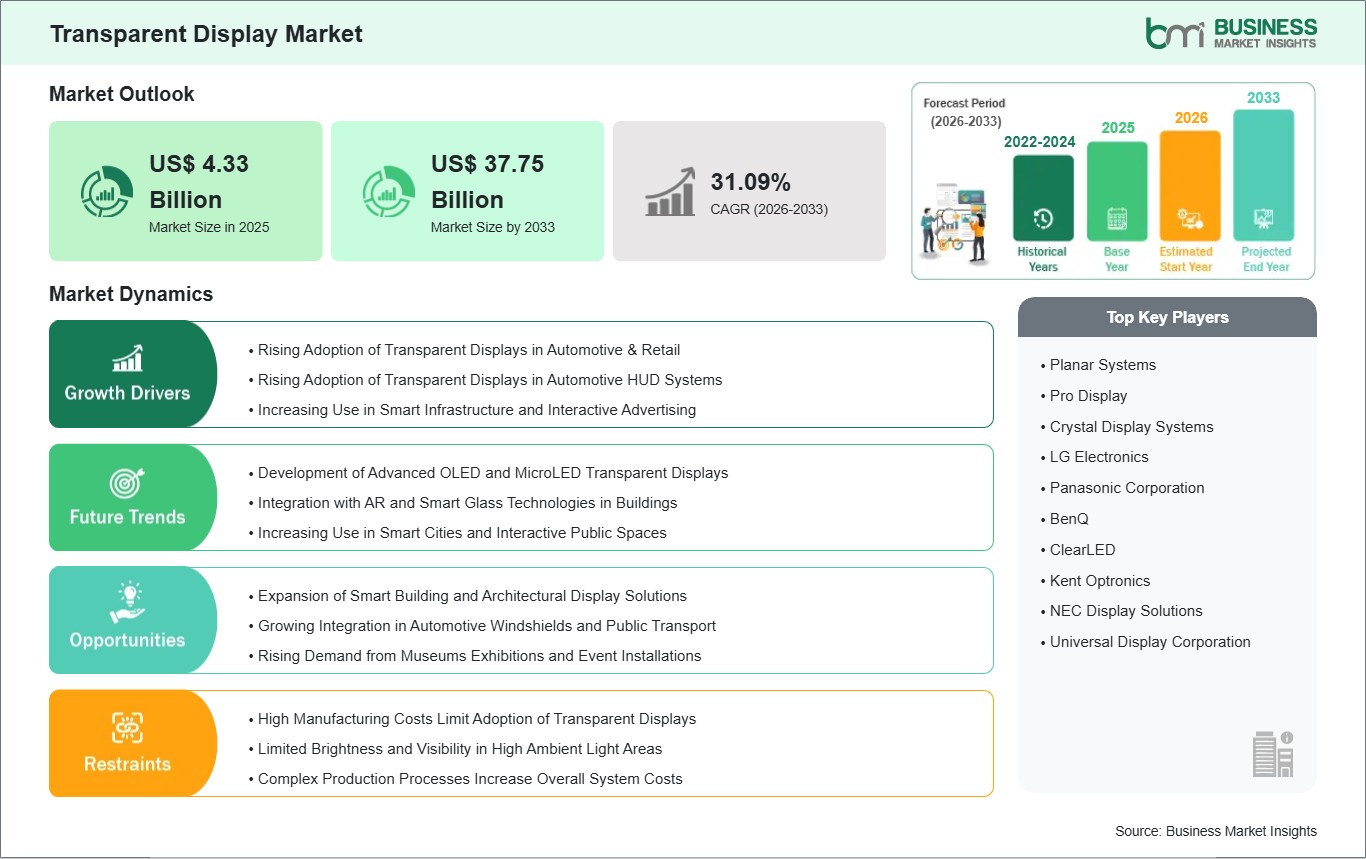
The Transparent Display Market size is expected to reach US$ 37.75 billion by 2033 from US$ 4.33 billion in 2025. The market is estimated to record a CAGR of 31.09% from 2026 to 2033.
The transparent display market continues to expand at a rapid pace globally as both businesses and customers look for new ways to create immersive, interactive visual experiences that combine digital content with the real world. Transparent displays provide an opportunity for users to view dynamic digital content but will still be able to see objects located behind the screen when using the product. This technology is on the rise in a variety of industries such as automotive, retail, aerospace, hospitality and consumer electronics. In the retail industry, companies are utilizing transparent displays to develop attention-grabbing retail windows and to create engaging experiences inside stores to enhance customer engagement. Combined with digital messaging, transparent displays allow for products to be visible while simultaneously communicating information through digital signage.
For example, in the automotive industry, transparent display technology is becoming an essential element of modern Head Up Displays (HUD) and smart dashboards. These technologies can display navigation, safety alerts or vehicle information on the driver's line of sight. The rapid advancement of display technology such as OLED and micro-LED is fueling the enormous growth of the transparent display market driven by their ability to provide higher brightness levels, increased levels of transparency and greater design shape flexibility. As a result of these advancements, manufacturers are able to produce larger and more visually impressive installations using transparent display technologies.
In addition, the increasing trend toward developing smart buildings and the growing number of interactive public display installations are creating a greater demand for transparent display screens to be utilized in commercial spaces and at transportation hubs. However, the market faces challenges. High production costs for advanced transparent panels and technical issues related to outdoor visibility in bright light can limit large-scale adoption, particularly in emerging markets where cost is a concern. As manufacturers continue to innovate and improve production, transparent displays are expected to become important in high-value sectors. They will play a crucial role in next-generation user interfaces and immersive digital environments worldwide.

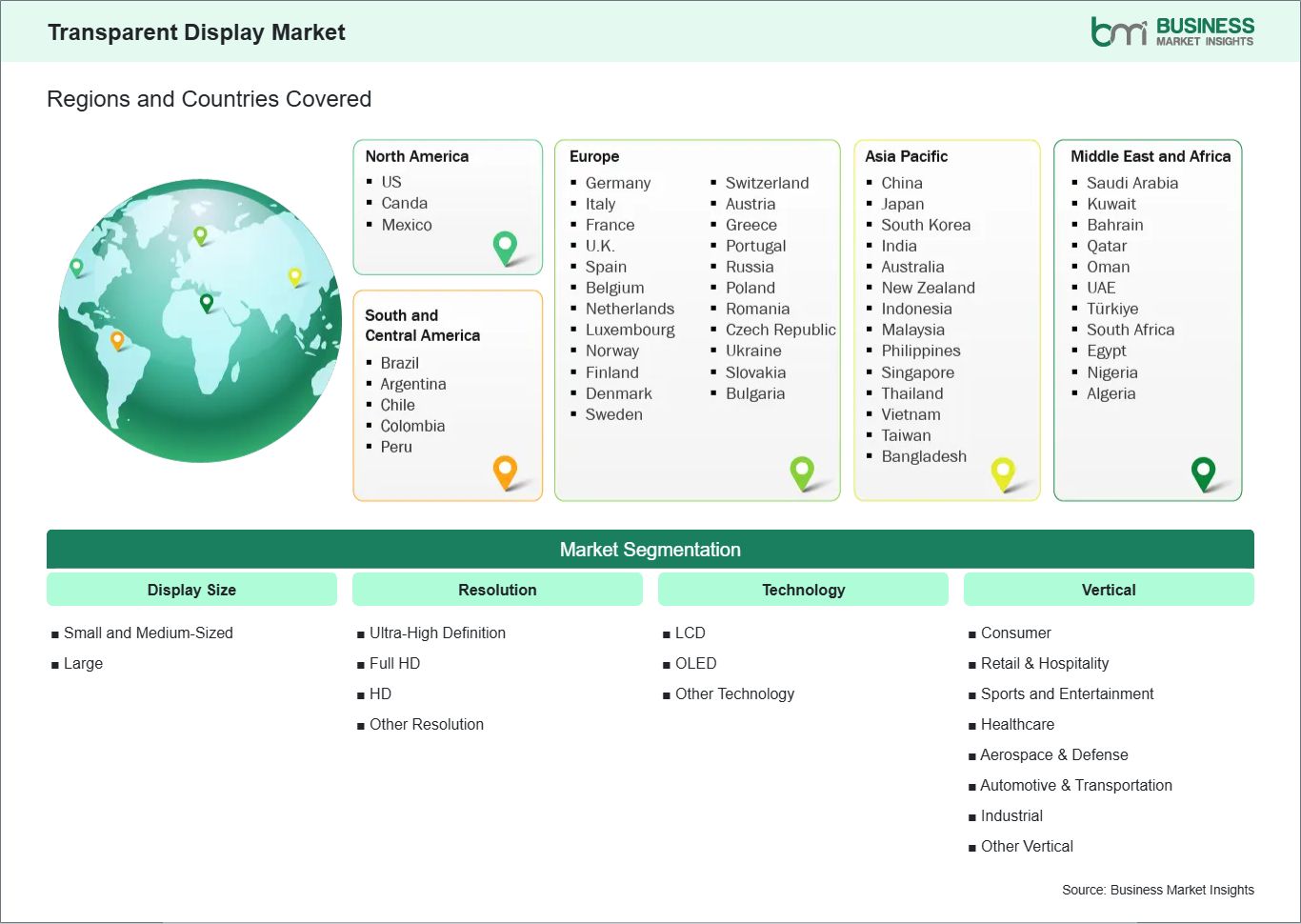
Key segments that contributed to the derivation of the transparent display market analysis are display size, resolution, technology, vertical and product.
The automotive and retail industries are paying extensive attention to the global transparent display with changes in consumer expectations to create seamless digital integration. For the automotive sector, car manufacturers are beginning to use transparent displays in head-up displays (HUDs), as well as in smart cockpit systems to enhance safety, navigation, and driver assistance. Major OEMs in North America and Europe are leading this initiative through the use of transparent display systems by placing real-time data within the driver’s forward line of sight to reduce distraction and enhance situational awareness. This trend will also affect next-generation mobility systems that provide electric and autonomous vehicles with improved contextual awareness through transparent displays.
In retail, transparent display systems are being utilized across the world to enhance engagement and tell stories to customers. Retailers in flagship stores located in the Asia Pacific and North American regions are currently testing the efficacy of transparent OLED window screens where passersby will be able to see products behind a piece of glass while also observing digital promotional content that is superimposed over the product. As a result of this dual-visibility experience, it will allow retailers to seamlessly mix physical products with interactive messages thereby allowing customers to spend more time in the store and enhance their exploration of the store. Luxury brands and fashion retailers in the European region are also utilizing the technology of transparent display systems for the creation of visually impactful displays that are in sync with their seasonal marketing campaigns and provide consumers with an immersive brand experience.
Smart building initiatives occurring around the globe have changed the way in which transparent displays are used in architectural and informational environments. In Asia Pacific’s commercial towers, the use of transparent display panels embedded into glass partition walls and digital info walls allow for the delivery of real-time wayfinding and environmental data as well as building notifications without blocking natural light or changing the architectural aesthetics. These installations support occupant experience strategies that create convenience, sustainability, and visual comfort within high-end commercial real estate developments.
Europe is seeing transparent display technology used within cultural institutions and public infrastructure like museums and airports where architectural transparency and digital wayfinding converge. Curated digital exhibits utilize transparent display technology to create a contextual layer of content visible through the use of transparent display technology while maintaining the same spatial integrity and design intent of these spaces by providing contextual content that is visible behind the transparent display. Ultimately, such deployments illustrate how transparent displays provide both an information and experience-based function while not impacting a structure's aesthetic or functional design.
The transparent display market demonstrates steady growth, with size and share analysis highlighting evolving trends and competitive dynamics among key players. The report examines subsegments categorized within display size, resolution, technology, vertical and product, offering insights into their contribution to overall market performance.
By display size, the small and medium-sized subsegment dominated the market in 2025, driven by its widespread adoption in compact and wearable displays where cost-effectiveness and ease of integration are crucial.
Based on resolution, the full HD subsegment dominated the market in 2025, driven by its optimal balance of visual clarity and affordability, making it suitable for most commercial and consumer applications.
Based on technology, the LCD subsegment dominated the market in 2025, driven by its mature manufacturing ecosystem, low production cost, and versatility across multiple transparent display applications.
Based on vertical, the automotive & transportation subsegment dominated the market in 2025, driven by the rising integration of head-up displays (HUDs) and transparent interfaces in vehicles to improve safety and user experience.
In terms of product, the touchless biometric equipment and others subsegment dominated the market in 2025, driven by its critical role in projecting essential information directly into the driver’s line of sight, making it indispensable in modern vehicles.
| Report Attribute | Details |
|---|---|
| Market size in 2025 | US$ 4.33 Billion |
| Market Size by 2033 | US$ 37.75 Billion |
| Global CAGR (2026 - 2033) | 31.09% |
| Historical Data | 2022-2024 |
| Forecast period | 2026-2033 |
| Segments Covered | By Display Size
|
|
Regions and Countries Covered
| |
| North America | US, Canada, Mexico |
| Europe | Belgium, Austria, Finland, Denmark, Greece, Poland, Romania, Russia, Ukraine, Czech Republic, Slovakia, Bulgaria, Italy, Luxembourg, Germany, Switzerland, France, Netherlands, Norway, Portugal, Spain, Sweden, United Kingdom |
| Asia-Pacific | Australia, China, India, Japan, South Korea, Indonesia, Malaysia, Philippines, Singapore, Thailand, Vietnam, Bangladesh, New Zealand, Taiwan |
| South and Central America | Brazil, Argentina, Peru, Chile, Colombia |
| Middle East and Africa | Bahrain, Kuwait, Oman, Qatar, Saudi Arabia, United Arab Emirates, Turkiye, South Africa, Egypt, Algeria, Nigeria |
| Market leaders and key company profiles |
|
The "Transparent Display Market Size and Forecast (2022 - 2033)" report provides a detailed analysis of the market covering below areas:
The geographical scope of the Transparent Display Market report is divided into North America, Asia Pacific, Europe, Middle East & Africa, and South & Central America. North America held the largest share in 2025.
The Transparent Display Market demonstrates strong regional variations, with North America emerging as the dominant region driven by high adoption of automotive head-up displays (HUDs), advanced retail digital signage, and substantial investments in AR-enabled and smart display technologies.
The United States, in particular, benefits from a mature technological ecosystem, extensive R&D activities, and early adoption across automotive, consumer electronics, and commercial sectors, making it the largest contributor to revenue in the region.
In the Asia Pacific, the market is witnessing rapid growth due to large-scale manufacturing capabilities in China, Japan, and South Korea, coupled with increasing deployment of smart retail displays, automotive HUDs, and urban digital infrastructure projects. Cost-effective production and rising urbanization in these countries further support the adoption of transparent displays.
Europe maintains a steady market presence, led by Germany, France, and the U.K., driven by luxury retail modernization, automotive innovations, and integration into smart buildings, with a strong focus on energy-efficient and sustainable display technologies.
The Middle East & Africa market is gradually expanding, primarily through high-end retail, hospitality, and airport installations where transparent displays are used for premium customer engagement and information presentation.
Meanwhile, South & Central America represents a developing market where growing urbanization, modernization of retail environments, and increasing awareness of interactive display solutions are fueling adoption, particularly in Brazil and Mexico.
Overall, the global transparent display market is characterized by North America leading in technological deployment and commercial adoption, Asia Pacific driving volume through manufacturing and rapid integration, Europe emphasizing innovation and sustainability, and emerging regions such as the Middle East & Africa and South & Central America providing new growth opportunities as the market continues to expand. This regional diversity highlights both mature and high-growth areas, positioning the transparent display industry for broad global expansion.

The Transparent Display Market is evaluated by gathering qualitative and quantitative data post primary and secondary research, which includes important corporate publications, association data, and databases. A few of the key developments in the transparent display market are:
The Transparent Display Market is valued at US$ 4.33 Billion in 2025, it is projected to reach US$ 37.75 Billion by 2033.
As per our report Transparent Display Market, the market size is valued at US$ 4.33 Billion in 2025, projecting it to reach US$ 37.75 Billion by 2033. This translates to a CAGR of approximately 31.09% during the forecast period.
The Transparent Display Market report typically cover these key segments-
The historic period, base year, and forecast period can vary slightly depending on the specific market research report. However, for the Transparent Display Market report:
The Transparent Display Market is populated by several key players, each contributing to its growth and innovation. Some of the major players include:
The Transparent Display Market report is valuable for diverse stakeholders, including:
Essentially, anyone involved in or considering involvement in the Transparent Display Market value chain can benefit from the information contained in a comprehensive market report.
Please tell us your area of interest
(Market Segments/ Regions and Countries/ Companies)