Market Summary
Executive Summary and Global Market Analysis
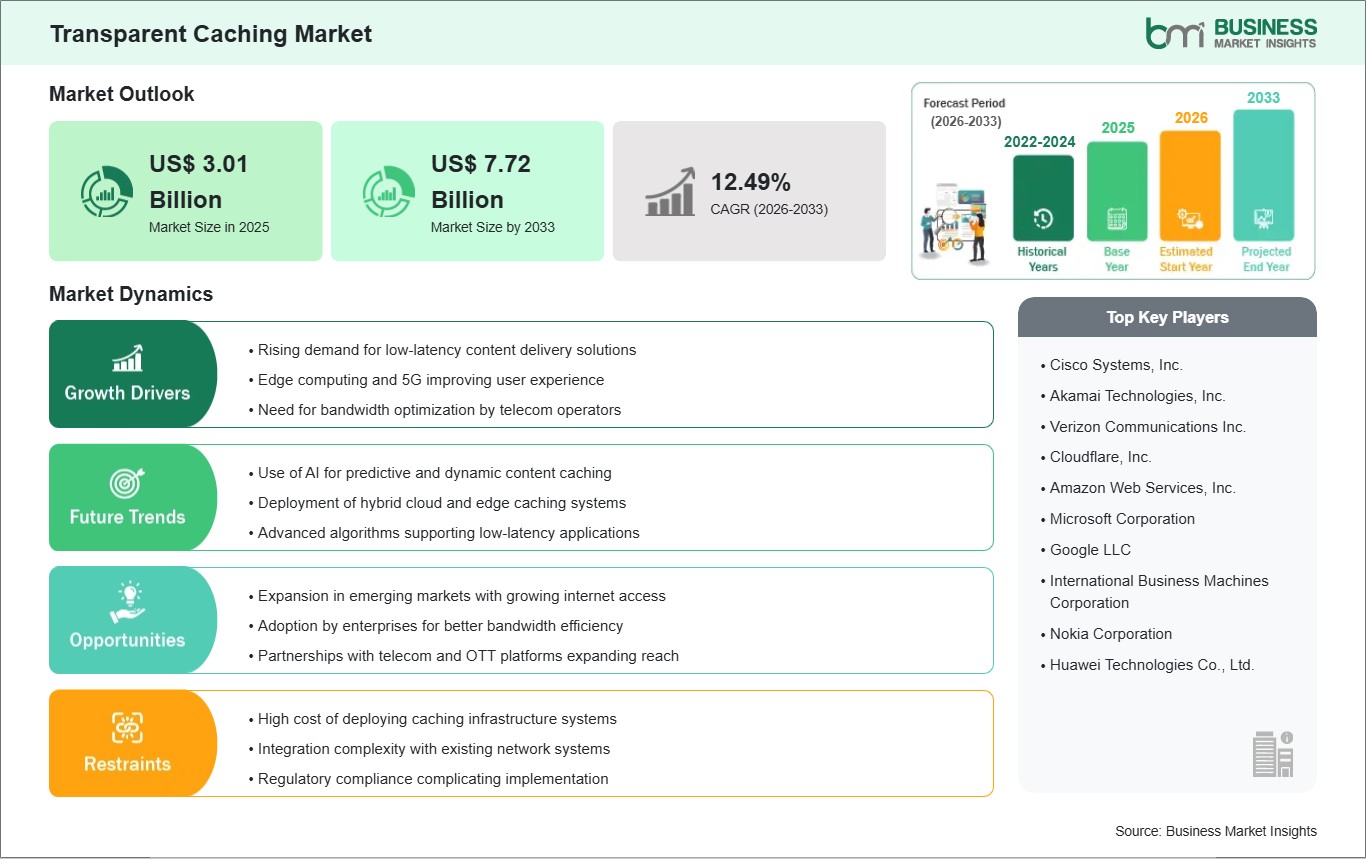
Transparent caching represents a transformative network optimization technology that intercepts and stores frequently requested digital content at the network edge, delivering it to end-users without requiring client-side configuration or content provider intervention. In the current 2026 landscape, these solutions have evolved from peripheral accelerators into essential infrastructure components that alleviate the immense strain on backhaul links and origin servers caused by the global data explosion. By localizing content delivery, transparent caching significantly reduces round-trip latency and minimizes IP transit costs for service providers, ensuring a high-fidelity Quality of Experience (QoE) for bandwidth-intensive applications.
However, the industry faces significant technical and operational hurdles. The widespread adoption of end-to-end encryption (HTTPS/TLS) and advanced protocols like QUIC has increased the complexity of content inspection, necessitating sophisticated SSL/TLS termination capabilities. Furthermore, integration complexity remains a critical restraint, as 47% of organizations identify interoperability with diverse legacy network architectures and multi-vendor environments as a primary barrier to deployment. High initial capital expenditures for hardware-intensive solutions and stringent data privacy regulations, such as GDPR and CCPA, further complicate localized data storage strategies.
Despite these deterrents, the market is rife with lucrative opportunities. The ongoing global transition to 5G Standalone (SA) and initial 6G research has created a "sensing-to-delivery" imperative, where ultra-low latency is non-negotiable. The emergence of AI-driven predictive caching—capable of analyzing regional consumption patterns to pre-fetch viral content during off-peak hours offers a specialized avenue for vendors to provide high-value, automated network management. Additionally, the shift toward software-defined and cloud-native caching architectures provides a scalable, cost-effective alternative to proprietary hardware, positioning transparent caching as a cornerstone of the modern, hyper-connected digital economy.
Segment Analysis
Transparent Caching Market Segmentation
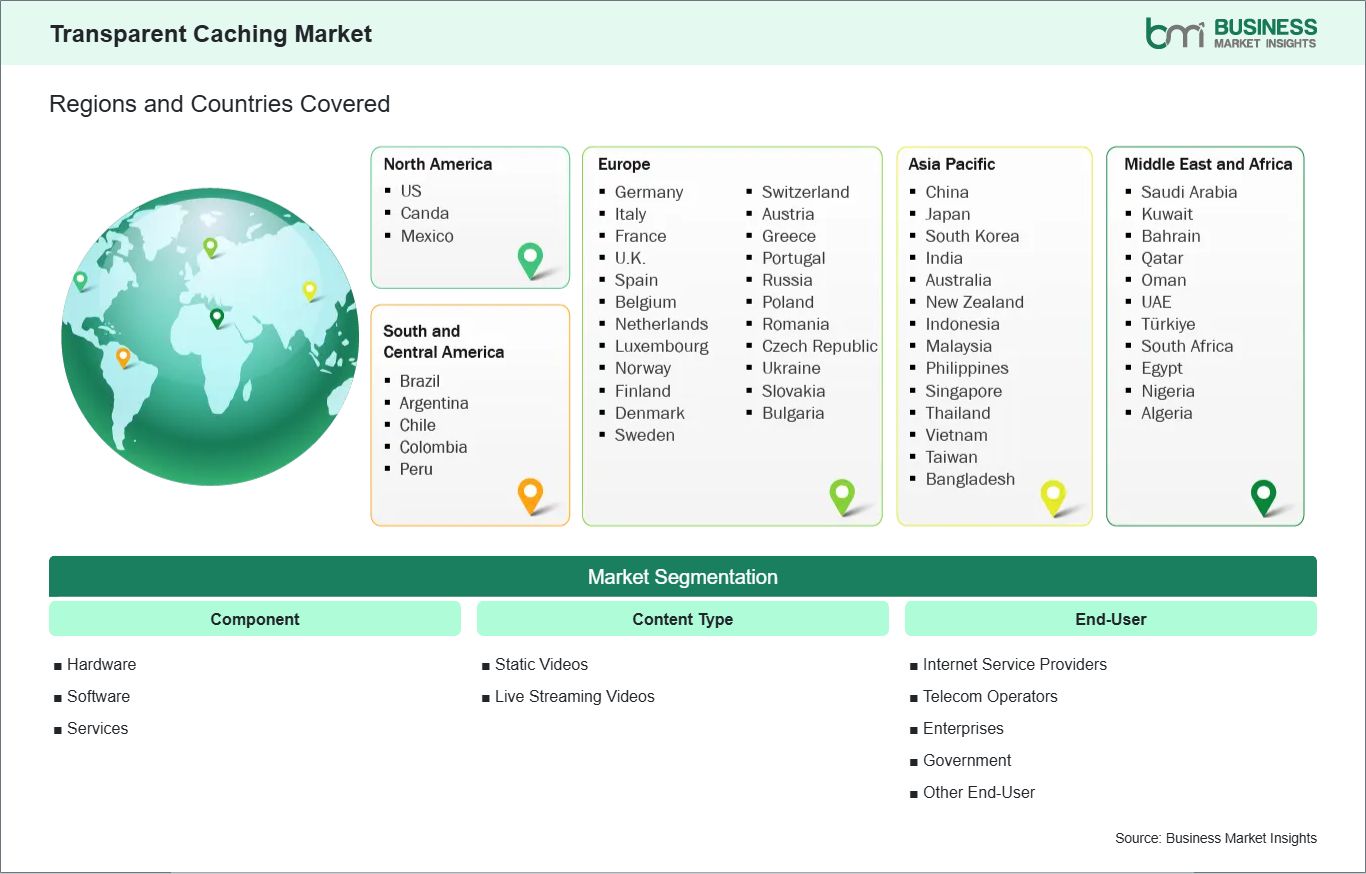
Key segments that contributed to the derivation of the Transparent Caching market analysis are component, content type, and end-user.
- By Component, the market is segmented into Hardware, Software, and Service.
- By Content Type, the market is divided into Static Videos and Live Streaming Videos.
- By End-User, the market is categorized into Internet Service Providers, Telecom Operators, Enterprises, Government, and Others.
Market Forces
Transparent Caching Market Drivers and Opportunities
Surge in High-Definition Video Traffic and Bandwidth Cost Optimization
The primary driver for the transparent caching market is the massive escalation of global internet traffic, predominantly fueled by the transition toward high-definition and ultra-high-definition video streaming. As video content becomes the dominant form of digital engagement, the volume of data traversing core networks has created substantial operational pressure for service providers. The shift from standard definition to high-definition and now ultra-high-definition formats has significantly increased the size of each individual data packet, necessitating far greater network capacity to maintain smooth playback without buffering.
Transparent caching addresses this challenge by localizing the delivery of frequently accessed content. When multiple users in the same geographic area request the same popular video, the system stores a copy at the network edge rather than fetching it from a distant origin server every time. This approach effectively reduces the total volume of data that must pass through expensive international transit links and core backhaul infrastructure. By serving content locally, internet service providers can significantly lower their recurring expenses related to data transit while simultaneously improving the experience for their subscribers. This localized delivery model ensures that even during periods of peak demand, such as major live sporting events or global news breaks, the network remains resilient and responsive, preventing the congestion that typically leads to degraded video quality.
Integration of AI and Machine Learning for Predictive Content Delivery
A significant opportunity within the market lies in the application of artificial intelligence and machine learning to transform caching from a reactive process into a proactive and predictive one. Traditional caching systems generally rely on historical demand, storing content only after it has been requested multiple times. However, the emergence of intelligent algorithms allows network operators to anticipate consumption patterns before they occur. By analyzing regional viewing trends, social media velocity, and temporal data, these advanced systems can identify content that is likely to go viral and pre-position it at edge servers during periods of low network activity.
This "sensing-to-delivery" pipeline allows for the seamless handling of massive traffic spikes that would otherwise overwhelm traditional infrastructure. For example, an intelligent caching system can recognize that a specific video series or live broadcast is gaining rapid traction and automatically download the relevant data to local caches across the network. This not only ensures ultra-low latency for the end-user but also allows the service provider to manage network resources with far greater precision. As digital ecosystems become more complex and decentralized, the ability to make context-aware, autonomous caching decisions provides a specialized avenue for technology vendors to offer high-value software solutions that emphasize operational efficiency and automated network management.
Size and Share Analysis
Transparent Caching Market Size and Share Analysis
The Transparent Caching market demonstrates steady growth, with size and share analysis revealing evolving trends and competitive positioning among key players. The report further examines subsegments categorized within component, content type, and end-user, offering insights into their contribution to overall market performance.
Within the component segment, the Software sub-segment represents a rapidly growing share as operators shift toward Virtualized Network Functions (VNF) to achieve greater scalability.
Regarding content type, the Live Streaming Videos sub-segment is seeing the most significant momentum due to the rising popularity of real-time sports and social broadcasting.
Among end-users, the Internet Service Providers (ISPs) sub-segment remains the largest contributor to the market, as they utilize transparent caching as a core strategy to offset the high costs of international bandwidth and peering.
Report Coverage
Transparent Caching Market Report Coverage and Deliverables
The "Transparent Caching Market Size and Forecast (2022 - 2033)" report provides a detailed analysis of the market covering below areas:
- Transparent Caching market size and forecast at global, regional, and country levels for all the key market segments covered under the scope
- Transparent Caching market trends, as well as market dynamics such as drivers, restraints, and key opportunities
- Transparent Caching market analysis covering key market trends, global and regional framework, major players, regulations, and recent market developments
- Industry landscape and competition analysis covering market concentration, heat map analysis, prominent players, and recent developments for the Transparent Caching market
- Detailed company profiles, including SWOT analysis
Geographic Insights
Transparent Caching Market Geographic Insights
The geographical scope of the Transparent Caching market report is divided into five regions: North America, Asia Pacific, Europe, the Middle East and Africa, and South and Central America.
In North America, the market is characterized by a high concentration of primary technology vendors and early-stage adoption of advanced networking standards, particularly within the aerospace and defense sectors, where secure, high-speed signal integrity is paramount. Europe maintains a specialized focus on digital sovereignty, with organizations increasingly deploying localized caching architectures to ensure compliance with stringent data residency regulations while optimizing healthcare and automotive telemetry. The Asia-Pacific region serves as a massive engine for volume growth, driven by an extensive electronics manufacturing ecosystem and aggressive investments in high-capacity mobile infrastructure across major urban hubs.
In the Middle East and Africa, market activity is increasingly anchored by large-scale smart city developments and the modernization of telecommunications frameworks aimed at supporting expanding digital economies. Meanwhile, South and Central America are witnessing a steady rise in demand as regional industrial sectors undergo digital transformation, necessitating more efficient content delivery to overcome the geographic challenges of distributed network nodes. This diversified regional expansion ensures a resilient global market as local operators continue to align their caching strategies with broader economic and technological goals.
Industry Activity
Recent Developments
The Transparent Caching market is evaluated by gathering qualitative and quantitative data post primary and secondary research, which includes important corporate publications, association data, and databases. A few of the key developments in the Transparent Caching market are:
- In November 2025, Nokia held its Capital Markets Day 2025 and announced a comprehensive strategy to position itself as a leader in the AI-driven transformation of networks. As part of this realignment, the company evolved its operating model to include Transparent Caching capabilities within its high-growth Network Infrastructure segment, specifically to capture the value of the "AI supercycle" and data center expansion. Nokia also simplified its operational structure into two primary segments—Network Infrastructure and Mobile Infrastructure—while targeting an annual comparable operating profit of up to EUR 3.2 billion by 2028.
- In January 2025, Citrix, a business unit of Cloud Software Group, Inc., announced the strategic acquisition of Unicon GmbH, a Citrix Ready™ partner and provider of the secure endpoint operating system (OS), eLux®, along with the enterprise management platform, Scout™. This acquisition allowed Citrix to integrate advanced endpoint management and Transparent Caching functionalities into its hybrid work solutions, enabling companies to repurpose existing hardware and optimize data delivery to secure virtual desktops and applications.
Trust & Transparency
Research Methodology
The market analysis combines proprietary research with secondary data from government agencies, company disclosures, regulatory filings, industry databases and expert interviews. Market estimates are validated through data triangulation, cross-market benchmarking and analyst
review.
View Full Research Methodology
Key Sources Referred:
World Bank - Global Trade Indicators World Trade Organization (WTO) International Monetary Fund (IMF) International Trade Administration (ITA) Company website Company annual reports Company investor presentations