Wireless Charging for EV Market Outlook: Size, Share, Trends, Growth Analysis, Competitive Landscape & Forecast, 2026-2033

The Wireless Charging For EV Market size was valued at US$ 101.44 Million in 2025 and is projected to reach US$ 1843.73 Million by 2033, growing at a CAGR of 43.69% during 2026–2033, driven by electric mobility adoption, charging infrastructure expansion, technological innovation, and rising demand for convenient energy solutions.

Report Coverage
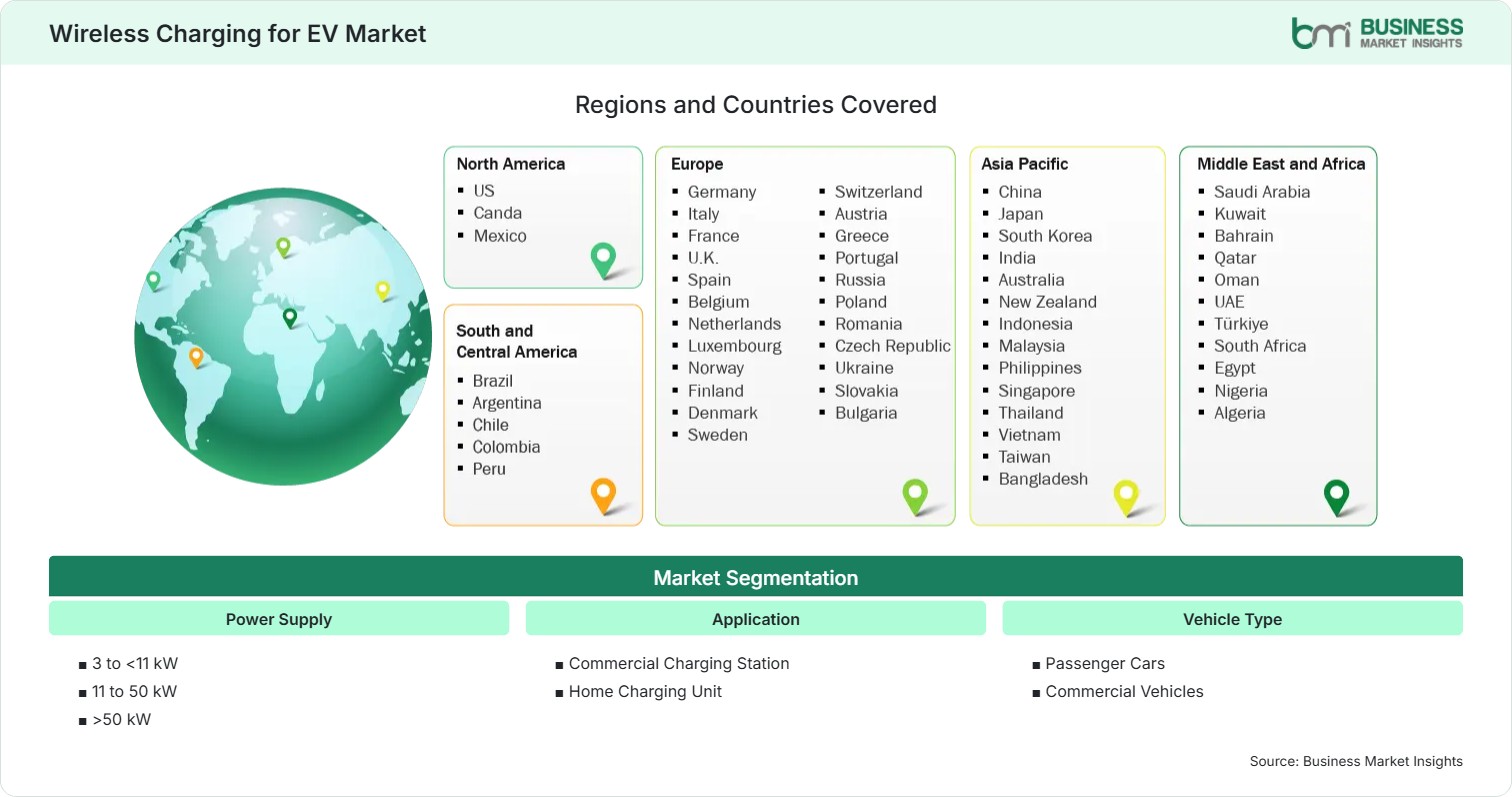
  • Power Supply: 3 to <11 kW, 11 to 50 kW, >50 kW
  • Application: Commercial Charging Station, Home Charging Unit
  • Vehicle Type: Passenger Cars , Commercial Vehicles
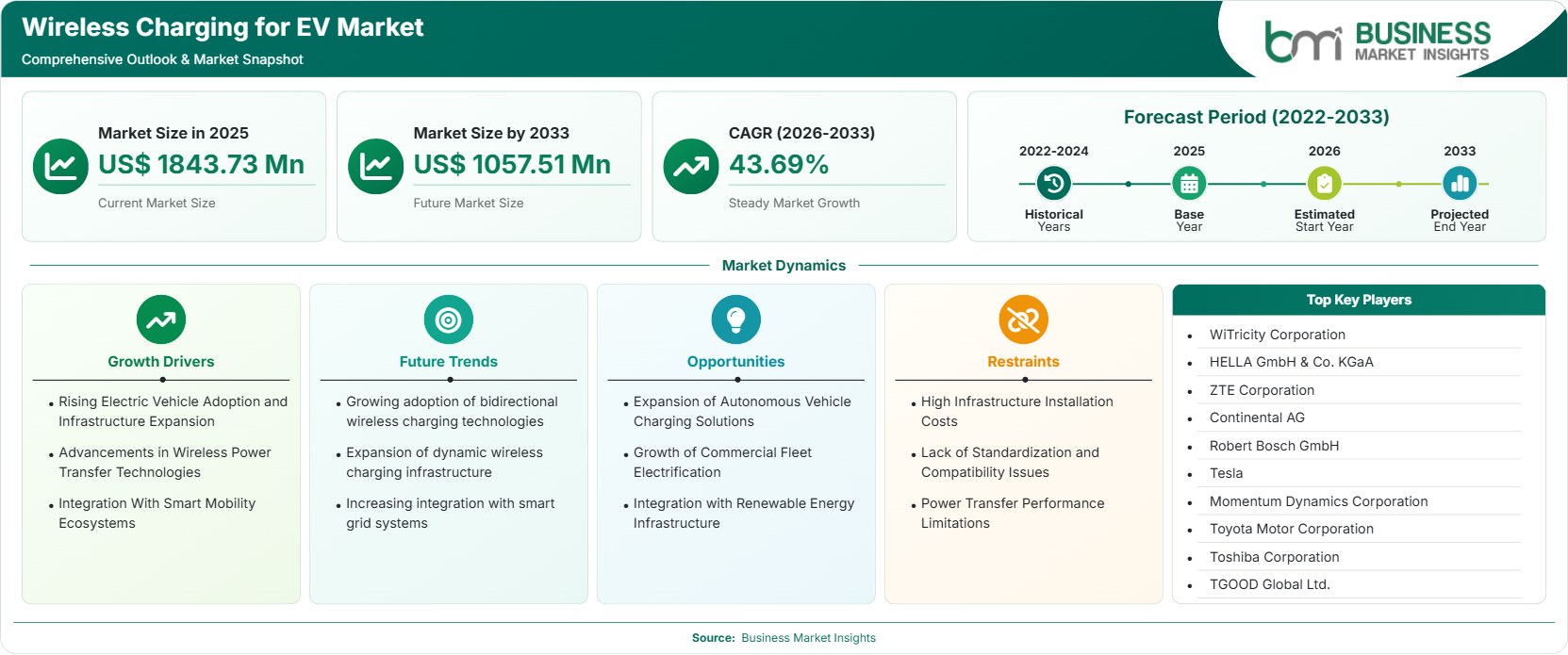
US$ 1843.73 Mn Market size in 2025
US$ 1057.51 Mn Market Size by 2033
43.69% CAGR, 2026 - 2033
2026-2033 Forecast Period

01 AI Overview

Wireless Charging for EV Market Summary

  • North America Region: North America holds a 30%–34% share in 2025, growing at a CAGR of 41%–43% during 2026–2033, supported by EV infrastructure investments, government incentives, smart mobility initiatives, and automotive technology dEVelopment. The U.S. market analysis indicates strong adoption through automaker partnerships and charging innovation, expanding at a CAGR of 42%–44% between 2026–2033.
  • Fastest Growing Region: Asia Pacific represents a 34%–38% share in 2025, advancing at a CAGR of 45%–47% during 2026–2033, supported by electric vehicle manufacturing expansion, urban mobility programs, battery technology integration, charging infrastructure deployment, and increasing investments from automotive companies.
  • Leading Segment: Home Charging Unit accounts for a 52%–56% share in 2025, expanding at a CAGR of 42%–44% during 2026–2033, driven by residential EV adoption, convenience-focused charging solutions, improved energy management systems, and increasing consumer preference for private charging environments.
  • High Growth Segment: Commercial Charging Station represents a 44%–48% share in 2025, growing at a CAGR of 46%–48% during 2026–2033, influenced by fleet electrification, public charging networks, autonomous mobility initiatives, and investments in high-power wireless charging infrastructure.
  • Key Market Opportunity: Wireless charging technology creates opportunities through autonomous charging systems, dynamic charging roads, fleet electrification, smart cities, and integration with renewable energy infrastructure supporting next-generation electric transportation ecosystems.
  • Major Market Players: WiTricity Corporation, HELLA GmbH & Co. KGaA, ZTE Corporation, Continental AG, Robert Bosch GmbH, Tesla, Momentum Dynamics Corporation, Toyota Motor Corporation, Toshiba Corporation, and TGOOD Global Ltd.
02 Strategic Insights

Wireless Charging for EV Market: Strategic Insights

Wireless Charging for EV Market Strategic Framework
FREE PDF
Request your free sample
Request free sample
03 Stakeholder View

Key Takeaways

  • The value chain is EVolving from conventional charging equipment suppliers toward integrated ecosystems involving automakers, semiconductor providers, infrastructure dEVelopers, and software companies delivering complete wireless mobility solutions.
  • Passenger vehicles remain a major adoption area, while commercial fleets, autonomous vehicles, and logistics applications present higher long-term opportunities due to operational efficiency requirements and reduced downtime.
  • Innovation is shifting toward higher power transfer efficiency, automated alignment technologies, bidirectional charging capabilities, and integration with vehicle-to-grid systems supporting intelligent energy management.
  • Asia Pacific provides a compelling investment opportunity due to large-scale EV manufacturing capacity, government-backed electrification programs, and growing deployment of charging infrastructure across urban transportation networks.
  • Strategic collaborations and technology partnerships are increasing as automotive companies, charging technology dEVelopers, and infrastructure providers seek competitive advantages in wireless mobility ecosystems.
  • Standardization initiatives and interoperability improvements will influence future adoption by reducing compatibility barriers between vehicles, charging equipment, and energy management platforms.
04 Geographic Outlook

Wireless Charging for EV Market Regional Highlights

North America Wireless Charging For EV Market

North America maintains a 30%–34% share in 2025, with growth projected at a CAGR of 41%–43% from 2026–2033. The region benefits from EV infrastructure investments, automotive innovation, and supportive government policies. The Wireless Charging For EV Market share reflects strong demand from the U.S. and Canada due to increasing electric mobility adoption and technology partnerships. Automakers are focusing on integrated charging solutions to improve consumer experience and accelerate EV acceptance.

  • The United States leads regional adoption through investments in EV charging infrastructure, automotive research, and commercial fleet electrification programs supporting wireless charging deployment.
  • Canada demonstrates increasing potential through clean transportation initiatives, renewable energy integration, and investments in sustainable mobility infrastructure across urban centers.
  • Automotive manufacturers are collaborating with technology providers to dEVelop efficient wireless charging platforms compatible with next-generation electric vehicles.
  • Public and private charging operators are exploring wireless solutions for convenience-driven charging networks and automated fleet management applications.

US Wireless Charging For EV Market

The U.S. represents a 25%–28% share within North America in 2025 and is estimated to expand at a CAGR of 42%–44% during 2026–2033. The country benefits from EV adoption, technology investments, and charging infrastructure modernization. The Wireless Charging For EV Market growth is supported by government initiatives, automotive innovation, and increasing consumer interest in seamless charging experiences.

  • U.S. automakers are investing in wireless charging compatibility to enhance electric vehicle ownership convenience and strengthen competitive positioning.
  • Federal and state-lEVel clean transportation programs encourage deployment of advanced charging technologies across residential and commercial locations.
  • Fleet operators are EValuating wireless charging systems to improve operational efficiency and reduce charging-related vehicle downtime.

Europe Wireless Charging For EV Market

Europe accounts for a 24%–28% share in 2025, growing at a CAGR of 40%–42% during 2026–2033. Germany, the United Kingdom, France, and Nordic countries are driving adoption through emission reduction targets and EV infrastructure expansion. The Wireless Charging For EV Market share is supported by automotive manufacturing expertise, sustainability policies, and investments in advanced mobility solutions.

  • Germany remains a key contributor due to automotive engineering capabilities, EV production expansion, and charging technology dEVelopment initiatives.
  • France and the United Kingdom are supporting electrification through government incentives, infrastructure programs, and urban mobility transformation projects.
  • Nordic countries demonstrate strong adoption potential due to high electric vehicle penetration and renewable energy availability.
  • European automakers are dEVeloping wireless charging solutions to improve vehicle integration and charging convenience.

Asia Pacific Wireless Charging For EV Market

Asia Pacific holds a 34%–38% share in 2025 and records a CAGR of 45%–47% during 2026–2033. China, Japan, South Korea, and India are major contributors due to EV manufacturing expansion and infrastructure investments. The Wireless Charging For EV Market share reflects strong regional demand from automotive producers, technology companies, and government-supported electrification programs.

  • China leads regional deployment through extensive EV production capacity, charging infrastructure dEVelopment, and technology investments.
  • Japan focuses on advanced automotive innovation, wireless power systems, and integration with smart mobility applications.
  • South Korea supports growth through electric vehicle manufacturing and semiconductor technology expertise.
  • India presents emerging opportunities through urban electrification initiatives and expanding electric mobility adoption.
  • Regional automotive companies are increasing partnerships to commercialize efficient wireless charging technologies.

Rest of World Wireless Charging For EV Market

Rest of World regions, including South and Central America and Middle East and Africa, represent a 6%–10% share in 2025, expanding at a CAGR of 38%–40% during 2026–2033. Adoption is supported by sustainable transportation initiatives, urban dEVelopment, and increasing interest in electric mobility solutions. The Wireless Charging For EV Market growth in these regions depends on infrastructure investment and policy support.

South American countries are exploring EV charging expansion through renewable energy integration and transportation modernization programs. Middle Eastern nations are investing in smart cities and sustainable mobility initiatives.

  • Brazil and Mexico show potential through growing EV adoption and infrastructure dEVelopment programs.
  • Gulf countries are integrating electric mobility solutions into smart city projects and sustainability strategies.
  • African urban centers are EValuating EV infrastructure opportunities linked with clean transportation goals.
  • Infrastructure partnerships are essential for overcoming charging accessibility challenges across dEVeloping regions.
Global Market Geography
FREE PDF
Request your free sample
Request free sample
05 Segment Analysis

Wireless Charging for EV Market Segmentation

Power Supply

The power supply segment represents a critical component of the Wireless Charging For EV Market, enabling efficient energy transfer across different vehicle applications. It accounted for a 100% share in 2025 across charging power categories and is projected to expand at a CAGR of 43%–45% during 2026–2034. Increasing demand for faster charging, improved efficiency, and compatibility with multiple EV models is shaping technology dEVelopment and deployment strategies.

  • 3-<11 KW: This category supports residential charging applications with lower power requirements. It enables convenient overnight charging solutions, improved household EV adoption, and cost-effective wireless charging installations.
  • 11-50 KW: Medium-power systems support commercial applications and public charging environments. They provide balanced charging speed, efficiency, and infrastructure flexibility for passenger vehicles and fleet operations.
  • >50 KW: High-power solutions are designed for rapid charging applications requiring advanced power management. They support commercial fleets, autonomous vehicles, and high-utilization transportation networks.

Application

The application segment defines deployment opportunities across residential and commercial charging environments. The Wireless Charging For EV Market scope expands through increasing consumer acceptance, infrastructure dEVelopment, and integration of smart charging technologies. Home charging units represented a 52%–56% share in 2025, while commercial charging stations demonstrate faster adoption momentum with a CAGR of 46%–48% during 2026–2034 due to fleet electrification and public charging investments.

  • Commercial Charging Station: Commercial charging infrastructure supports fleet operators, public mobility networks, and high-frequency charging requirements. Expansion is driven by transportation electrification programs and demand for automated charging solutions.
  • Home Charging Unit: Residential charging systems provide convenience for private EV owners. Adoption is increasing due to rising electric vehicle ownership, improved charging efficiency, and consumer preference for simplified charging experiences.

Vehicle Type

Vehicle type segmentation highlights adoption differences between passenger and commercial mobility applications. The segment benefits from increasing EV penetration, charging infrastructure expansion, and automotive technology advancements. Passenger cars maintain a leading position with a 60%–64% share in 2025, while commercial vehicles demonstrate higher adoption potential through fleet electrification initiatives and operational efficiency requirements.

  • Passenger Cars: Passenger vehicles represent the largest application area due to increasing consumer EV adoption. Wireless charging improves ownership convenience and supports future autonomous vehicle integration.
  • Commercial Vehicles: Commercial vehicle adoption is increasing through fleet operators seeking efficient charging processes. Logistics, transportation, and autonomous mobility applications create strong demand for wireless charging systems.
06 Market Forces

Wireless Charging for EV Market Dynamics

Key Market Drivers

Rising Electric Vehicle Adoption and Infrastructure Expansion

Increasing electric vehicle adoption is a primary factor supporting market growth as consumers and fleet operators seek convenient charging solutions. The International Energy Agency reported continued global EV sales expansion, creating demand for advanced charging technologies. Automotive manufacturers are investing in wireless charging integration to improve user experience and reduce charging complexity. The Wireless Charging For EV Market trends indicate rising deployment of automated charging solutions, particularly for residential and commercial applications. Infrastructure dEVelopers are also focusing on interoperable charging systems that support multiple vehicle platforms. Government incentives, emission reduction targets, and smart mobility initiatives are strengthening demand for efficient wireless power transfer technologies across dEVeloped and emerging economies.

Advancements in Wireless Power Transfer Technologies

Technological improvements in inductive charging systems are enhancing efficiency, alignment accuracy, and charging speed for electric vehicles. Companies are dEVeloping advanced magnetic resonance technologies, improved power electronics, and intelligent energy management platforms. These innovations are enabling better compatibility between vehicles and charging infrastructure while reducing energy losses. Automotive suppliers are focusing on compact designs and improved thermal management systems to support commercial deployment. Research and dEVelopment investments are accelerating improvements in high-power charging capabilities and dynamic charging concepts. These advancements are creating opportunities for broader adoption among passenger vehicles, commercial fleets, and autonomous mobility solutions requiring reliable automated energy transfer systems.

Integration With Smart Mobility Ecosystems

Integration of wireless charging into connected transportation systems provides new opportunities for intelligent mobility management. Smart city projects, autonomous vehicles, and transportation fleets are introducing digital charging systems that allow them to control energy charging and optimize their operations. Wireless charging systems will be useful for vehicle-to-grid applications, allowing electric vehicles to become part of the larger energy management system. Transport companies are considering these innovations to save time and improve operational efficiency. Digital charging management, sensors, and remote monitoring are becoming increasingly effective in improving charging performance

Key Market Opportunities

Expansion of Autonomous Vehicle Charging Solutions

Autonomous vehicles require seamless and automated energy replenishment systems, creating significant opportunities for wireless charging technologies. The Wireless Charging For EV Market Forecasts indicate increasing potential from self-parking vehicles, robotic mobility systems, and autonomous transportation services. Wireless charging eliminates manual connection requirements and supports continuous vehicle operation. Automotive companies and technology dEVelopers are investing in automated charging platforms designed for future mobility ecosystems. Integration with artificial intelligence and smart infrastructure can improve charging scheduling and energy efficiency. These dEVelopments create opportunities for charging providers to collaborate with vehicle manufacturers, municipalities, and fleet operators dEVeloping next-generation transportation solutions.

Growth of Commercial Fleet Electrification

Electric charging for commercial fleets is another area with great potential, as logistics firms and transportation businesses seek efficient charging solutions. Delivery trucks, taxis, and public transport fleets need effective charging infrastructure to ensure maximum efficiency. With wireless charging technology, less human involvement and more vehicle availability will be possible. Charging hubs powered with renewable energy sources and digital technologies are being considered by fleet owners. Environmental and sustainability concerns among companies have driven the shift to electric fleets. Technology firms can capitalize on these opportunities by developing scalable solutions to meet these needs.

Integration with Renewable Energy Infrastructure

The integration of renewable energy offers opportunities to integrate wireless EV charging with sustainable energy generation systems. Solar power-enabled charging stations, energy storage integration, and grid connectivity have become topics of interest among infrastructural developers. The development of wireless charging powered by clean energy facilitates low-carbon transportation systems and improved energy management efficiency. Government organizations and enterprises are working to build sustainable transport infrastructure to meet their ecological goals. Corporations that develop smart charging systems with renewable-energy integration capabilities can meet the needs of green transportation.

Market Restraints and Challenges

High Infrastructure Installation Costs

Factor: High installation costs associated with wireless charging infrastructure can limit adoption among residential users and commercial operators. Impact: Expensive equipment deployment, installation complexity, and additional grid requirements may delay widespread commercialization compared with conventional charging solutions. Wireless charging technologies demand specific equipment, power electronics, and maintenance services that increase the capital outlay requirement at the outset. Organizations evaluating the charging technology need to weigh the future gains from operations against the present costs of implementation. Cost reductions due to technological innovations and economy of scale would be crucial to making the technology more accessible to the market.

Lack of Standardization and Compatibility Issues

Factor: Limited global standardization across wireless charging technologies creates compatibility challenges between vehicles and charging systems. Impact: Differences in technical specifications can restrict interoperability and slow adoption among consumers and infrastructure providers. Automotive manufacturers and EV charge point developers are moving towards establishing common standards to improve user experience and accelerate the technology's commercialization. The issue of compatibility is especially pertinent in the context of the foreign market, which has different vehicles and infrastructure needs. Setting up of the widely accepted standards will be instrumental in helping the ecosystem develop by lowering uncertainties for all parties involved.

07 Company Analysis

Competitive Landscape

The Wireless Charging For EV Market analysis highlights a competitive environment shaped by automotive manufacturers, charging technology dEVelopers, infrastructure providers, and electronic component specialists. Companies are focusing on improving charging efficiency, dEVeloping interoperable wireless power systems, expanding EV ecosystem partnerships, and integrating advanced technologies such as automation, digital monitoring, and intelligent energy management to strengthen market positioning.

Company Name

Overview

Products and Services relEVant to this market

WiTricity Corporation

WiTricity dEVelops wireless power transfer technologies focused on electric vehicle charging applications and mobility electrification.

Provides magnetic resonance wireless charging systems, EV charging technology platforms, licensing solutions, and integration support.

HELLA GmbH & Co. KGaA

HELLA dEVelops automotive electronic solutions supporting vehicle electrification and advanced mobility technologies.

Offers wireless charging components, automotive electronics, power management systems, and EV-related technology solutions.

ZTE Corporation

ZTE provides communication and technology solutions supporting smart transportation and connected infrastructure dEVelopment.

Delivers EV charging infrastructure technologies, intelligent charging solutions, and digital connectivity platforms.

Continental AG

Continental dEVelops automotive technologies supporting electric mobility, vehicle electronics, and intelligent transportation systems.

Provides charging technologies, automotive electronics, power solutions, and EV integration technologies.

Robert Bosch GmbH

Bosch supplies automotive components and mobility technologies supporting electric vehicle transformation.

Offers EV systems, power electronics, charging solutions, vehicle technologies, and intelligent mobility services.

Tesla

Tesla dEVelops electric vehicles and charging ecosystems supporting global electric mobility adoption.

Provides EV charging infrastructure, vehicle charging technologies, battery systems, and integrated mobility solutions.

Momentum Dynamics Corporation

Momentum Dynamics specializes in wireless charging technology for electric vehicles and transportation applications.

Provides high-power wireless charging systems for buses, fleets, commercial vehicles, and automated charging applications.

Toyota Motor Corporation

Toyota dEVelops hybrid and electric mobility technologies with a focus on sustainable transportation solutions.

Offers electric vehicle technologies, charging integration solutions, automotive systems, and mobility platforms.

Toshiba Corporation

Toshiba provides electronic technologies supporting energy management and advanced power systems.

Supplies power electronics, semiconductor technologies, charging components, and energy infrastructure solutions.

TGOOD Global Ltd.

TGOOD dEVelops charging infrastructure and energy solutions for electric mobility applications.

Provides EV charging equipment, energy management systems, charging stations, and infrastructure services.

10 Trust & Transparency

Research Methodology

The market analysis combines proprietary research with secondary data from government agencies, company disclosures, regulatory filings, industry databases and expert interviews. Market estimates are validated through data triangulation, cross-market benchmarking and analyst review.

View Full Research Methodology

11 Questions Answered

Frequently Asked Questions

What factors will influence future wireless EV charging deployment?

Future deployment will depend on infrastructure costs, technology standardization, vehicle compatibility, government support, and collaboration between automotive manufacturers, energy providers, and charging technology companies.

Why are commercial vehicles important for wireless charging adoption?

Commercial vehicles benefit from reduced charging downtime, automated energy transfer, and improved fleet efficiency. Logistics operators, public transportation providers, and autonomous mobility companies are exploring wireless charging to optimize operations.

What technologies influence the Wireless Charging For EV Market Report?

The report Evaluates developments in inductive charging, magnetic resonance technology, power electronics, automation systems, and digital monitoring platforms shaping future EV charging ecosystems.

How does wireless charging support future smart cities in Wireless Charging For EV Market?

Wireless charging enables integration with smart transportation networks by connecting vehicles, charging infrastructure, and energy management platforms. It supports automated mobility, optimized energy usage, and sustainable urban transportation planning.

What advantages does wireless EV charging provide compared with conventional charging?

Wireless charging improves user convenience by removing physical connectors, enabling automated charging experiences, and supporting applications such as autonomous vehicles and commercial fleets requiring frequent energy replenishment.

Access the Full Wireless Charging for EV Market Report

Get segment-level forecasts, regional estimates, competitive benchmarking, company profiles and downloadable Excel datasets.

Access the full Wireless Charging for EV Market Report
350 pages PDF & Excel | 2026-08-12