
Motorcycle Market Outlook: Size, Share, Trends, Growth Analysis, Competitive Landscape & Forecast, 2026-2033

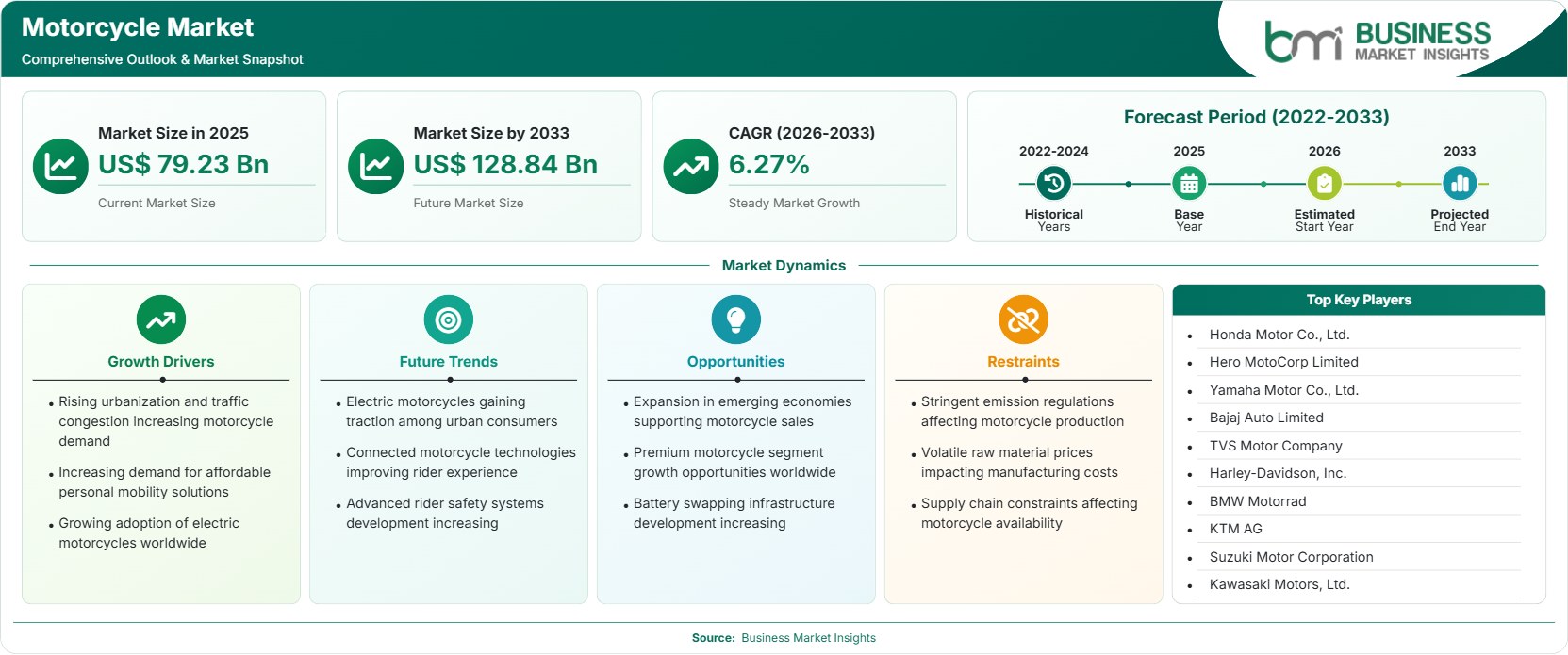
The Motorcycle Market size was valued at US$ 79.23 billion in 2025 and is projected to reach US$ 128.84 billion by 2033, growing at a CAGR of 6.27% during 2026–2033. The market is influenced by urbanization trends, increased demand for cost-effective personal transportation, and growing demand for electric motorcycles. Market growth will be fueled by expansion into emerging markets, demand for premium motorcycles, and battery swapping facilities.

Report Coverage
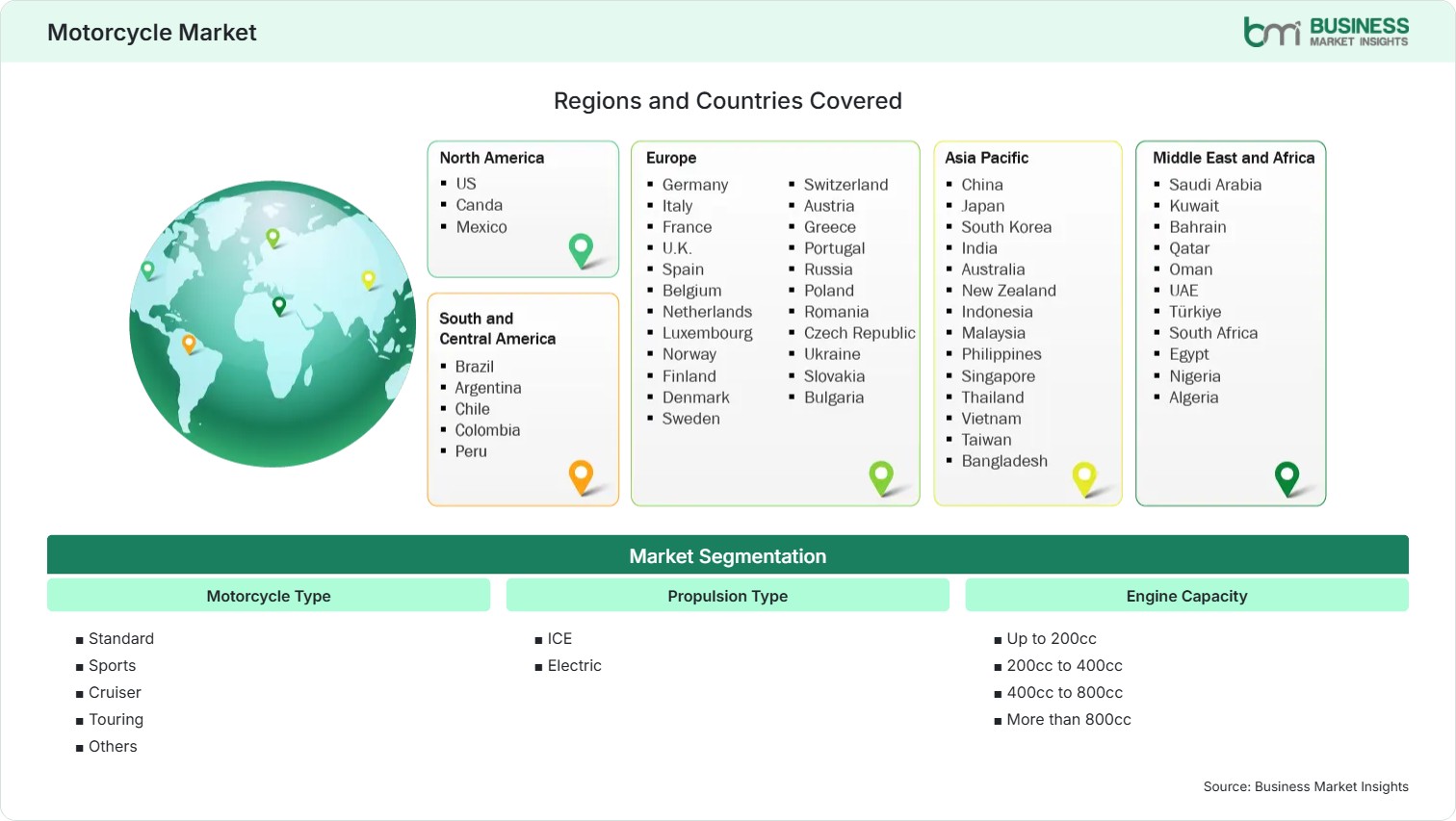
  • Motorcycle Type: Standard, Sports, Cruiser, Touring, Others
  • Propulsion Type: ICE, Electric
  • Engine Capacity: Up to 200cc, 200cc to 400cc, 400cc to 800cc, More than 800cc
US$ 79.23 Bn Market size in 2025
US$ 128.84 Bn Market Size by 2033
6.27% CAGR, 2026 - 2033
2026-2033 Forecast Period

AI Overview

Motorcycle Market Summary

  • North America Region: North America holds 14%–17% market share in 2025 and is projected to grow at a CAGR of 5.8%–6.2% during 2026–2033. Rising recreational riding, increasing premium motorcycle demand, expanding electric motorcycle adoption, and investments in charging infrastructure continue supporting regional growth. The U.S. dominates the regional market with strong recreational vehicle demand, premium motorcycle sales, and increasing electric motorcycle adoption, registering a CAGR of approximately 5.9%–6.3% during the forecast period.
  • Fastest Growing Region: Asia Pacific accounts for 56%–59% market share in 2025 and is expected to register the fastest CAGR of 6.8%–7.2% through 2033. Rapid urbanization, rising disposable incomes, expanding middle-class populations, and strong demand for economical two-wheelers continue driving regional expansion.
  • Leading Segment: Standard motorcycles account for 40%–43% market share in 2025 and are projected to grow at a CAGR of 6.2%–6.5% during the forecast period. Affordability, fuel efficiency, daily commuting suitability, and lower maintenance costs continue supporting segment leadership.
  • High Growth Segment: Electric motorcycles account for 12%–15% market share in 2025 and are projected to register a CAGR of 17.0%–18.5% through 2033. Government incentives, battery technology improvements, lower operating costs, and expanding charging infrastructure continue accelerating adoption.
  • Key Market Opportunity: Expansion of electric mobility, battery swapping networks, premium motorcycles, and increasing motorcycle ownership across developing economies continues creating attractive opportunities for manufacturers during motorcycle market forecasts.
  • Major Market Players: Honda Motor Co., Ltd., Hero MotoCorp Limited, Yamaha Motor Co., Ltd., Bajaj Auto Limited, TVS Motor Company, Harley-Davidson, Inc., BMW Motorrad, KTM AG, Suzuki Motor Corporation, Kawasaki Motors, Ltd.
Strategic Insights

Motorcycle Market: Strategic Insights

Motorcycle Market Strategic Framework
FREE PDF
Request your free sample
Request free sample
Stakeholder View

Key Takeaways

  • Manufacturers are strengthening vertically integrated supply chains while expanding partnerships with battery suppliers, technology companies, dealerships, and component manufacturers to improve operational efficiency.
  • Electric motorcycles and premium motorcycle categories continue presenting the strongest long-term growth opportunities alongside traditional commuter motorcycles in emerging markets.
  • Innovation is increasingly focused on battery technology, lightweight materials, connected vehicle systems, advanced rider assistance features, and improved energy efficiency.
  • Asia Pacific remains the most attractive investment destination due to high motorcycle ownership, expanding urban populations, supportive government policies, and strong manufacturing capabilities.
  • Strategic collaborations, manufacturing expansion, and investments in electric mobility infrastructure continue strengthening competitive positioning across global motorcycle manufacturers.
  • Rising consumer preference for environmentally sustainable transportation and connected mobility solutions continues encouraging long-term product innovation across the industry.
Geographic Outlook

Motorcycle Market Regional Highlights

North America Motorcycle Market

North America accounts for 14%–17% of the Motorcycle Market share in 2025 and is projected to grow at a CAGR of 5.8%–6.2% during 2026–2033. Demand is supported by recreational riding, premium motorcycle ownership, expanding electric motorcycle adoption, and improving charging infrastructure. Rising consumer interest in touring motorcycles and connected riding technologies continues supporting regional market development.

  • The United States dominates regional demand through strong recreational riding culture and premium motorcycle ownership.
  • Increasing adoption of electric motorcycles is supported by expanding charging infrastructure and government sustainability initiatives.
  • Growing popularity of adventure touring and performance motorcycles continues supporting premium segment expansion.
  • Manufacturers continue investing in connected technologies, rider safety features, and dealership network expansion.

US Motorcycle Market

The U.S. represents 83%–86% of the North American market in 2025 and is projected to register a CAGR of 5.9%–6.3% through 2033. Strong consumer spending, recreational riding culture, premium motorcycle demand, and expanding electric mobility continue supporting market growth. Continuous product innovation and dealership expansion further strengthen industry development.

  • Premium touring and cruiser motorcycles continue generating significant demand across the country.
  • Electric motorcycle adoption is increasing with improving charging infrastructure and battery technologies.
  • Growing rider communities and motorsports activities continue supporting motorcycle sales.
  • Manufacturers continue introducing connected motorcycles with advanced rider assistance technologies.

Europe Motorcycle Market

Europe holds 17%–20% market share in 2025 and is expected to expand at a CAGR of 6.0%–6.4% during the forecast period. Rising electric motorcycle adoption, stringent emission regulations, and growing premium motorcycle demand continue supporting market growth. Germany leads regional revenue, while Italy records comparatively faster expansion due to its strong motorcycle manufacturing ecosystem.

  • Germany remains the largest regional market supported by premium motorcycle demand and technological innovation.
  • Italy continues witnessing strong growth through established motorcycle manufacturing and exports.
  • Electric motorcycles are gaining popularity due to supportive environmental policies and urban mobility initiatives.
  • Connected mobility technologies and rider safety innovations continue supporting product development.

Asia Pacific Motorcycle Market

Asia Pacific captures 56%–59% market share in 2025 and is projected to register the fastest CAGR of 6.8%–7.2% during 2026–2033. Rising urbanization, expanding middle-class populations, increasing disposable incomes, and strong demand for affordable transportation continue driving regional growth. India leads overall motorcycle sales, while China records rapid expansion in electric motorcycles.

  • India remains the largest market supported by high commuter motorcycle demand and domestic manufacturing.
  • China continues expanding electric motorcycle production through supportive government policies.
  • Indonesia, Vietnam, and Thailand maintain strong two-wheeler demand driven by urban mobility requirements.
  • Manufacturers continue expanding production capacity and launching affordable electric motorcycle models.

Rest of World Motorcycle Market

Rest of World accounts for 8%–10% market share in 2025 and is expected to grow at a CAGR of 6.1%–6.5% through 2033. South & Central America and the Middle East & Africa continue witnessing increasing motorcycle demand due to rising urbanization, affordable transportation needs, and expanding distribution networks. Brazil leads regional demand, while the United Arab Emirates records increasing premium motorcycle adoption.

  • Brazil remains the leading Latin American market supported by growing commuter motorcycle demand.
  • Middle Eastern countries continue witnessing increasing premium and recreational motorcycle ownership.
  • Improving dealer networks continue expanding motorcycle accessibility across developing economies.
  • Rising investments in electric mobility and infrastructure continue supporting future regional growth.
Global Market Geography
FREE PDF
Request your free sample
Request free sample
Segment Analysis

Motorcycle Market Segmentation

Motorcycle Type

The Motorcycle Type segment accounted for 40%–43% market share in 2025 and is projected to grow at a CAGR of 6.2%–6.5% through 2033. The Motorcycle Market scope continues expanding as consumers seek motorcycles suited for commuting, touring, sports riding, and leisure activities. Product innovation, improved fuel efficiency, enhanced rider comfort, and expanding premium offerings continue supporting segment growth.

  • Standard: The leading segment supported by affordability, fuel efficiency, comfortable riding ergonomics, and strong demand for daily commuting across both developed and emerging markets.
  • Sports: Demand continues increasing due to rising consumer interest in high-performance motorcycles, motorsports activities, and advanced riding technologies.
  • Cruiser: Growth is supported by increasing recreational riding, premium motorcycle ownership, and demand for long-distance riding comfort.
  • Touring: Adoption continues expanding with growing motorcycle tourism, improved touring features, and increasing preference for long-distance travel.

By Propulsion Type

The By Propulsion Type segment accounted for 85%–88% market share in 2025 and is projected to grow at a CAGR of 5.7%–6.0% during the forecast period. The Motorcycle Market trends indicate steady demand for conventional motorcycles alongside rapid adoption of electric alternatives. Advancements in battery technology, charging infrastructure, and supportive government policies are accelerating the transition toward electric mobility.

  • ICE: Continues dominating the market due to extensive fueling infrastructure, established manufacturing capabilities, broad product availability, and consumer familiarity.
  • Electric: The fastest-growing propulsion category driven by lower operating costs, emission reduction initiatives, battery improvements, and expanding charging and battery-swapping infrastructure.

By Engine Capacity

The By Engine Capacity segment accounted for 46%–49% market share in 2025 and is expected to register a CAGR of 6.4%–6.8% through 2033. Rising urban commuting, increasing disposable incomes, and expanding premium motorcycle ownership continue influencing engine capacity preferences across different consumer groups and geographic markets.

  • Up to 200cc: Represents the largest segment owing to affordability, fuel efficiency, and widespread adoption for daily transportation.
  • 200cc to 400cc: Demand continues increasing among consumers seeking improved performance while maintaining practical operating costs.
  • 400cc to 800cc: Growth is supported by rising adventure touring, recreational riding, and premium motorcycle purchases.
  • More than 800cc: Adoption remains concentrated among enthusiasts seeking high-performance motorcycles, luxury touring models, and premium riding experiences.
Market Forces

Motorcycle Market Dynamics

Key Market Drivers

Rising urbanization and traffic congestion increasing motorcycle demand

Rapid urbanization and increasing traffic congestion across major cities are encouraging consumers to adopt motorcycles as an efficient and economical mode of transportation. Two-wheelers provide faster mobility, lower fuel consumption, and easier parking compared to passenger cars, making them suitable for daily commuting. The Motorcycle Market growth is further supported by expanding urban populations, improving road connectivity, and increasing demand for affordable mobility solutions across developing economies. The rapid development of urban areas and the increase in commuters are driving the requirement for transportation that can cope with the traffic. Motorcycles facilitate faster commute and lower transportation cost, making it convenient to travel from one place to another. Moreover, the increasing availability of motorcycle finance and ownership solutions, along with better dealership networks, is making motorcycles available to more consumers.

Increasing demand for affordable personal mobility solutions

The combination of rising fuel prices, rising ownership costs of vehicles, and rising consumer interest in saving on transportation costs has resulted in the increase in the demand for motorcycles. Cheap acquisition costs, low maintenance costs, and improved fuel efficiency of motorcycles make them a preferable choice for commuters, students, and small business owners. Besides, feature-packed motorcycles are being offered by the manufacturers in various cost brackets. Expansion in the field of ride-sharing services, delivery services, and gig economy jobs is also helping motorcycles increase in sales due to the economical nature of commercial transportation with two-wheelers. Financing facilities, low down payment schemes, and warranty programs are some of the methods through which financial organizations and manufacturers are encouraging new buyers.

Growing adoption of electric motorcycles worldwide

Electric motorcycles have been increasingly popular owing to the existence of favorable government incentives, tighter emission standards, and innovations in battery technologies. Advances in driving range, charging facilities, and battery capabilities are making it easier for people to buy them in large numbers. Manufacturers are continuously expanding their electric motorcycle ranges to cater to increasing demand for sustainable forms of transport among consumers. The government is trying to facilitate the adoption of electric vehicles with the help of purchase incentives, tax cuts, and building charging stations which creates favorable conditions for the development of this market. Battery producers are making further advances in battery performance, energy density, charging speed, and battery life to improve performance of vehicles. In addition, there have been many developments in connected vehicles, over-the-air software updates, and smartphone integration technologies.

Key Market Opportunities

Expansion in emerging economies supporting motorcycle sales

Economic growth, increase in income levels, and urbanization of populations in emerging markets have continued to offer significant potential for the motorcycles manufacturers. The improvements in the road network, financing options, and first-time automobile purchasing by the consumers are expected to facilitate long-term market expansion. Investment in the dealerships, after-sale services, and local production facilities has enhanced the accessibility and affordability of the products. Rural connectivity and use of motorcycles for commercial purposes are also offering market growth potentials.

Premium motorcycle segment growth opportunities worldwide

Due to rising consumer expenditures and increased focus on recreation through motorcycles, there is an upsurge in the demand for premium motorcycles that come fitted with various safety features, connectivity and engines with high performance. Companies are adding premium models in their offerings.

Battery swapping infrastructure development increasing

Battery-swapping stations will make electric motorcycles a more realistic option because they decrease charging times and increase availability. Working together with battery companies, manufacturers, and infrastructure suppliers will result in increased adoption of electric motorcycles in urban areas.

Market Restraints and Challenges

Stringent emission regulations affecting motorcycle production

Factor: Governments continue implementing stricter emission standards that require manufacturers to invest in cleaner engine technologies and advanced exhaust treatment systems. Impact: Compliance increases production costs, extends product development timelines, and raises vehicle prices, particularly for entry-level motorcycle models.

Volatile raw material prices impacting manufacturing costs

Factor: Fluctuating prices of steel, aluminum, lithium, copper, and other critical materials directly influence manufacturing expenses. Impact: Rising input costs reduce profit margins, create pricing challenges, and increase supply chain uncertainty for motorcycle manufacturers and component suppliers.

Company Analysis

Competitive Landscape

The market continues to be very competitive with firms emphasizing innovation in products, electric mobility, premium bikes, and growth in emerging markets. According to the Motorcycle Market Analysis report, there is an emphasis by firms in developing technologies that connect bikes to other systems, batteries, light weight and partnerships.

Company Name

Overview

Products and Services Relevant to this Market

Honda Motor Co., Ltd.

Global motorcycle manufacturer with a diversified portfolio spanning commuter, premium, and electric two-wheelers.

Standard motorcycles, sports motorcycles, touring motorcycles, electric motorcycles, engines, and mobility solutions.

Hero MotoCorp Limited

Leading two-wheeler manufacturer with a strong presence in commuter motorcycles and expanding electric mobility offerings.

Commuter motorcycles, premium motorcycles, electric two-wheelers, spare parts, and after-sales services.

Yamaha Motor Co., Ltd.

International manufacturer recognized for performance motorcycles and advanced mobility technologies.

Sports motorcycles, standard motorcycles, scooters, electric motorcycles, and connected mobility solutions.

Bajaj Auto Limited

Global motorcycle manufacturer with strong exports and a broad portfolio across commuter and performance segments.

Commuter motorcycles, sports motorcycles, electric motorcycles, three-wheelers, and mobility solutions.

TVS Motor Company

Major two-wheeler manufacturer focused on innovation, electric mobility, and premium motorcycles.

Motorcycles, electric motorcycles, scooters, connected vehicle technologies, and mobility services.

Harley-Davidson, Inc.

Premium motorcycle manufacturer known for heavyweight motorcycles and touring models.

Cruiser motorcycles, touring motorcycles, electric motorcycles, accessories, and rider services.

BMW Motorrad

Premium motorcycle division of BMW specializing in advanced technology and performance motorcycles.

Adventure motorcycles, touring motorcycles, sports motorcycles, electric motorcycles, and connected rider technologies.

KTM AG

Global manufacturer specializing in high-performance motorcycles for on-road and off-road applications.

Sports motorcycles, adventure motorcycles, electric motorcycles, racing motorcycles, and related accessories.

Suzuki Motor Corporation

Diversified automotive manufacturer with a broad global motorcycle portfolio.

Standard motorcycles, sports motorcycles, commuter motorcycles, engines, and motorcycle components.

Kawasaki Motors, Ltd.

Manufacturer of premium motorcycles recognized for engineering innovation and high-performance products.

Sports motorcycles, touring motorcycles, off-road motorcycles, premium motorcycles, and engine technologies.

Trust & Transparency

Research Methodology

The market analysis combines proprietary research with secondary data from government agencies, company disclosures, regulatory filings, industry databases and expert interviews. Market estimates are validated through data triangulation, cross-market benchmarking and analyst review.

View Full Research Methodology

Questions Answered

Frequently Asked Questions

What information is included in a market report?

A Motorcycle Market Report includes market size, trends, segmentation, regional analysis, competitive landscape, company profiles, recent developments, growth opportunities, challenges, and forecasts through 2033.

Which propulsion type is expected to grow the fastest?

Electric motorcycles are projected to record the fastest growth due to government incentives, improving battery technologies, expanding charging infrastructure, and increasing consumer preference for sustainable mobility.

Which motorcycle type has the largest market share?

Standard motorcycles lead the market because of their affordability, fuel efficiency, ease of maintenance, and widespread use for daily commuting across developed and emerging economies.

Which region leads the Motorcycle Market?

Asia Pacific leads the market due to high motorcycle ownership, strong manufacturing capabilities, rapid urbanization, rising disposable incomes, and increasing demand for commuter and electric motorcycles.

What factors are driving the market?

The market is driven by increasing urbanization, growing demand for affordable personal mobility, expanding electric motorcycle adoption, rising disposable incomes, and continuous technological advancements in motorcycle design and connectivity.

Access the Full Motorcycle Market Report

Get segment-level forecasts, regional estimates, competitive benchmarking, company profiles and downloadable Excel datasets.

Access the full Motorcycle Market Report
350 pages PDF & Excel | 2026-08-10