
CV Depot Charging Market Outlook: Size, Share, Trends, Growth Analysis, Competitive Landscape & Forecast, 2026-2033

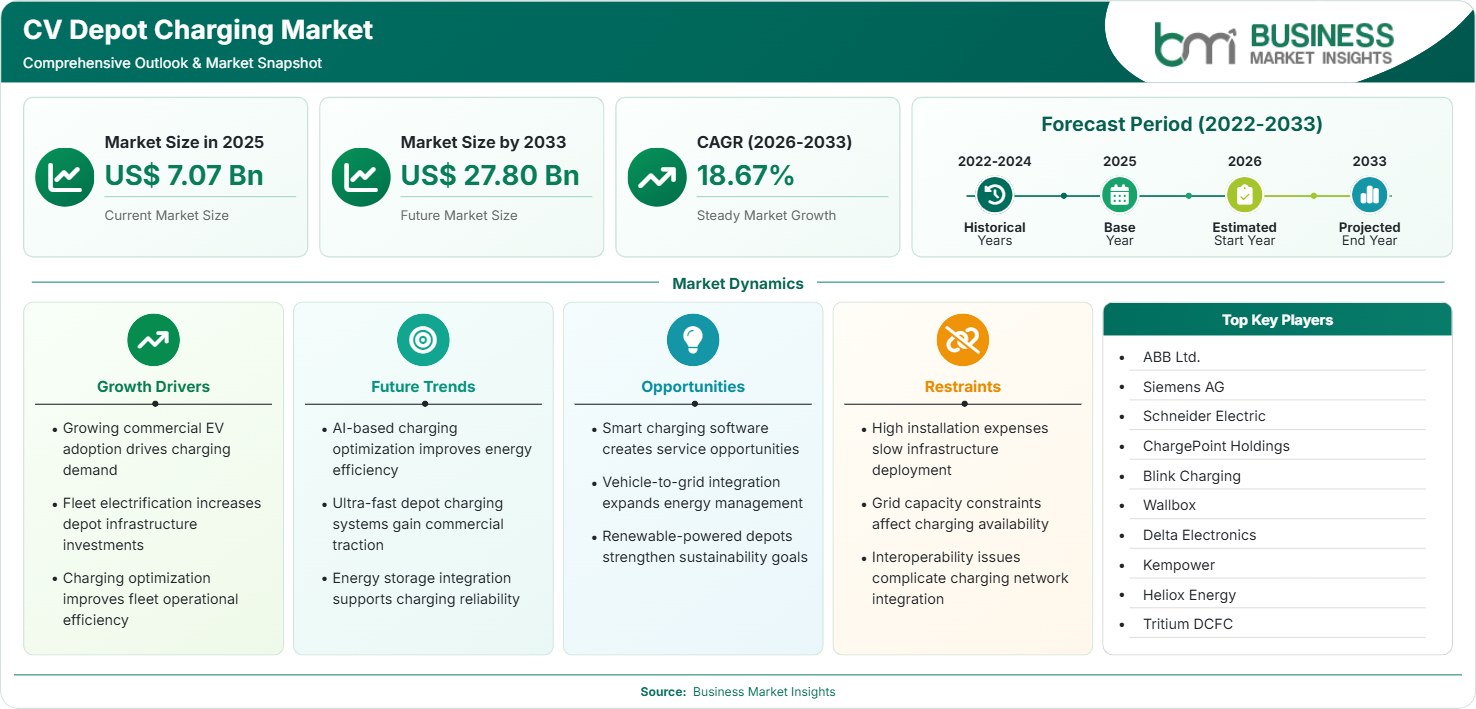
The CV Depot Charging Market size was valued at US$ 7.07 billion in 2025 and is projected to reach US$ 27.8 billion by 2033, growing at a CAGR of 18.67% during 2026–2033. Fleet electrification, rising commercial electric vehicle adoption, and expanding investments in depot charging infrastructure continue accelerating market development across logistics, public transportation, and industrial fleet operations.

Report Coverage
  • Charging Infrastructure Type: AC Charging, DC Fast Charging, Ultra-fast
  • Vehicle Type: Electric Buses, Electric Trucks, Electric Light Commercial Vehicles
  • Depot Type: Private Fleet Depots, Public Charging Depots, Municipal/Government Fleet Depots
  • Charger Power Output: Below 50 kW, 50-150 kW, 150-350 kW, Above 350 kW
  • End User: Logistics & E-commerce Companies, Public Transport Authorities, Industrial & Utility Fleets, Third-party Charging Operators
US$ 7.07 Bn Market size in 2025
US$ 27.80 Bn Market Size by 2033
18.67% CAGR, 2026 - 2033
2026-2033 Forecast Period

AI Overview

CV Depot Charging Market Summary

  • North America Region: North America holds 30%–33% market share in 2025 and is projected to register a CAGR of 17.8%–18.5% during 2026–2033. Government incentives, commercial fleet electrification, and large-scale charging infrastructure investments continue supporting market expansion. The U.S. remains the regional leader, growing at a CAGR of 18.0%–18.8%, driven by logistics fleet modernization and utility-backed charging projects.
  • Fastest Growing Region: Asia Pacific accounts for 34%–37% market share in 2025 and is expected to expand at a CAGR of 20.1%–21.0%, supported by rapid electric bus deployment, commercial vehicle electrification, and increasing investments in high-capacity charging infrastructure.
  • Leading Segment: DC Fast Charging captures 41%–44% market share in 2025 and is projected to record a CAGR of 19.0%–19.8%, driven by shorter charging times, improved fleet utilization, and growing deployment across commercial vehicle depots.
  • High Growth Segment: Logistics & E-commerce Companies represent 33%–36% market share in 2025 and are forecast to expand at a CAGR of 20.2%–21.1%, supported by rapid fleet electrification and increasing demand for efficient last-mile delivery operations.
  • Key Market Opportunity: Smart energy management, renewable-powered charging depots, vehicle-to-grid technologies, and intelligent charging software continue creating attractive investment opportunities for charging infrastructure providers and fleet operators.
  • Major Market Players: ABB Ltd., Siemens AG, Schneider Electric SE, ChargePoint Holdings, Inc., Blink Charging Co., Wallbox N.V., Delta Electronics, Inc., Kempower Oyj, Heliox Energy, and Tritium DCFC Limited.
Strategic Insights

CV Depot Charging Market: Strategic Insights

CV Depot Charging Market Strategic Framework
FREE PDF
Request your free sample
Request free sample
Stakeholder View

Key Takeaways

  • Fleet electrification is reshaping charging infrastructure investment, encouraging integrated solutions combining high-power charging equipment, intelligent energy management, and digital fleet monitoring platforms.
  • Logistics companies and public transportation operators remain the strongest demand generators as they accelerate electric vehicle deployment to reduce emissions and operating costs.
  • Software-enabled charging optimization, predictive maintenance, and energy analytics are becoming key competitive differentiators for infrastructure providers.
  • Asia Pacific offers the strongest long-term investment opportunity due to expanding electric commercial vehicle production, government incentives, and rapid charging infrastructure deployment.
  • Strategic collaborations between utilities, charging technology providers, vehicle manufacturers, and fleet operators continue accelerating commercialization of advanced depot charging solutions.
  • Renewable energy integration and vehicle-to-grid capabilities are expected to strengthen long-term infrastructure efficiency while supporting grid stability and lower fleet operating expenses.
Geographic Outlook

CV Depot Charging Market Regional Highlights

North America CV Depot Charging Market

North America accounts for **30%–33% CV Depot Charging Market Share in 2025 and is expected to expand at a CAGR of 17.8%–18.5% during 2026–2033. Commercial fleet electrification, government incentives, expanding logistics operations, and increasing investment in high-power charging infrastructure continue supporting regional expansion. Utilities and private charging operators are also strengthening charging networks through strategic partnerships and smart energy management solutions.

  • Public funding programs continue accelerating installation of commercial EV depot charging infrastructure across major freight corridors.
  • Fleet operators increasingly deploy intelligent charging systems to optimize electricity consumption and reduce operational expenses.
  • Utilities continue investing in grid modernization projects supporting large-scale commercial charging facilities.
  • Growing adoption of electric delivery vehicles strengthens long-term demand for depot charging technologies.

US CV Depot Charging Market

The United States contributes 82%–85% of North American revenue and is projected to grow at a CAGR of 18.0%–18.8% during the forecast period. Expansion of electric logistics fleets, public transit electrification, and utility-supported charging infrastructure continue strengthening domestic market development.

  • Major logistics companies continue investing in dedicated charging depots supporting nationwide electric fleet operations.
  • Federal and state incentive programs encourage rapid deployment of commercial EV charging infrastructure.
  • High-power DC charging installations continue expanding across freight transportation hubs.
  • Smart charging software improves fleet scheduling and energy utilization efficiency.

Europe CV Depot Charging Market

Europe represents 27%–30% CV depot charging market share in 2025 and is expected to register a CAGR of 18.2%–18.9% through 2026–2033. Strong climate policies, commercial fleet decarbonization strategies, and public transportation electrification continue supporting charging infrastructure investments. Germany leads regional deployment, while the Netherlands records the fastest growth through extensive charging network expansion and government-backed sustainability initiatives.

  • Fleet electrification targets continue driving investments in high-capacity depot charging facilities.
  • Smart energy management systems improve charging efficiency across commercial vehicle fleets.
  • Renewable electricity integration strengthens sustainable charging infrastructure development.
  • Public transit agencies continue expanding electric bus charging depots throughout urban areas.

Asia Pacific CV Depot Charging Market

Asia Pacific holds 34%–37% CV depot charging market share in 2025 and is projected to register the fastest 20.1%–21.0% CAGR during the forecast period. Large-scale electric bus deployment, expanding logistics fleets, manufacturing investments, and supportive government policies continue driving regional market expansion. China remains the largest market, while India records the fastest growth owing to commercial EV adoption and increasing charging infrastructure investments.

  • Rapid urbanization continues increasing demand for electric public transportation infrastructure.
  • Commercial vehicle manufacturers expand electric fleet production across regional markets.
  • Government incentive programs support nationwide charging infrastructure deployment.
  • Private logistics companies continue investing in dedicated fleet charging facilities.

Rest of World CV Depot Charging Market

The Rest of World region accounts for 7%–10% market share in 2025 and is expected to expand at a CAGR of 18.5%–19.3% through 2026–2033. Growth is supported by expanding commercial vehicle electrification, infrastructure modernization, and sustainability initiatives across Latin America, the Middle East, and Africa. Brazil leads regional adoption, while the UAE records the fastest growth through clean mobility investments and smart city development.

  • Municipal fleet electrification projects continue supporting charging infrastructure deployment.
  • Renewable-powered charging depots gain traction across energy-intensive fleet operations.
  • Public-private partnerships accelerate commercial charging network expansion.
  • Industrial fleet operators increasingly adopt depot charging systems to reduce fuel costs and emissions.
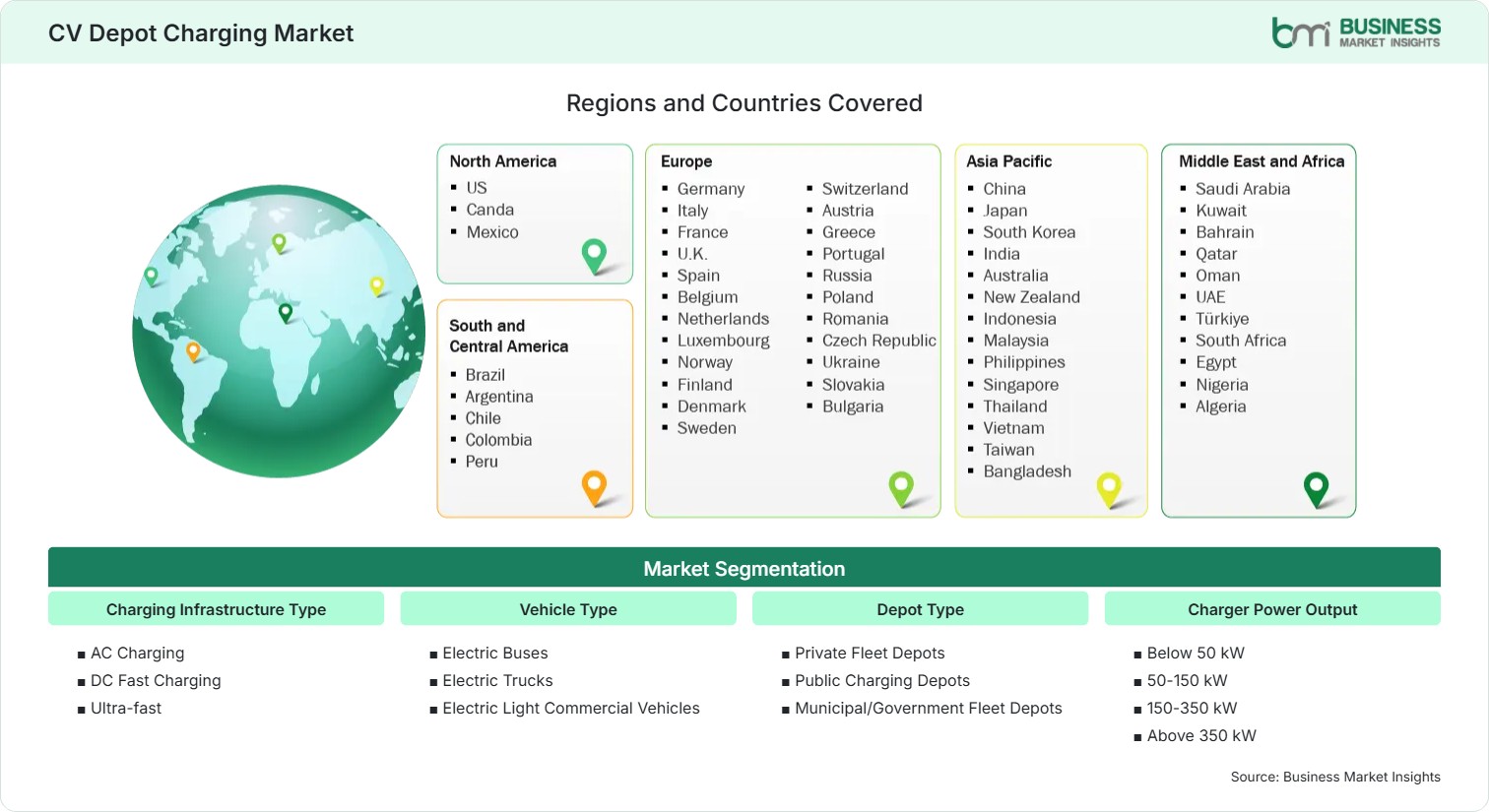
Global Market Geography
FREE PDF
Request your free sample
Request free sample
Segment Analysis

CV Depot Charging Market Segmentation

Charging Infrastructure Type

Charging infrastructure type remains the foundation of depot electrification strategies as fleet operators select charging technologies based on vehicle utilization, charging duration, and operational requirements. This segment accounted for 41%–44% market share in 2025 and is projected to register a CAGR of 19.0%–19.8% during 2026–2033. Expanding fleet electrification, high-power charging deployment, and smart energy management continue broadening the CV Depot Charging Market scope across commercial transportation and public transit applications.

  • AC Charging: Primarily deployed for overnight charging where fleets operate on predictable schedules. Lower installation costs, reduced grid requirements, and dependable charging performance make AC systems suitable for light commercial vehicle depots.
  • DC Fast Charging: Represents the largest deployment category owing to significantly shorter charging durations, higher operational efficiency, and the ability to maximize commercial fleet utilization across logistics and public transportation networks.
  • Ultra-fast: Gains momentum among high-utilization commercial fleets requiring minimal charging downtime. Continuous improvements in charger performance and battery compatibility are supporting broader deployment across large depot facilities.

Vehicle Type

Vehicle electrification continues reshaping charging infrastructure investment as commercial fleet operators expand zero-emission transportation programs. The segment accounted for 36%–39% market share in 2025 and is expected to grow at a CAGR of 19.4%–20.1% through 2026–2033. Current CV Depot Charging Market trends indicate growing deployment of dedicated charging infrastructure for heavy-duty commercial vehicles and urban delivery fleets.

  • Electric Buses: Public transit authorities continue expanding electric bus fleets, increasing demand for high-capacity depot charging systems capable of supporting scheduled overnight and opportunity charging operations.
  • Electric Trucks: Long-haul distribution, regional freight, and industrial logistics companies continue investing in depot charging infrastructure to support expanding electric truck deployment and improve fleet productivity.
  • Electric Light Commercial Vehicles (eLCVs): Rapid expansion of e-commerce, courier services, and urban logistics continues driving adoption of depot charging solutions designed for high-frequency delivery vehicle operations.

Depot Type

Depot ownership models significantly influence charging infrastructure deployment strategies, operational control, and energy management capabilities. This segment represents 33%–36% market share in 2025 and is projected to expand at a CAGR of 18.9%–19.6% during the forecast period as organizations increase investments in dedicated commercial charging facilities.

  • Private Fleet Depots: Large logistics companies increasingly develop private charging hubs to optimize charging schedules, lower operating expenses, and improve fleet availability through centralized energy management.
  • Public Charging Depots: Independent charging providers continue expanding commercial charging networks that serve multiple fleet operators while improving infrastructure accessibility and utilization rates.
  • Municipal/Government Fleet Depots: Government agencies continue investing in depot charging infrastructure supporting electric buses, sanitation vehicles, utility fleets, and other public service transportation assets.

Charger Power Output

Power output selection depends on vehicle battery capacity, charging frequency, fleet utilization, and available electrical infrastructure. The segment continues expanding as operators prioritize efficient charging strategies while balancing installation costs and operational performance across commercial fleet depots.

  • Below 50 kW: Commonly used for overnight charging applications where extended charging duration does not affect daily fleet utilization or operational schedules.
  • 50–150 kW: Offers an effective balance between charging speed, infrastructure investment, and energy efficiency, making it suitable for medium-duty commercial fleet operations.
  • 150–350 kW: Increasingly deployed for heavy commercial fleets requiring faster turnaround times, reduced downtime, and improved daily vehicle utilization.
  • Above 350 kW: Supports next-generation commercial vehicle charging applications requiring ultra-high charging capacity for heavy-duty electric trucks and future high-performance fleet operations.

End User

End-user demand continues expanding as commercial transportation organizations accelerate electrification to improve sustainability, reduce operating costs, and comply with emission regulations. This segment accounted for 33%–36% market share in 2025 and is forecast to register the fastest 20.2%–21.1% CAGR through 2026–2033.

  • Logistics & E-commerce Companies: Represents the largest end-user category as expanding delivery operations require reliable depot charging infrastructure supporting high-frequency electric vehicle utilization.
  • Public Transport Authorities: Continue deploying dedicated charging depots to support growing electric bus fleets while improving operational efficiency and reducing urban transportation emissions.
  • Industrial & Utility Fleets: Utilities, construction companies, and industrial operators increasingly electrify commercial vehicle fleets supported by centralized depot charging infrastructure.
  • Third-party Charging Operators: Continue expanding commercial depot charging services by providing scalable charging infrastructure, digital energy management platforms, and charging-as-a-service business models for fleet customers.
Market Forces

CV Depot Charging Market Dynamics

Key Market Drivers

Growing commercial EV adoption drives charging demand

The shift of electric commercial vehicles to all-electric operation has led to consistent demand for infrastructure specifically designed to charge them. This need for reliable charging systems that can sustain the use of the vehicle without causing any downtime in their operations is becoming a norm among fleet owners. Technological innovations in batteries and charging equipment have made electric commercial vehicles a feasible solution. This has resulted in the development of energy management systems for charging infrastructure. These developments continue supporting CV Depot Charging Market Growth by enabling businesses to operate larger electric fleets with improved efficiency and lower operating costs.

Fleet electrification increases depot infrastructure investments

Businesses across freight transportation, public transit, and industrial operations are accelerating fleet electrification to reduce emissions, comply with environmental regulations, and improve long-term operating efficiency. As the deployment of electric vehicles increases, companies are developing dedicated charging stations to service larger numbers of vehicles with varying charging needs. Similarly, manufacturers of charging equipment have begun to develop new lines of modular equipment that can be expanded in the future. The collaboration between utility companies, fleet owners, and technology companies is becoming more robust to enhance the charging environment.

Charging optimization improves fleet operational efficiency

Fleet operators increasingly rely on intelligent charging management platforms to maximize charger utilization, reduce electricity expenses, and optimize vehicle availability. Smart scheduling systems balance charging requirements based on fleet operating hours, battery status, and energy costs. These innovations can also help in better maintenance of vehicles via their diagnostics and predictive monitoring features. The integration of such technologies with fleet management systems allows coordination between charging processes and schedules, making it possible to increase productivity. Further innovation in this area changes the way fleet management operates and makes depot charging solutions more competitive in the market.

Key Market Opportunities

Smart charging software creates service opportunities

As the charging process becomes increasingly complex, there is a need for advanced software platforms that can manage multiple chargers, monitor power consumption, and offer remote monitoring for vehicle fleets. Software vendors are developing more cloud-based solutions that maximize charger efficiency while making it easier for fleet owners to manage infrastructure. CV Depot Charging Market Forecasts indicate that software-driven charging ecosystems will become increasingly important as commercial fleets continue expanding and charging infrastructure becomes more digitally connected.

Vehicle-to-grid integration expands energy management

Vehicle-to-grid technology is creating new opportunities for fleet operators to participate in energy balancing while improving utilization of parked commercial vehicles. Charging infrastructure capable of bidirectional power flow enables fleets to support grid stability, optimize electricity consumption, and generate additional revenue through energy services. Utilities are increasingly collaborating with charging providers to develop integrated energy management platforms that improve operational flexibility. As charging infrastructure evolves, vehicle-to-grid capabilities are expected to become an important differentiator for large commercial fleet operators.

Renewable-powered depots strengthen sustainability goals

Commercial fleet operators are increasingly combining depot charging infrastructure with on-site renewable energy generation and battery storage systems to improve energy resilience and reduce operating expenses. Solar-powered charging facilities and integrated energy storage solutions help lower dependence on conventional electricity while supporting corporate sustainability initiatives. Renewable-powered depots also improve long-term cost predictability by reducing exposure to electricity price fluctuations. These integrated energy solutions are expected to gain wider adoption as organizations pursue lower-carbon transportation operations and improved environmental performance.

Market Restraints and Challenges

High installation expenses slow infrastructure deployment

Factor: Commercial depot charging projects require significant capital investment for charging equipment, electrical upgrades, transformers, grid connections, civil construction, and energy management systems. These infrastructure requirements substantially increase initial deployment costs, particularly for large commercial fleet operators establishing high-capacity charging depots. Impact: Higher upfront expenditure extends investment payback periods and may delay infrastructure expansion, especially among small and medium-sized fleet operators with limited capital resources, slowing broader market adoption.

Grid capacity constraints affect charging availability

Factor: Rapid expansion of commercial charging infrastructure increases electricity demand beyond the existing capacity of many local distribution networks, requiring costly grid reinforcement and utility coordination before large-scale charging systems can become operational. Impact: Limited grid availability can postpone charging infrastructure deployment, reduce charging reliability during peak demand periods, and increase project development timelines, creating operational challenges for fleet operators planning rapid commercial vehicle electrification.

Interoperability issues complicate charging network integration

Factor: Differences in charging protocols, communication standards, software platforms, and hardware compatibility continue creating integration challenges across commercial charging ecosystems involving multiple vehicle manufacturers and charging providers. Impact: Inconsistent interoperability increases deployment complexity, raises maintenance requirements, and may reduce operational efficiency, making large-scale fleet charging management more difficult for organizations operating diverse electric commercial vehicle fleets.

Company Analysis

Competitive Landscape

The competitive environment is shaped by continuous investments in high-power charging systems, smart energy management software, and integrated fleet charging solutions. CV Depot Charging Market Analysis shows that leading companies are expanding manufacturing capacity, strengthening software capabilities, and forming partnerships with fleet operators, utilities, and vehicle manufacturers to accelerate commercial charging infrastructure deployment across global markets.

Company Name

Overview

Products and Services Relevant to this Market

ABB Ltd.

Global electrification technology leader providing EV charging solutions and digital energy management systems for commercial and industrial applications.

DC fast chargers, ultra-fast charging systems, energy management software, fleet charging solutions, and charging infrastructure services.

Siemens AG

Multinational technology company delivering intelligent charging infrastructure integrated with power distribution and digital grid solutions.

Depot charging systems, smart charging software, electrical infrastructure, grid integration solutions, and fleet energy management platforms.

Schneider Electric SE

Global energy management specialist focused on sustainable charging infrastructure and intelligent electrical systems.

EV charging equipment, energy management software, depot electrification solutions, power distribution products, and automation technologies.

ChargePoint Holdings, Inc.

Leading charging network provider offering scalable commercial charging infrastructure and cloud-based fleet management services.

Commercial charging stations, fleet charging software, network management, charging analytics, and subscription-based charging services.

Blink Charging Co.

Provider of EV charging equipment and network solutions serving commercial fleets and public charging operators.

DC fast chargers, charging stations, charging network services, fleet charging software, and maintenance solutions.

Wallbox N.V.

Charging technology company specializing in intelligent charging hardware and energy management solutions.

Smart chargers, depot charging systems, energy optimization software, bidirectional charging technology, and fleet charging solutions.

Delta Electronics, Inc.

Industrial technology company supplying advanced power electronics and commercial EV charging systems.

DC chargers, power conversion systems, depot charging equipment, industrial power solutions, and energy management technologies.

Kempower Oyj

Finnish charging technology company focused on scalable fast-charging systems for commercial transportation.

Fast charging systems, modular chargers, charging software, fleet charging infrastructure, and depot charging solutions.

Heliox Energy

Provider of heavy-duty charging infrastructure designed for buses, trucks, and commercial vehicle fleets.

High-power charging systems, smart depot charging solutions, energy management software, and charging infrastructure integration services.

Tritium DCFC Limited

Manufacturer specializing in high-performance DC fast charging solutions for commercial transportation networks.

DC fast chargers, ultra-fast charging systems, charging software, fleet charging technologies, and charging network infrastructure.

Trust & Transparency

Research Methodology

The market analysis combines proprietary research with secondary data from government agencies, company disclosures, regulatory filings, industry databases and expert interviews. Market estimates are validated through data triangulation, cross-market benchmarking and analyst review.

View Full Research Methodology

Questions Answered

Frequently Asked Questions

What does the CV Depot Charging Market Report cover?

The Market Report provides detailed insights into market segmentation, regional outlook, competitive landscape, technology developments, investment opportunities, industry challenges, and future growth prospects.

Which end-user segment offers the strongest opportunity?

Logistics and e-commerce companies represent the strongest growth opportunity as businesses continue electrifying delivery fleets to improve operational efficiency and achieve sustainability objectives.

Which region is expected to grow the fastest?

Asia Pacific is projected to record the highest growth, supported by rapid commercial EV deployment, government incentives, expanding manufacturing capacity, and increasing investments in charging infrastructure.

Which charging infrastructure type leads the market?

DC Fast Charging leads the market because it significantly reduces charging time, improves commercial fleet utilization, and supports continuous operation of buses, trucks, and electric light commercial vehicles.

What is driving demand in the CV Depot Charging Market?

Growing commercial electric vehicle adoption, fleet electrification programs, expanding logistics operations, and increasing investments in high-capacity charging infrastructure are the primary factors accelerating market demand.

Access the Full CV Depot Charging Market Report

Get segment-level forecasts, regional estimates, competitive benchmarking, company profiles and downloadable Excel datasets.

Access the full CV Depot Charging Market Report
350 pages PDF & Excel | 2026-08-21