
EV Platform Market Outlook: Size, Share, Trends, Growth Analysis, Competitive Landscape & Forecast, 2026-2033

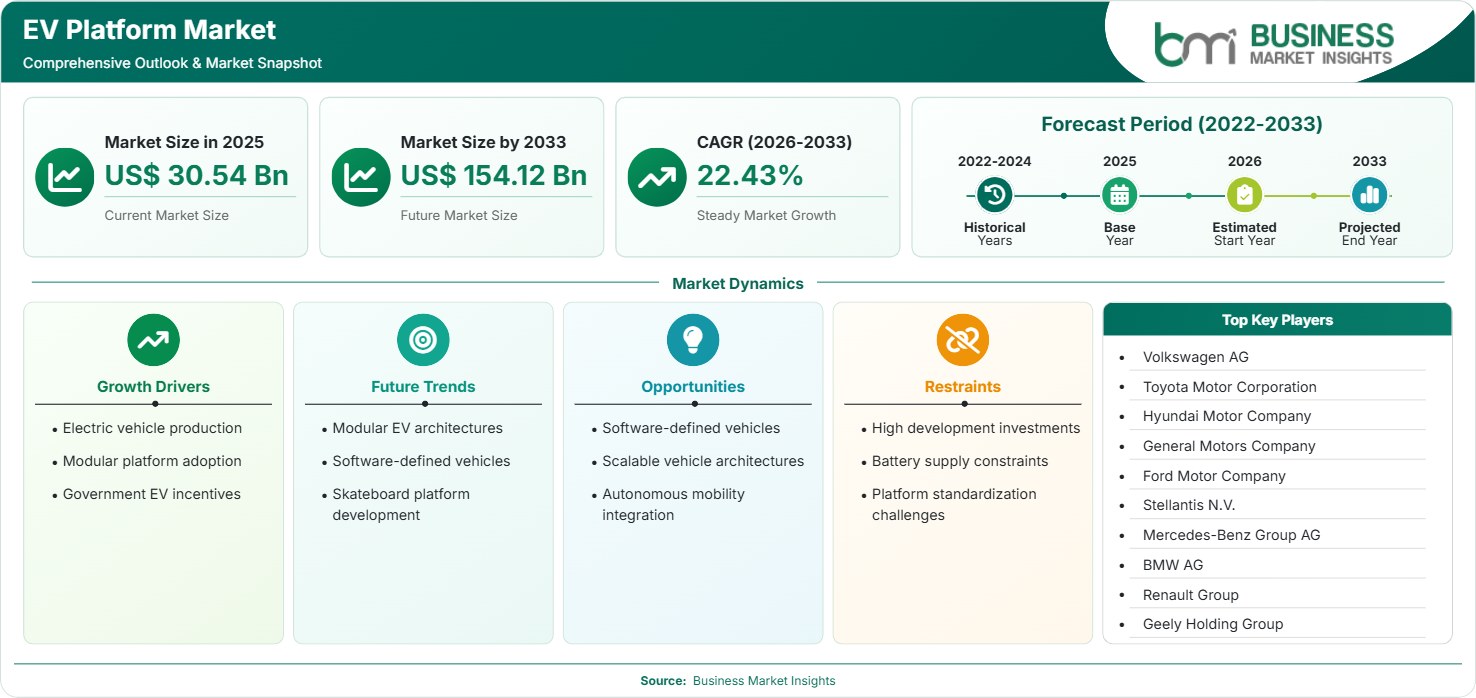
The EV Platform Market size was valued at US$ 30.54 billion in 2025 and is projected to reach US$ 154.12 billion by 2033, growing at a CAGR of 22.43% during 2026–2033. Growth is driven by electric vehicle production expansion, modular platform adoption, government EV incentives, software-defined vehicles, scalable architectures, and autonomous mobility integration.

Report Coverage
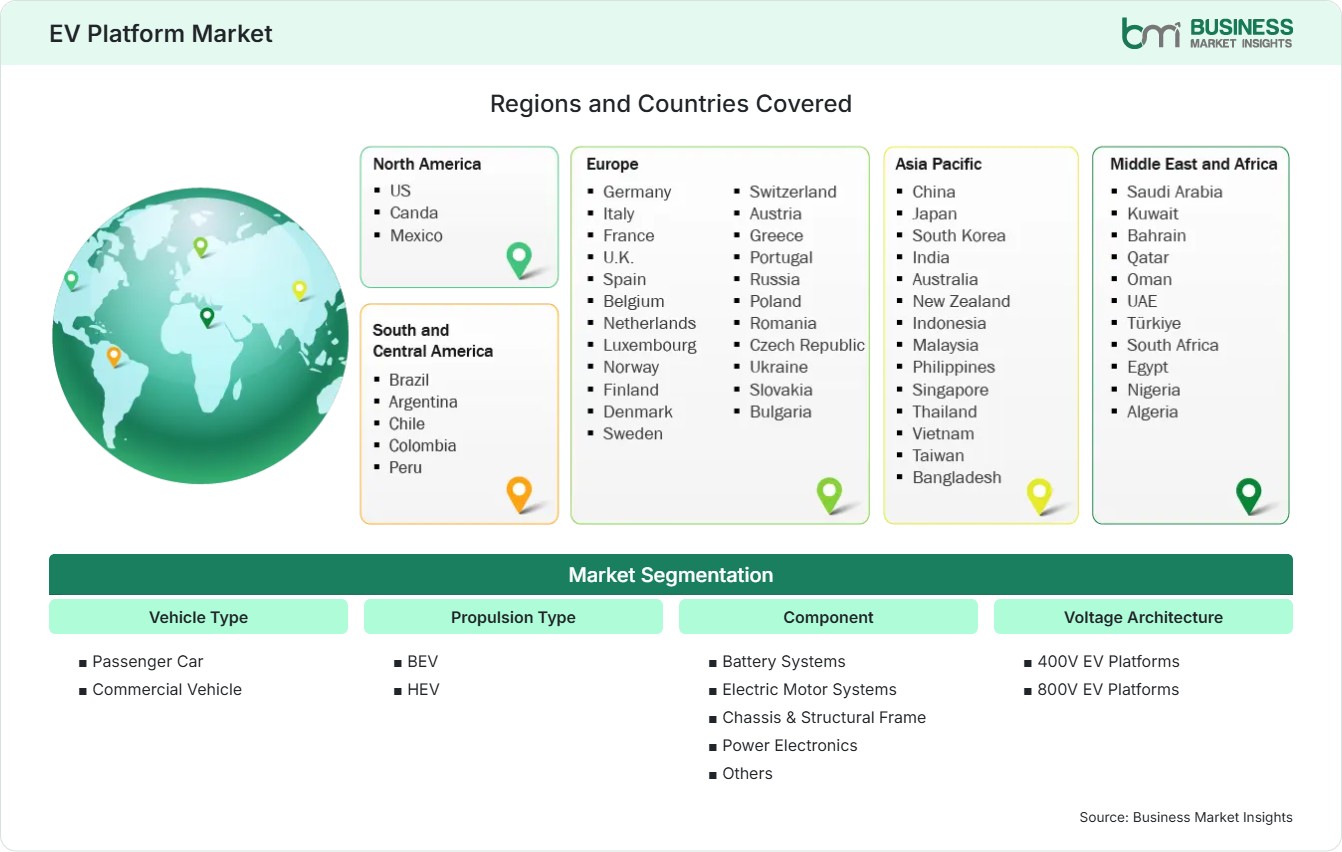
  • Vehicle Type: Passenger Car, Commercial Vehicle
  • Propulsion Type: BEV, HEV
  • Component: Battery Systems, Electric Motor Systems, Chassis & Structural Frame, Power Electronics, Others
  • Voltage Architecture: 400V EV Platforms, 800V EV Platforms
US$ 30.54 Bn Market size in 2025
US$ 154.12 Bn Market Size by 2033
22.43% CAGR, 2026 - 2033
2026-2033 Forecast Period

01 AI Overview

EV Platform Market Summary

  • North America Region: North America holds an estimated 28%–32% EV platform market share in 2025, growing at a 21.5%–22.5% CAGR during 2026–2033. Growth is supported by EV manufacturing expansion, charging infrastructure development, government incentives, and investments in dedicated electric vehicle architectures. The US market remains the largest contributor, growing at an estimated 21.8%–22.8% CAGR through 2033 due to rising EV production and domestic battery ecosystem development.
  • Fastest Growing Region: Asia Pacific accounts for an estimated 45%–49% share in 2025, expanding at a 23.0%–24.0% CAGR during 2026–2033. Growth is driven by large-scale EV manufacturing, battery supply chain integration, government electrification programs, and rapid adoption of modular vehicle platforms.
  • Leading Segment: Battery Electric Vehicle (BEV) platforms account for an estimated 74%–78% share in 2025, growing at a 22.5%–23.5% CAGR during 2026–2033. Expansion is influenced by automaker investments in dedicated EV architectures, battery optimization, and next-generation electric mobility solutions.
  • High Growth Segment: 800V EV platforms represent an estimated 18%–22% share in 2025, expanding at a 27.0%–28.0% CAGR during 2026–2033. Growth is supported by faster charging requirements, premium EV adoption, improved energy efficiency, and high-performance electric vehicle development.
  • Key Market Opportunity: Software-defined vehicles, scalable EV architectures, and autonomous mobility integration are creating opportunities for manufacturers developing flexible platforms with advanced electronics and intelligent vehicle control capabilities.
  • Major Market Players: Volkswagen AG, Toyota Motor Corporation, Hyundai Motor Company, General Motors Company, Ford Motor Company, Stellantis N.V., Mercedes-Benz Group AG, BMW AG, Renault Group, Geely Holding Group.
02 Strategic Insights

EV Platform Market: Strategic Insights

EV Platform Market Strategic Framework
FREE PDF
Request your free sample
Request free sample
03 Stakeholder View

Key Takeaways

  • The EV platform ecosystem includes automotive manufacturers, battery suppliers, semiconductor providers, software developers, component suppliers, and mobility technology companies creating integrated electric vehicle architectures.
  • Dedicated EV platforms provide significant growth opportunities by enabling faster vehicle launches, shared components, improved manufacturing efficiency, and broader electric vehicle portfolio expansion.
  • Platform innovation is shifting toward software-defined architectures, centralized computing systems, advanced battery integration, and high-voltage electrical systems.
  • Asia Pacific offers the strongest investment opportunity due to EV manufacturing leadership, battery production capacity, government electrification policies, and expanding electric vehicle supply chains.
  • Automotive companies are pursuing strategic partnerships, technology collaborations, and platform-sharing initiatives to reduce development costs and accelerate EV commercialization.
  • Integration of EV platforms with autonomous driving systems, connected technologies, and intelligent energy management solutions is shaping the future automotive development landscape.
04 Geographic Outlook

EV Platform Market Regional Highlights

North America EV Platform Market

North America accounts for an estimated 28%–32% share in 2025, supported by expanding EV production, domestic battery investments, government incentives, and increasing demand for electric SUVs and commercial vehicles. The region is projected to grow at a 21.5%–22.5% CAGR during 2026–2033. The United States represents the primary contributor due to growing EV manufacturing capacity and strategic investments in electrification technologies.

  • The United States leads EV platform investments through expanding domestic production capabilities.
  • Government incentives encourage automakers to establish regional EV manufacturing ecosystems.
  • Battery supply chain development supports dedicated electric vehicle architecture deployment.
  • Automotive manufacturers are increasing investments in scalable EV platforms.

US EV Platform Market

The US represents an estimated 85%–89% share of North America's market in 2025 and is expected to expand at a 21.8%–22.8% CAGR through 2033. Growth is driven by electric pickup trucks, passenger EV adoption, battery manufacturing investments, and increasing collaboration between automakers and technology providers.

  • Electric pickup and SUV platforms are expanding rapidly across the US market.
  • Automakers are developing dedicated EV architectures for multiple vehicle segments.
  • Federal and state incentives support domestic EV manufacturing expansion.

Europe EV Platform Market

Europe represents an estimated 23%–27% share in 2025, growing at a 21.7%–22.6% CAGR during 2026–2033. Growth is supported by stringent emission regulations, electrification targets, premium EV development, and strong automotive engineering capabilities. Germany, France, the United Kingdom, and Sweden remain major contributors due to established automotive industries and EV innovation programs.

  • Germany drives platform development through premium EV manufacturing investments.
  • France supports EV architecture expansion through domestic automotive electrification programs.
  • Sweden advances electric mobility through sustainable vehicle development initiatives.
  • European automakers prioritize modular platforms for diversified EV portfolios.

Asia Pacific EV Platform Market

Asia Pacific represents an estimated 45%–49% share in 2025 and records the fastest growth at a 23.0%–24.0% CAGR during 2026–2033. China, Japan, South Korea, and India are major contributors due to strong EV production capacity, battery ecosystem development, and government-backed electrification strategies. Regional manufacturers are rapidly scaling dedicated electric platforms for domestic and global markets.

  • China leads EV platform adoption through extensive electric vehicle manufacturing capacity.
  • Japan develops advanced platforms through established automotive technology expertise.
  • South Korea expands EV architecture investments through battery and vehicle integration.
  • India is increasing EV platform development through emerging electrification initiatives.
  • Southeast Asia is attracting EV manufacturing investments from global automakers.

Rest of World EV Platform Market

Latin America, the Middle East, and Africa collectively account for an estimated 4%–8% share in 2025, expanding at a 21.5%–22.5% CAGR through 2033. Growth is supported by emerging EV adoption, infrastructure development, renewable energy investments, and government electrification initiatives. Brazil, Mexico, UAE, and South Africa represent important markets for future EV platform expansion.

  • Brazil is developing EV adoption through increasing electric mobility investments.
  • Mexico benefits from automotive manufacturing capabilities supporting EV production.
  • Middle Eastern countries invest in electric mobility diversification strategies.
  • South Africa is exploring EV manufacturing opportunities through industrial initiatives.
  • Regional charging infrastructure development supports future platform deployment.
Global Market Geography
FREE PDF
Request your free sample
Request free sample
05 Segment Analysis

EV Platform Market Segmentation

Vehicle Type

The Vehicle Type segment represents a major classification within the EV Platform Market, accounting for an estimated 96%–98% share in 2025 and expanding at a 22.0%–22.8% CAGR during 2026–2033. Passenger cars dominate adoption due to rising consumer electrification demand, increasing EV model availability, and automaker investments in dedicated architectures. Commercial vehicle platforms are gaining momentum as logistics companies and fleet operators adopt electric mobility solutions to reduce emissions and operating costs.

  • Passenger Car: Passenger car EV platforms support expanding electric vehicle portfolios, improved battery integration, enhanced driving range, and scalable architectures for diverse consumer mobility applications.
  • Commercial Vehicle: Commercial vehicle platforms enable electric trucks, buses, and fleet vehicles through durable architectures designed for higher loads, operational efficiency, and reduced transportation emissions.

Propulsion Type

The propulsion type segment holds a market share of around 98% to 99% in 2025 and is expected to expand at a 22.3% to 23.1% CAGR between 2026 and 2033. BEV platforms retain market dominance due to growing efforts toward electrification, innovations in battery technology, and investments in EV platform architecture. HEV platforms continue supporting transitional mobility strategies as manufacturers balance electrification goals with existing powertrain technologies and consumer requirements across different markets.

  • BEV: BEV platforms experience strong adoption through dedicated battery integration, simplified drivetrain structures, software capabilities, and increasing investments from global automotive manufacturers.
  • HEV: HEV platforms support the electrification transition by combining conventional powertrains with electric systems, improving efficiency and enabling gradual vehicle technology transformation.

Component

Component Segment is forecast to have a share of about 94%-98% by 2025 and is projected to witness growth at a CAGR of 22.1%-22.9% until 2033. Battery systems play a pivotal role in the creation of EV platforms owing to their emphasis on higher energy density and better vehicle range. There has been considerable investment in electric motor systems, power electronics, and structural components, which are also receiving significant investment as automakers seek integrated architectures with improved efficiency, reduced weight, and enhanced performance, aligning with EV platform market trends.

  • Battery Systems: Battery systems are critical EV platform components, influencing vehicle range, charging speed, energy efficiency, thermal management, and overall electric vehicle performance.
  • Electric Motor Systems: Electric motor systems improve propulsion efficiency, power delivery, and vehicle performance while supporting compact and integrated electric platform designs.
  • Chassis & Structural Frame: Chassis and structural frames enable optimized battery placement, vehicle safety, lightweight construction, and flexible platform adaptation across multiple EV models.
  • Power Electronics: Power electronics systems manage energy conversion, charging functions, and electrical performance while supporting advanced EV platform efficiency requirements.

Voltage Architecture

The Voltage Architecture segment is projected to account for 92%–96% of the market in 2025 and register a CAGR of 22.6%–23.5% between 2026 and 2033. The rising demand for enhanced charging speeds, efficiency, and luxury electric vehicles has led to the rapid adoption of cutting-edge voltage architectures. Although a 400V voltage architecture is popular because of its existing infrastructure and lower cost, an 800V voltage architecture is witnessing robust growth.

  • 400V EV Platforms: 400V EV platforms maintain broad adoption due to established technology, lower costs, charging compatibility, and deployment across mainstream electric vehicle segments.
  • 800V EV Platforms: 800V EV platforms enable faster charging, improved efficiency, reduced energy losses, and enhanced performance for premium and high-performance electric vehicles.
06 Market Forces

EV Platform Market Dynamics

Key Market Drivers

Electric vehicle production accelerates platform demand

The growth of the EV Platform Market is mainly attributed to increased electric vehicle production as carmakers move towards dedicated electric architectures. Car manufacturers are making more investments in scalable platforms that make it possible for several models of cars to be made at the same time while being cost-effective and efficient in production. Increased battery production capability, development of charging infrastructure, and consumer uptake have led to companies making efforts towards building flexible electric car platforms.

Modular platform adoption improves manufacturing efficiency

Modular designs of EVs are increasingly being used by car manufacturers because of their potential to save costs, speed up time-to-market, and enhance manufacturing versatility. Modular systems permit adjustments in the size of batteries, vehicle sizes, and performance characteristics of various car models through shared engineering designs. This way, it becomes easier for manufacturers to scale up electric vehicle product lines according to market needs. The automobile industry is focusing on the use of skateboard systems, shared platforms, and flexible manufacturing systems.

Government EV incentives accelerate electrification investments

Government incentives and regulations have made EV platform investments more aggressive, encouraging manufacturers and consumers to adopt electric mobility. Policies for battery production, car manufacture, charging infrastructure, and emissions are enhancing the overall EV ecosystem. Car makers are utilizing these incentives to build manufacturing plants and EV platforms. Electrification policies across regions are driving higher demand for platforms that can be integrated with batteries to improve performance and reduce emissions.

Key Market Opportunities

Software-defined vehicles reshape EV platform development

Software-Defined Vehicles are a significant opportunity that exists as EV Platforms increasingly adopt central processing, OTA upgrades, superior connectivity, and intelligent vehicle management systems. Current EV design is evolving from hardware-centric to software-based, enabling improvements even in use. EV Platform Market forecasts are driven by the rising need for connectivity, autonomy, and vehicle digitalization. Organizations designing flexible platforms that feature advanced software integration, security measures, and scalable electronic architecture will be able to capitalize on emerging opportunities.

Scalable vehicle architectures expand market opportunities

Scalable vehicle architecture helps in creating several types of vehicles using a common platform architecture, making development easier and more efficient. The platforms allow the design of varying body types, battery types, and performance characteristics. The automakers are focusing on scalable architectures to quickly expand their electric vehicle portfolio in regional markets. Supplier companies offering modular parts and system solutions, along with platform engineering technology, could gain from the rising demand for efficient electric vehicle development methods.

Autonomous mobility integration creates future opportunities

Integration of autonomous mobility solutions into electric vehicles is presenting avenues for advanced development of vehicle architectures. This is because the platform for the electric vehicle has numerous strengths in relation to the use of autonomous mobility solutions, as it allows flexibility in electronic configurations, efficient computing, and power management. There is a need for future design of the electric vehicle platform to accommodate intelligent vehicle control and advanced computing capabilities.

Market Restraints and Challenges

High development investments limit platform expansion

Factor: The development of custom-built electric vehicle platforms involves huge capital investments for engineering, batteries, factories, software, and testing systems.

Impact: Higher development costs may be a deterrent to adoption by smaller car makers and place a strain on automobile firms financially. Automakers must reach scale and develop effective platform-sharing techniques.

Battery supply constraints affect EV platform scalability

Factor: The limited availability of crucial battery components, production capacity constraints, and supply chain disruptions affect EV production planning.

Impact: Constraints related to batteries could cause delays in launching cars, raise the cost of components, and limit platform scalability. Automakers are making efforts to enhance supply chain security through battery partnerships and alternative technologies.

07 Company Analysis

Competitive Landscape

The competitive environment in this market is driven by global automobile companies, electric vehicle pioneers, stakeholders in the battery industry, and vendors of technologies building specific platforms for vehicles. Companies are concentrating on modular platforms, scalable electric architectures, high voltage, software integration, and battery management capabilities to build strong portfolios of EVs. According to the EV Platform Market analysis, the competition in this market is growing in relation to flexible platforms accommodating various vehicles, rapid development, autonomous driving features, and software-defined vehicles.

Company Name

Overview

Products and Services relevant to this market

Volkswagen AG

Global automotive manufacturer investing heavily in electric mobility platforms and vehicle architectures.

MEB electric platform, scalable EV architectures, battery integration, electric vehicle platforms.

Toyota Motor Corporation

Automotive company developing electrified mobility solutions and next-generation vehicle platforms.

Electric vehicle platforms, hybrid architectures, battery systems, vehicle development technologies.

Hyundai Motor Company

Automotive manufacturer advancing dedicated electric vehicle platforms globally.

E-GMP platform, EV architectures, battery integration, electric powertrain technologies.

General Motors Company

Automotive manufacturer focused on electric mobility transformation and scalable platforms.

Ultium platform, battery systems, EV architectures, electric vehicle technologies.

Ford Motor Company

Global automaker developing electric vehicle platforms and commercial EV solutions.

Electric vehicle platforms, battery systems, commercial EV architectures, power electronics.

Stellantis N.V.

Automotive group developing multi-energy vehicle platforms for global markets.

STLA electric platforms, EV architectures, battery solutions, electric mobility systems.

Mercedes-Benz Group AG

Premium automotive company developing advanced luxury electric vehicle platforms.

EVA electric architecture, battery platforms, premium EV systems, software technologies.

BMW AG

Automotive manufacturer focused on flexible electrified vehicle architectures.

Neue Klasse platform, EV systems, battery integration, electric mobility solutions.

Renault Group

Automotive company expanding electric mobility through dedicated vehicle platforms.

CMF-EV platform, electric vehicle architectures, battery systems, mobility technologies.

Geely Holding Group

Automotive group developing electric platforms across multiple vehicle brands.

Sustainable Experience Architecture, EV platforms, electric powertrain technologies.

08 Industry Activity

Recent Developments

June 2026

Tata Motors confirmed that the Sierra EV will be built on its Gen2 acti.ev+ architecture, the same platform used for the Harrier EV, and announced that the vehicle will be available in both rear-wheel-drive and all-wheel-drive configurations with 65 kWh and 75 kWh battery pack options.

June 2026

Tata Motors overhauled the technology strategy for its Avinya premium electric vehicle program by replacing the previously planned JLR Electrified Modular Architecture (EMA) with a platform sourced from the Chery-JLR (CJLR) ecosystem.

June 2026

Trevel raised US$1 million (approximately ₹8.5 crore) in a funding round co-led by India Accelerator and Finvolve to support the expansion of its electric mobility platform.

January 2026

WATT Electric Vehicle Company and Donut Lab unveiled a lightweight skateboard EV platform at CES 2026, integrating Donut Lab's in-wheel motor technology with WATT's PACES aluminum chassis to support modular passenger and commercial electric vehicle applications.

10 Trust & Transparency

Research Methodology

The market analysis combines proprietary research with secondary data from government agencies, company disclosures, regulatory filings, industry databases and expert interviews. Market estimates are validated through data triangulation, cross-market benchmarking and analyst review.

View Full Research Methodology

11 Questions Answered

Frequently Asked Questions

What challenges affect EV platform development?

Major challenges include high engineering investments, battery supply constraints, raw material availability issues, complex manufacturing transitions, and the need for advanced software capabilities.

How are 800V EV platforms influencing the market?

800V platforms enable faster charging, improved energy efficiency, reduced electrical losses, and enhanced performance, particularly in premium and high-performance electric vehicles.

Why are modular EV platforms important?

Modular EV platforms reduce development costs, accelerate vehicle launches, support multiple models, and improve manufacturing flexibility across different vehicle segments.

Which propulsion type dominates EV platform adoption?

In the EV platform market report, BEV platforms dominate due to rising demand for fully electric vehicles, dedicated battery architectures, improved efficiency, and increasing investments by global automakers.

What is driving growth in the market?

Growth is driven by increasing electric vehicle production, modular platform adoption, government electrification incentives, battery technology advancements, and demand for scalable vehicle architectures.

Access the Full EV Platform Market Report

Get segment-level forecasts, regional estimates, competitive benchmarking, company profiles and downloadable Excel datasets.

Access the full EV Platform Market Report
350 pages PDF & Excel | 2026-07-31