
Battery As A Service Market Outlook: Size, Share, Trends, Growth Analysis, Competitive Landscape & Forecast, 2026–2033

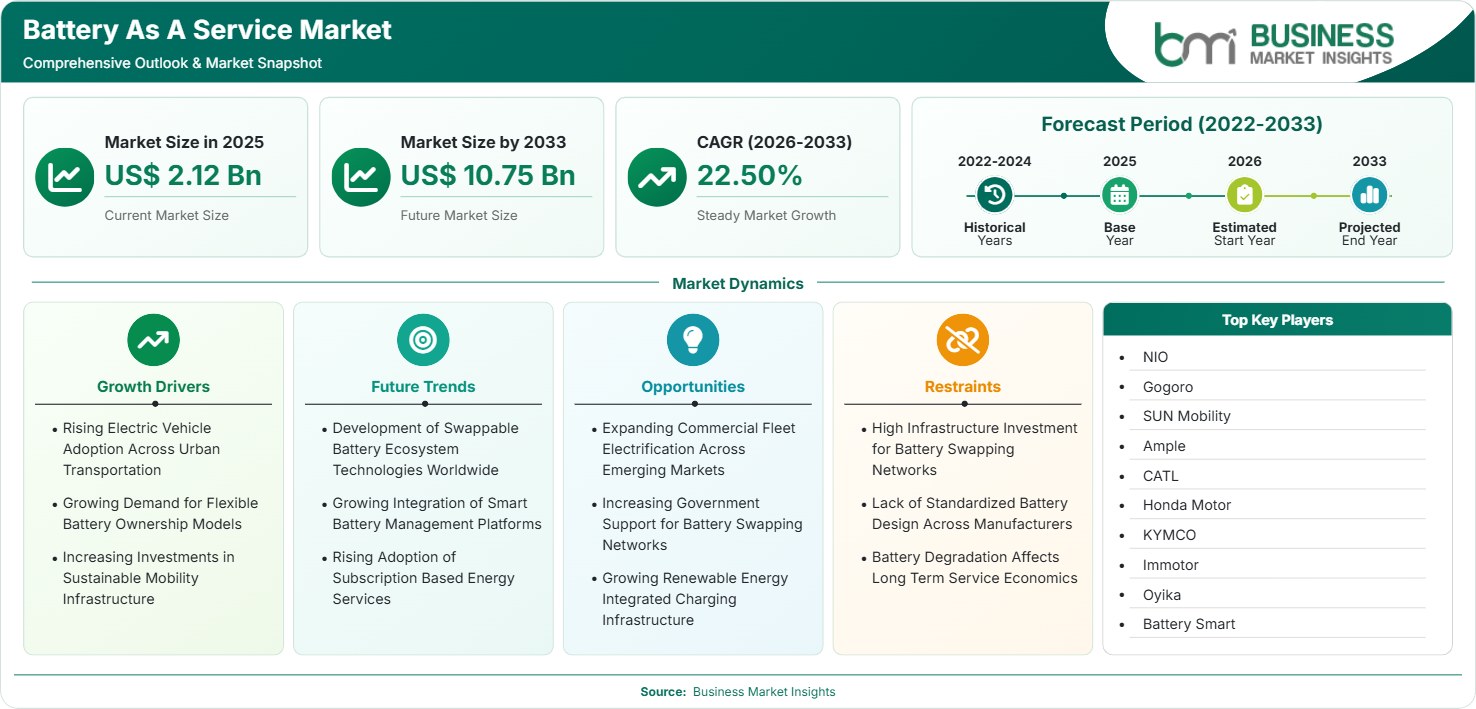
The Battery As A Service Market size was valued at US$ 2.12 billion in 2025 and is projected to reach US$ 10.75 billion by 2033, growing at a CAGR of 22.50% during 2026–2033. Rising electric vehicle adoption, battery swapping infrastructure expansion, flexible ownership models, and sustainable mobility investments are driving market opportunities.

Report Coverage
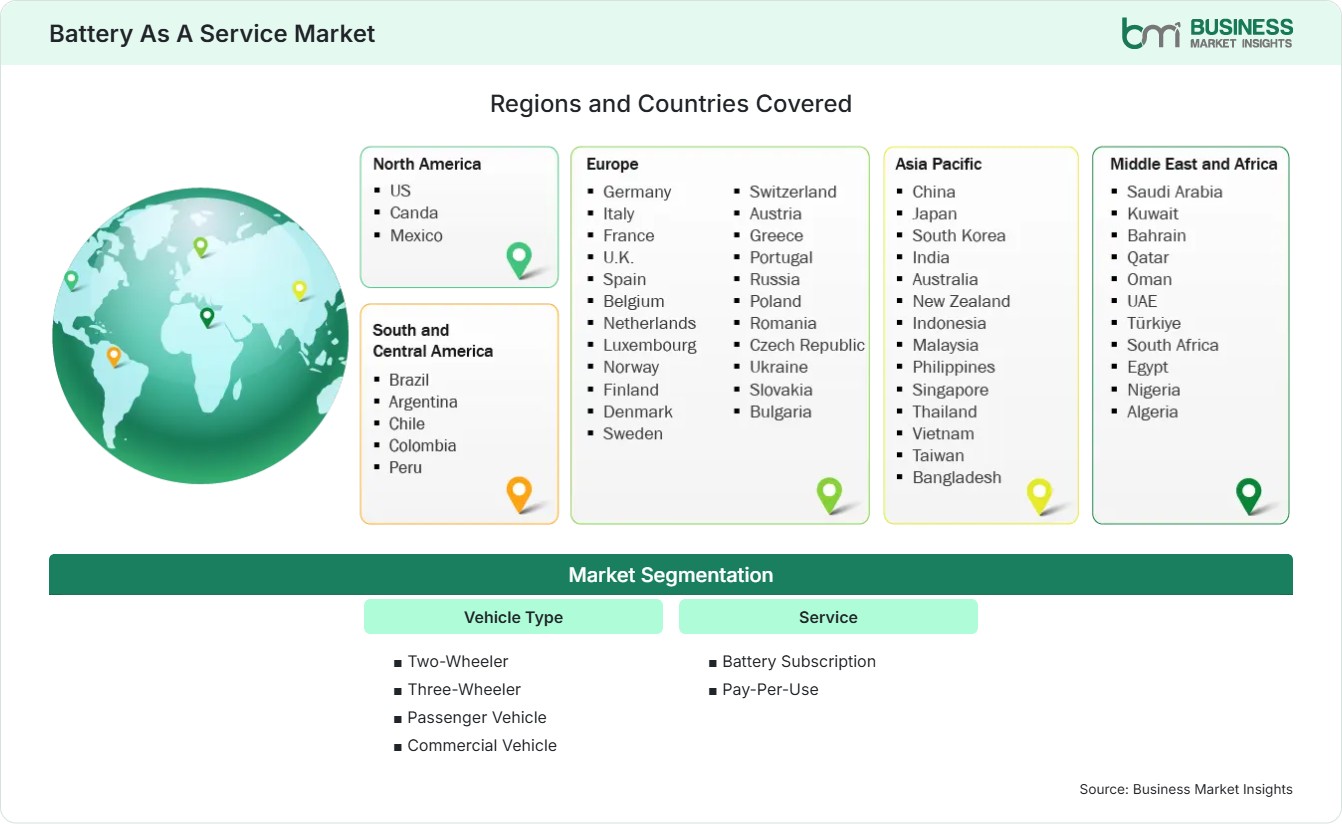
  • Vehicle Type: Two-Wheeler, Three-Wheeler, Passenger Vehicle, Commercial Vehicle
  • Service: Battery Subscription, Pay-Per-Use
US$ 2.12 Bn Market size in 2025
US$ 10.75 Bn Market Size by 2033
22.50% CAGR, 2026 - 2033
2026-2033 Forecast Period

AI Overview

Battery As A Service Market Summary

  • North America Region: North America holds a market share of 24%–28% in 2025 and is expected to grow at a CAGR of 20.0%–21.0% during 2026–2033. Regional adoption is supported by electric vehicle infrastructure development, fleet electrification initiatives, battery technology investments, and increasing interest in flexible energy ownership models. The United States remains a key contributor due to commercial EV adoption, growing charging networks, and mobility service expansion, growing at a CAGR of 20.5%–21.5%.
  • Fastest Growing Region: Asia Pacific accounts for a market share of 45%–49% in 2025 and is projected to expand at a CAGR of 24.0%–25.0% during 2026–2033. Growth is supported by large electric two-wheeler markets, battery swapping adoption, urban mobility demand, and government support for clean transportation infrastructure.
  • Leading Segment: Two-Wheeler vehicles represent a market share of 38%–42% in 2025 and are expected to grow at a CAGR of 23.0%–24.0% during 2026–2033. Growth is driven by urban mobility requirements, commercial delivery applications, and demand for cost-effective electric transportation solutions.
  • High Growth Segment: Commercial Vehicle applications are expected to expand at a CAGR of 24.0%–25.0% during 2026–2033 due to fleet electrification programs, logistics sector adoption, and demand for reduced vehicle downtime.
  • Key Market Opportunity: Battery swapping networks, fleet electrification, renewable energy integration, and subscription-based battery ownership models are creating opportunities for companies developing scalable energy mobility solutions.
  • Major Market Players: NIO, Gogoro, SUN Mobility, Ample, CATL, Honda Motor, KYMCO, Immotor, Oyika, Battery Smart.
Strategic Insights

Battery As A Service Market: Strategic Insights

Battery As A Service Market Strategic Framework
FREE PDF
Request your free sample
Request free sample
Stakeholder View

Key Takeaways

  • The value chain includes battery manufacturers, mobility operators, vehicle producers, energy infrastructure providers, software platforms, and fleet management companies creating an interconnected ecosystem.
  • Growth opportunities are concentrated in two-wheelers, commercial fleets, urban mobility services, and subscription-based models that improve electric vehicle accessibility.
  • Innovation is shifting toward modular battery designs, automated swapping stations, artificial intelligence-based battery monitoring, and digital platforms for efficient energy management.
  • Asia Pacific presents strong investment potential due to high electric two-wheeler adoption, urban transportation challenges, and expanding battery swapping networks.
  • Companies are pursuing strategic partnerships, infrastructure expansion, technology development, and ecosystem collaborations to strengthen competitive positioning.
  • Future market competitiveness will depend on battery standardization, infrastructure scalability, cost optimization, and integration with renewable energy systems.
Geographic Outlook

Battery As A Service Market Regional Highlights

North America Battery As A Service Market

North America represents 24%–28% of global demand in 2025 and is expected to grow at a CAGR of 20.0%–21.0% through 2033. The region is advancing through electric fleet adoption, charging infrastructure expansion, and investments in sustainable transportation solutions. The United States and Canada are witnessing increasing interest in battery swapping models among commercial mobility operators seeking reduced charging downtime and improved operational efficiency.

  • Fleet operators are exploring battery service models to reduce upfront EV acquisition costs and improve vehicle utilization across commercial transportation applications.
  • Government initiatives supporting electric mobility infrastructure are encouraging investments in battery swapping facilities and sustainable transportation networks.
  • Automotive manufacturers are collaborating with technology providers to develop flexible battery ownership solutions for electric vehicles.
  • Growing demand for efficient urban mobility systems is increasing adoption among delivery and logistics operators.

US Battery As A Service Market

The United States maintains a strong position within North America due to increasing electric vehicle adoption, commercial fleet electrification, and investments in charging alternatives. The country is witnessing growing interest in subscription-based battery models as businesses seek cost-effective methods to transition toward electric transportation. Expansion of mobility-as-a-service platforms is supporting demand for flexible battery solutions across urban regions.

  • Commercial fleet operators are adopting battery service models to improve vehicle availability and reduce operational challenges.
  • Increasing investments in EV infrastructure are supporting development of battery swapping and energy management systems.
  • Technology companies are developing digital platforms to improve battery tracking, management, and utilization.

Europe Battery As A Service Market

Europe accounts for 18%–22% of global demand in 2025 and is projected to grow at a CAGR of 19.0%–20.0% through 2033. Germany, France, the Netherlands, and Norway are contributing to regional expansion through electric mobility policies, sustainability targets, and charging infrastructure development. The region is emphasizing efficient energy usage and innovative ownership models to accelerate EV adoption among consumers and businesses.

  • Government emission reduction programs are encouraging investments in electric transportation solutions.
  • Commercial vehicle operators are evaluating battery service models to improve fleet economics.
  • Automotive companies are developing partnerships for battery exchange networks and mobility services.
  • Increasing renewable energy adoption is supporting integrated battery management solutions.
  • Urban transportation projects are creating opportunities for shared electric mobility services.

Asia Pacific Battery As A Service Market

Asia Pacific represents 45%–49% of global demand in 2025 and is expected to grow at a CAGR of 24.0%–25.0% through 2033. China, India, Japan, Taiwan, and Southeast Asian countries are driving growth through electric two-wheeler adoption, battery swapping infrastructure, and government-backed clean transportation initiatives. The region provides significant opportunities due to dense urban populations and rising demand for affordable electric mobility solutions.

  • Electric two-wheelers are increasing adoption of battery swapping solutions in highly populated urban markets.
  • Government policies supporting EV adoption are encouraging infrastructure development and technology investments.
  • Mobility companies are expanding battery exchange networks to improve transportation accessibility.
  • Commercial delivery fleets are adopting battery service models to enhance operational efficiency.
  • Local manufacturers are focusing on standardized battery technologies and scalable energy platforms.

Rest of World Battery As A Service Market

The Rest of World region accounts for 8%–12% of global demand in 2025 and is expected to grow at a CAGR of 16.0%–17.0% through 2033. Latin America, Middle East, and Africa are gradually adopting battery service models due to increasing urbanization, electric mobility investments, and demand for affordable transportation solutions.

Latin American countries are exploring electric fleet applications, while Middle Eastern and African markets are focusing on sustainable transportation infrastructure and renewable energy integration. These regions provide emerging opportunities for battery service providers targeting commercial mobility applications.

  • Developing transportation networks are encouraging adoption of cost-efficient electric mobility solutions.
  • Commercial fleet electrification projects are creating demand for flexible battery ownership models.
  • Renewable energy integration is supporting development of sustainable battery infrastructure.
  • Urban mobility challenges are encouraging alternative transportation service models.
  • Infrastructure partnerships are helping expand battery swapping capabilities in emerging markets.
Global Market Geography
FREE PDF
Request your free sample
Request free sample
Segment Analysis

Battery As A Service Market Segmentation

Vehicle Type

The vehicle type segment is expanding due to increasing electric mobility adoption across personal and commercial transportation applications. Two-wheelers represent a leading category due to urban mobility demand, while commercial vehicles are gaining momentum through fleet electrification. The Battery As A Service Market scope continues expanding as businesses seek flexible battery ownership solutions.

  • Two-Wheeler: Two-wheelers represent a major adoption area due to urban transportation needs, lower battery requirements, and suitability for swapping infrastructure.
  • Three-Wheeler: Three-wheelers are adopting battery services for commercial transportation, last-mile delivery operations, and cost-efficient electric mobility solutions.
  • Passenger Vehicle: Passenger vehicles are gradually adopting battery service models to reduce ownership costs and improve EV accessibility.
  • Commercial Vehicle: Commercial vehicles are increasingly using battery services to improve fleet efficiency, reduce downtime, and support electrification strategies.

Service

The service segment is driven by increasing demand for alternative battery ownership approaches that reduce initial electric vehicle costs. Subscription-based models are gaining acceptance among consumers and businesses seeking predictable expenses, while pay-per-use solutions support flexible transportation needs. The Battery As A Service Market trend reflects growing preference for convenient and scalable energy access models.

  • Battery Subscription: Battery subscription services enable users to access energy storage solutions without direct ownership, reducing upfront investment requirements.
  • Pay-Per-Use: Pay-per-use models provide flexible charging alternatives for users requiring adaptable battery access based on mobility requirements.
Market Forces

Battery As A Service Market Dynamics

Key Market Drivers

Rising Electric Vehicle Adoption Across Urban Transportation

Higher uptake of electric vehicles in the urban transport network is driving demand for more affordable, convenient battery services. There is an increasing need for efficient transport systems due to traffic congestion, environmental concerns, and transportation development strategies. Battery services are helpful in overcoming the challenges that may arise when buying an EV since it separates the vehicle from battery costs. The Battery As A Service Market growth is driven by increased uptake among commuters, delivery service companies, and mobility service companies. This is being done through investments in battery-swapping facilities, digital battery services, and fleet solutions. The growing number of urban electric mobility programs is prompting mobility service providers to adopt different ownership models.

Growing Demand for Flexible Battery Ownership Models

Flexible battery ownership solutions are becoming increasingly popular as individuals and organizations seek to use electric vehicles affordably without incurring high battery costs. Flexible battery subscription and pay-per-use solutions can help users access battery power without worrying about replacing batteries or being responsible for their ownership. Such solutions will be particularly useful for fleets that require cost predictability and battery-use optimization. Companies are looking to use digital solutions to monitor battery use and payments, while greater attention to mobility-as-a-service is helping promote such solutions in urban transport segments.

Increasing Investments in Sustainable Mobility Infrastructure

The sustainable mobility infrastructure investments will facilitate the development of battery-swapping networks, the integration of renewable energy sources, and the overall electric mobility ecosystem. There will be investment by governments and private players in sustainable mobility solutions to curb emissions and improve mobility efficiency. Battery service infrastructure enables faster battery recharging than traditional charging methods and facilitates continuous vehicle mobility. There will be development of scalable battery-swapping stations and battery service management platforms. The development of infrastructure will play a critical role in facilitating future market development.

Key Market Opportunities

Expanding Commercial Fleet Electrification Across Emerging Markets

Electrification of commercial fleets in emerging economies presents a substantial opportunity for companies providing battery services by addressing challenges associated with the deployment of electric vehicles. There is growing interest among companies in delivery services, logistics, and public transport in batteries-as-a-service to optimize their fleets and minimize downtime during vehicle charging. The Battery As A Service Market forecast indicates significant growth potential as companies seek alternative ways to power their vehicles. It is possible to increase fleet productivity through batteries-as-a-service, thanks to fast energy replenishment and reduced reliance on stationary charging stations.

Increasing Government Support for Battery Swapping Networks

Government support for battery-swapping infrastructure is opening new opportunities by investing in electric mobility and sustainable transportation solutions. Government policies, incentives, and sustainable transportation schemes are making it attractive for businesses to establish battery-swapping infrastructure and battery ecosystems. The importance of such initiatives is greater in areas where charging infrastructure is less available or where there is a need for quick energy replacement in commercial vehicles. The public and private sectors can contribute to accelerating infrastructure development and building customer trust. Battery-swapping service providers have an opportunity to work with the government, power companies, and automotive firms to create an extensive network.

Growing Renewable Energy Integrated Charging Infrastructure

The integration of renewable energy and battery charging is offering possibilities for sustainable battery service business models. Renewable energy can be used to generate sustainable energy, thereby improving the environmental performance of the electric mobility system. There is research on developing platforms that manage batteries, making charging more efficient, and reducing the load on the energy grid. Batteries charged by renewable energy can be used for remote mobility and in areas where the energy infrastructure is still developing. Due to the rising interest in carbon reduction strategies, there is increased interest in using sustainable energy sources in battery service business models.

Market Restraints and Challenges

High Infrastructure Investment for Battery Swapping Networks

Factor: Establishing battery swapping networks requires significant investment in stations, battery inventory, maintenance systems, and digital infrastructure. Impact: High initial costs can slow deployment and limit adoption among smaller companies and emerging mobility providers. Developing extensive swapping networks requires coordination between battery manufacturers, vehicle producers, and infrastructure operators. Companies must invest in technology platforms, operational facilities, and service networks to ensure reliable performance. These financial requirements may create barriers in regions with limited investment availability. Although infrastructure costs are expected to decline with market maturity, initial capital requirements remain a challenge. Businesses focusing on strategic partnerships and scalable deployment approaches can improve investment efficiency while expanding battery service accessibility.

Lack of Standardized Battery Design Across Manufacturers

Factor: Different battery designs and specifications among vehicle manufacturers create compatibility challenges for battery swapping systems. Impact: Limited standardization can increase infrastructure complexity and restrict network scalability across multiple vehicle platforms. Battery service providers require cooperation among automotive manufacturers to develop compatible systems and improve user convenience. Variations in battery dimensions, charging requirements, and management systems can increase operational challenges. Industry stakeholders are working toward improved standardization approaches, but widespread adoption remains a gradual process. Companies developing adaptable battery platforms and collaborative ecosystems can reduce compatibility limitations. Achieving greater standardization will be essential for expanding battery service networks and improving long-term market efficiency.

Company Analysis

Competitive Landscape

The Battery As A Service Market analysis highlights increasing competition among battery technology companies, electric mobility providers, automotive manufacturers, and energy service operators. Companies are focusing on battery swapping infrastructure, subscription models, digital management platforms, and strategic partnerships to strengthen their position.

Company Name

Overview

Products and Services relevant to this market

NIO

Electric vehicle company providing innovative battery service solutions and mobility technologies.

Battery swapping stations, Battery as a Service subscription programs, EV ecosystem solutions, and energy management services.

Gogoro

Smart mobility company specializing in electric two-wheelers and battery swapping infrastructure.

Battery swapping networks, smart batteries, electric scooters, and mobility service platforms.

SUN Mobility

Energy infrastructure provider focused on battery swapping solutions for electric vehicles.

Battery swapping stations, modular battery systems, energy access platforms, and EV infrastructure solutions.

Ample

Technology company developing automated battery swapping systems for electric vehicles.

Automated swapping stations, modular battery technology, fleet electrification solutions, and EV energy services.

CATL

Battery manufacturer providing advanced battery technologies and energy solutions.

Battery systems, EV battery technologies, battery management solutions, and energy storage services.

Honda Motor

Automotive manufacturer developing electric mobility and battery ecosystem solutions.

Electric vehicles, battery technologies, swapping solutions, and mobility services.

KYMCO

Mobility company specializing in electric scooters and urban transportation solutions.

Electric two-wheelers, battery exchange systems, smart mobility solutions, and related services.

Immotor

Electric mobility technology company focused on smart battery solutions.

Portable battery systems, battery swapping technology, smart mobility platforms, and EV solutions.

Oyika

Electric mobility company providing battery subscription and swapping services.

Battery leasing, swapping infrastructure, electric mobility services, and fleet solutions.

Battery Smart

Battery swapping company focused on electric vehicle energy solutions.

Battery swapping networks, subscription services, EV infrastructure, and energy management platforms.

Trust & Transparency

Research Methodology

The market analysis combines proprietary research with secondary data from government agencies, company disclosures, regulatory filings, industry databases and expert interviews. Market estimates are validated through data triangulation, cross-market benchmarking and analyst review.

View Full Research Methodology

Questions Answered

Frequently Asked Questions

What role does the Battery As A Service Market report provide for industry participants?

The report provides insights into competitive strategies, technology developments, infrastructure expansion, and emerging opportunities shaping the industry. It helps stakeholders understand market dynamics, investment areas, and factors influencing adoption of battery service solutions across global mobility ecosystems.

Why are government initiatives creating new opportunities for battery service providers?

Government initiatives supporting electric mobility, emission reduction, and clean transportation infrastructure are encouraging investments in battery swapping networks. Policy support, incentives, and infrastructure programs are helping companies expand battery service operations and improve electric vehicle accessibility.

How are battery swapping technologies influencing adoption?

Battery swapping technologies are improving adoption by reducing charging delays, increasing vehicle availability, and supporting high-utilization transportation applications. Automated swapping stations and digital battery management platforms are helping companies create efficient mobility ecosystems for commercial and consumer users.

Which applications present the strongest opportunity in the market?

Commercial fleets, electric two-wheelers, three-wheelers, shared mobility services, and urban transportation applications represent strong opportunities. These segments benefit from reduced charging downtime, predictable energy costs, and scalable battery access solutions that support increasing electrification requirements.

What factors are improving Battery As A Service Market return on investment?

Increasing electric vehicle adoption, growing fleet electrification, reduced battery ownership costs, and demand for flexible mobility solutions are improving return on investment. Battery service models help users avoid high upfront battery expenses while enabling efficient utilization, faster energy replacement, and improved vehicle operating economics.

Access the Full Battery As A Service Market Report

Get segment-level forecasts, regional estimates, competitive benchmarking, company profiles and downloadable Excel datasets.

Access the full Battery As A Service Market Report
350 pages PDF & Excel | 2026-08-24