
Tugboats Market Outlook: Size, Share, Trends, Growth Analysis, Competitive Landscape & Forecast, 2026-2033

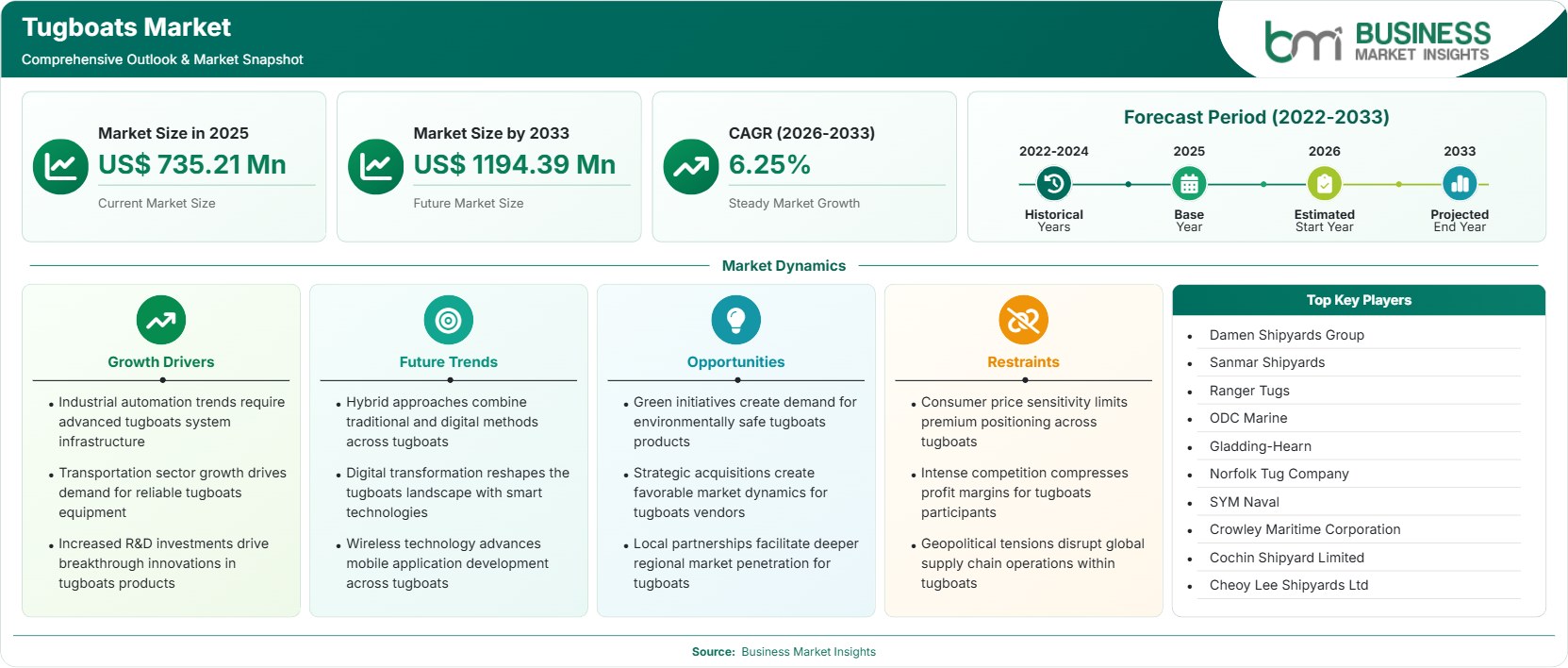
The Tugboats Market size was valued at US$ 735.21 Million in 2025 and is projected to reach US$ 1194.39 Million by 2033, growing at a CAGR of 6.25% during 2026–2033. Increasing global port modernization, expansion of offshore energy projects, rising seaborne trade, and investments in sustainable low-emission tug fleets are accelerating market demand, while autonomous navigation technologies and hybrid propulsion systems continue to create attractive long-term opportunities.

Report Coverage
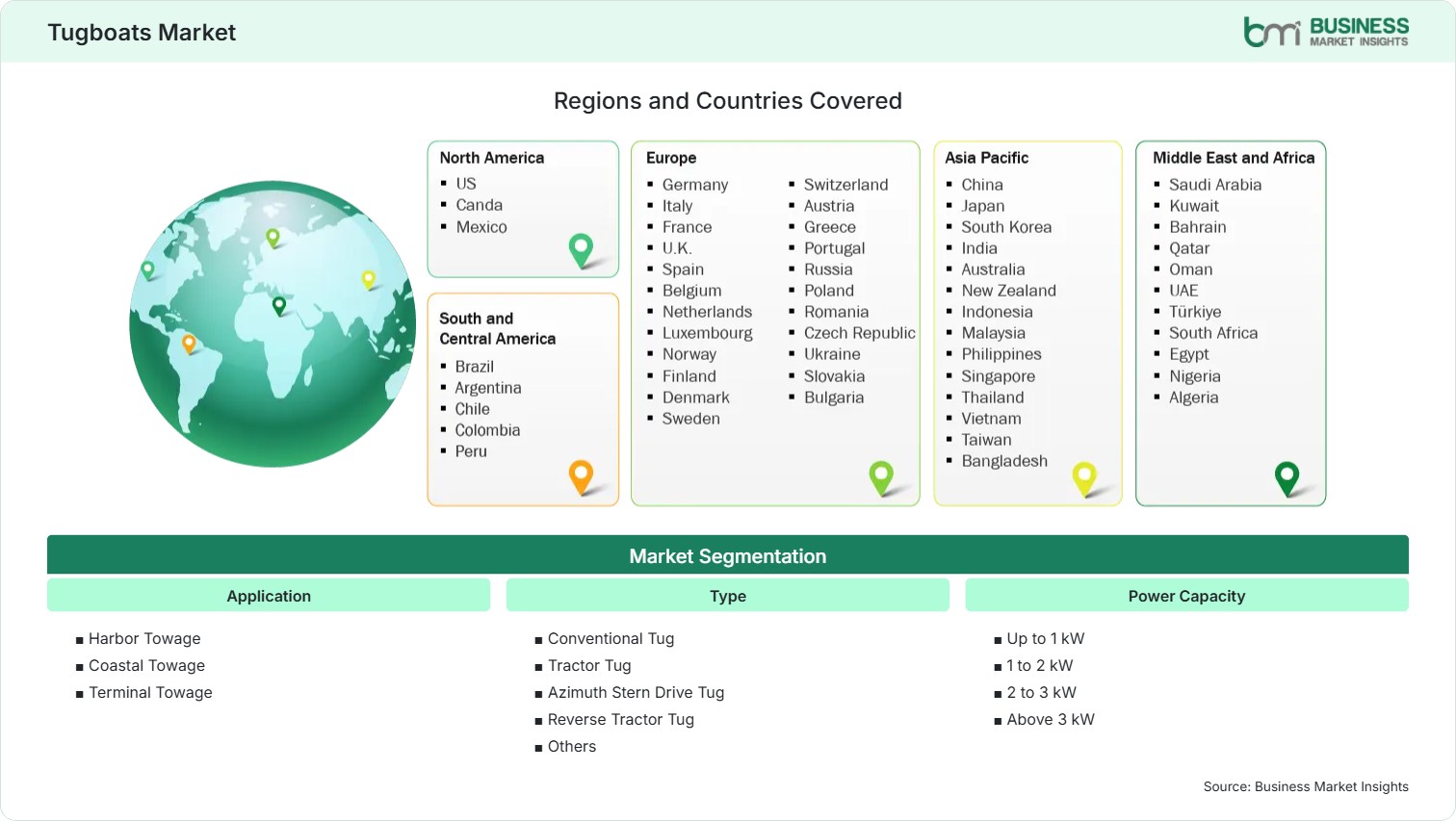
  • Application: Harbor Towage, Coastal Towage, Terminal Towage
  • Type: Conventional Tug, Tractor Tug, Azimuth Stern Drive Tug, Reverse Tractor Tug, Others
  • Power Capacity: Up to 1 kW, 1 to 2 kW, 2 to 3 kW, Above 3 kW
US$ 735.21 Mn Market size in 2025
US$ 1194.39 Mn Market Size by 2033
6.25% CAGR, 2026 - 2033
2026-2033 Forecast Period

AI Overview

Tugboats Market Summary

  • North America Region: North America holds 34%–37% market share in 2025, growing with a 5.8%–6.2% CAGR during 2026–2033, supported by port modernization, offshore energy expansion, fleet replacement, environmental compliance, and rising investments in hybrid harbor towing technologies across commercial ports. The U.S. dominates regional demand through extensive commercial ports, offshore energy operations, and fleet modernization, advancing at approximately 5.9%–6.3% CAGR.
  • Fastest Growing Region: Asia Pacific accounts for 28%–31% market share in 2025 and expands at a 7.0%–7.5% CAGR, driven by increasing shipbuilding activities, container traffic, expanding coastal infrastructure, government-backed port investments, offshore wind projects, and regional maritime logistics modernization.
  • Leading Segment: Harbor Towage represents 46%–49% market share in 2025 while growing at 5.9%–6.3% CAGR, supported by expanding commercial ports, larger vessel movements, stricter navigation safety regulations, increasing cargo throughput, and continuous harbor infrastructure development worldwide.
  • High Growth Segment: Azimuth Stern Drive Tug captures 24%–27% market share in 2025 and records 7.3%–7.8% CAGR, driven by superior maneuverability, fuel efficiency, enhanced escort capabilities, reduced operational costs, and increasing adoption at high-capacity international container terminals.
  • Key Market Opportunity: Growing investments in hybrid-electric tugboats, digital fleet management, autonomous navigation technologies, offshore wind support vessels, and green port initiatives provide substantial opportunities for shipbuilders, operators, component suppliers, and maritime technology providers globally.
  • Major Market Players: Amsbach Marine (S) Pte. Ltd.; Astro Offshore Pte. Ltd.; Cashman Equipment Corporation; Cheoy Lee Shipyards Limited; Cochin Shipyard Limited; Damen Shipyards Group; Hongkong Salvage & Towage Services Limited; Jiangsu Zhenjiang Shipyard Co., Ltd.; Mazagon Dock Shipbuilders Limited; Sanmar Shipyards.
Strategic Insights

Tugboats Market: Strategic Insights

Tugboats Market Strategic Framework
FREE PDF
Request your free sample
Request free sample
Stakeholder View

Key Takeaways

  • The industry value chain is becoming increasingly integrated as shipbuilders, propulsion manufacturers, digital navigation providers, and maintenance specialists collaborate to deliver efficient, environmentally compliant tug solutions for commercial ports.
  • Harbor operations, offshore wind installations, and LNG terminal developments represent the strongest commercial opportunities, supported by rising investments in port modernization and expanding maritime logistics infrastructure worldwide.
  • Innovation increasingly focuses on hybrid propulsion systems, battery-assisted operations, intelligent navigation software, predictive maintenance platforms, and autonomous vessel technologies that improve safety, efficiency, and lifecycle performance.
  • Asia-Pacific presents the strongest long-term investment potential because expanding container trade, government-backed port infrastructure, and regional shipbuilding capacity continue creating sustained demand for modern tug fleets.
  • Strategic acquisitions, technology partnerships, and joint shipbuilding ventures are increasing as manufacturers strengthen production capabilities, accelerate green vessel development, and improve regional market presence.
  • Sustainability requirements are reshaping procurement strategies, encouraging operators to replace aging fleets with environmentally compliant tugboats capable of supporting next-generation maritime logistics and offshore energy operations.
Geographic Outlook

Tugboats Market Regional Highlights

North America Tugboats Market

North America accounted for 34%–37% of the global Tugboats Market share in 2025 and is projected to register a CAGR of 5.8%–6.2% during 2026–2033. The region benefits from well-established port infrastructure, increasing fleet replacement activities, growing offshore oil and gas operations, and expanding investments in hybrid propulsion technologies. The United States and Canada continue strengthening maritime logistics capacity through port modernization initiatives, while stricter environmental regulations accelerate demand for cleaner and technologically advanced tugboats supporting commercial shipping and offshore energy operations.

  • Major ports are investing in hybrid and battery-assisted tugboats to reduce greenhouse gas emissions while improving operational efficiency, vessel maneuverability, and compliance with increasingly stringent environmental standards across North American coastal facilities.
  • Offshore energy exploration in the Gulf of Mexico continues generating sustained demand for high-powered escort and terminal tugboats capable of supporting drilling platforms, LNG terminals, and heavy marine logistics operations.
  • Growing vessel sizes across container shipping require higher bollard pull tugboats equipped with advanced navigation systems, encouraging fleet modernization among public and private towing operators throughout the region.
  • Digital fleet management platforms, predictive maintenance technologies, and remote vessel diagnostics are improving fleet utilization, reducing maintenance costs, and enhancing operational safety across commercial harbor operations.

US Tugboats Market

The United States accounted for approximately 76%–79% of the North American Tugboats Market in 2025 and is anticipated to expand at a CAGR of 5.9%–6.3% through 2033. Strong commercial shipping activity, large coastal infrastructure investments, LNG export terminal expansion, and continuous harbor modernization programs support sustained procurement of advanced tugboats. Increasing federal emphasis on maritime resilience and environmental compliance further encourages operators to adopt cleaner propulsion technologies.

  • Gulf Coast ports continue expanding towing capacity to accommodate increasing LNG exports, offshore energy development, and larger commercial vessels requiring advanced escort operations and enhanced safety capabilities.
  • Growing adoption of hybrid propulsion systems enables operators to reduce fuel consumption, lower maintenance requirements, and meet evolving emissions standards established by maritime authorities.
  • Shipyard modernization and government-backed infrastructure funding support replacement of aging tug fleets while strengthening domestic vessel manufacturing capabilities and long-term operational reliability.
  • Digital navigation technologies improve vessel positioning, collision avoidance, and operational coordination across busy commercial ports handling increasing cargo volumes.

Europe Tugboats Market

Europe captured approximately 25%–28% of the global market in 2025 and is expected to record a CAGR of 5.6%–6.0% between 2026 and 2033. The region emphasizes sustainable maritime transportation, green port initiatives, and advanced shipbuilding capabilities. Countries including the Netherlands and Norway remain leading adopters of hybrid tug technologies, while offshore wind expansion across Northern Europe creates additional long-term demand for specialized escort and support tugboats serving renewable energy installations.

  • The Netherlands leads regional adoption through advanced shipbuilding expertise, integrated port infrastructure, and continuous innovation in sustainable harbor tug technologies serving international shipping operations.
  • Norway records one of Europe's fastest growth rates at approximately 6.4%–6.8% CAGR, supported by offshore wind developments, zero-emission vessel programs, and strong government sustainability incentives.
  • European ports increasingly deploy battery-assisted and hybrid tugboats to comply with carbon reduction objectives while lowering operational costs and improving environmental performance.
  • Maritime digitalization initiatives encourage adoption of AI-supported navigation, predictive maintenance platforms, and smart fleet management systems that improve operational productivity.

Asia Pacific Tugboats Market

Asia Pacific held around 28%–31% of the global Tugboats Market in 2025 and is forecast to grow at the fastest 7.0%–7.5% CAGR during the study period. Rapid expansion of commercial ports, increasing international trade, extensive shipbuilding activities, and government investments in coastal infrastructure continue supporting regional demand. China, Japan, South Korea, Singapore, and India remain major maritime economies driving procurement of technologically advanced harbor and offshore tugboats.

  • China dominates regional demand through extensive shipbuilding capacity, expanding container ports, offshore infrastructure projects, and continuous investments in commercial maritime logistics modernization.
  • India demonstrates one of the strongest regional growth trajectories with approximately 7.5%–8.0% CAGR, supported by Sagarmala initiatives, port expansion, and increasing domestic shipbuilding activities.
  • Offshore wind development throughout East Asia increases demand for escort tugboats supporting installation vessels, maintenance operations, and specialized offshore logistics activities.
  • Rapid containerization and increasing trade volumes encourage commercial ports to procure higher-capacity tugboats with advanced maneuvering technologies capable of servicing larger cargo vessels.
  • Public investments in smart ports, digital navigation infrastructure, and sustainable marine transportation continue strengthening long-term regional competitiveness.

Rest of World Tugboats Market

The Rest of World region accounted for approximately 8%–10% of the global Tugboats Market in 2025 and is projected to register a CAGR of 6.3%–6.7% through 2033. South & Central America continue benefiting from expanding port modernization and offshore oil activities, while the Middle East & Africa experience growing investments in logistics infrastructure, energy exports, and maritime trade corridors. These developments support increasing procurement of modern tug fleets across emerging coastal economies.

Growing commercial shipping activity, LNG export projects, and strategic maritime investments continue strengthening demand for specialized towing services. Brazil and the UAE remain leading regional markets, while Saudi Arabia demonstrates one of the fastest growth rates with approximately 6.8%–7.2% CAGR, supported by large-scale port expansion and logistics diversification initiatives.

  • Brazil leads South & Central America through offshore energy activities, commercial port investments, and increasing modernization of coastal towing operations supporting expanding maritime trade.
  • The UAE remains a major Middle Eastern hub, driven by world-class ports, increasing container traffic, and continuous investments in advanced harbor support vessels.
  • Saudi Arabia records strong future growth as Vision 2030 investments expand maritime logistics infrastructure, industrial ports, and offshore energy developments requiring modern tugboat fleets.
  • African coastal nations continue upgrading strategic ports to improve regional trade connectivity, creating opportunities for technologically advanced harbor and terminal towing services.
  • Green port initiatives and increasing adoption of low-emission propulsion technologies are gradually improving environmental performance across emerging maritime markets.
Global Market Geography
FREE PDF
Request your free sample
Request free sample
Segment Analysis

Tugboats Market Segmentation

Application

The Application segment accounted for the largest revenue contribution across the market, supported by expanding commercial shipping activities, offshore infrastructure development, and continuous investments in port modernization. The segment represented 44%–47% market share in 2025 and is anticipated to register a CAGR of 6.2%–6.6% during the forecast period. Growing vessel traffic, larger cargo ships, and stricter maritime safety regulations continue strengthening operational demand. The Tugboats Market scope is expanding through diversified harbor, terminal, and coastal towing applications supporting global maritime logistics.

  • Harbor Towage: Represents the largest application owing to increasing container vessel movements, port congestion management, harbor navigation assistance, and rising investments in modern port infrastructure requiring reliable towing operations.
  • Coastal Towage: Supports transportation of barges, disabled vessels, offshore equipment, and coastal logistics, benefiting from expanding regional shipping routes and increasing offshore industrial activities across developing maritime economies.
  • Terminal Towage: Experiences rising adoption with LNG terminals, bulk cargo facilities, and oil terminals demanding precise vessel maneuvering, operational safety, and efficient docking assistance for large commercial ships.

Type

The Type segment continues evolving with technological improvements that enhance maneuverability, fuel efficiency, and operational flexibility. It accounted for approximately 34%–37% Tugboats Market share in 2025 and is projected to expand at a CAGR of 6.5%–6.9% through 2033. Modern ship operators increasingly replace conventional vessels with advanced propulsion systems capable of supporting larger commercial ships while lowering emissions and operating costs.

  • Conventional Tug: Remains widely deployed for routine harbor operations due to lower acquisition costs, operational familiarity, and dependable performance across medium-capacity commercial ports.
  • Tractor Tug: Offers exceptional maneuverability for escort operations, congested ports, and offshore applications where rapid directional control and enhanced vessel stability are operational priorities.
  • Azimuth Stern Drive Tug: Gains strong commercial adoption because of superior propulsion efficiency, higher bollard pull, reduced fuel consumption, and outstanding maneuverability during complex docking operations.
  • Reverse Tractor Tug: Provides enhanced escort performance and operational flexibility for high-speed marine assistance, particularly supporting large tankers, LNG carriers, and modern container vessels.

Power Capacity

Power capacity remains a critical purchasing criterion as operators align tug performance with vessel size, cargo volume, and port requirements. This segment contributed nearly 31%–34% market share in 2025 while advancing at a CAGR of 6.6%–7.0% during the assessment period. Increasing deployment of higher-capacity tugboats reflects growing global trade volumes, larger container vessels, and expanding offshore energy infrastructure requiring stronger towing capabilities.

  • Up to 1000 KW: Commonly utilized at smaller commercial ports, inland waterways, fishing harbors, and light-duty towing operations where operational efficiency and affordability remain primary considerations.
  • 1000 to 2000 KW: Serves medium-sized commercial ports by balancing towing capability, fuel efficiency, and operating economics across routine harbor assistance and coastal vessel movements.
  • 2000 to 3000 KW: Increasingly preferred for container terminals, offshore logistics, and industrial ports requiring stronger bollard pull and higher operational reliability under demanding marine conditions.
  • Above 3000 KW: Supports heavy escort duties, LNG terminals, offshore energy developments, and large commercial ports handling ultra-large container vessels and high-capacity maritime operations.
Market Forces

Tugboats Market Dynamics

Key Market Drivers

Expansion of Global Port Infrastructure and Container Traffic

Growing investments in commercial port infrastructure continue to strengthen demand for advanced tugboat fleets. According to international maritime trade indicators, over 80% of global merchandise trade by volume is transported by sea, driving the continuous expansion of deep-water ports and container terminals. Larger container ships require high-performance escort and harbor tugboats with greater bollard pull and maneuverability. Increasing automation across port operations further supports the deployment of digitally connected vessels equipped with intelligent navigation systems. Tugboats Market growth is reinforced by government-backed port modernization programs, higher cargo throughput, fleet renewal initiatives, and rising investments in maritime logistics infrastructure that improve operational safety, efficiency, and vessel turnaround times across global shipping hubs.

Rising Offshore Energy and Renewable Marine Projects

Offshore oil, gas, and renewable energy developments are generating sustained demand for specialized tugboats capable of supporting construction, towing, installation, and emergency response activities. Offshore wind farms, offshore production platforms, LNG terminals, and subsea systems all need reliable offshore support vessels that must perform in difficult circumstances. With increasing capacity being developed for offshore wind farms in Europe and Asia-Pacific, more companies are buying high-horsepower escort tugs that have better efficiency and dynamic positioning capabilities. These increased investments are encouraging the construction of technically advanced ships that would ensure good fuel efficiency and performance.

Transition Toward Hybrid and Low-Emission Propulsion Systems

Environmental regulations established by maritime authorities are accelerating the replacement of aging fleets with cleaner propulsion technologies. Hybrid-electric propulsion, battery-assisted systems, and energy-efficient diesel engines reduce greenhouse gas emissions while lowering fuel consumption and lifecycle operating costs. The major port facilities are gradually considering emission reduction in their harbors due to the need to achieve decarbonization goals. The integration of advanced propulsion systems not only helps in increasing the efficiency of maintenance but also increases the efficiency of vessels through digital monitoring systems. The continuous developments in the field of propulsion engineering have led to the adoption of sustainable tugs.

Key Market Opportunities

Growth of Hybrid-Electric Fleet Modernisation Programmes

The replacement programs provide significant investment opportunities to shipyards, propulsion manufacturers, and technological providers. Many ports around the globe are making investments in hybrid electric tugs that have the potential to cut down both carbon emissions and costs of operations. The government support for eco-friendly ships speeds up the purchasing process, while fleet management systems make the investment more efficient. Tugboats Market Forecasts indicate sustained demand for environmentally compliant vessels as commercial operators seek long-term fuel savings, regulatory compliance, and enhanced operational resilience. These developments position hybrid propulsion technologies as one of the most attractive commercial investment areas throughout the forecast period.

Expansion of Offshore Wind Installation Support Services

Emerging Tugboats Market Trends include: Rapid deployment of offshore wind farms creates significant opportunities for specialized escort, terminal, and support tugboats. Construction, laying of cables, maintenance, and equipment transportation need highly maneuverable marine support vessels that can operate in hazardous offshore environments. Investments made in Northern Europe, East Asia, and North America have led to an increase in the demand for tugboats with dynamic positioning capabilities and towing capabilities. Shipbuilders that design offshore support vessels are poised to take advantage of increased spending on renewable energy and decarbonization.

Digitalisation and Autonomous Navigation Technologies

AI, remote monitoring systems, navigation software, and predictive maintenance solutions are revolutionizing tugboats. More fleet managers choose to invest in technology solutions for their vessels, which will improve route planning, reduce downtime, ensure safety, and increase fuel efficiency. Integration of autonomous assistance functions, digital twins, and sensor-based performance monitoring supports higher operational reliability while reducing lifecycle costs. Technology developers collaborating with shipyards have opportunities to deliver intelligent marine solutions that strengthen competitiveness as commercial ports continue adopting smart infrastructure and automated vessel traffic management systems over the coming decade.

Market Restraints and Challenges

High Capital Investment and Extended Vessel Replacement Cycles

Factor: Modern tugboats incorporating hybrid propulsion systems, advanced navigation equipment, and emission-control technologies require substantial upfront investment.

Impact: The smaller fleet owners generally defer procurement due to increased acquisition costs and longer return on investment periods, which restrict their buying flexibility. The financing problem also hinders the replacement of old ships, especially in countries where funding sources are not available or are expensive. Longer ship lifetimes lead to fewer replacements and hence fewer annual orders even when there is more shipping.

Complex Environmental Compliance and Skilled Workforce Shortages

Factor: Compliance with evolving international emissions regulations requires continuous technological upgrades alongside highly skilled marine engineers, technicians, and vessel operators.

Impact: The cost of training, certification, and advanced on-board technology contributes to higher operational costs for the owner of the fleet. The lack of skilled maritime workers makes it difficult to conduct maintenance and ensure safety during the operations of hybrid and technologically integrated tugs. It may result in less availability of the fleet, a higher maintenance schedule, and a delay in the use of new technologies due to a shortage of skilled staff.

Company Analysis

Competitive Landscape

The competitive environment remains moderately consolidated, with established shipbuilders, specialised marine engineering companies, and regional towing service providers competing through vessel innovation, hybrid propulsion, digital navigation technologies, and customised shipbuilding capabilities. Tugboats Market analysis indicates that manufacturers are strengthening their global presence through strategic partnerships, green vessel development, offshore support solutions, and investments in smart shipbuilding technologies to address evolving environmental regulations and customer requirements.

Company Name

Overview

Products and Services Relevant to this Market

AMSBACH MARINE (S) PTE LTD

Singapore-based marine engineering and shipbuilding company serving commercial and offshore marine sectors with customised vessel solutions and technical expertise.

Tugboat construction, vessel repair, marine engineering services, harbour support vessels, offshore support craft, maintenance solutions, and lifecycle technical services.

ASTRO OFFSHORE PTE LTD.

UAE-headquartered offshore marine services provider supporting energy, shipping, and maritime infrastructure projects across regional and international markets.

Offshore support vessels, towing services, marine logistics, harbour assistance, vessel chartering, and integrated offshore transportation services.

Cashman Equipment Corp.

U.S.-based marine construction and heavy equipment company with extensive experience supporting marine infrastructure and specialised towing operations.

Marine towing solutions, dredging support, construction barges, harbour assistance vessels, marine transportation, and infrastructure support services.

Cheoy Lee Shipyards Ltd

Hong Kong-based international shipbuilder recognised for producing commercial, patrol, offshore, and customised workboats for global maritime operators.

Tugboat design, commercial vessel construction, hybrid vessel development, engineering support, customised workboats, and after-sales technical services.

Cochin Shipyard Limited

India's leading shipbuilding and ship repair enterprise serving commercial shipping, defence, and offshore industries with advanced vessel manufacturing capabilities.

Harbour tugboats, offshore support vessels, ship repair, vessel maintenance, engineering services, and customised commercial shipbuilding solutions.

Damen Shipyards Group

Netherlands-based global shipbuilding leader specialising in standardised and customised vessels with strong expertise in sustainable marine technologies.

ASD tugboats, hybrid tugboats, harbour tugs, escort tugs, lifecycle maintenance, digital vessel services, and marine engineering solutions.

Hongkong Salvage & Towage Services Limited

Established maritime services provider delivering towing, salvage, harbour support, and emergency response solutions across regional shipping operations.

Harbour towing, marine salvage, emergency response, escort services, vessel assistance, and commercial port support operations.

Jiangsu Zhenjiang Shipyard Co. Ltd.

Chinese shipbuilder specialising in offshore vessels, workboats, harbour craft, and technologically advanced commercial marine platforms.

Harbour tugboats, offshore support vessels, engineering vessels, customised marine craft, shipbuilding, and vessel maintenance services.

Mazagon Dock Shipbuilders Limited

Major Indian shipbuilder serving defence and commercial maritime sectors with expanding expertise in specialised marine vessel construction.

Commercial tugboats, naval support vessels, engineering services, shipbuilding, ship repair, and integrated maritime manufacturing solutions.

Trust & Transparency

Research Methodology

The market analysis combines proprietary research with secondary data from government agencies, company disclosures, regulatory filings, industry databases and expert interviews. Market estimates are validated through data triangulation, cross-market benchmarking and analyst review.

View Full Research Methodology

Questions Answered

Frequently Asked Questions

Why should businesses invest in the Tugboats Market Report?

The report provides detailed insights into industry trends, regional opportunities, competitive positioning, market segmentation, technology developments, and strategic forecasts that support informed business and investment decisions.

What technologies are shaping future industry development?

Hybrid-electric propulsion, battery-assisted systems, AI-enabled navigation, predictive maintenance, digital fleet management, and autonomous vessel technologies are transforming operational efficiency and sustainability.

Which region is expected to witness the fastest growth?

Asia Pacific is projected to record the highest growth due to expanding shipbuilding activities, large-scale port investments, increasing maritime trade, and government support for logistics infrastructure.

Which application segment dominates the market?

Harbor Towage remains the leading application because nearly every commercial port requires tug assistance for vessel berthing, escort operations, navigation safety, and efficient cargo movement.

What factors are driving demand in the Tugboats Market?

Growing port expansion, increasing container shipping, offshore energy projects, stricter environmental regulations, and adoption of hybrid propulsion technologies are the primary factors accelerating market demand worldwide.

Access the Full Tugboats Market Report

Get segment-level forecasts, regional estimates, competitive benchmarking, company profiles and downloadable Excel datasets.

Access the full Tugboats Market Report
350 pages PDF & Excel | 2026-08-18
Similar Research

Related Market Reports