Market Summary
Executive Summary and Global Market Analysis
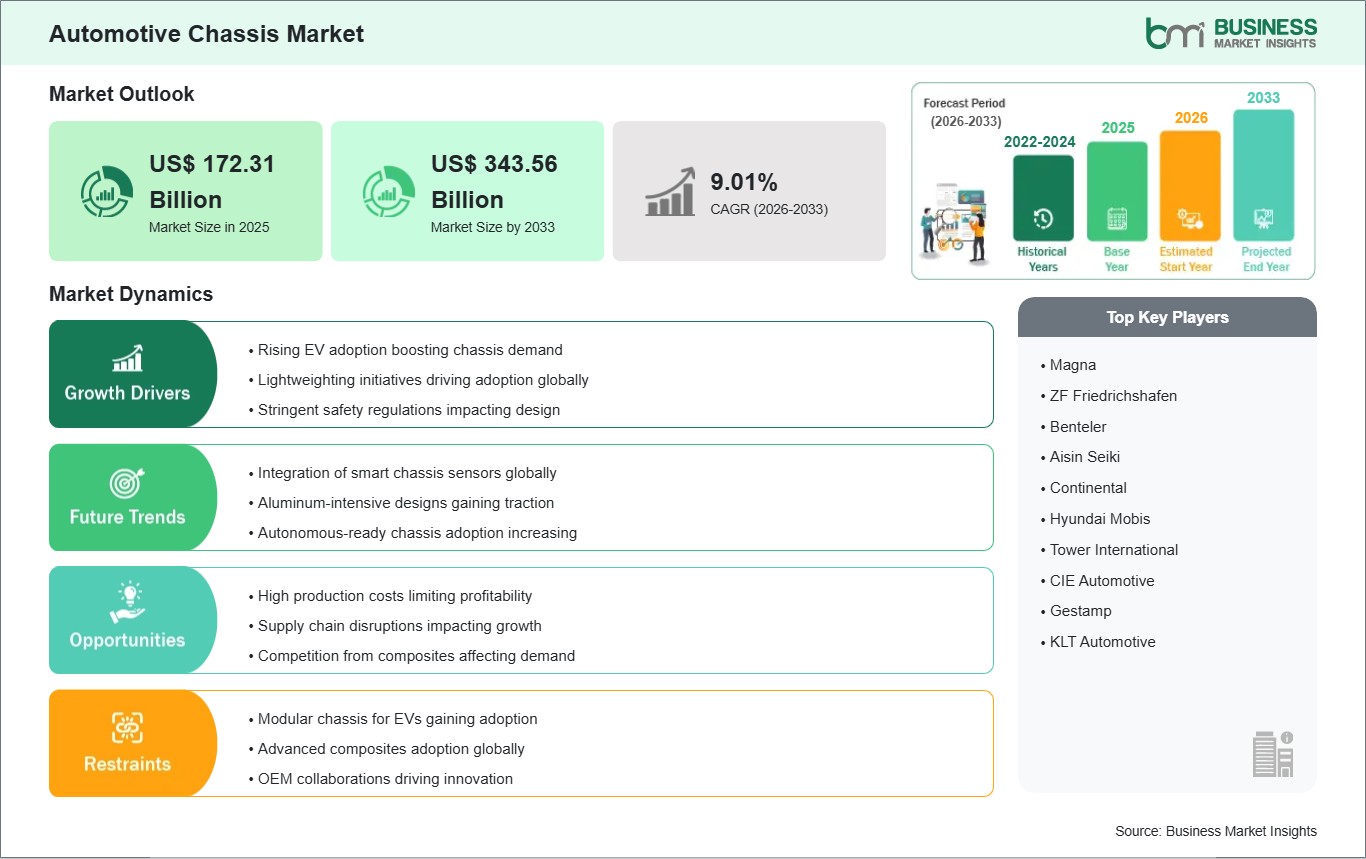
Automotive chassis form the structural foundation of a vehicle, providing support for the engine, suspension, drivetrain, body, and other critical systems. The chassis plays a vital role in determining vehicle strength, safety, handling, durability, and overall performance. Common chassis designs include monocoque, ladder, and modular structures, each serving different vehicle requirements. The Automotive Chassis market continues to evolve as manufacturers focus on vehicle safety, lightweight construction, fuel efficiency, and electric vehicle development. Demand for advanced chassis systems is increasing as automotive companies seek improved structural integrity while reducing overall vehicle weight. The growing use of advanced manufacturing technologies and modern engineering techniques is supporting the development of stronger and more efficient chassis platforms. Material innovations, particularly in aluminum and composite structures, are also contributing to changing market dynamics.
The market faces several challenges despite growing demand. Fluctuations in raw material costs can affect production expenses and supply chain planning. The development of lightweight chassis structures often requires specialized manufacturing processes and higher investments in research and development. Integrating new materials while maintaining safety standards and durability requirements can create engineering complexities. Additionally, manufacturers must continuously adapt chassis designs to meet evolving vehicle regulations, crash safety standards, and electrification requirements. These factors can increase development timelines and production costs across the automotive value chain.
The Automotive Chassis market is expected to benefit from ongoing advancements in vehicle architecture and mobility technologies. The growing adoption of electric vehicles is encouraging the development of dedicated chassis platforms optimized for battery integration and improved performance. Modular chassis systems are gaining attention because they enable manufacturers to support multiple vehicle models using common architectures. Increased focus on sustainability, lightweight materials, and smart manufacturing processes is creating new opportunities for innovation. As connected, autonomous, and electric vehicles continue to expand globally, demand for advanced chassis solutions is expected to strengthen across both passenger and commercial vehicle segments.
Segment Analysis
Automotive Chassis Market Segmentation
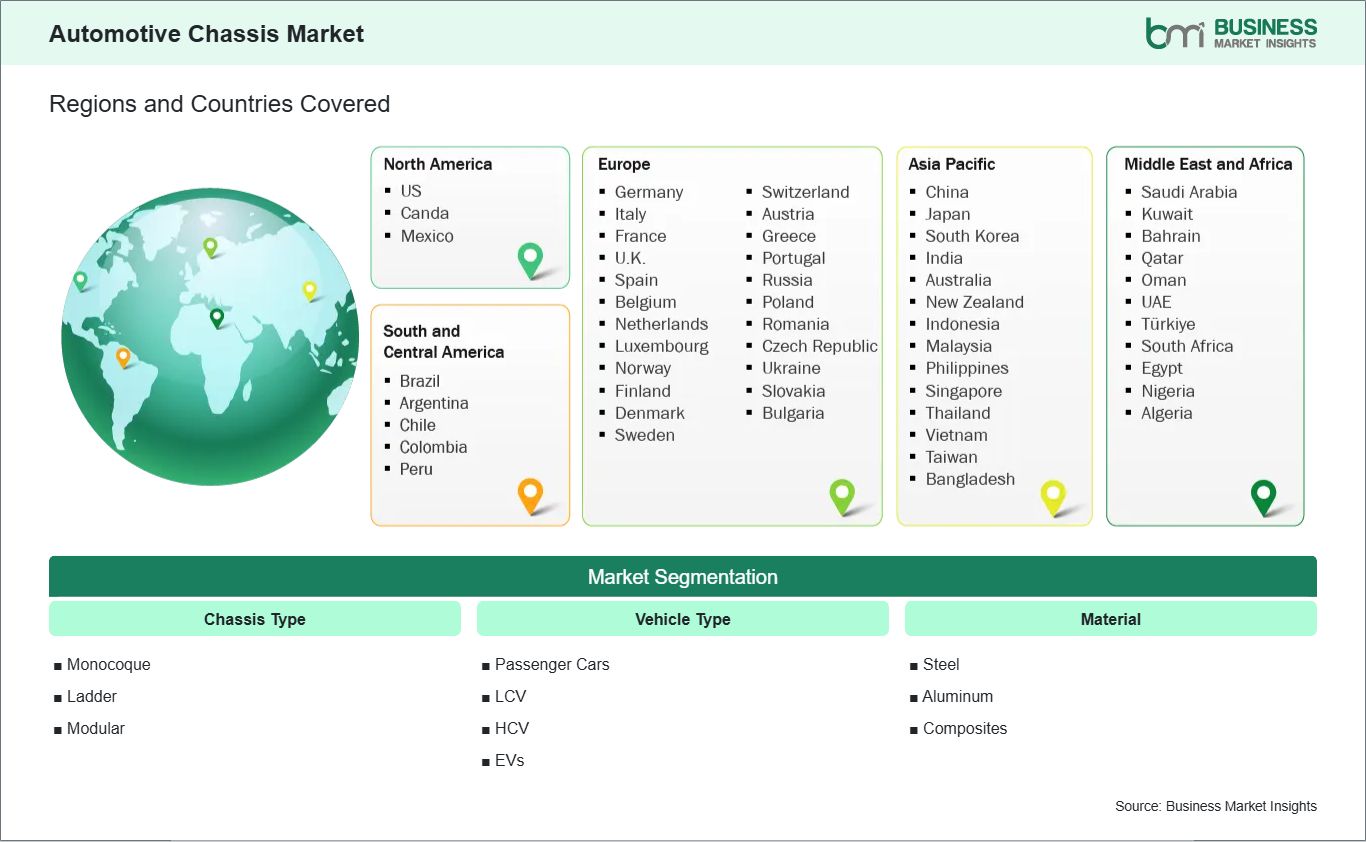
The Automotive Chassis market is segmented by chassis type, vehicle type, and material. Each segment contributes to vehicle performance, safety, and manufacturing efficiency.
By Chassis Type
- Monocoque: Widely used in passenger vehicles due to its lightweight design, structural rigidity, and improved fuel efficiency.
- Ladder: Commonly adopted in commercial vehicles and off-road applications because of its durability and load-carrying capability.
- Modular: Increasingly preferred for modern vehicle platforms as it enables flexibility, scalability, and efficient manufacturing.
By Vehicle Type
- Passenger Cars: Represent a major segment driven by high production volumes and demand for improved safety and comfort.
- LCV: Utilized for commercial transportation applications requiring durability and operational efficiency.
- HCV: Depend on robust chassis structures capable of supporting heavy loads and long-distance transportation.
- EVs: Growing adoption is driving demand for chassis designs optimized for battery integration and lightweight construction.
By Material
- Steel: Remains widely used due to its strength, affordability, and proven performance.
- Aluminum: Gaining popularity because of its lightweight characteristics and corrosion resistance.
- Composites: Emerging as advanced materials offering weight reduction and enhanced structural performance.
Market Forces
Automotive Chassis Market Drivers and Opportunities
Rising Demand for Lightweight and Fuel-Efficient Vehicle Platforms
Automotive manufacturers are increasingly focusing on reducing vehicle weight to improve fuel efficiency, performance, and emissions compliance. Chassis systems represent a significant portion of a vehicle’s overall weight, making them a key area for engineering improvements. Regulatory requirements related to fuel economy and environmental performance are encouraging the adoption of advanced chassis designs and lightweight materials. Manufacturers are integrating aluminum alloys, high-strength steel, and composite materials into chassis structures to achieve better weight optimization without compromising safety. These developments contribute to improved vehicle handling, lower energy consumption, and enhanced driving performance. In addition, lightweight chassis solutions support the operational requirements of electric vehicles by helping extend driving range and improve battery efficiency.
The growing demand for efficient transportation solutions across passenger and commercial vehicle categories continues to strengthen the importance of advanced chassis technologies. As automotive companies invest in next-generation vehicle architectures, lightweight chassis systems are expected to remain a major factor supporting market growth and product innovation throughout the forecast period.
Expansion of Electric and Modular Vehicle Architectures
The global transition toward electric mobility is creating significant opportunities for chassis manufacturers. Electric vehicles require chassis platforms specifically designed to accommodate battery packs, electric drivetrains, and advanced electronic systems. This shift is encouraging the development of dedicated chassis architectures that improve performance, safety, and manufacturing flexibility. Modular chassis platforms are becoming increasingly important because they allow manufacturers to build multiple vehicle models using common structural designs. This approach helps reduce development costs, simplify production processes, and accelerate product launches. Growing investments in autonomous driving technologies and connected vehicle systems are further increasing demand for adaptable chassis solutions.
Advancements in digital engineering, simulation technologies, and manufacturing automation are also creating opportunities for innovative chassis development. Future vehicle platforms are expected to incorporate smarter structural designs capable of supporting evolving mobility requirements. As electric vehicles gain wider adoption and vehicle architectures become more versatile, the Automotive Chassis market is positioned to benefit from expanding opportunities across global automotive industries.
Size and Share Analysis
Automotive Chassis Market Size and Share Analysis
The Automotive Chassis Market size is expected to reach US$ 343.56 billion by 2033 from US$ 172.31 billion in 2025. The market is estimated to record a CAGR of 9.01% from 2026 to 2033.
By chassis type, monocoque chassis account for a significant share of the market due to their widespread adoption in passenger vehicles and their ability to provide structural strength while reducing overall vehicle weight. Ladder chassis remain important in commercial and heavy-duty vehicles where durability and load-bearing capability are critical. Modular chassis platforms are gaining traction as manufacturers seek greater flexibility and efficiency in vehicle production.
By vehicle type, passenger cars represent a major portion of demand owing to high production volumes and continuous advancements in vehicle design and safety. Electric vehicles are emerging as an important growth segment as manufacturers develop specialized chassis architectures to support battery systems and electric drivetrains. Light commercial vehicles and heavy commercial vehicles continue to generate steady demand for robust chassis solutions.
By material, steel maintains a strong presence because of its strength and cost-effectiveness. Aluminum adoption is increasing due to its lightweight benefits, while composite materials are gradually expanding their role in premium and next-generation vehicle applications that require advanced performance characteristics.
Report Coverage
Automotive Chassis Market Report Coverage and Deliverables
The "Automotive Chassis Market Size and Forecast (2022-2033)" report provides a detailed analysis of the market covering below areas:
- Market size and forecast at global, regional, and country levels for all the key market segments covered under the scope
- Market trends, as well as market dynamics such as drivers, restraints, and key opportunities
- Market analysis covering key market trends, global and regional framework, major players, regulations, and recent market developments
- Industry landscape and competition analysis covering market concentration, heat map analysis, prominent players, and recent developments for the market
- Detailed company profiles, including SWOT analysis
Geographic Insights
Automotive Chassis Market Geographic Insights
The Automotive Chassis Market shows diverse regional adoption patterns influenced by vehicle production capabilities, regulatory frameworks, material innovation, and investments in automotive manufacturing infrastructure.
Asia Pacific is a leading region for Automotive Chassis adoption due to its extensive automotive production ecosystem and strong manufacturing capabilities. Countries such as China, Japan, India, and South Korea continue to invest in advanced vehicle technologies, electric mobility, and lightweight vehicle structures. China benefits from large-scale vehicle production and rapid electric vehicle adoption, while Japan and South Korea emphasize engineering innovation and advanced manufacturing. India is witnessing increasing demand for passenger and commercial vehicles, creating opportunities for chassis suppliers. The region's mature supply chain network and expanding industrial infrastructure support continued market growth.
North America remains an important market driven by strong demand for passenger vehicles, commercial vehicles, and electric mobility solutions. The United States leads regional adoption through investments in vehicle electrification, autonomous driving technologies, and advanced manufacturing facilities. Canada supports market development through automotive research activities and integration within regional supply chains. Manufacturers in the region increasingly focus on lightweight chassis platforms, modular vehicle architectures, and compliance with evolving safety standards. The presence of established automotive infrastructure and advanced engineering capabilities contributes to market maturity and sustained demand for innovative chassis solutions.
Industry Activity
Recent Developments
The Automotive Chassis Market is analyzed using a mix of primary and secondary research sources, including corporate publications, industry associations, and verified databases. This approach ensures accurate tracking of innovation trends and strategic developments influencing the market.
- In April 2026, Magna International announced the commercial expansion of its versatile FAST skateboard vehicle architecture, standardizing a modular rolling chassis designed specifically for battery electric vehicles (BEVs). The technological framework leverages lightweight structural alloys to minimize engineering development costs while allowing diverse OEM vehicle bodies to adapt to a unified chassis loop. This advancement emphasizes a growing industry push toward shared platform structural scalability.
- In September 2025, Gestamp unveiled its Ges-Ring Frame structural solutions alongside specialized Highpertube hydroformed subframe configurations designed for advanced electric vehicle chassis protection. Built with ultra-high-strength steel surpassing 800 MPa, the hydroformed tubes optimize vehicle crash energy management without adding unneeded curb weight. The product introduction directly highlights how tier-one suppliers are merging physical mass-reduction with intense passenger safety performance.
Trust & Transparency
Research Methodology
The market analysis combines proprietary research with secondary data from government agencies, company disclosures, regulatory filings, industry databases and expert interviews. Market estimates are validated through data triangulation, cross-market benchmarking and analyst
review.
View Full Research Methodology
Key Sources Referred:
World Bank - Global Trade IndicatorsWorld Trade Organization (WTO)International Monetary Fund (IMF)International Trade Administration (ITA)Company WebsitesCompany Annual ReportsCompany Investor Presentations