Market Summary
Executive Summary and Global Market Analysis
Cargo shipping refers to maritime transport systems that facilitate movement of bulk, liquid, and containerized goods across international trade routes. These processes incorporate coordination of vessels, port management, and logistical planning within worldwide routes. This sector aids international transportation logistics by providing reliable movement of cargo on a massive scale through established maritime infrastructure. An increase in international business activity and manufacturing activities has increased dependency on maritime freight systems.
Increasing production and international logistics demand is further aiding ship-based transportation solutions. Economical long-distance freight costs relative to air freight add to the appeal of maritime services. On the basis of segments, container transportation continues to be structurally dominant owing to logistics efficiency benefits associated with standardized logistics. Bulk transportation provides services for commodities, while tankers serve for energy products.
Technological integration is reshaping fleet management through digital tracking systems and automated port operations. Fuel-efficient vessel designs and route optimization tools are improving operational predictability. These advancements are also enhancing scheduling accuracy and reducing turnaround inefficiencies across major ports. For instance, according to data published by A.P. Moller - Maersk, September 2023, the introduction of the Laura Maersk methanol-powered vessel marked a transition toward alternative-fuel container shipping, reflecting early decarbonization deployment across mainline routes Maersk Official Release.
Similarly, according to data published by Hapag-Lloyd in January 2024, the Gemini Cooperation agreement with Maersk was announced to optimize East-West network capacity and improve schedule reliability across major global trade lanes Hapag-Lloyd Announcement. Competitive conditions remain shaped by fleet expansion strategies and service network optimization. Operators emphasize contract stability, capacity utilization, and integrated logistics services. Strategic alliances and long-term freight agreements continue to define market positioning across major global shipping corridors.
Segment Analysis
Cargo Shipping Market Segmentation
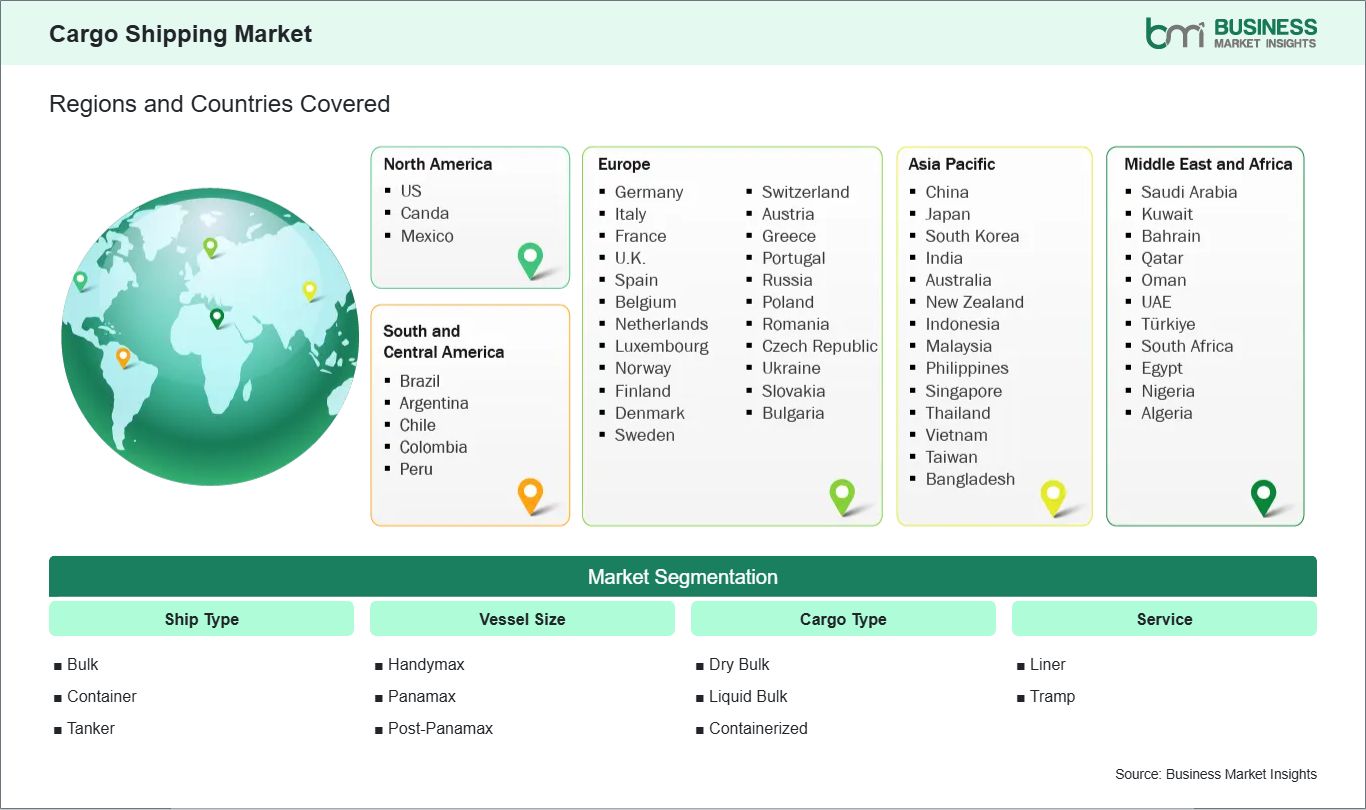
The cargo shipping market is segmented based on ship type, vessel size, cargo type, service, end-use, and vessel operation reflecting the growing specialization of maritime logistics systems and operational configurations across global freight networks.
By Ship Type
- Bulk - Enables high-volume transport of unpackaged raw materials across industrial supply chains.
• Container - Supports standardized cargo handling with efficient intermodal and port integration.
• Tanker - Facilitates safe movement of liquid commodities including fuels and chemicals.
By Vessel Size
- Handymax - Designed for flexible mid-range cargo operations across regional and feeder routes.
• Panamax - Optimized for canal transit compatibility and balanced cargo capacity utilization.
• Post-Panamax - Supports large-scale shipping operations across deep-sea international corridors.
By Cargo Type
- Dry Bulk - Covers solid commodities such as ores, coal, and grains transported in bulk form.
• Liquid Bulk - Handles energy and chemical liquids requiring controlled containment systems.
• Containerized - Provides standardized freight movement ensuring global logistics efficiency.
By Service
- Liner - Operates on fixed schedules enabling predictable and structured cargo transport services.
• Tramp - Offers flexible, demand-based shipping arrangements across variable trade routes.
By End-use
- Manufacturing - Relies on continuous raw material imports for production and assembly continuity.
• Food - Requires time-sensitive maritime logistics for agricultural and processed food distribution.
• Pharma - Depends on controlled shipping environments ensuring regulatory compliance and product integrity.
By Vessel Operation
- Long-Haul - Supports intercontinental trade movement across major global shipping lanes.
• Short-Sea - Enables regional cargo distribution between nearby ports with faster turnaround cycles.
Market Forces
Cargo Shipping Market Drivers and Opportunities
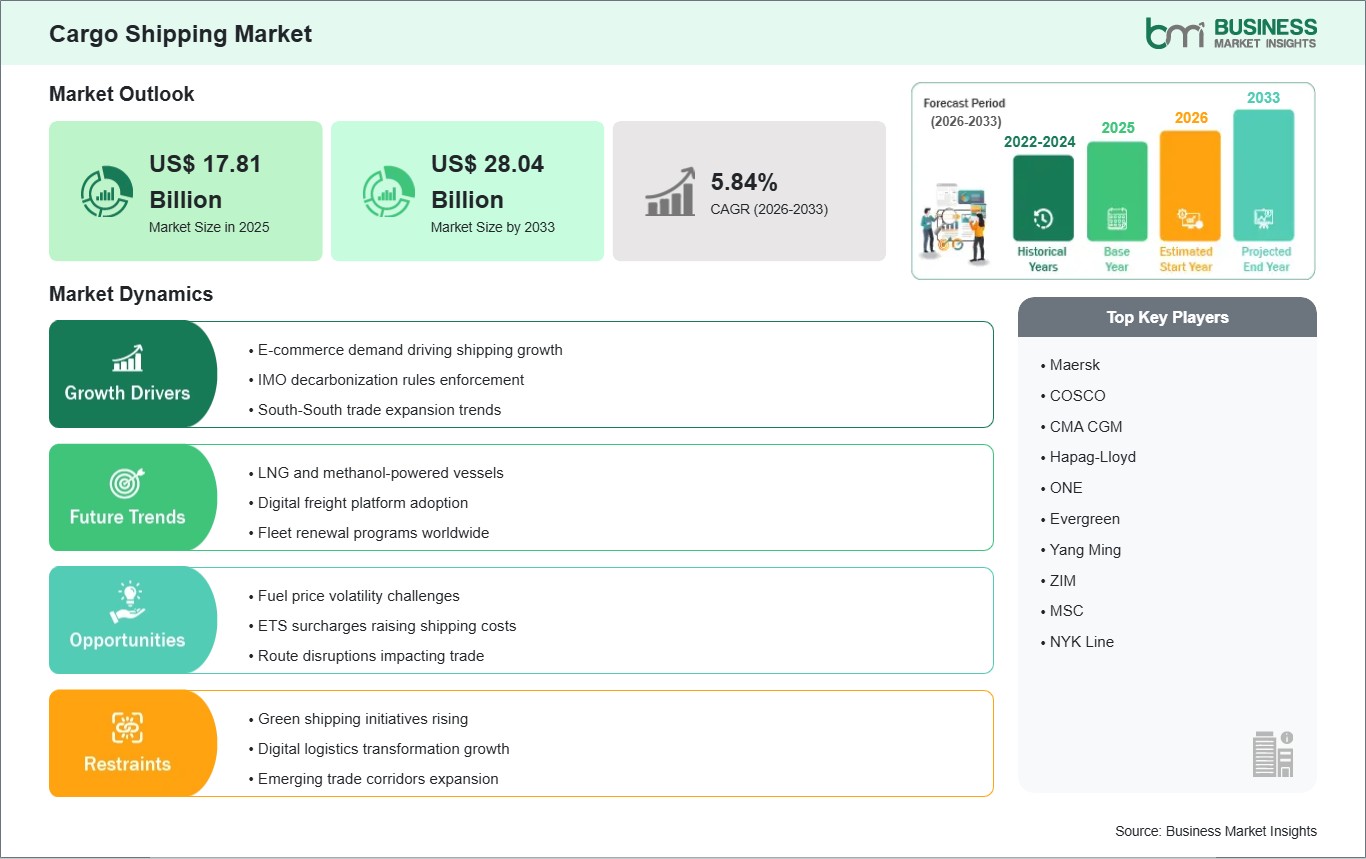
E-commerce demand driving shipping
Rapid expansion of online retail ecosystems has intensified cross-border parcel movement through maritime corridors. Increasing consumer dependency on foreign suppliers creates the need for greater cargo consolidation at the major port locations. This is achieved by adopting the strategy of using containerized logistics and rapid cycle times within the transportation system. Increased import/export activities lead to greater dependency on liner operations.
The expansion of e-commerce continues to influence freight transportation networks in developing and developed nations. Shipping lines plan their capacity utilization for managing mixed loads associated with the fulfillment process. The change improves the efficiency of port operations and allows for logistics facilities to be scaled according to demand.
Green shipping initiatives rising
Decarbonization initiatives are accelerating adoption of low-emission propulsion systems and cleaner marine fuels. Shipping companies are using energy-efficient ship designs to minimize their carbon footprint during voyages through various shipping lines. The use of digital technologies helps in optimizing fuel usage and making better voyage plans.
Further expansion is expected by way of adopting alternative fuel usage as well as building electrified ports. The development of green corridors contributes towards sustainable transportation routes in key geographical locations. This helps to boost efficiency in the long term, while also meeting the needs of global emission reduction objectives.
Size and Share Analysis
Cargo Shipping Market Size and Share Analysis
The Cargo Shipping Market is projected to grow from US$ 17.81 Billion in 2025 to US$ 28.04 Billion by 2033 , registering a CAGR of 5.84% from 2026 to 2033. The market expansion is supported by sustained growth in international trade flows, increased reliance on containerized logistics systems, and continuous movement of energy and raw material shipments across global maritime corridors.
By ship type, container shipping accounts for a significant share due to its standardized cargo handling structure and seamless integration with global supply chain networks. Bulk shipping maintains a strong position driven by industrial raw material transportation requirements across mining and manufacturing sectors. Tanker operations sustain stable demand supported by global energy distribution and chemical transport activities across long-haul routes.
By vessel size, Panamax and Post-Panamax vessels hold a dominant share due to their high-capacity deployment across deep-water ports and major trade lanes. Handymax vessels contribute steadily through flexible operations in regional and mid-range routes requiring adaptable cargo handling. Growing demand for efficiency in large-scale freight movement continues to reinforce preference for higher-capacity vessels across global shipping networks.
By cargo type, containerized cargo holds a leading share due to its efficiency in standardized handling and compatibility with multimodal transport systems. Dry bulk maintains a substantial position supported by continuous demand for minerals, grains, and industrial inputs. Liquid bulk remains essential for energy and petrochemical supply chains, ensuring stable utilization across international shipping corridors.
By service, liner shipping accounts for a notable share driven by scheduled operations and predictable global trade connectivity. Tramp services maintain a strong position supported by flexible, demand-driven cargo movement across variable routes. Increasing trade volatility and diversified freight requirements continue to support balanced utilization across both service models.
By end-use, manufacturing dominates market share due to sustained dependency on imported raw materials and export-oriented production systems. Food transportation maintains steady utilization supported by global agricultural trade and perishable goods logistics. Pharmaceutical shipments are expanding gradually due to increasing regulatory requirements and controlled-condition maritime transport needs.
By vessel operation, long-haul shipping holds a major share driven by intercontinental trade flows and high-volume freight movement across major ocean routes. Short-sea shipping maintains consistent demand supported by regional trade connectivity and feeder route operations between nearby ports. Expanding global supply chain integration continues to strengthen both operational segments across maritime logistics systems.
Report Coverage
Cargo Shipping Market Report Coverage and Deliverables
The "Cargo Shipping Market Size and Forecast (2022 - 2033)" report provides a detailed analysis of the market covering below areas:
- The market size and forecast at global, regional, and country levels for all market segments covered under the scope
- The market trends, as well as drivers, restraints, and opportunities
- The market analysis covering key trends, global and regional framework, major players, regulations, and recent developments
- Industry landscape and competition analysis covering market concentration, heat map analysis, prominent players, and recent developments for the market
- Detailed company profiles, including SWOT analysis
Geographic Insights
Cargo Shipping Market Geographic Insights
Cargo Shipping Market experiences varying adoption levels around the world, dependent upon the levels of intensity of business trade, level of development of infrastructures, and connections to industries. Differences in port facilities and logistics also contribute towards regional variations.
North America serves as an example of the existence of structured maritime logistics due to the existence of highly automated ports and sound systems for exports and imports. Demand stability is assured via the industrial supply chain logistics and the transportation of energy.
The Asia Pacific region is still an area with high levels of activity due to manufacturing concentration and export economies. Efficient utilization of the ports' infrastructure and ship traffic density ensures that the transportation process for containers is carried out efficiently.
Regulatory compliance with environmental shipping standards as well as optimal shipping routes is maintained in Europe. Developing nations in the Middle East, Africa, and South America have seen growing investment in their ports and gradual improvements in logistics systems.
Industry Activity
Recent Developments
The cargo shipping market is evaluated by gathering qualitative and quantitative data post primary and secondary research, which includes important corporate publications, association data, and databases. A few of the key developments in the cargo shipping market are:
- In February 2024, CMA CGM announced that it had completed the acquisition of Bolloré Logistics for approximately US$ 5.64 billion, significantly expanding its global end-to-end logistics footprint across warehousing, freight forwarding, and supply chain services beyond ocean shipping.
- In October 2024, CMA CGM announced that it had entered a strategic partnership with SUEZ to develop renewable biomethane fuel production, targeting up to 100,000 tonnes annually by 2030 to support decarbonization of its shipping fleet and reduce greenhouse gas emissions.
Trust & Transparency
Research Methodology
The market analysis combines proprietary research with secondary data from government agencies, company disclosures, regulatory filings, industry databases and expert interviews. Market estimates are validated through data triangulation, cross-market benchmarking and analyst
review.
View Full Research Methodology
Key Sources Referred:
International Maritime Organization (IMO) reports UNCTAD Review of Maritime Transport World Bank logistics and trade datasets OECD transport and infrastructure studies Port authority operational statistics Shipping industry whitepapers and journals Company annual and sustainability reports Global trade and freight analytics publications